

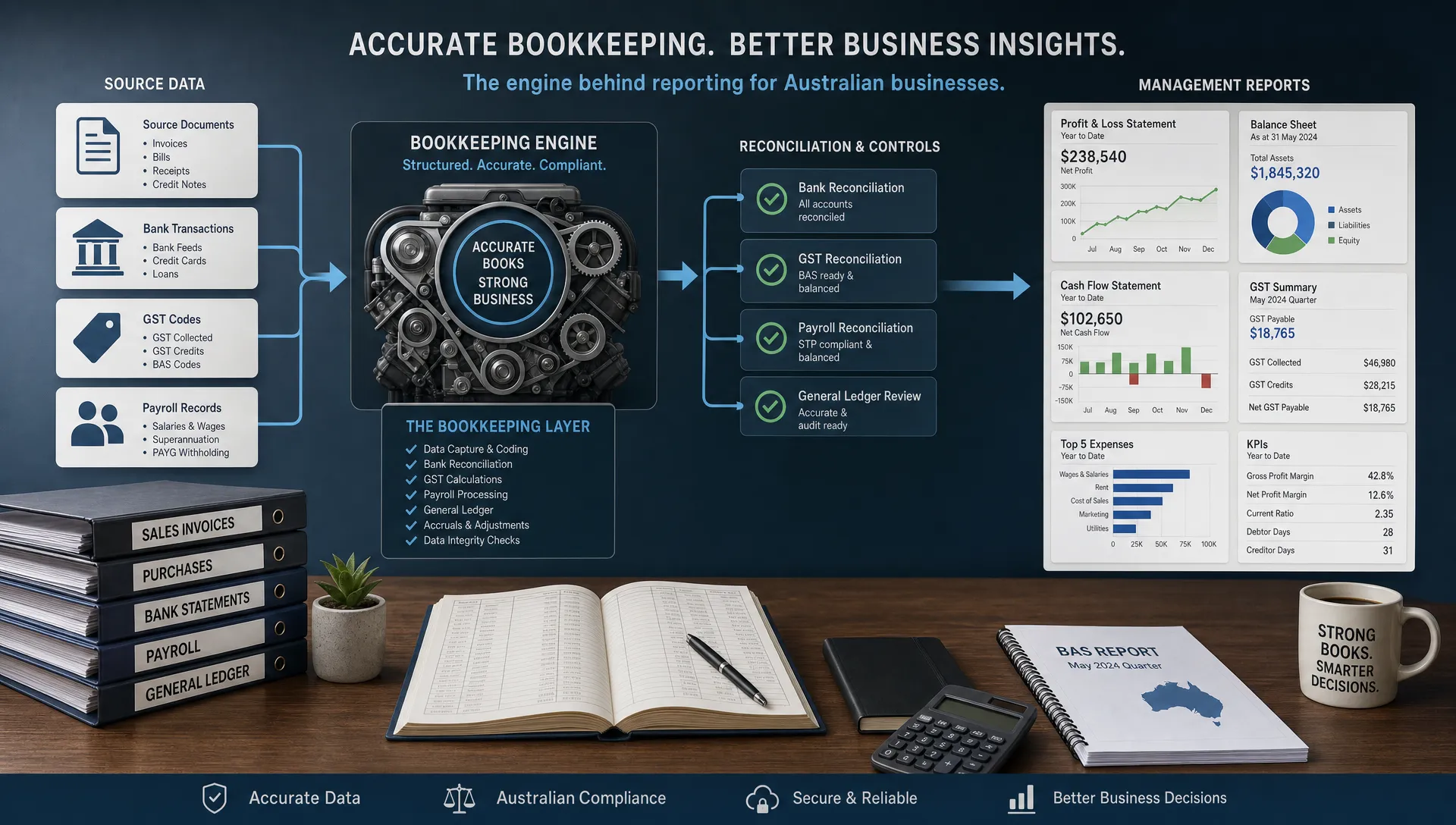
For Australian business owners and directors, financial reports are only as useful as the data behind them. A profit and loss statement, balance sheet or cash-flow forecast cannot provide strategic clarity if transactions are miscoded, GST is treated inconsistently, payroll records are incomplete or bank reconciliations are weeks behind.
This is where professional bookkeeping services in Australia create measurable value. Bookkeeping is not merely administration. Done properly, it becomes the operating system for better reporting, stronger compliance and more confident commercial decisions.
In our work with SMEs, family groups, property investors, professional firms and growing companies across Adelaide, Sydney, Melbourne and wider Australia, we see a clear pattern: better reporting starts with disciplined bookkeeping design. When the source data is structured correctly, directors can move beyond historical summaries and use reporting as a tool for margin improvement, cash-flow control and corporate growth.
Better reporting starts before the report is generated
A report is the output. Bookkeeping is the infrastructure.
If supplier invoices are entered late, management accounts will understate expenses. If loan accounts are not reconciled, the balance sheet may mislead directors about liquidity. If GST codes are applied inconsistently, BAS reporting becomes risky. If payroll, Superannuation and leave liabilities are not captured correctly, workforce costs can be materially distorted.
The ATO expects businesses to keep records that explain all transactions and, in most cases, retain those records for five years. Its record keeping guidance for businesses reinforces a point we consider fundamental: reliable reporting depends on complete, accessible and accurate source records.
For decision-makers, better reporting usually means five things.
| Reporting quality | Bookkeeping discipline behind it | Commercial value |
|---|---|---|
| Accuracy | Correct coding, reconciliations and source documentation | Directors can trust margins, liabilities and profitability |
| Timeliness | Regular processing and a defined month-end close | Issues are identified before they become expensive |
| Compliance | Correct GST, BAS, payroll and Superannuation treatment | Lower risk of ATO errors, penalties and rework |
| Comparability | Consistent chart of accounts and cost centre structure | Trends can be assessed across months, projects and locations |
| Strategic relevance | Segmented reporting and management commentary | Reports support pricing, hiring, funding and expansion decisions |
A financial report should not simply tell a business what happened. It should help leadership understand why it happened, what is changing and where action is required.
How bookkeeping services in Australia convert transactions into reporting intelligence
Effective bookkeeping services in Australia bring structure to the full transaction lifecycle. That lifecycle begins when a sale is made, a bill is received, payroll is processed or a loan repayment is made. It ends when the transaction appears in a reliable management report, tax workpaper or board pack.
Source capture and evidence
Digital source capture is one of the most important foundations of modern bookkeeping. Supplier invoices, receipts, loan statements, payroll reports, merchant settlement data and contract documents should be captured in a way that supports audit trails and quick review.
Our AI-driven processes assist with faster document handling, pattern recognition and workflow consistency. However, automation is only valuable when combined with professional judgement. For example, an invoice may be easy to scan, but determining whether it is a capital item, deductible expense, private component, project cost or FBT-relevant benefit still requires Australian tax and accounting expertise.
Correct classification through the chart of accounts
A poorly designed chart of accounts limits every report that follows. Many businesses outgrow their original bookkeeping setup, especially when they add locations, staff, entities, product lines or property assets.
We often refine bookkeeping structures to show performance by business unit, project, cost centre, state, property, contractor team or service line. This allows directors to see which activities are generating profit and which are consuming cash.
For example, a construction group may need job-by-job profitability. A medical practice may need practitioner-level reporting. An e-commerce business may need sales channel and fulfilment cost visibility. A property investor may need reporting by asset, loan and entity. These insights are impossible if bookkeeping is limited to generic expense categories.
Reconciliations that protect the balance sheet
The balance sheet is where weak bookkeeping often hides. Bank accounts may appear reconciled, but clearing accounts, director loan accounts, inter-entity loans, merchant accounts, payroll liabilities, GST control accounts and Superannuation payable balances may still be inaccurate.
A disciplined bookkeeping function reconciles these accounts regularly. This gives directors a clearer view of working capital, tax liabilities, debt exposure and available cash. It also reduces the risk of year-end surprises.
For businesses seeking broader control, our article on improving financial control explains how accounting systems, checks and reporting disciplines work together.
Compliance reporting creates the base for strategic reporting
Australian compliance obligations are not separate from management reporting. They are deeply connected.
BAS, GST, PAYG withholding, Superannuation, Single Touch Payroll, FBT and income tax planning all rely on the same underlying bookkeeping records. If the data is unreliable for compliance, it is usually unreliable for strategic decisions as well.
| Compliance area | Bookkeeping requirement | Reporting impact |
|---|---|---|
| GST and BAS | Correct GST coding, tax invoices and reconciliation to GST control accounts | More accurate BAS lodgement and clearer net tax position |
| Payroll and STP | Accurate wages, PAYG withholding, allowances, deductions and TFN declaration records | Better labour cost reporting and reduced payroll compliance risk |
| Superannuation | Timely Superannuation accruals and payments | Clearer employee liability reporting and cash-flow planning |
| FBT | Identification of benefits, motor vehicle use and employee-related expenses | Earlier FBT review and fewer year-end adjustments |
| Loans and drawings | Reconciliation of director loans, related-party balances and private expenditure | Stronger balance sheet accuracy and tax planning visibility |
When bookkeeping is treated only as a lodgement task, the business receives basic compliance. When it is treated as a reporting discipline, the business gains a platform for advisory, forecasting and growth planning.
The management reports stronger bookkeeping should produce
Once the bookkeeping foundation is sound, reporting becomes more powerful. Directors should not have to wait until year-end to understand profitability, tax exposure or cash pressure.
The right reporting suite depends on the business model, but we commonly help clients improve the following outputs.
| Report | Why it matters | Bookkeeping dependency |
|---|---|---|
| Profit and loss | Measures trading performance and margin trends | Accurate income, expense and cost allocation |
| Balance sheet | Shows assets, liabilities, equity and funding position | Reconciled accounts, loans, tax liabilities and payroll balances |
| Cash-flow report | Identifies timing pressure and funding needs | Current bank data, debtor and creditor records |
| Aged receivables | Highlights collection risk and working capital delays | Accurate invoicing, receipts and customer allocations |
| Aged payables | Supports supplier management and payment planning | Complete supplier bills and payment matching |
| Project or job reports | Reveals profitability at project level | Consistent project coding and cost capture |
| Multi-entity reports | Supports groups, investors and cross-state operations | Inter-entity reconciliation and standardised account structures |
This is where bookkeeping begins to support leadership. A director can assess whether a pricing model is sustainable. A property investor can compare asset yields. A professional firm can understand utilisation and payroll pressure. A national operator can compare Adelaide, Sydney and Melbourne performance using consistent data definitions.

Why AI-driven bookkeeping improves reporting quality
AI and automation do not replace professional accountability. They strengthen the reporting process when implemented correctly.
In our view, the best use of AI in bookkeeping is to reduce manual friction, improve consistency and give directors faster access to cleaner data. This is particularly valuable for businesses with high transaction volumes, multiple payment platforms, recurring supplier bills, payroll complexity or operations across several locations.
| Automation layer | Reporting benefit | Professional oversight required |
|---|---|---|
| Document capture | Faster processing of invoices and receipts | Review of tax treatment and business purpose |
| Bank feed rules | More consistent coding of recurring transactions | Monitoring for incorrect assumptions or changed suppliers |
| Exception detection | Earlier identification of unusual amounts or duplicate entries | Investigation and correction by qualified staff |
| Approval workflows | Stronger control over supplier payments and expenses | Governance design and segregation of duties |
| Reporting refresh | More current dashboards and management accounts | Interpretation, commentary and advisory recommendations |
The strategic benefit is speed with control. Directors do not want reports that are fast but unreliable. They need reporting that is timely, explainable and aligned with Australian compliance obligations.
This is also why we do not view bookkeeping as a standalone function. It should connect to tax planning, cash-flow forecasting, structure reviews, payroll compliance and board-level decision-making. Our article on how a business services accountant supports better decisions explores this connection in more detail.
Common reporting problems caused by weak bookkeeping
Poor bookkeeping usually shows up as reporting confusion before it becomes a formal compliance problem. Directors may notice that profit looks healthy but cash is tight. GST payable may fluctuate unexpectedly. Payroll liabilities may not reconcile. Debtor reports may not match the bank. Project margins may be impossible to explain.
These issues are not just technical irritations. They affect real decisions.
A business may hire too early because labour costs are understated. A company may underprice work because overheads are not allocated properly. A director may take drawings without understanding tax or cash-flow consequences. A property group may make funding decisions using incomplete debt and interest data.
We often see five root causes.
- Transactions are processed for tax lodgement rather than management insight.
- The chart of accounts no longer reflects the business model.
- Month-end reconciliations are incomplete or inconsistent.
- GST, payroll and Superannuation controls are reviewed too late.
- Reporting is not connected to advisory, forecasting or growth planning.
The correction is rarely a single software change. It requires a redesigned process, clearer accountability, automation where appropriate and professional review.
Choosing bookkeeping services that support better reporting
Not all bookkeeping support is designed for strategic reporting. Some providers focus only on data entry. Others provide compliance processing but limited interpretation. For established businesses, company directors and high-net-worth groups, the standard should be higher.
When assessing bookkeeping services in Australia, we recommend considering the following criteria.
- Australian compliance capability across GST, BAS, payroll, Superannuation and FBT.
- A clear month-end close process with reconciliations and review points.
- Technology integration across cloud accounting, payroll, bank feeds and document capture.
- Reporting design that reflects entities, locations, projects, assets or business units.
- Access to tax and advisory expertise, not just transaction processing.
Where BAS services are provided for a fee, directors should also consider whether the provider is appropriately registered with the Tax Practitioners Board or working under suitable professional supervision. This matters because BAS work is not simply clerical. It can involve GST classification, PAYG withholding and compliance judgements that affect ATO reporting.
For businesses comparing scope, frequency and service levels, our bookkeeping pricing options provide a useful starting point. The right investment depends on transaction volume, complexity, reporting expectations and whether the business needs advisory input as well as processing support.
How our team supports better reporting across Australia
Our team approaches bookkeeping as part of a broader financial operating model. With 25 years of professional experience, we focus on building workflows that support accurate compliance, better reporting and strategic advisory.
For clients in Adelaide, Sydney, Melbourne and across Australia, this often means standardising processes across entities or locations, improving GST and BAS controls, integrating digital capture tools, reviewing payroll and Superannuation records, and producing management reports that directors can actually use.
We also help businesses move from reactive reporting to forward-looking visibility. That may include cash-flow modelling, tax provision tracking, debtor analysis, project reporting, management dashboards or virtual CFO support.
The objective is not to produce more reports. It is to produce better reports, with fewer manual delays and clearer commercial meaning.
Frequently Asked Questions
How do bookkeeping services in Australia improve financial reporting? They improve reporting by ensuring transactions are captured, coded, reconciled and reviewed consistently under Australian compliance rules. This creates more reliable profit and loss reports, balance sheets, cash-flow reports, BAS data and management accounts.
How often should a business update its bookkeeping for better reporting? Most established businesses should update bookkeeping at least monthly, with higher-volume businesses often requiring weekly or near real-time processing. The right cadence depends on transaction volume, payroll complexity, cash-flow pressure and reporting needs.
Can bookkeeping help with BAS and GST accuracy? Yes, bookkeeping is central to BAS and GST accuracy because GST codes, tax invoices, adjustments and reconciliations all flow from transaction records. Where BAS services are provided for a fee, appropriate registration or professional supervision should be considered.
Is cloud accounting software enough to produce reliable reports? Software helps, but it is not enough on its own. Reliable reporting requires correct setup, disciplined coding, reconciliations, compliance knowledge and professional review. Automation improves speed, but judgement protects accuracy.
How does AI improve bookkeeping and reporting? AI can speed up document capture, identify recurring transaction patterns, flag anomalies and support faster reporting cycles. We use automation to improve accuracy and visibility, while our professionals review the data and interpret the commercial implications.
Next steps: turn bookkeeping into a reporting advantage
If your management reports are late, unclear or disconnected from decision-making, the issue may not be the report template. It may be the bookkeeping system behind it.
We recommend starting with a structured review of your chart of accounts, GST coding, payroll records, reconciliations, reporting cadence and automation opportunities. From there, we can identify whether your current process supports compliance only or whether it can become a stronger foundation for strategic advisory and corporate growth.
Our team at Perfect Accounting & Tax Services supports businesses, directors and investors across Australia, with integrated capability in Adelaide, Sydney and Melbourne. We combine Australian tax expertise with AI-driven accounting workflows to improve accuracy, speed and real-time financial visibility.
Contact our team to discuss how we can strengthen your bookkeeping, improve your reporting and design an automated accounting workflow that supports better financial decisions.