
For a growing Australian firm, tax stops being a once-a-year reporting task the moment decisions begin to affect cash flow, valuation, director risk and future expansion. At that point, corporate tax services become a strategic control system, not simply a compliance function.
We see this shift most clearly when a business moves from founder-led operations to structured management. Revenue increases, payroll expands, BAS obligations become more material, directors draw funds in different ways, and the ATO expects records to reconcile across income tax, GST, PAYG withholding, Superannuation and Single Touch Payroll.
The firms that manage this transition well do not wait for year-end. They build tax planning, automation and governance into the way financial decisions are made. That is where corporate tax support matters most.
Growth changes the tax profile of a company
A small company can often survive with basic bookkeeping and annual tax return preparation. A growing company cannot. As transactions increase, small errors compound quickly. GST coding mistakes become larger. Payroll obligations become more complex. Inter-entity loans become harder to explain. Director drawings can create Division 7A issues if they are not managed properly.
Australian companies also operate within a specific tax framework. The ATO’s guidance on company tax rates distinguishes between base rate entities and other companies, which can affect forecasting, profit retention and dividend planning. The tax rate itself is only one part of the equation. The more important question is whether the company has the structure, records and controls to apply the rules correctly.
Growth also increases the number of stakeholders relying on financial accuracy. Banks, investors, boards, co-founders, family offices and potential buyers all look for evidence that tax risk is understood and controlled. Strong tax governance can improve confidence in the business. Weak governance can reduce valuation, delay finance approvals or trigger ATO scrutiny.
When corporate tax services matter most
Corporate tax support is most valuable at transition points. These are the moments when a firm’s tax position can materially affect cash, compliance and strategic options.
When profits increase and cash flow becomes more sensitive
A profitable company can still run into cash pressure if tax liabilities are not forecast correctly. Income tax, GST, PAYG withholding, Superannuation Guarantee, FBT and payroll tax (where applicable) can all create timing gaps.
We often see growing firms reinvest cash into stock, staff, equipment or marketing, then face a larger-than-expected tax payment. This is not always a profitability problem. It is usually a forecasting and provisioning problem.
Corporate tax services should help directors build tax into rolling cash flow forecasts. That includes estimating company tax, reviewing PAYG instalments, planning dividend timing and ensuring BAS obligations are funded before cash is committed elsewhere.
When BAS and GST obligations become material
BAS reporting becomes more strategic as the business scales. A $2,000 GST coding error is inconvenient. A recurring GST error across a national operation can become a significant compliance exposure.
The ATO sets out the core requirements for business activity statements, but growing businesses need more than lodgement. They need review processes that identify unusual GST treatment, reconcile sales to bank receipts, and ensure purchases are coded consistently.
This is especially important for e-commerce businesses, property groups, professional services firms, importers, construction companies and multi-entity groups. If BAS data is unreliable, management reports are unreliable as well. That weakens decision-making.
When directors draw funds, pay dividends or use company assets
Director and shareholder transactions are a common risk area for private companies. The company may pay wages, directors’ fees, dividends, reimbursements, loans or personal expenses. Each category has different tax consequences.
If these transactions are not classified correctly, directors may face unexpected income tax, Division 7A consequences, FBT exposure or weak substantiation. The issue is rarely one transaction in isolation. The problem is usually the absence of a clear policy for how owners extract value from the company.
A corporate tax adviser should help determine the most appropriate mix of salary, superannuation, dividends and reinvested profits, taking into account the company’s cash flow, shareholder agreements and future plans. For directors seeking a broader framework, our article on company tax planning tips for directors explores several of these planning issues in more depth.
When payroll, contractors and Superannuation become more complex
Hiring is a major growth milestone. It is also a tax and compliance milestone. As headcount grows, the company must manage PAYG withholding, Superannuation Guarantee, Single Touch Payroll, payroll tax thresholds in relevant states and territories, contractor classification risks, and possible FBT obligations.
The ATO’s Single Touch Payroll framework means payroll data is reported regularly. This makes inconsistent payroll records easier to identify. It also means late corrections can become more visible.
Corporate tax services matter when the business starts relying on multiple payroll categories: employees, contractors, casuals, directors, remote workers and interstate staff. The question is not only whether payroll is processed. The question is whether payroll data is tax-ready, audit-ready and aligned with the company’s commercial model.
When the business expands across states or cities
A company operating only in Adelaide may have a relatively simple compliance footprint. Once it expands into Sydney, Melbourne or other locations, the tax environment becomes more layered.
Payroll tax is administered by state and territory revenue offices, not the ATO. Workers compensation, employment arrangements, property leases and state-based duties can all vary. Multi-site operations also need consistent reporting processes so that location performance, GST treatment and payroll obligations are not fragmented.
Our team supports clients across Australia with integrated capabilities in Adelaide, Sydney and Melbourne. For growing firms, this national perspective matters because tax decisions made in one location can affect the wider group.
When the company restructures, acquires or prepares for investment
Restructures, acquisitions and capital raises are moments when corporate tax advice is critical. A transaction that looks commercially attractive can create tax costs if it is not planned properly.
Before signing documents, directors should understand potential income tax, GST, stamp duty, employee entitlement, FBT, debt forgiveness and CGT implications. Buyers and investors will also assess the company’s tax history during due diligence. Late BAS lodgements, unresolved ATO debts, weak payroll records or unclear related-party balances can reduce confidence.
For scaling technology firms, property groups, medical practices, construction businesses and family-owned companies, tax planning should be part of transaction design from the beginning. It should not be treated as a clean-up exercise after terms are agreed.
When ATO scrutiny or late lodgements become a risk
A growing firm may attract ATO attention because of mismatches, late lodgements, unusual deductions, GST inconsistencies or poor payroll reporting. Sometimes the issue is technical. Sometimes it is simply a lack of documentation.
The best response is not panic. It is disciplined reconstruction, evidence gathering and professional communication. Directors should understand what the ATO is asking, what records support the company’s position, and whether the issue points to a wider control weakness.
Poor reconciliations can create the types of company tax return errors that trigger ATO attention, particularly when income, GST, payroll and balance sheet accounts do not align.
Compliance is the foundation, not the finish line
Corporate tax services should cover compliance, but they should not stop there. Lodging a company tax return confirms what happened. Strategic tax advisory helps directors decide what should happen next.
A mature corporate tax service model typically includes:
- Company tax return preparation and review with supporting reconciliations.
- BAS and GST review processes that test coding accuracy and transaction treatment.
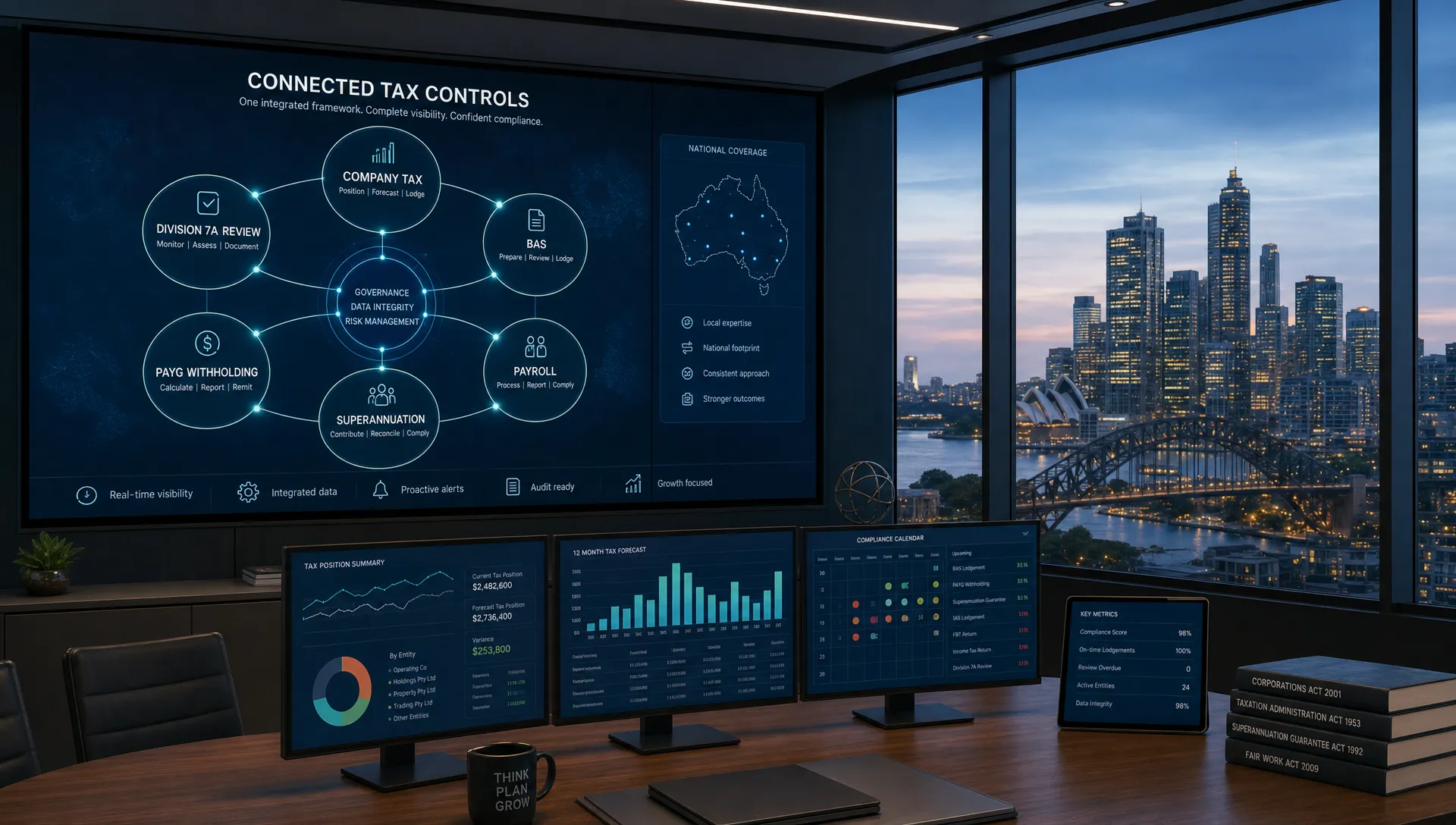
- PAYG withholding, Superannuation and STP alignment with payroll records.
- FBT review for vehicles, entertainment, benefits and employee arrangements.
- Division 7A monitoring for shareholder and associate loans or payments.
- Tax cash flow forecasting for PAYG instalments, GST and year-end liabilities.
- Structure review for companies, trusts, SMSFs, family groups and related entities.
- ATO correspondence, audit support and late lodgement rectification where required.
This is where accounting becomes a management discipline. Once tax data is accurate, directors can use it to improve margins, manage working capital, plan remuneration, support finance applications and make better expansion decisions.
| Growth trigger | Tax pressure point | Strategic response |
|---|---|---|
| Revenue increases quickly | PAYG instalments and company tax provisioning may lag behind profits | Build rolling tax forecasts and review instalment settings |
| More employees or contractors | PAYG withholding, SG, STP and payroll tax risk increase | Reconcile payroll monthly and review worker classification |
| Director drawings increase | Division 7A, FBT and dividend planning become more sensitive | Set formal remuneration and loan policies |
| Interstate expansion begins | State-based payroll tax and operational reporting become more complex | Standardise reporting across locations and review state obligations |
| Investors or lenders request reports | Tax debts, late lodgements and weak reconciliations affect confidence | Clean up governance before due diligence begins |
| Multiple entities are used | Inter-entity balances and GST treatment become harder to support | Maintain clear agreements, reconciliations and group reporting |

How AI-driven automation improves corporate tax outcomes
Automation does not replace professional judgement. It improves the quality and speed of the information that judgement relies on.
In our work with growing firms, AI-driven processes help streamline transaction review, document capture, exception detection and reporting workflows. This allows our team to focus more time on interpretation, advisory and strategic planning rather than manual data handling.
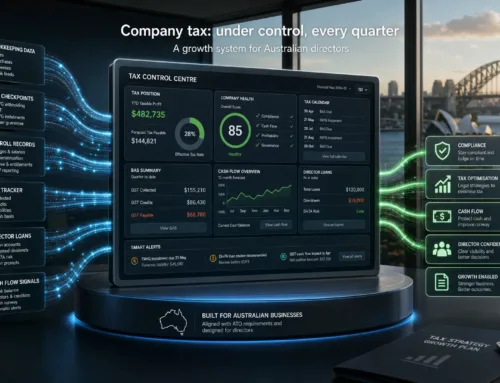
For directors, the practical benefit is real-time visibility. Instead of discovering tax issues after year-end, management can identify unusual movements during the quarter. For example, a sudden increase in GST payable, unexplained director loan movement, payroll variance or margin decline can be reviewed before it becomes a compliance problem.
This is particularly valuable for companies with high transaction volumes, multiple bank accounts, recurring subscriptions, online sales platforms, project-based revenue or remote teams. Automation helps create a cleaner audit trail. Professional review turns that audit trail into strategic insight.
A tech-forward accounting workflow should support three outcomes:
- Faster detection of anomalies in GST, payroll, expenses and balance sheet accounts.
- More reliable management reporting for cash flow, tax provisioning and board decisions.
- Better evidence management for ATO reviews, finance applications and investor due diligence.
The result is not simply a smoother tax return. It is a stronger financial operating system.
What directors should monitor before tax becomes urgent
Directors do not need to become tax technicians. They do need to know which indicators suggest the company’s tax settings are no longer fit for purpose.
| Indicator to monitor | Why it matters |
|---|---|
| GST payable as a percentage of sales | Large changes may indicate coding errors, sales mix changes or timing issues |
| PAYG withholding versus payroll reports | Variances can indicate payroll processing or STP reporting problems |
| Superannuation payable balances | Unpaid or late SG creates compliance and director risk |
| Shareholder loan balances | Movement may need Division 7A treatment or formal loan agreements |
| Inter-entity balances | Weak records can create tax, GST and audit complications |
| Tax payable versus cash reserves | A profitable company can still face liquidity stress if tax is not provisioned |
| Gross margin trends | Margin shifts can indicate pricing, stock, contractor or revenue recognition issues |
If these indicators are reviewed only at year-end, the company has already lost control of the timing. Quarterly review is better. Monthly review is appropriate for fast-growth firms, multi-site operators and companies preparing for finance, investment or sale.
How to decide whether your firm needs deeper corporate tax support
A useful test is to ask whether tax now affects strategic decisions. If the answer is yes, basic compliance is no longer enough.
Corporate tax services become more important when the company is:
- Generating profits that require active tax provisioning and reinvestment planning.
- Hiring staff, using contractors or operating across multiple states.
- Managing director loans, dividends, trusts, SMSFs or family group entities.
- Preparing for finance, investment, acquisition, restructure or exit.
- Experiencing late lodgements, ATO debt, audit activity or poor record quality.
- Expanding into Adelaide, Sydney, Melbourne or multiple Australian markets.
If you are reassessing your advisory support, our guide on choosing tax services that support business growth explains why capability, systems and strategic alignment matter more than lodgement alone.
Frequently Asked Questions
Are corporate tax services only for large companies? No. They are relevant for any company where tax affects cash flow, director decisions, compliance risk or growth strategy. Many SMEs need corporate tax support well before they would consider themselves large.
How often should a growing company review its tax position? We generally recommend at least quarterly reviews, aligned with BAS cycles. Fast-growth companies, multi-entity groups and firms preparing for finance or investment may need monthly tax and cash flow review.
Can automation replace a corporate tax adviser? No. Automation improves data capture, anomaly detection and reporting speed, but professional judgement is still essential. Tax law requires interpretation, documentation and strategic decision-making.
What is the biggest tax risk for growing private companies? The most common risks we see involve GST errors, payroll and Superannuation inconsistencies, director loan issues, poor inter-entity records and tax liabilities that were not forecast in cash flow planning.
Do corporate tax services include BAS, GST and payroll? They should. BAS, GST, PAYG withholding, STP and Superannuation data all influence the company’s tax position. Treating them separately can create reporting gaps and avoidable risk.
Next steps: build tax into your growth strategy
The right time to strengthen your corporate tax framework is before a major decision, not after a problem appears. If your company is growing, hiring, expanding interstate, raising capital or preparing for a transaction, tax should be part of the planning conversation.
Our team at Perfect Accounting & Tax Services supports Australian businesses with corporate tax, BAS, payroll, virtual CFO advisory, complex structuring and AI-driven accounting workflows. We work with clients across Adelaide, Sydney, Melbourne and nationally, combining practical tax compliance with strategic financial visibility.
If you want stronger tax control, cleaner reporting and a more scalable accounting workflow, contact our team for a consultation. We can review your current tax position, identify risk areas and show how automated accounting processes can support better decisions as your firm grows.