
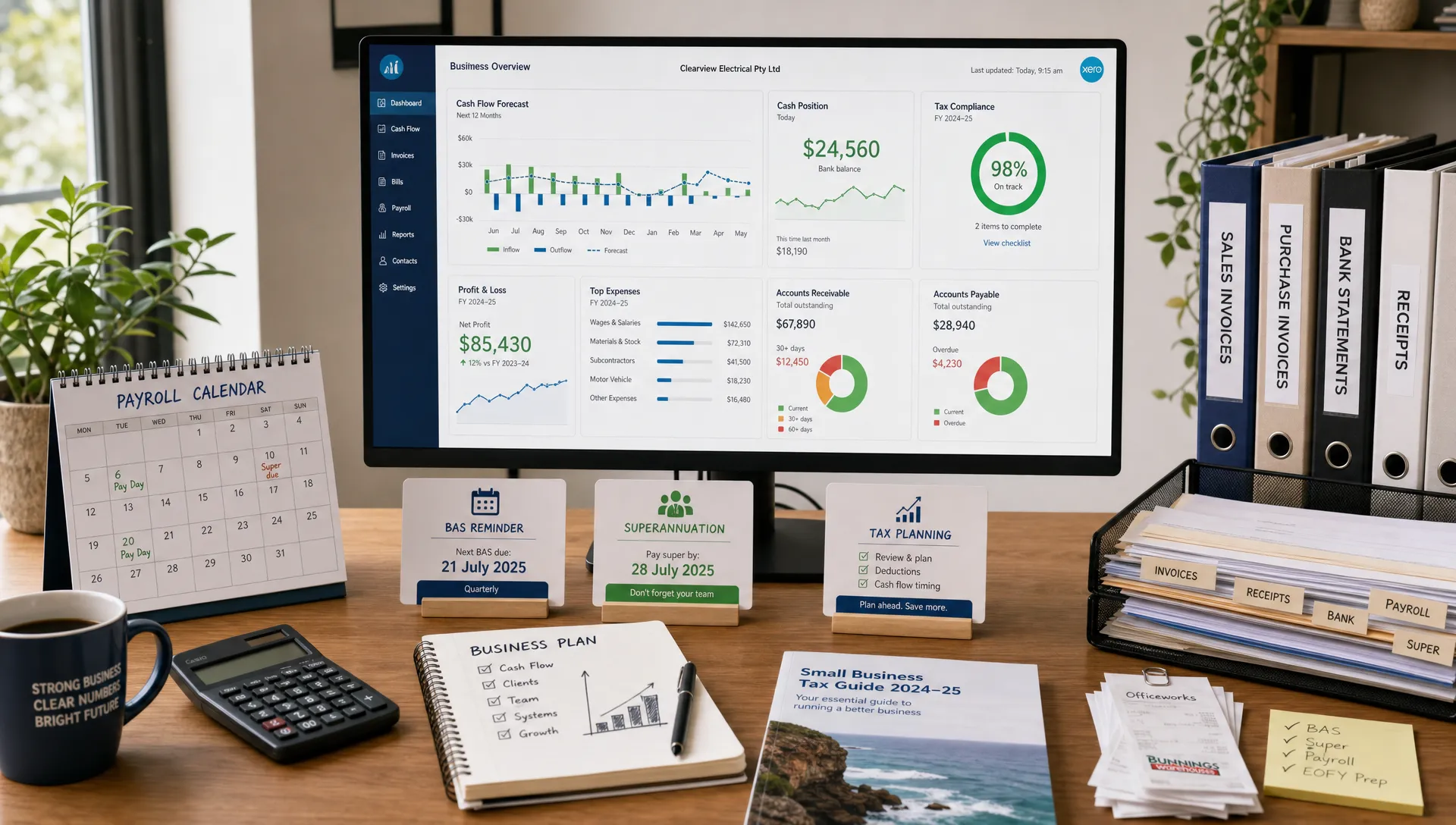
Small business tax services in 2026 should do far more than prepare an annual income tax return. For Australian business owners, directors and high-net-worth individuals with operating entities, the tax function now sits at the centre of cash flow, payroll governance, digital record keeping, ATO risk management and growth strategy.
We see the strongest outcomes when tax is managed continuously. A compliant return is only the final output. The real value is created throughout the year, when GST coding is reviewed before BAS lodgement, superannuation obligations are funded on time, deductions are substantiated before the ATO asks, and business decisions are modelled before they affect taxable income.
In 2026, that standard is even more important. ATO interest charges are no longer deductible from 1 July 2025, the Superannuation Guarantee rate has reached 12%, and payday super has made payroll timing a live cash flow issue. Add digital reporting, data matching and tighter governance expectations, and the old tax-time only model is no longer sufficient.
For context on the major rule changes affecting owners this year, we have also outlined the key business tax changes for 2026. In this article, we focus on what a modern small business tax service should actually include.
The 2026 benchmark: tax services should be continuous, not seasonal
A traditional tax engagement often starts after 30 June, when the accountant receives a data file, asks for missing records, prepares the accounts and lodges the return. That approach may still produce a lodgement, but it does not provide enough control for a serious business.
In 2026, small business tax services should operate as a year-round advisory and compliance framework. We expect the accountant to understand the business model, revenue cycle, payroll profile, debt position, asset base, entity structure and future plans. That includes plans to hire, buy equipment, raise capital, acquire property, expand interstate, sell the business or introduce new shareholders.
The objective is not simply to reduce tax. The objective is to optimise financial health while staying firmly inside Australian tax law. That means aligning the tax strategy with profitability, working capital, risk management and corporate growth.
A well-designed tax service should also use automation intelligently. Cloud accounting, bank feeds, digital document capture and AI-assisted review processes can identify issues earlier. They do not replace professional judgement, but they give our team better visibility and allow us to spend more time interpreting the numbers rather than chasing paperwork.
What small business tax services should include
At a minimum, a 2026 tax service should cover compliance, governance, planning and reporting. The following table summarises the core inclusions we would expect for an Australian small business.
| Service inclusion | What it should cover | Strategic value |
|---|---|---|
| Annual tax return and financial statements | Company, trust, partnership or sole trader return, depreciation, reconciliations and disclosures | Accurate lodgement and reliable year-end position |
| BAS and GST management | GST coding, BAS preparation, PAYG withholding, instalments and lodgement calendar | Stronger cash flow control and reduced ATO correction risk |
| Payroll and superannuation compliance | STP, TFN declarations, award-linked payroll data, super payments and SG obligations | Lower exposure to penalties, underpayments and director risk |
| Record keeping and substantiation | Digital receipts, invoices, contracts, logbooks and asset records | Faster audits, better deduction support and cleaner reporting |
| Tax planning | Forecast taxable income, dividends, trust distributions, asset purchases and owner remuneration | Better decisions before 30 June, not after |
| Entity and structure review | Company, trust, sole trader and group structure implications | Asset protection, tax efficiency and succession readiness |
| ATO correspondence and debt management | Payment plans, overdue lodgements, objections and audit support | Lower stress and more disciplined compliance management |
| Management reporting | Profitability, cash flow, margins, tax liabilities and director reporting | Turns compliance data into strategic advisory insight |
| Automation workflow | Bank feeds, document capture, exception alerts and reconciliations | Faster processing, fewer errors and real-time visibility |
This is also why we encourage business owners to assess tax services alongside broader finance capability. We have explored this in more detail in our guide to modern accounting services for small businesses, particularly where management reporting and automation are becoming standard rather than optional.
BAS, GST and PAYG should be reviewed before lodgement
BAS preparation is one of the most common areas where small errors compound. GST on mixed-use expenses, motor vehicle claims, imports, exports, deposits, director reimbursements and software subscriptions can all be coded incorrectly if the process relies only on bank descriptions.
A proper small business tax service should review BAS data before lodgement, not simply submit what appears in the software. We look for unusual GST movements, unreconciled clearing accounts, negative sales, duplicated expenses, incorrect tax codes and mismatches between payroll and PAYG withholding.
For businesses with turnover near the GST registration threshold, the accountant should also monitor whether registration is required or whether existing GST settings still suit the business model. E-commerce operators, tradies, consultants, agencies and import businesses often need more careful GST treatment than they realise.
The ATO expects business records to be complete and generally retained for five years. Its guidance on record keeping for business reinforces the importance of keeping evidence that explains transactions, not just bank movements.
Payroll, STP and superannuation need tighter controls in 2026
Payroll has become one of the most strategically important compliance areas for small business. In 2026, tax services should include a review of payroll settings, Single Touch Payroll reporting, PAYG withholding, superannuation calculations and cash flow timing.
The Superannuation Guarantee rate is 12% from 1 July 2025. The transition to payday super from 1 July 2026 has also shifted super from a quarterly compliance task into a pay-cycle control issue. This affects cash flow planning, payroll software configuration, clearing house timing and internal authorisation processes.
The accountant should review whether all eligible employees and contractors are being assessed correctly. Some contractors may be entitled to superannuation for SG purposes, even where they quote an ABN. That is a common risk area for construction, professional services, healthcare, logistics, IT consulting, creative production and field-based service businesses.
ATO guidance on paying super contributions is clear that employers must pay the right amount, to the right fund, by the required time. From a strategic perspective, we also want owners to understand how payroll obligations affect working capital. A profitable business can still experience pressure if tax, BAS and super liabilities are not forecast properly.
Tax planning should happen before the decision is made
Tax planning is most valuable before the transaction, not after it. In 2026, small business tax services should include scheduled planning sessions before 30 June and at key decision points during the year.
This should cover projected taxable income, director wages, dividends, trust distributions, Division 7A loans, capital purchases, finance arrangements, bad debts, stock levels, work in progress, prepayments and depreciation. Where the owner has investment properties, SMSF interests or family trust structures, the business tax position should be reviewed together with the broader personal and investment position.
For company owners, the accountant should confirm whether the company is a base rate entity and whether the 25% or 30% company tax rate applies. For trusts, the accountant should review distribution resolutions before year-end and ensure beneficiaries understand the tax consequences. For businesses involving personal services income, the accountant should consider whether PSI rules affect deductions and income attribution.
We also expect a modern tax service to model scenarios. For example, should the business buy equipment before year-end, lease it, finance it or defer the purchase? Should profits be retained in the company for growth, paid out to owners, or used to reduce debt? The right answer depends on cash flow, tax rate differences, risk, commercial need and future plans.
ATO debt and interest must be managed proactively
From 1 July 2025, deductions are no longer available for ATO general interest charge and shortfall interest charge incurred on or after that date. This makes ATO debt more expensive on an after-tax basis.
For business owners, the lesson is direct. Tax services should not treat ATO debt as an afterthought. They should include cash flow forecasting, lodgement discipline, payment plan support and early engagement where liabilities cannot be paid on time.
The accountant should also help distinguish between a short-term timing issue and a deeper structural problem. If the business consistently cannot meet BAS, PAYG withholding or superannuation obligations, the issue may be underpricing, weak debtor collection, poor margin control, excessive drawings or an unsustainable cost base. Tax compliance then becomes a diagnostic tool for business performance.
This is where strategic advisory matters. We do not view ATO debt purely as a payment problem. We view it as a signal that the financial operating model needs review.
Digital automation should be part of the service, not an optional extra
In 2026, business owners should expect their accountant to use technology to improve accuracy, speed and visibility. Automation is not about removing accountability. It is about creating a cleaner data environment so that professional judgement can be applied earlier.
Our AI-driven workflows are designed to streamline data capture, flag unusual transactions, support reconciliation quality and give clients more timely financial information. When applied properly, automation reduces manual handling and helps identify tax issues before they become expensive.
A digital tax workflow should include secure document collection, bank feed review, rule-based transaction coding with accountant oversight, exception reporting, digital workpapers and periodic management reports. It should also create a clear audit trail so that income, expenses, GST credits, payroll liabilities and asset purchases can be substantiated.
For owners operating across Adelaide, Sydney, Melbourne and other Australian locations, this digital infrastructure is particularly important. It allows one integrated advisory team to manage compliance consistently while still considering local operational realities, such as payroll arrangements, state-based payroll tax exposure, property transactions and industry conditions.
Industry-specific tax issues should be built into the review
A generic checklist is not enough. Small business tax services should be adapted to the industry, structure and risk profile of the client.
A building contractor may need stronger controls around Taxable payments annual report obligations, subcontractor onboarding, motor vehicle claims, work in progress and retention amounts. A medical specialist may need payroll, service entity and private use reviews. An e-commerce business may need GST treatment for platforms, imports, merchant fees, inventory and international sales. A SaaS company may need advice on R&D tax incentive eligibility, contractor arrangements, capitalised development costs and employee share schemes.
The following table shows how service scope should shift by business type.
| Business profile | Tax service priorities in 2026 |
|---|---|
| Sole traders and consultants | PSI review, home office substantiation, GST registration, super planning and quarterly tax forecasting |
| Tradies and construction firms | TPAR, subcontractor compliance, vehicle records, work in progress, payroll and super controls |
| E-commerce and digital businesses | GST coding, inventory, platform income reconciliation, overseas supplier records and merchant fee treatment |
| Professional practices | Payroll, service entity arrangements, FBT, owner remuneration and profit distribution planning |
| Property investors and developers | GST, CGT, trading stock versus capital treatment, finance costs, entity structure and cash flow forecasting |
| Tech startups and SaaS companies | R&D, contractor versus employee risk, capital raising costs, ESIC considerations and equity incentives |
| Family companies and trusts | Division 7A, trust distributions, succession planning, beneficiary tax positions and asset protection |
This industry lens is essential. It is also where experienced advisory adds value beyond software. Software records transactions. A skilled tax advisor interprets the commercial implications.
Record keeping should support deductions, audits and decision-making
Small business owners often think of record keeping as a compliance burden. We view it as the evidence layer behind every strategic financial decision.
A complete record-keeping process should capture tax invoices, receipts, contracts, loan documents, payroll records, superannuation records, motor vehicle logbooks, depreciation schedules, shareholder loan movements, trust distribution records and working papers for significant estimates.
It should also include a clear monthly close process. That means bank accounts, credit cards, loan accounts, payroll clearing accounts, GST accounts and director loan accounts are reconciled regularly. If these balances are only cleaned up at year-end, the business is operating with incomplete information for most of the year.
For a practical view of the records owners should monitor, our article on tax for small business in Australia sets out the key categories we expect business owners to track throughout the year.
Strategic advisory should be connected to tax compliance
The best tax services do not separate compliance from strategy. BAS, payroll, bookkeeping and annual returns all produce data. That data should be converted into management insight.
For example, rising GST payable may indicate higher sales, but it may also reveal cash flow stress if debtor collections are slow. A growing PAYG withholding liability may indicate successful hiring, but it may also point to wage cost pressure. A high taxable profit may be positive, but it may also require planning for reinvestment, debt reduction, dividends or asset protection.
We believe tax services should help business owners answer sharper questions:
- Are margins improving or being absorbed by labour and supplier costs?
- Is the business setting aside enough for GST, PAYG, income tax and superannuation?
- Is the entity structure still appropriate for growth, investment or succession?
- Are owner drawings aligned with profit and tax obligations?
- Are compliance issues masking deeper cash flow or pricing problems?
When those questions are reviewed regularly, tax becomes a management tool rather than a year-end obligation.
Red flags in small business tax services
Not every tax service is built for the 2026 environment. Business owners should be cautious where the service is limited to annual lodgement and provides little visibility during the year.
Common red flags include no BAS review process, no payroll or superannuation oversight, no discussion before 30 June, no review of entity structure, no cash flow forecasting, no digital document system and no clear explanation of tax liabilities before they fall due.
Another warning sign is advice that focuses only on deductions. Deductions matter, but they are only one part of tax strategy. A strong advisor should also consider risk, timing, substantiation, working capital, governance and future growth plans.
The most important question is simple: does the service help you run a better business, or does it only help you lodge a return?
How to assess a small business tax service provider
Before engaging a tax advisor in 2026, we suggest asking practical questions that reveal how the service actually operates.
| Question to ask | Why it matters |
|---|---|
| How often will you review our accounts during the year? | Tax problems are easier to fix before lodgement deadlines |
| Do you review BAS and GST coding before lodgement? | Incorrect GST treatment can trigger amendments and cash flow issues |
| How do you monitor payroll, STP and superannuation compliance? | Payroll errors can create penalties, employee disputes and director exposure |
| Do you provide tax planning before 30 June? | Most planning opportunities disappear after year-end |
| What automation do you use to improve accuracy? | Digital workflows reduce manual errors and improve reporting speed |
| Can you advise on structure, growth and cash flow? | Compliance should support strategic decision-making |
| Can you support us across multiple Australian locations? | Growing businesses need consistent processes across states and teams |
A capable provider should answer these questions clearly. If the response is vague, the engagement may be too narrow for a growing business.
Frequently Asked Questions
What should small business tax services include in 2026? They should include annual tax returns, BAS and GST review, PAYG withholding, payroll and superannuation compliance, tax planning, ATO correspondence support, record-keeping systems, management reporting and automation-driven workflow controls.
How often should a small business review tax with an accountant? We generally recommend at least quarterly reviews, aligned with BAS cycles. Businesses with payroll, rapid growth, ATO debt, multiple entities or significant assets may need monthly review and forecasting.
Do I still need tax services if I use cloud accounting software? Yes. Software records and organises data, but it does not replace professional judgement. An accountant should review coding, interpret tax law, identify risks and convert the data into strategic advice.
When should tax planning happen for a small business? Tax planning should occur before 30 June and whenever major decisions are being considered. This includes asset purchases, hiring, finance, dividends, trust distributions, restructuring, business sales and property transactions.
Can tax services help with overdue lodgements or ATO debt? Yes. A proper service should help quantify the debt, bring lodgements up to date, communicate with the ATO, negotiate payment arrangements where appropriate and improve cash flow systems to reduce recurrence.
Next steps: build a tax function that supports growth
In 2026, small business tax services should give you more than compliance. They should give you control, visibility and strategic direction. The right service helps you understand your tax position in real time, manage ATO obligations confidently and make better commercial decisions.
Our team at Perfect Accounting & Tax Services supports businesses and private clients across Australia, with integrated service capability in Adelaide, Sydney and Melbourne. We combine 25 years of professional experience with AI-driven accounting workflows to improve accuracy, accelerate review cycles and turn compliance data into strategic insight.
If your current tax process is still centred on year-end lodgement, now is the time to upgrade it. Contact our firm for a consultation and learn how our automated accounting workflows can support cleaner compliance, stronger cash flow and more confident business growth.