

Choosing the right accountant is no longer a once-a-year tax-time decision. For business owners, company directors, property investors, SMSF trustees and high-net-worth individuals, the right adviser influences cash flow, compliance risk, asset protection, growth decisions and how confidently you deal with the ATO.
Trusted tax accountants in Australia should do more than prepare returns. They should understand your structure, review your numbers throughout the year, identify tax risks early and translate financial data into practical decisions. In our view, trust is built through registration, technical capability, transparent communication, digital accuracy and consistent strategic judgement.
Below is a practical framework we use when assessing whether a tax accountant is genuinely equipped to support complex Australian financial affairs.
Start with TPB registration and legal authority
The first test is non-negotiable. Any person or firm charging a fee to provide tax agent services in Australia must generally be registered with the Tax Practitioners Board (TPB). This matters because registration brings professional obligations under the Code of Professional Conduct, including competence, confidentiality, honesty and proper management of conflicts of interest.
Before engaging an accountant, verify their status through the TPB public register. Do not rely only on a website badge or verbal assurance. Check the registered entity name, registration type and whether there are any relevant conditions.
For companies and trusts, this is particularly important. A tax position that is prepared by someone without proper authority can create unnecessary exposure if the ATO later reviews GST, PAYG withholding, Superannuation Guarantee, FBT, Division 7A, capital gains tax or deductions.
A registered tax accountant should also be clear about who is responsible for your work. In larger teams, junior staff may prepare workpapers, but senior review and accountability should be built into the process. We consider this part of the governance standard, not an optional extra.
Match the accountant to your complexity, not just your return
A simple individual tax return and a multi-entity business group require different levels of expertise. The same applies to a sole trader compared with a company director managing payroll, contractors, GST, stock, equipment finance and retained earnings.
When assessing trusted tax accountants, look beyond whether they can lodge an income tax return. Ask whether they understand the transactions, industries and structures that shape your financial risk.
For a business owner, relevant capability may include:
- BAS and GST treatment across different revenue streams
- PAYG withholding, payroll tax exposure and Superannuation Guarantee compliance
- FBT treatment for vehicles, entertainment and employee benefits
- Contractor versus employee risk under Australian law
- Company, trust and partnership structures
- Director loan accounts and Division 7A issues
- Asset purchases, depreciation and temporary tax measures where applicable
- ATO payment arrangements and debt management
- Management reporting and cash flow forecasting
For high-net-worth individuals and investors, the focus may shift to capital gains tax, property portfolios, trust distributions, SMSF compliance, estate planning coordination, foreign income, employee share schemes or crypto asset reporting.
If your affairs are complex, a generalist may not be enough. We have written separately about what sets expert tax accountants apart in complex matters, particularly where multiple entities, property transactions, SMSFs or ATO reviews are involved.
Look for year-round advisory discipline
The most valuable tax work happens before the financial year ends. Once 30 June has passed, many planning opportunities become limited or unavailable.
Trusted advisers will not wait until lodgement season to ask how your business performed. They will establish a review rhythm that suits your risk profile. For some businesses, quarterly BAS cycles are enough. For growing companies, monthly management reporting may be essential. For directors preparing for expansion, acquisition, funding or exit, tax and accounting advice should sit alongside commercial strategy.
A year-round accountant should review:
- GST coding and BAS accuracy
- Payroll, superannuation and Single Touch Payroll reporting
- Debtors, creditors and working capital
- Gross margin and expense trends
- Tax instalment positions and expected liabilities
- Director drawings and inter-entity loans
- Cash reserves for GST, PAYG and income tax
- Whether your structure still supports your commercial goals
This is where compliance becomes strategic. Accurate bookkeeping and BAS lodgements are not merely administrative tasks. They create the data foundation for pricing decisions, hiring plans, debt management, profit extraction and investment timing.
For business owners who want that broader approach, our guide on what a business tax accountant should be reviewing year-round outlines the key review points that should not be left until tax time.
Assess their technology and automation capability
Modern accounting is now a data discipline. If an accountant still relies heavily on manual spreadsheets, delayed reconciliations and year-end clean-ups, you may be operating with stale information.
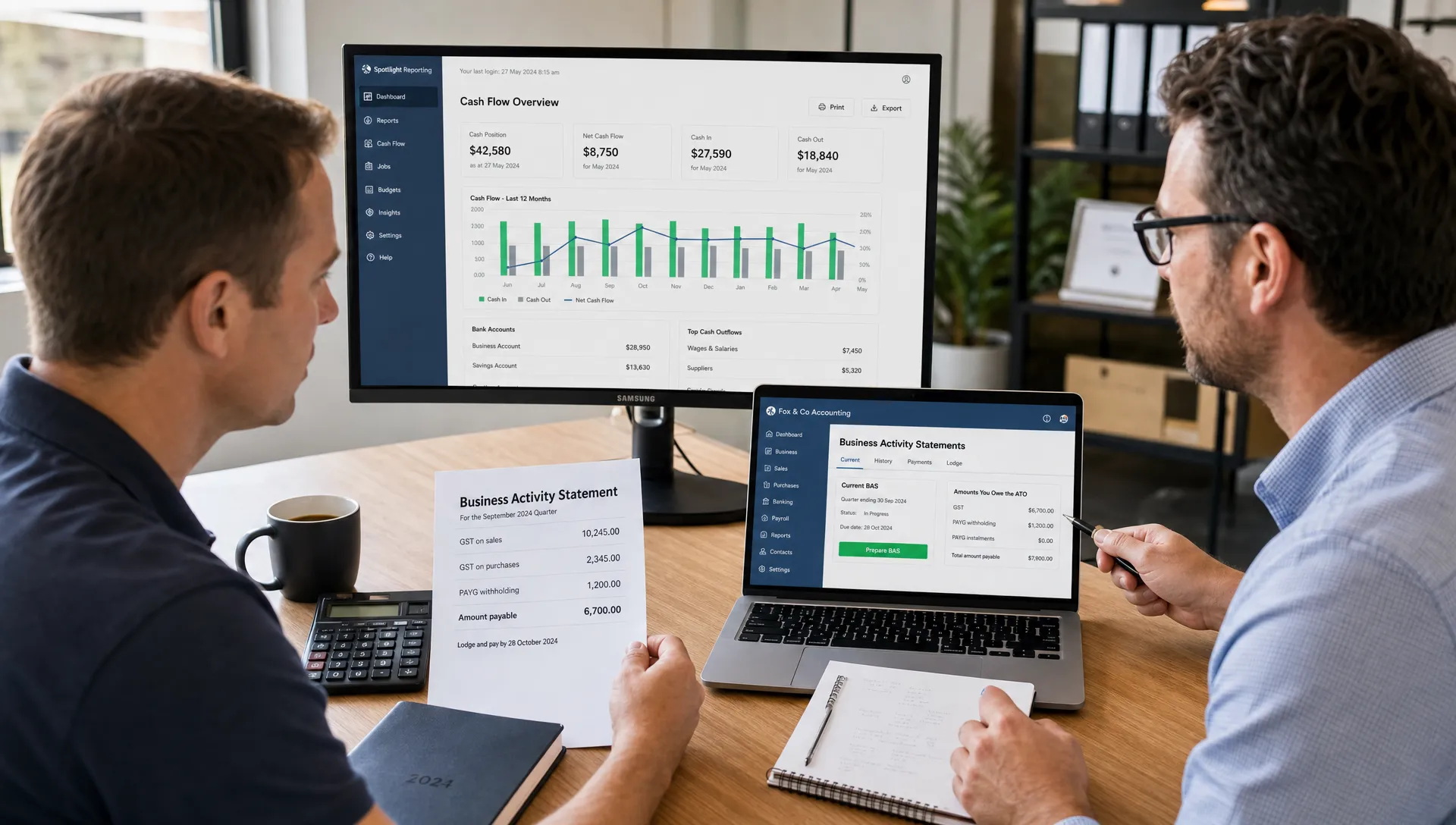
We believe trusted tax accountants should combine professional judgement with technology that improves speed, accuracy and visibility. AI-driven workflows can help identify anomalies, duplicate entries, unusual GST treatment, missing documents, coding inconsistencies and cash flow patterns that would otherwise be found too late.
However, automation should never replace technical review. The strongest accounting systems use AI and cloud tools to remove repetitive processing, then apply senior-level judgement to tax treatment, risk and strategy.
When assessing digital capability, ask practical questions:
- Do they use cloud accounting platforms and secure document collection?
- Can they integrate bank feeds, payroll data and invoice capture?
- Do they provide real-time or near real-time reporting?
- How do they review AI-generated or automated classifications?
- Can they build workflows for multi-entity or multi-location businesses?
- How do they protect client data and manage access permissions?
For clients operating across Adelaide, Sydney, Melbourne and other Australian locations, digital systems are especially important. A national business cannot rely on fragmented bookkeeping, inconsistent BAS treatment or localised processes that do not speak to each other.
Evaluate their approach to ATO risk and compliance governance
A trusted accountant should not simply ask, “What can we claim?” A better question is, “What is the correct treatment, what evidence supports it and how would it stand up under review?”
The ATO increasingly uses data matching and analytics across income, GST, payroll, superannuation, property, crypto assets, contractor payments and lifestyle indicators. That does not mean clients should be defensive or overly conservative. It means tax positions should be deliberate, documented and aligned with Australian law.
Strong compliance governance includes maintaining records in line with ATO expectations. The ATO provides guidance on record keeping for business, and we consider this a baseline for every business owner. In practice, effective records should include invoices, receipts, payroll records, superannuation records, contracts, loan documents, logbooks where relevant and evidence supporting apportionment.
A good accountant will also distinguish between tax minimisation and tax avoidance. Legitimate tax planning is essential. Artificial arrangements that lack commercial substance can create penalties, interest and reputational risk.
This distinction matters for:
- Trust distributions and beneficiary entitlements
- Related-party payments
- Motor vehicle claims
- Home office claims
- Property development and capital versus revenue treatment
- Contractor payments
- Private company loans
- SMSF investments
- Cross-border income and transfer pricing issues
If an adviser suggests aggressive claims without asking for evidence, that is not strategy. It is risk transfer to you.
Compare accountants using a practical trust framework
Trust should not be based only on personality. Professional rapport matters, but business owners need a more objective method for comparison.
| Selection factor | What to look for | Why it matters |
|---|---|---|
| TPB registration | Active tax agent registration with the Tax Practitioners Board | Confirms legal authority to provide paid tax agent services |
| Australian tax expertise | Clear knowledge of ATO, BAS, GST, PAYG, Superannuation and FBT | Reduces compliance risk across business operations |
| Industry relevance | Experience with your sector, structure and transaction profile | Improves the quality of advice and practical decision-making |
| Advisory cadence | Scheduled reviews throughout the year | Allows tax planning before deadlines pass |
| Technology capability | Cloud accounting, automation and secure digital workflows | Improves accuracy, speed and real-time visibility |
| Communication | Clear explanations, documented advice and responsive support | Helps directors make informed decisions |
| Fee transparency | Written scope, pricing basis and engagement terms | Prevents disputes and clarifies responsibilities |
| ATO support | Ability to manage reviews, objections and payment arrangements | Provides protection when matters become complex |
This table is not a substitute for judgement, but it helps identify whether an accountant is operating as a lodgement provider or as a strategic adviser.
Review communication style and decision support
Technical knowledge is only useful if it is communicated clearly. As directors, investors and business owners, you need advice that is timely, commercial and actionable.
A trusted accountant should explain the issue, the available options, the tax consequences, the cash flow impact and the risks. They should not overwhelm you with legislation, but they also should not reduce complex matters to vague assurances.
Before engaging a firm, observe how they handle your first discussion. Do they ask detailed questions about your structure, revenue model, employees, assets, debts and future plans? Do they explain where they need more information? Do they outline immediate risks and next steps?
Strong communication often shows up in small behaviours:
- They confirm advice in writing where appropriate
- They set expectations around deadlines and document requests
- They explain ATO correspondence without alarmist language
- They tell you what they do not yet know
- They challenge assumptions when a decision may create tax or cash flow risk
For high-growth businesses, this communication style is critical. The accountant should be able to brief directors, collaborate with bookkeepers, liaise with lawyers and finance brokers, and support management reporting without creating confusion.
Understand the difference between preparation and advice
Not every tax provider offers the same level of service. Some focus primarily on preparing and lodging returns. Others provide deeper accounting, tax planning and advisory support.
There is nothing wrong with simple preparation when the client’s circumstances are simple. The problem arises when complex clients engage a basic lodgement service and assume strategic advice is included.
If you have business income, employees, GST registration, investment properties, a trust, a company, an SMSF or ATO debt, you need to be clear about the service level. Preparation answers the question, “What needs to be lodged?” Advisory answers, “How do we structure, manage and improve the financial position?”
We have explored this distinction in more detail in our article on tax preparers versus accountants, which is useful if you are deciding whether your affairs require a higher level of support.
Ask the right questions before you engage
The best way to choose trusted tax accountants is to test how they think. A capable adviser will welcome informed questions because they indicate that you take governance seriously.
Consider asking:
- Are you registered with the Tax Practitioners Board, and who will supervise our work?
- What experience do you have with businesses or investors like us?
- How do you review BAS, GST, payroll and superannuation compliance during the year?
- What technology do you use to automate data capture and improve accuracy?
- How do you identify tax planning opportunities before 30 June?
- How do you support clients during ATO reviews or audits?
- What is included in your engagement, and what is outside scope?
- How do you report performance, tax liabilities and cash flow risks?
- Can you support our operations across Adelaide, Sydney, Melbourne or other locations?
The answers should be specific. If you receive generic claims such as “we maximise refunds” or “we handle everything” without process, evidence or scope, proceed carefully.
Watch for red flags
Some warning signs are obvious. Others are more subtle. In our experience, clients often seek help after years of poor systems, late lodgements or advice that was never properly documented.
Be cautious if an accountant:
- Is not registered with the TPB for the services being offered
- Promises unrealistic refunds or guaranteed outcomes
- Does not ask for records before suggesting deductions
- Treats BAS, GST, payroll or superannuation as minor administration
- Avoids written engagement terms
- Cannot explain their fee basis
- Uses outdated manual processes for complex businesses
- Provides advice verbally on significant matters without documentation
- Shows little interest in your business model or future plans
- Only contacts you close to lodgement deadlines
A trusted adviser should reduce uncertainty. If the relationship creates more confusion, delays or unexplained risk, it may be time to reassess.
Consider national capability and local context
Many Australian businesses now operate across state lines. A company may have a head office in Adelaide, contractors in Sydney, customers in Melbourne and inventory moving through several jurisdictions. Property investors may hold assets across multiple states. Professional service firms may engage remote teams and digital contractors.
This requires both national consistency and local awareness. Your accountant should understand federal tax obligations, but also recognise state-based issues such as payroll tax, land tax, duties and industry-specific compliance.
Our team supports clients across Australia with integrated service capability in Adelaide, Sydney and Melbourne. We see particular value in standardised digital workflows for cross-state businesses because they reduce duplication, improve reporting consistency and give directors a clearer view of group performance.
For companies scaling nationally, the accountant should be able to consolidate data, align reporting cycles and provide advice that reflects both compliance obligations and growth strategy.
How we can help
At Perfect Accounting & Tax Services, we view tax and accounting as a strategic operating system for your business, not just a compliance function. Our team combines 25 years of professional experience with AI-driven automation to help clients improve accuracy, reduce manual workload and gain better financial visibility.
We support business owners, company directors, investors and high-net-worth individuals with:
- Corporate and SME accounting, including bookkeeping, BAS and payroll management
- Advanced tax planning and complex structuring support
- ATO review, audit representation and late return assistance
- Virtual CFO services and strategic business advisory
- SMSF, payroll and industry-specific compliance support
- Digital workflow integration across finance functions
- National support across Adelaide, Sydney, Melbourne and wider Australia
Our approach is practical. We first stabilise the compliance base, then use cleaner data to support better cash flow decisions, tax planning and corporate growth.
Frequently Asked Questions
How do I know if a tax accountant is trusted in Australia? Start by checking TPB registration, then assess their Australian tax expertise, industry experience, communication standards, technology capability and willingness to provide documented advice. Trust should be based on evidence, not only reputation.
Should I choose a local accountant or a national firm? It depends on your needs. A local accountant may suit simple affairs, but businesses operating across multiple cities often benefit from national systems and consistent digital workflows. We support clients across Australia, including Adelaide, Sydney and Melbourne.
Can AI replace a tax accountant? No. AI can improve data capture, anomaly detection, reconciliations and reporting speed, but tax advice requires professional judgement, legal interpretation and commercial context. The best results come from combining automation with senior accounting expertise.
When should I change tax accountants? Consider changing if you experience repeated delays, poor communication, late lodgements, lack of strategic advice, weak technology, unexplained fees or advice that is not properly documented. Complex businesses need proactive support, not reactive processing.
What should a business tax accountant review before 30 June? Key areas include expected taxable income, GST and BAS accuracy, payroll and superannuation, director loans, asset purchases, bad debts, trust distributions, FBT exposure and cash reserves for upcoming tax liabilities.
Next steps
If you are choosing trusted tax accountants in Australia, treat the decision as a governance decision. The right adviser should protect compliance, improve visibility and help you make stronger commercial decisions throughout the year.
We invite you to contact Perfect Accounting & Tax Services for a confidential consultation. Our team can review your current accounting workflows, identify tax and compliance gaps, and show how automated systems can support more accurate reporting and strategic growth.