
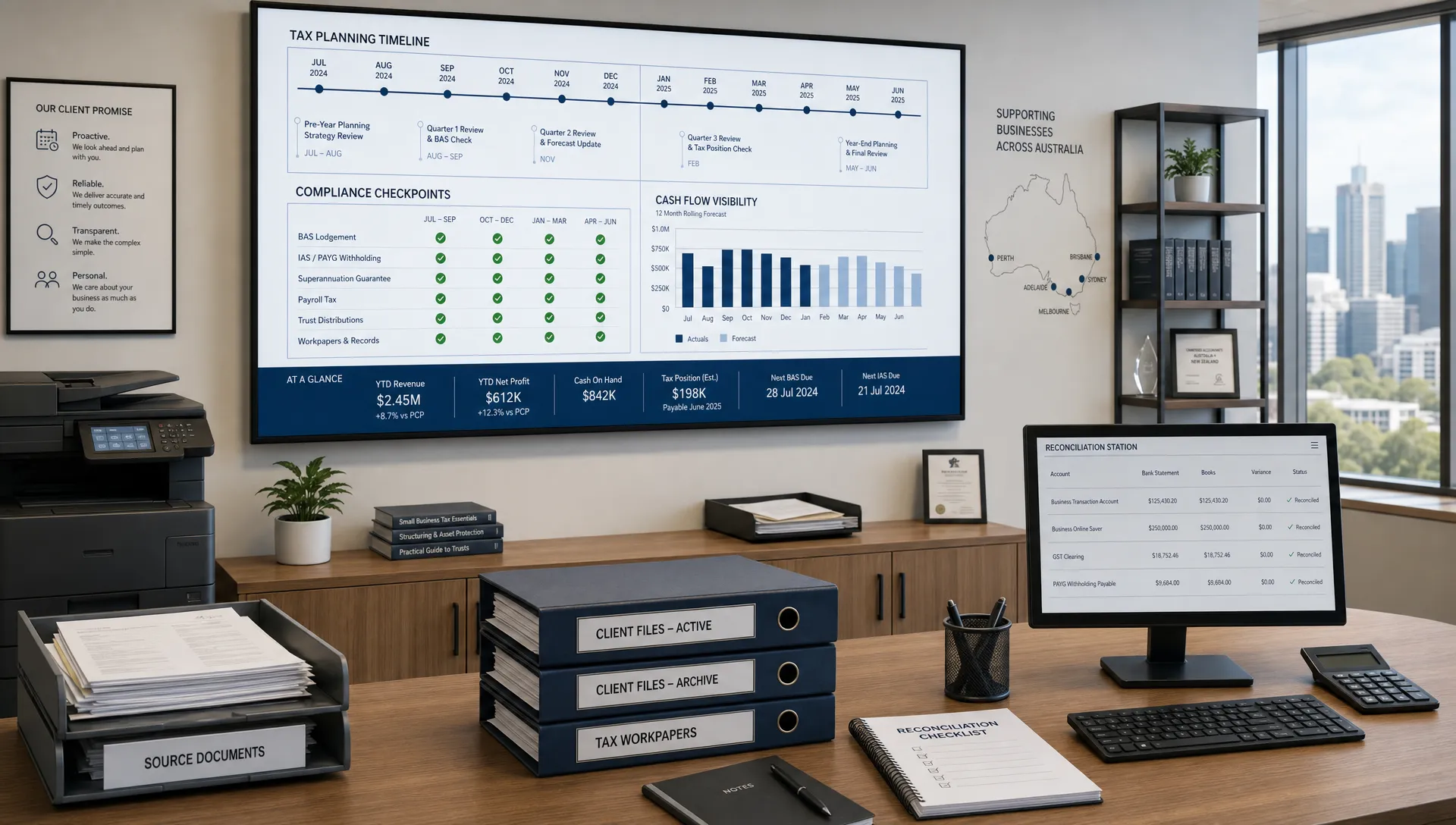
Reducing tax in Australia is not about finding loopholes. It is about making commercial decisions early, applying the law correctly, and keeping evidence strong enough to withstand ATO scrutiny.
For business owners, company directors and high-net-worth individuals, the real objective is not simply to pay less tax this year. The objective is to improve after-tax cash flow, protect capital, reduce compliance risk, and create a stronger platform for growth.
We approach tax planning as a strategic discipline. Done properly, it connects bookkeeping, BAS, payroll, superannuation, asset purchases, investment structures, estate planning and corporate growth. Done poorly, it creates red flags, cash flow stress and avoidable ATO attention.
Below, we outline practical ways to reduce tax in Australia while keeping ATO risk controlled, especially for SMEs, directors, property investors, professional firms and growing companies operating across Adelaide, Sydney, Melbourne and nationally.
Start with the right principle: tax planning is not tax avoidance
The ATO does not object to taxpayers arranging their affairs in a tax-effective way. The problem arises when arrangements lack commercial substance, are poorly documented, or rely on artificial steps designed mainly to obtain a tax benefit.
That distinction matters.
A compliant tax plan should be able to answer three questions:
- What is the commercial reason for the transaction?
- What tax law supports the treatment?
- What records prove the position if the ATO asks?
If the answer is vague, the risk is already rising.
For directors and high-net-worth individuals, we also consider how the transaction fits the wider group. A deduction in one entity may create assessable income elsewhere. A company distribution may affect franking credits, Division 7A, trust beneficiaries or family group tax outcomes. A property decision may affect CGT, GST, land tax, financing and asset protection.
Tax planning should never be isolated from the full financial architecture.
Understand what increases ATO risk
The ATO now has broad data-matching capability. It receives information from banks, employers, super funds, health funds, property platforms, cryptocurrency exchanges, government agencies and digital marketplaces. For businesses, it can compare income, GST, payroll, Single Touch Payroll, superannuation and industry benchmarks.
This does not mean every discrepancy is a problem. It does mean unsupported positions are harder to defend.
| Risk area | What often attracts attention | Lower-risk approach |
|---|---|---|
| Deductions | Large claims without invoices or clear business purpose | Keep tax invoices, payment records and business-use calculations |
| GST and BAS | GST claimed on non-creditable items or mismatched sales reporting | Reconcile BAS to the ledger, bank account and source documents |
| Private expenses | Personal costs coded as business expenses | Separate business and private accounts and apportion mixed-use costs |
| Contractors and payroll | Treating employees as contractors to avoid PAYG, superannuation or payroll tax | Review worker classification and contracts before engagement |
| Director loans | Funds taken from a company without Division 7A treatment | Maintain loan agreements, repayments and dividend planning |
| Property claims | Interest, repairs or travel claims that do not align with ATO rules | Keep ownership, loan, rental and capital works records clearly separated |
| Late lodgements | BAS, tax returns or super obligations lodged after due dates | Use automated reminders and real-time workflow tracking |
Many ATO issues start with basic record weaknesses, not aggressive tax schemes. We have covered this in more detail in our guide to tax return mistakes that cost Australian business owners, particularly where GST, BAS and deduction records do not align.
Build tax planning around real-time numbers
Tax cannot be optimised from outdated accounts. If the ledger is three months behind, decisions become reactive. By the time the tax return is prepared, most planning opportunities have already closed.
We prefer a forward-looking model. This means directors and owners should know their estimated taxable profit, GST exposure, PAYG instalments, wage costs, superannuation obligations, debtor position and expected cash flow before 30 June, not after.
This is where digital transformation is now essential. AI-driven accounting workflows can help identify unusual transactions, missing invoices, GST coding errors, unpaid superannuation, duplicate expenses and margin shifts earlier. Automation does not replace professional judgement, but it improves the quality and speed of the information we use to advise.
The stronger the underlying data, the more confidently we can make strategic recommendations.
Compliant ways to reduce tax in Australia
The most effective tax strategies are usually not dramatic. They are disciplined, timely and well documented. Below are key planning areas we review with clients.
Review deductions before year end
A business can generally claim deductions for expenses incurred in earning assessable income, provided the expense is not private, capital or specifically non-deductible. The key is to review expenditure before year end and ensure it is properly recorded.
Common areas include professional fees, software subscriptions, insurance, marketing, repairs, training, motor vehicle expenses, home office costs, interest, rent and accounting fees. The treatment depends on the facts. For example, a repair may be deductible, while an improvement may need to be depreciated or treated as capital.
We also review whether eligible prepaid expenses can be deducted earlier under the relevant prepayment rules. This can be useful for insurance, subscriptions, rent and interest in some situations, but the arrangement must be commercially genuine and meet the tax rules.
Time income and expenses correctly
Timing can legitimately affect taxable income. However, income should not be deferred artificially, and expenses should not be accelerated through backdated or sham transactions.
For businesses using accrual accounting, income may be derived before cash is received if the business has done what is required to earn it. For cash-based taxpayers, timing may depend more closely on receipt and payment. The correct method depends on business size, operations and ATO expectations.
We focus on commercial timing. For example, if a planned business expense is necessary and cash flow permits, bringing it forward before year end may be sensible. If an invoice relates to work genuinely completed after year end, backdating it creates unnecessary risk.
Use depreciation and asset planning carefully
Asset purchases can reduce taxable income through depreciation or other available concessions. However, buying equipment purely to reduce tax is rarely sound strategy. Cash flow comes first.
Before acquiring vehicles, machinery, technology or fit-out assets, we assess:
- Whether the asset is genuinely needed for the business
- Whether the business-use percentage is supportable
- Whether current depreciation or instant asset rules apply
- Whether finance terms create tax or cash flow pressure
- Whether GST credits, FBT or private-use adjustments apply
Asset planning works best when it supports productivity, automation, safety or growth. A technology investment that improves margins and operational visibility may create more value than a rushed purchase made only for a deduction.
Manage superannuation contributions with precision
Superannuation can be a powerful planning tool, but timing and caps are critical. Employer superannuation is generally deductible only when it is paid to the super fund by the required time and received in accordance with the rules. Late super can create significant problems, including loss of deduction and Superannuation Guarantee Charge exposure.
For 2026 planning, employers also need to factor in the 12 percent Superannuation Guarantee rate and the shift toward more frequent super payment expectations. This is not just a compliance issue. It changes working capital management.
For individuals, concessional contributions may reduce taxable income if properly structured and within the relevant caps. High-income earners must also consider Division 293 tax. Where eligible, carry-forward concessional contribution rules may provide opportunities, but only after checking total super balance, caps and cash flow.
Write off genuine bad debts
If a debtor is genuinely unrecoverable, a business may be able to claim a bad debt deduction, provided the debt has been included in assessable income and is written off before year end. A vague concern that a customer may not pay is not enough.
We look for evidence such as reminder emails, repayment negotiations, legal correspondence, insolvency notices and board or management approval to write off the debt. The accounting entry should align with the commercial reality.
This is an example of how compliance and strategy overlap. A clean debtor review can reduce tax, improve cash flow forecasting and expose weak credit control processes.
Review stock and work in progress
For businesses carrying stock, obsolete or slow-moving inventory can affect taxable income. Stock should be valued under the applicable tax rules, and write-downs must be supportable.
Professional firms, consultants, engineering practices and agencies should also review work in progress. Unbilled work, partially completed projects and deferred revenue can materially affect profit. This is particularly important for firms with long project cycles or milestone billing.
Structure matters, but substance matters more
Entity structure can have a major impact on tax, asset protection, succession and cash flow. Companies, trusts, partnerships, sole trader structures and SMSFs all have different advantages and obligations.
However, structure alone does not reduce tax safely. The administration must match the structure.
For company directors, this includes director loan accounts, dividends, franking credits, retained earnings, PAYG withholding, payroll tax, FBT and Division 7A. For trusts, this includes trust deed compliance, distribution resolutions, beneficiary entitlements and unpaid present entitlements. For SMSFs, this includes investment strategy, contribution caps, related-party rules and pension compliance.
We often see tax risk arise when a structure was set up years ago but not actively managed. The business grows, family circumstances change, investments expand across states, and the structure no longer reflects the economic reality.
Directors should review their structure at least annually, especially before significant transactions such as property purchases, business acquisitions, equity raises, asset sales or succession events. Our more detailed discussion on company tax planning for Australian directors explains how remuneration, GST, PAYG, Division 7A and cash flow should be considered together.
High-net-worth tax planning: focus on capital, not only income
For high-net-worth individuals, the largest tax outcomes often arise from capital events rather than salary or business income. Property sales, share disposals, business exits, trust distributions, inheritance planning and SMSF decisions can have long-term consequences.
CGT planning should start before the transaction is locked in. We review ownership history, cost base evidence, main residence issues, discount eligibility, small business CGT concessions, trust structures, carried-forward losses and timing. A rushed CGT review after settlement is rarely optimal.
Investment debt also needs careful attention. Interest deductibility depends on the use of borrowed funds, not merely the security provided. Mixing private and investment borrowings can create avoidable complexity. Clean loan splits and clear records make future tax positions easier to defend.
For property investors and developers, GST, margin scheme eligibility, revenue versus capital treatment, construction costs and financing must be analysed early. These issues can materially change after-tax returns.

Documentation is your strongest ATO defence
The ATO expects records to explain the transaction, not just prove that money changed hands. A bank statement alone is usually not enough. For businesses, the ATO generally requires records to be kept for five years, and longer periods can apply in some situations, such as CGT assets.
The ATO provides detailed guidance on record keeping for business, and we recommend treating that guidance as a minimum standard, not the ideal standard.
| Claim or tax area | Evidence we expect to see |
|---|---|
| Business expenses | Tax invoices, receipts, payment records and business purpose notes |
| Motor vehicle claims | Logbook, odometer readings, business-use calculation and running costs |
| Home office claims | Work pattern evidence, floor area or fixed-rate method records, and supporting costs |
| Travel | Itinerary, meeting records, invoices and private-use apportionment |
| GST credits | Valid tax invoices and correct GST coding in the accounting system |
| Contractor payments | Written agreement, invoices, ABN checks and worker classification review |
| Superannuation | Payroll records, clearing house confirmations and fund payment dates |
| Capital assets | Purchase contract, finance documents, depreciation schedule and disposal records |
Strong documentation changes the risk profile. It allows us to take positions confidently where the law supports them. Weak documentation forces conservative treatment or creates exposure during review.
Use automation to reduce both tax leakage and ATO risk
Manual bookkeeping often hides tax leakage. Expenses are miscoded. GST is claimed incorrectly. Payroll categories drift. Superannuation payments are missed. Director withdrawals sit unresolved. BAS lodgements are prepared from incomplete data.
AI-driven automation helps reduce these problems by improving consistency and visibility. In our workflows, the goal is not just faster data entry. The goal is better decision-making.
Automated accounting systems can help surface issues such as:
- Transactions posted to unusual accounts
- GST claimed where it may not apply
- Missing supplier invoices
- Duplicate payments
- Payroll and superannuation anomalies
- Profit movements outside normal expectations
- BAS figures that do not reconcile to the general ledger
The strategic benefit is timing. When anomalies are identified in real time, directors can act before tax positions become entrenched. That is how bookkeeping becomes a foundation for strategic advisory and corporate growth, not just a compliance chore.
Our integrated teams support businesses across Adelaide, Sydney and Melbourne with consistent processes, centralised technical oversight and on-the-ground understanding of local commercial conditions.
A practical 90-day plan to reduce tax risk
If you want to reduce tax without increasing ATO risk, start well before year end. A structured 90-day review is often enough to identify major issues and put corrective action in place.
- Prepare a profit and tax forecast: Estimate taxable income, GST, PAYG instalments, superannuation, FBT and cash flow to 30 June.
- Clean the general ledger: Review suspense accounts, loan accounts, private expenses, fixed assets, GST coding and unusual transactions.
- Reconcile BAS and payroll: Match BAS lodgements to the ledger and ensure STP, PAYG withholding, wages and superannuation align.
- Review director and related-party accounts: Identify Division 7A issues, unpaid present entitlements, shareholder loans and trust distributions early.
- Assess deductions and capital purchases: Confirm whether planned expenditure is commercial, deductible, capital or subject to depreciation rules.
- Model remuneration and distributions: Compare salary, dividends, trust distributions, retained profits and superannuation contributions in context.
- Prepare an ATO-ready evidence file: Store invoices, contracts, calculations, board notes and working papers in a structured digital folder.
This plan is simple, but it is powerful. It turns tax from an after-the-fact calculation into a managed financial outcome.
What not to do when trying to reduce tax in Australia
Some tax-saving ideas create more risk than value. We recommend avoiding any strategy that depends on poor visibility, missing evidence or artificial steps.
High-risk behaviours include claiming private expenses as business deductions, paying family members without genuine work and market-based documentation, backdating invoices, suppressing cash income, creating circular transactions, ignoring Division 7A, misclassifying employees as contractors, and entering schemes promoted mainly for tax benefits.
If the ATO contacts you about a review, audit, debt or discrepancy, the response should be disciplined. Do not ignore notices, provide incomplete explanations or make admissions without understanding the technical position. We have outlined a practical framework in our article on dealing with the ATO without costly mistakes.
Frequently Asked Questions
Can I legally reduce tax in Australia? Yes. Australian tax law allows legitimate deductions, concessions, structuring choices and timing decisions. The key is to ensure the strategy has commercial substance, is supported by law and is properly documented.
What is the biggest mistake business owners make with tax planning? The biggest mistake is waiting until after 30 June. Once the financial year has ended, many opportunities are lost. We recommend reviewing profit, cash flow, deductions, superannuation, BAS and structure before year end.
Does claiming more deductions increase ATO risk? Not if the deductions are genuine, business-related and supported by evidence. Risk increases when claims are unusually high, poorly documented, private in nature or inconsistent with reported income and industry norms.
How does automation help reduce tax risk? Automation improves data accuracy, flags anomalies earlier and gives directors real-time visibility over GST, payroll, superannuation, expenses and profit. Better data allows better advice and reduces the chance of avoidable errors.
Should company directors focus on salary, dividends or retained profits? There is no single answer. The right mix depends on company profit, cash flow, franking credits, personal tax rates, superannuation, Division 7A, asset protection and growth plans. We model these factors before recommending a position.
Is this article personal tax advice? No. This article is general information for Australian taxpayers and business owners. Your circumstances, structure and records need to be reviewed before any tax strategy is implemented.
Next steps: reduce tax with confidence, not risk
Reducing tax in Australia requires more than a deduction checklist. It requires accurate data, commercial judgement, forward planning and a clear understanding of ATO expectations.
Our team at Perfect Accounting & Tax Services works with business owners, directors and high-net-worth individuals across Australia, including Adelaide, Sydney and Melbourne. We combine 25 years of professional experience with AI-driven accounting workflows to improve accuracy, speed and real-time financial visibility.
If you want to reduce tax while protecting your position, we can help you review your structure, clean your accounts, forecast tax outcomes, strengthen documentation and implement automated workflows that support better decisions.
Contact Perfect Accounting & Tax Services to arrange a consultation and learn how our strategic advisory approach can turn tax compliance into a platform for stronger financial performance.