
When Airbnb hosts ask us about “tax filing australia”, we start with ownership, property use and the underlying transactions, not the platform’s payout total. A return can appear complete while still understating income, overstating deductions or overlooking a future capital gains tax liability.
We approach the review as both a compliance exercise and a financial-health assessment. For property investors, company directors and households with significant assets, reliable records support better decisions about pricing, financing and portfolio growth. Our AI-assisted workflows help organise financial data and identify discrepancies, while our professional review determines the appropriate tax treatment.
We establish the property’s tax profile first
Before calculating deductions, we establish who earns the income and how the accommodation operates. Renting a spare bedroom, periodically letting a principal residence and operating dedicated investment accommodation can produce different outcomes.
We confirm the ownership structure, including whether the property belongs to individuals, a company or a trust. For ordinary co-ownership, rental income and expenses generally follow each owner’s legal interest, unless a different beneficial ownership position is properly established. Receiving all Airbnb payouts into one person’s account does not, by itself, change that allocation.
We also distinguish property owners from tenants who sublet and businesses that manage accommodation for others. Management fees and rent received by an owner are not the same income stream.
Our review of tax filing in Australia does not assume that frequent bookings or an ABN automatically make hosting a business. We assess the scale, organisation and services provided. Where an owner lives overseas, we also review residency and the obligations associated with Australian property income.
Our “tax filing australia” review checklist
We use a structured review to connect each amount in the return to supporting evidence. The ATO’s residential rental property guidance provides the foundation, but the treatment depends on the property’s circumstances.
| Review area | Evidence we examine | Issue we aim to resolve |
|---|---|---|
| Ownership and taxpayer | Ownership records, entity details and management agreements | Reporting income in the correct return |
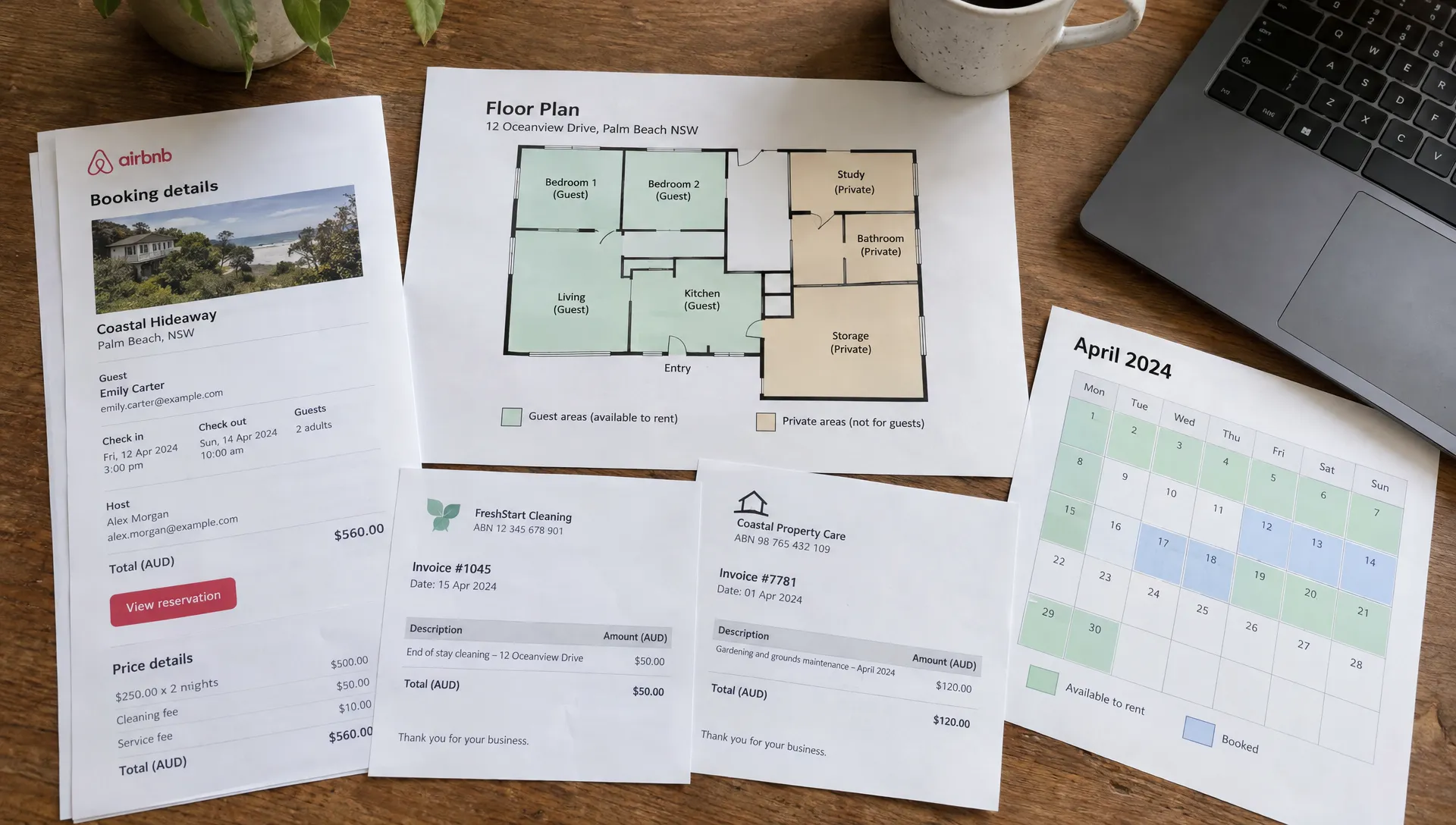
| Rental receipts | Platform statements, direct bookings, refunds and bank transactions | Reconciling gross income with net payouts |
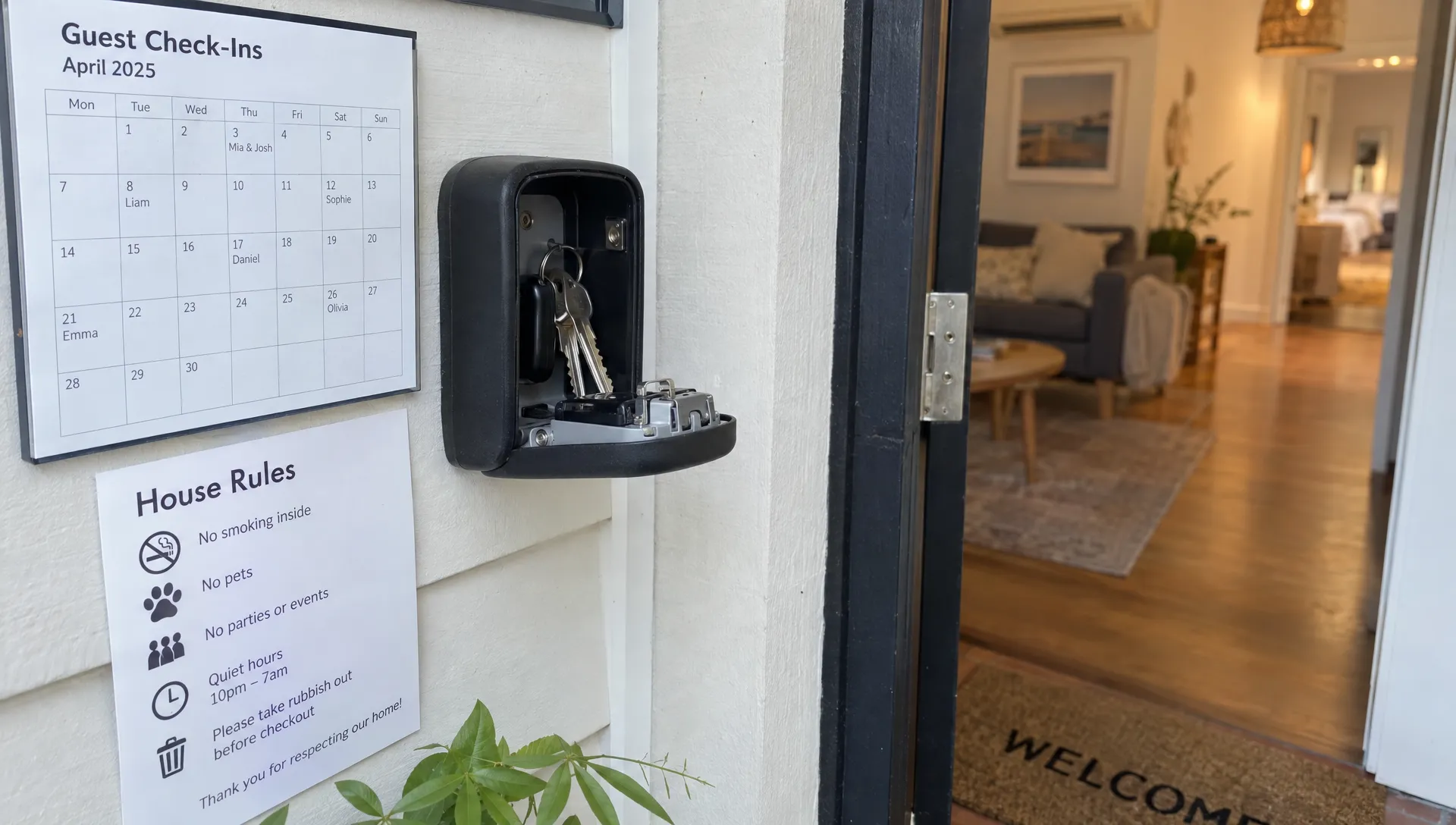
| Rental and private use | Booking calendars, blocked dates, listings and floor plans | Establishing a defensible deduction allocation |
| Expenses and assets | Invoices, loan statements and asset records | Separating deductible costs from private or capital expenditure |
| GST and future disposal | Accommodation arrangements and property-use history | Identifying GST classification and CGT implications |
We then connect these findings to the wider tax return preparation and review process. The Airbnb review should reconcile with the taxpayer’s other income, investment activities and entity obligations.
We reconcile gross income, not just bank deposits
A platform payout is often the amount remaining after fees and adjustments. Reporting only that deposit can understate both rental income and eligible expenses.
For example, if a host earns $2,000 in accommodation charges and the platform withholds a $60 host fee, the bank deposit may be $1,940. For an ordinary residential letting, we generally review $2,000 as rental income and assess the $60 fee separately as a potential deduction.
We also examine cleaning charges collected from guests, direct bookings, cancellations, refunds and retained amounts. A refundable security bond is different from an amount the host becomes entitled to retain. We determine its treatment from the circumstances rather than treating every receipt as rent.
For tax filing in Australia, we allocate income to the correct financial year using the applicable recognition basis, rather than assuming the booking date determines the answer. For a 2025–26 return, the relevant income year runs from 1 July 2025 to 30 June 2026.
Platform information supplied to the ATO does not replace the host’s own records. We reconcile that information where available and investigate discrepancies before lodgement, including differences caused by fees, adjustments or timing.
We test deductions against actual rental use
We separate direct expenses from shared costs
Guest-specific cleaning and eligible platform fees may relate directly to rental activity. Interest, insurance, council rates and utilities can require apportionment where the property also has private use.
We assess both the area used to earn income and the relevant period. Shared spaces need a reasonable allocation, not an assumption that every guest has exclusive use of the whole home.
As an illustration, suppose a defensible rental-use area is 30% and the eligible letting period is 120 days in a 365-day year. Applying those assumptions to $10,000 of eligible shared annual holding costs produces approximately $986:
$10,000 × 30% × 120 ÷ 365 = $986.
This is an illustration, not a standard Airbnb deduction rate. We establish the appropriate method from the layout, access arrangements and expense involved.
Our approach to tax filing in Australia also examines whether unoccupied periods were genuinely available for rent. A listing alone may not establish this if restrictive conditions, unrealistic pricing or owner-blocked dates prevented bookings. Below-market stays for family or friends require separate consideration.
We distinguish interest, repairs and capital expenditure
We trace borrowed funds to their use. Loan interest is not deductible merely because an income-producing property secures the loan, and private redraws can affect the deductible portion. Principal repayments are not rental deductions.
We distinguish repairs associated with rental wear from initial repairs, improvements and replacement assets. Renovating a bathroom is not automatically an immediate deduction simply because guests use it.
We also review capital works and depreciating assets separately. Restrictions can apply to deductions for second-hand assets in residential rental properties, including items previously used privately. We do not assume existing household furniture becomes deductible when a room is first listed.
We assess GST without assuming every host needs BAS
Ordinary residential accommodation is generally input taxed for GST. This means the host generally does not charge GST on that rent and cannot claim GST credits for related costs. Input-taxed residential rent is generally excluded when calculating GST turnover for registration purposes.
Commercial residential accommodation, such as qualifying hotel or motel operations, can have a different treatment. We examine the characteristics of the operation rather than relying on the Airbnb label, the number of bookings or whether cleaning is provided.
For tax filing in Australia, this distinction also matters when a host has another business. GST registration for consulting or retail activities does not automatically make ordinary residential rent taxable. We assess how shared expenses relate to each activity.
The ATO’s GST guidance supports this classification review. We determine whether BAS obligations arise from the relevant activities rather than treating a BAS as a universal requirement for hosts.
We separately consider state and local obligations, including Victoria’s short stay levy where applicable. These are distinct from federal income tax and GST. Planning permissions, strata conditions and accommodation registration also require attention outside the income tax return.
We examine CGT before the property is sold
Renting out a home can affect its main residence exemption. We therefore review the property’s use history while records and valuations remain accessible, rather than waiting until settlement.
We distinguish renting a room while continuing to live in the property from renting out a former home after moving elsewhere. The absence rule, which can allow a former home to remain the main residence for up to six years while producing income in qualifying circumstances, is not a blanket exemption for spare-room rentals.
In some circumstances, a home first used to produce income is treated as acquired at its market value at that time. The rule has conditions. We assess whether it applies and whether a defensible valuation is needed.
Our review of tax filing in Australia also preserves acquisition records, improvement costs, ownership dates and evidence of private use. These documents can influence a later calculation even when they do not generate an immediate deduction.
We refer to the ATO’s capital gains tax guidance when assessing these issues. Non-resident owners need a separate review because main residence exemption access and property-sale withholding rules can differ.
We use automation to strengthen the evidence trail
Airbnb records often sit across booking platforms, bank accounts, spreadsheets and emailed invoices. That fragmentation increases the risk of missed receipts, duplicate expenses and unexplained balances.
We use AI-assisted processes to help organise records, support transaction matching and flag inconsistencies for review. These processes can improve speed and accuracy while supporting more timely financial visibility. They do not determine whether an expense is deductible or whether a property qualifies for a CGT concession.
For tax filing in Australia, automation is most useful when the underlying data is complete. We recommend maintaining a dated booking calendar, preserving platform statements and keeping invoices that identify the supplier, amount and nature of the expense.
We retain human oversight of classifications and apportionment. An automatically suggested expense category is a starting point, not a tax conclusion. We also recommend controlled access to financial records and secure handling of TFNs and identity documents.
Rental expense records generally need to be kept for five years, while acquisition and other CGT records may need to be retained much longer. We establish retention requirements by record type rather than applying a single deletion date to everything.
We turn compliance records into financial decisions
A reliable return provides the foundation for Strategic Advisory, but taxable profit and available cash are not interchangeable. Depreciation may reduce taxable income without a current cash payment. Loan principal repayments and some capital expenditure consume cash without creating an immediate deduction.
We review the property’s cash contribution after platform charges, cleaning, utilities, financing costs and an appropriate maintenance allowance. This helps assess whether headline booking revenue supports the owner’s investment objectives.
Our approach to tax filing in Australia also supports forward planning. We assess whether a tax provision is needed, whether PAYG instalments require attention and how seasonal occupancy affects liquidity. We consider changes in property use alongside their potential deduction and CGT consequences.
For a growing accommodation portfolio, this disciplined information base supports Corporate Growth and financing decisions. We do not recommend a company or trust structure simply because the portfolio expands. Restructuring can create CGT, duty, financing and asset-protection implications that require assessment before implementation.
Frequently asked questions
Does Airbnb income need to be declared if we rent only occasionally? We generally include assessable rental income even where hosting is occasional. We then assess deductions according to the rental activity and private-use arrangements. Frequency alone does not create a tax-free exemption.
Can Airbnb rental expenses create a deductible loss? We assess whether the expenses are deductible, properly apportioned and associated with genuine income-producing activity. Private use and non-commercial arrangements can restrict claims. The ownership structure also affects how a loss is treated.
Does Airbnb hosting automatically require GST registration? We do not treat platform use as the deciding factor. Ordinary residential accommodation is generally input taxed. Commercial residential accommodation and other business activities require a separate GST assessment.
When should an Airbnb host arrange a return review? We recommend allowing time to resolve missing records and valuation questions before the applicable lodgement deadline. Individual self-lodgers generally work to a 31 October deadline, subject to weekend and public-holiday rules. Eligible registered tax agent clients may have different dates, which we confirm rather than assume.
Next steps: we review the records before lodgement
We begin with platform statements, bank transactions, ownership details, loan records, expense invoices and a calendar separating rental availability from private use. We also request the property’s occupation history where main residence CGT issues may arise.
Through our individual tax return services, we can review personal rental income alongside employment, investments and other relevant tax matters. For company or trust ownership, we assess the entity’s obligations separately.
Perfect Accounting & Tax Services brings 25 years of professional experience and integrated service capabilities across Adelaide, Sydney and Melbourne, supporting clients throughout Australia. We combine tax review with AI-driven workflow improvements so compliance records can support stronger financial decisions.
We invite Airbnb hosts seeking support with tax filing in Australia to contact our team for a consultation. We can discuss the property’s tax position, outstanding records and opportunities to improve automated accounting workflows before the next lodgement.