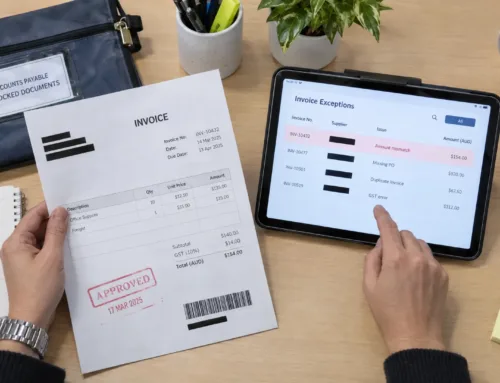


Our business tax services assess AI investments by examining what a business acquires, how it will use the technology and when expenditure becomes deductible. An AI subscription, an internally developed system and a shareholding in an AI company can produce very different tax outcomes. We establish those distinctions before treating expenditure as an operating cost or forecasting a tax benefit.
We connect that analysis with cash-flow planning, GST compliance and investment governance. Our objective is to help business owners and directors understand the after-tax commitment, preserve supporting evidence and assess whether the investment strengthens financial performance.
We define what the AI investment actually involves
We begin with the commercial arrangement rather than the supplier’s description of the product. An invoice labelled “AI implementation” might combine software access, configuration, employee training, hardware and intellectual property rights.
Our initial review establishes which entity signs the contract, who owns the resulting assets and whether the technology supports internal operations or a product intended for sale. We also examine payment milestones, cancellation rights and any private or non-business use.
We distinguish operating expenditure from investment ownership. Buying shares in an AI startup is not the same as buying software for an existing business. Share acquisitions generally require a separate capital gains tax and investment-structure analysis, rather than an operating-expense deduction.
How our business tax services classify AI expenditure
We assess each material component separately because a single contract can contain several tax treatments.
| Investment component | Our tax assessment | Evidence we examine |
|---|---|---|
| Recurring AI subscriptions | Revenue deductions, business-use allocation and prepayment rules | Subscription terms, invoices and access periods |
| Custom software for internal use | Whether in-house software or other capital expenditure rules apply | Development agreements, ownership rights and intended use |
| AI servers and computing equipment | Depreciation, applicable concessions and readiness for use | Asset invoices, installation records and business-use estimates |
| Integration, configuration and training | Whether costs are deductible or form part of a capital asset | Itemised scope, deliverables and project records |
| Shares in an AI company | Investment ownership, cost base and relevant entity-level consequences | Subscription agreements, shareholder records and transaction costs |
We do not assume that every implementation charge is immediately deductible. Equally, a large invoice does not automatically make every component capital expenditure. The substance of the arrangement determines the analysis.
Our business tax services also test prepaid subscriptions and multi-year contracts, since payment before 30 June does not necessarily produce a full deduction in that income year.
We separate accounting treatment from tax treatment
We reconcile the financial accounts with the tax position rather than assuming that an accounting expense produces an immediate tax deduction. Software capitalised in the accounts may also have a different tax deduction schedule.
Under the ordinary rules, qualifying in-house software is generally depreciated over five years. We check whether software development pooling or an applicable small-business concession changes that treatment. Software developed for sale or licensing requires a separate assessment.
We apply the ATO’s framework for depreciation and capital expenses and verify the rules for the relevant income year. We do not carry forward an earlier year’s concession threshold without checking eligibility and timing.
We assess R&D eligibility without assuming AI qualifies
Our business tax services distinguish genuine research and development from routine technology adoption. Using generative AI, connecting an existing model to business data or configuring a vendor’s platform does not, by itself, establish eligibility for the R&D Tax Incentive.
We assess whether an eligible company undertakes qualifying activities, including experimental work that satisfies the program’s requirements. For core R&D activities, we examine the technical uncertainty, the hypothesis being tested and the systematic progression of experiments, observations and conclusions.
We review the Australian Government’s R&D Tax Incentive requirements alongside the project evidence. Our assessment also considers registration deadlines, expenditure connections, contractor arrangements and any overseas activities requiring further analysis.
We encourage contemporaneous records rather than a reconstruction at year-end. Useful evidence includes experiment plans, test results, failed approaches and substantiated staff time allocations. Commercial novelty or management’s expectation of innovation is not enough.
Where expenditure qualifies for the incentive, we reconcile its treatment with other deductions and adjustments under the applicable rules. We do not simply add an R&D benefit to an ordinary deduction or promise eligibility before reviewing the facts.
We check GST and cross-border supplier risks
Our business tax services examine GST separately from income tax. A cost can be deductible without supporting a GST credit, particularly when the supplier is overseas or the acquisition does not satisfy the credit requirements.
For Australian acquisitions, we check GST registration, creditable purpose and the required supporting documentation. Where expenditure supports private use or input-taxed activities, we assess whether an apportionment or restriction applies.
For offshore AI subscriptions, cloud computing and model-access charges, we establish whether Australian GST has actually been charged. We do not extract a GST credit from an overseas invoice simply by dividing its total by eleven. We also consider whether imported-service reverse-charge rules require attention, particularly where an acquisition is not wholly for a creditable purpose.
Some software and intellectual-property arrangements can raise royalty withholding questions. We examine the rights granted, supplier residency and relevant treaty position, coordinating specialist advice where necessary.
Our automated GST checks support transaction review, but the contract and underlying use remain essential. Automation cannot determine complex cross-border treatment from a supplier name alone.
We build an evidence trail that supports the tax position
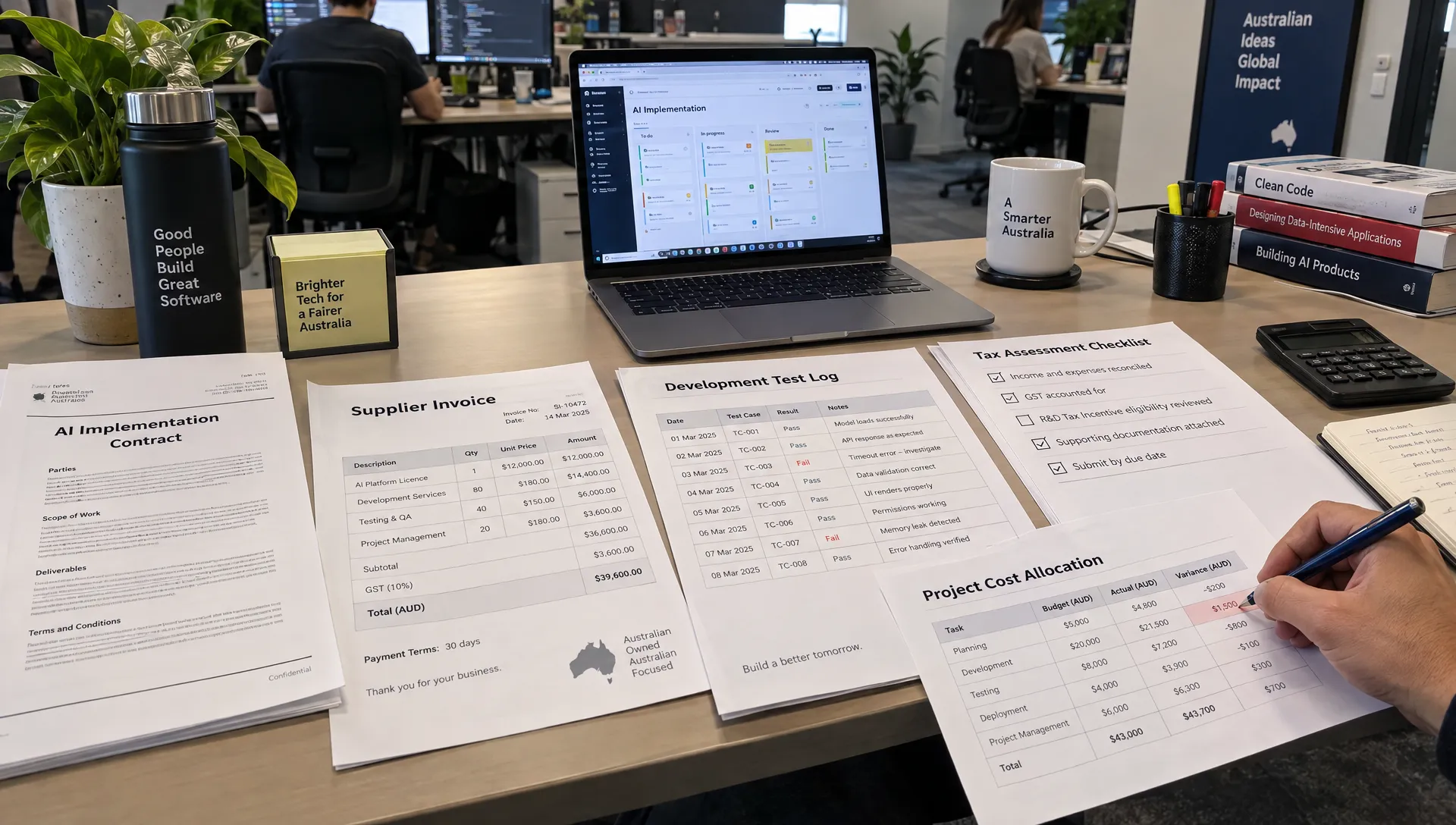
We structure the records around the decisions that may need to be explained later. A bank payment proves that money moved, but it rarely establishes ownership, business purpose or the correct deduction period.
For a material project, our review typically brings together the following records:
- Executed contracts, statements of work and itemised supplier invoices.
- Intellectual property provisions and details of the entity acquiring the rights.
- Project milestones, acceptance testing and evidence of when assets became ready for use.
- Development time records, contractor deliverables and substantiated cost allocations.
- Business-use assessments, funding arrangements and relevant grant documentation.
Our business tax services use this evidence to support the return, maintain asset schedules and explain differences between accounting profit and taxable income. Where payroll costs are allocated to development, we reconcile those allocations to underlying payroll records rather than relying on broad management estimates.
We also identify missing evidence while suppliers and project teams remain available. That is usually more efficient than trying to resolve an ambiguous implementation invoice months after the project closes.
We turn tax treatment into an investment decision
We assess the investment’s cash requirements before treating a deduction as a commercial benefit. A tax deduction reduces taxable income; it does not reimburse the full purchase price.
For illustration, if a company incurs $40,000 of fully deductible operating expenditure and its applicable tax rate is 25%, the income tax reduction would be $10,000, assuming sufficient taxable income. The remaining after-tax cost would be $30,000. This example excludes GST, financing costs and timing differences, and the assumed rate does not apply to every company.
Our business tax services incorporate those differences into a forecast. A capital purchase may require cash upfront while deductions arise over several years. A company with tax losses may not receive an immediate cash benefit from an ordinary deduction. An eligible R&D offset follows separate rules.
We then compare the after-tax commitment with measurable operating outcomes, such as reduced processing time, improved gross margin or additional delivery capacity. We also allow for implementation disruption, recurring usage charges and the cost of human review.
Through our strategic advisory and virtual CFO work, we can assess staged deployment against a larger upfront commitment. Tax treatment informs that decision, but it should not substitute for a credible commercial return.
We connect automated records with professional judgement
We use AI-driven automation to streamline financial workflows, reduce repetitive data handling and help identify inconsistencies earlier. With timely transaction feeds and reconciliations, this supports more current visibility over project spending, supplier commitments and the cash available for deployment.
Our business tax services retain professional review over classifications, tax adjustments and claims. AI-generated coding suggestions are not evidence of deductibility, and an automatically processed invoice can still contain the wrong entity name, an unsupported GST amount or mixed capital and operating costs.
We use bookkeeping and BAS compliance as the foundation for strategic advisory and corporate growth. Reliable records allow us to compare actual spending with the approved budget, identify rising usage costs and revisit the investment case before further commitments are made.
We support businesses across Australia through integrated service capabilities in Adelaide, Sydney and Melbourne. For businesses operating across several locations or entities, we coordinate the review around the actual contracts, asset ownership and inter-entity arrangements rather than treating each location as an isolated file.
Frequently asked questions
Can we claim an AI subscription immediately? We assess whether the subscription is an ordinary business expense, whether it includes capital components and whether prepayment rules affect timing. We also account for private or non-business use. A monthly subscription used wholly in an existing business will generally present a different analysis from a multi-year development arrangement.
Does developing an AI tool automatically qualify for the R&D Tax Incentive? We do not treat AI development as automatically eligible. Our business tax services assess the company, activities, expenditure and supporting records against the program’s requirements. Routine implementation and configuration may not qualify, even when the finished system is valuable to the business.
Should we buy AI technology through a separate company? We assess that question against commercial risk, intellectual property ownership, funding and intended use. We also consider GST, related-party arrangements and any R&D implications. A separate entity is not inherently more tax-effective and can introduce additional obligations.
Can we review an AI investment after the contract is signed? We can review an existing arrangement, identify the likely treatment and address record gaps. However, we generally have more scope to clarify deliverables, ownership and invoicing before execution. We cannot assume that an unfavourable contractual position can be corrected retrospectively.
Next steps: arrange an AI investment tax consultation
We recommend bringing the proposed contract, implementation budget, entity details and expected business use to an initial consultation. For development projects, we also review the technical scope and available experiment records. Our guide to preparing for a tax consultation outlines the broader financial information that supports an effective review.
Drawing on 25 years of professional experience, we bring tax analysis, accounting controls and strategic advisory together. We identify likely treatments, evidence requirements and cash-flow implications, then agree on the appropriate review and compliance scope.
We invite business owners and directors to contact Perfect Accounting & Tax Services for a consultation about an AI investment or our automated accounting workflows. We can assess the position before the next contract, payment milestone or tax claim.