

When business owners compare tax accounting companies, the visible differences often look narrow: tax returns, BAS, payroll, bookkeeping and advice. The real difference sits underneath those services. Leading firms build systems that identify risk early, convert compliance data into management insight and support growth decisions before the ATO deadline arrives. In our 25 years advising Australian businesses, directors and high-net-worth clients, we have seen that stronger accounting is rarely about one clever deduction. It is about governance, timing, documentation, cash flow discipline and the intelligent use of automation. That is where a tax adviser becomes part of the commercial infrastructure of the business, not an annual cost centre.
What leading tax accounting companies prioritise before lodgement
Compliance is mandatory, but it should not be the starting point of the conversation. We start by understanding the commercial model: how revenue is generated, where cash is tied up, what risks sit in payroll and GST, how assets are held and whether the structure still suits the owner’s objectives.
For a company director, this means looking beyond the tax return to director loan accounts, Division 7A exposure, PAYG withholding, Superannuation Guarantee, FBT, GST registration, trust distributions, asset protection and succession planning. For a property investor or high-net-worth individual, it may include negative gearing, capital gains tax timing, land tax coordination, SMSF issues and foreign income reporting.
Commercial diagnosis comes before technical work
A technically correct tax return can still be commercially weak if it ignores the broader position. We see this when businesses lodge on time but do not understand margins, cash conversion, working capital pressure or how future transactions will affect tax.
In our view, tax accounting companies earn their value when they diagnose the underlying financial condition before they prepare the paperwork. That diagnosis should include structure, record quality, ATO exposure, industry-specific obligations and the owner’s growth plan. We explored this distinction further in our article on when a tax professional becomes a strategic advantage, where the focus shifts from lodgement to decision support.
This approach is especially important for scaling businesses. A sole trader moving into a company structure, a family business preparing for external investment or a professional practice buying premises all require integrated advice. Tax, accounting and strategy cannot sit in separate conversations.
They convert compliance data into real-time management intelligence
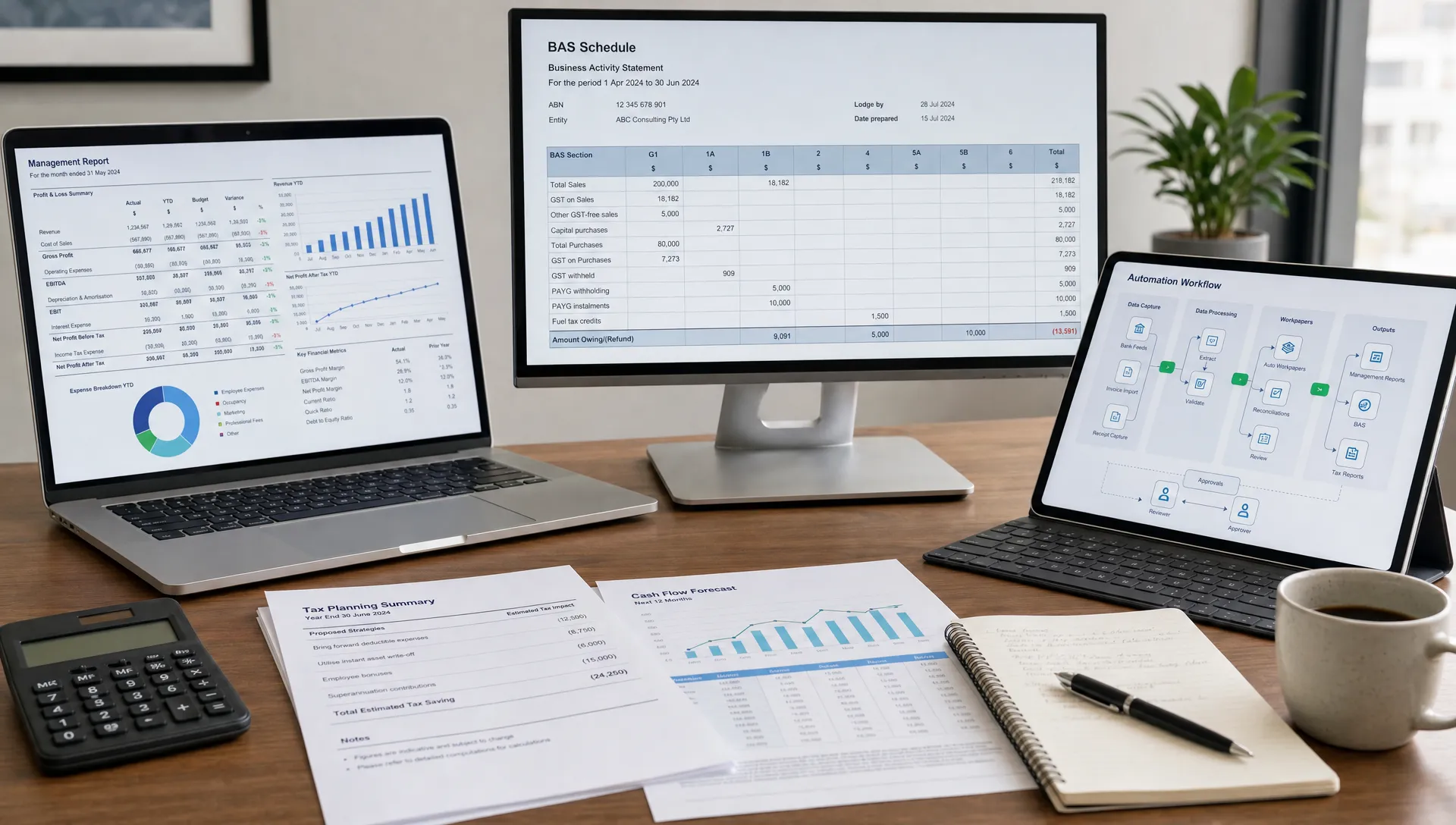
Modern accounting data should not remain dormant until BAS or year-end. With cloud ledgers, bank feeds, digital document capture and AI-assisted transaction review, we can identify anomalies much earlier than traditional desktop workflows allowed.
Leading tax accounting companies use automation to speed up routine processing, but the real benefit is visibility. When GST coding errors, payroll irregularities or unusual expense movements appear sooner, directors can respond before the issue becomes a cash flow problem or an ATO query.
Automation must still be governed by professional judgement
Automation improves accuracy only when it is configured, reviewed and governed properly. We do not treat AI as a replacement for professional judgement. We use it to reduce manual friction, flag exceptions and create cleaner working papers so our team can focus on interpretation.
For Australian businesses, this governance matters. The ATO record-keeping requirements place responsibility on taxpayers to keep accurate records that explain transactions and support claims. A fast system with poor review controls can create risk at scale. A well-designed automated workflow gives management speed without sacrificing accountability.
What decision-grade reporting should reveal
For established businesses, tax accounting companies should help convert accounting records into signals that management can use. Monthly reports should not simply list profit and loss figures. They should explain what changed, why it matters and what action is required.
| Reporting signal | What it can indicate | Strategic action |
|---|---|---|
| Gross margin movement | Pricing pressure, supplier cost increases or job costing weakness | Review quotes, supplier terms and product mix |
| GST payable trend | Revenue growth, timing issues or coding errors | Forecast BAS cash flow and check GST treatment |
| Payroll percentage | Hiring efficiency, rostering pressure or under-recovery of labour | Review staffing, pricing and productivity |
| Debtor days | Collection weakness or credit control gaps | Tighten payment terms and follow-up processes |
| Superannuation liability | Cash flow pressure or compliance risk | Schedule Superannuation Guarantee payments early |
When these indicators are reviewed consistently, compliance data becomes a board-level tool. It helps owners make pricing, hiring, investment and funding decisions with more confidence.
They manage ATO risk like a governance issue
ATO risk is not limited to audits. It includes preventable errors, weak substantiation, late lodgements, misclassified contractors, poor GST treatment, unpaid superannuation and inconsistent director drawings. These issues can accumulate quietly until they affect financing, valuations or sale readiness.
The stronger approach is preventive. We look for recurring risk patterns across BAS, income tax, payroll, superannuation, FBT and entity structures. That review is not about creating unnecessary complexity. It is about identifying where the business may be exposed and documenting positions before questions arise.
Taxpayers should also check that their adviser is appropriately registered. The Tax Practitioners Board maintains the register for tax agents and BAS agents in Australia. For directors, this is a minimum threshold, not the whole test. Registration confirms authority to provide certain services, but commercial depth depends on the adviser’s systems, experience and ability to interpret complexity.
Documentation is not administration, it is evidence
Good advice must leave an evidence trail. That includes source documents, reconciliations, working papers, tax position notes, loan agreements, trust distribution minutes, asset registers and correspondence that explains key judgements.
We place strong emphasis on documentation because memory is not a compliance strategy. If the ATO reviews a transaction two years later, the business needs more than a verbal explanation. It needs records that support the treatment adopted at the time.
They advise across the business lifecycle, not only the tax year
A business does not move in neat annual cycles. It hires staff, buys assets, expands premises, changes shareholders, raises capital, acquires competitors, enters new states and eventually prepares for succession or exit. Tax advice must follow that lifecycle.
The strongest firms build planning checkpoints around these events. Before a major equipment purchase, we assess depreciation, temporary full expensing status where relevant to the period, financing structure and GST cash flow. Before hiring, we review payroll setup, award obligations with the client’s employment adviser where needed, Single Touch Payroll, superannuation and workers compensation implications. Before an exit, we consider structure, capital gains tax concessions, earn-outs, warranties and due diligence readiness.
This is where tax accounting companies can materially affect value. A late conversation may still solve the lodgement problem, but it often misses planning choices that had to be made earlier. That is why our advisory process is built around forward visibility, not only annual reporting.
They understand national operations and local execution
Australian tax rules are national in many areas, but practical execution often has a local dimension. Payroll tax, land tax, duties, workers compensation and industry reporting can vary by state or territory. A business operating in South Australia, Victoria and New South Wales needs advice that sees the whole group, not isolated branch accounts.
Our team supports clients across Australia with integrated service capability in Adelaide, Sydney and Melbourne. That matters for cross-state groups, property investors, medical practices, construction firms, logistics operators, technology companies and family-owned businesses with assets or staff in more than one jurisdiction.
Industry nuance changes the advice
A hospitality group has different risk points from a SaaS company. A building contractor’s accounting needs differ from a medical specialist, a veterinary clinic, a manufacturer or a commercial landlord. The chart of accounts, GST treatment, revenue recognition, debtor controls, payroll profile and asset registers should reflect the operating model.
We also see industry-specific issues in areas such as contractor management, inventory controls, work-in-progress, R&D documentation, import GST, motor vehicle claims and SMSF investment compliance. Strong advice requires pattern recognition. The more clearly the accountant understands the industry, the more accurately they can identify where risk and opportunity are likely to sit.
They communicate early, with clear accountability
Deadlines should not be the communication strategy. BAS due dates, income tax lodgement programs, superannuation payment dates and FBT reporting timeframes are known well in advance. Leading firms build workflows around those dates so clients are not forced into rushed decisions.
In practice, tax accounting companies that communicate well do three things consistently. They tell the client what information is needed, explain the consequence of missing or poor-quality data and provide enough lead time for directors to manage cash flow. They also distinguish between compliance updates and strategic advice, so routine matters do not bury important decisions.
For example, a BAS review may reveal a GST coding issue. A strategic review asks whether the pricing model, supplier terms or debtor collection cycle is creating recurring BAS pressure. That distinction is where better accounting improves financial health. We discuss this cash flow angle in more detail in our article on tax-efficient accounting that improves cash flow.
How to assess a firm before you engage
When we assess tax accounting companies, we look for depth in systems, judgement and communication. The right firm should make your financial position clearer, not simply request documents at lodgement time.
Use these questions before you engage an adviser:
- Are they a registered tax agent or BAS agent where required?
- Do they review structure, cash flow and ATO risk before preparing returns?
- Can they integrate bookkeeping, BAS, payroll, tax planning and advisory?
- Do they use automation with human review controls, not automation alone?
- Will they provide clear management reporting throughout the year?
- Do they understand your industry and state-based obligations?
- Can they support growth, finance, acquisitions, exits or multi-entity groups?
If you want a broader selection framework, our guide on how to compare accounting and tax firms before you engage covers registration, communication, technical capability and automation in more detail.
Frequently Asked Questions
What makes a tax accounting firm suitable for a growing Australian business? A suitable firm should combine tax technical knowledge with BAS, payroll, GST, cash flow, structure and reporting capability. For a growing business, advice must be proactive because late tax planning often limits the available options.
Should automation be a deciding factor when choosing an accountant? Yes, but only if automation is supported by professional review. AI-driven workflows can improve speed, consistency and visibility, but the firm must still apply judgement to GST treatment, deductions, payroll issues, tax positions and risk management.
How often should business owners review tax and accounting strategy? We recommend reviewing strategy at least quarterly for active businesses, with additional reviews before major events such as asset purchases, hiring, financing, restructuring, property transactions or planned exits.
Can tax accounting companies help high-net-worth individuals as well as companies? Yes, where they have the right expertise. High-net-worth clients often need coordinated advice across trusts, companies, investment portfolios, property, SMSFs, foreign income, estate planning considerations and capital gains tax events.
Next steps: turn compliance into strategic advantage
If you are comparing tax accounting companies, look beyond lodgement capacity. Assess whether the firm can strengthen governance, improve cash flow visibility, reduce ATO risk and provide strategic advice before decisions are locked in.
Our team at Perfect Accounting & Tax Services supports business owners, company directors and high-net-worth individuals across Australia, with integrated capability in Adelaide, Sydney and Melbourne. We combine 25 years of professional experience with AI-driven automation to streamline workflows, improve accuracy and give clients clearer financial visibility throughout the year.
To discuss your accounting, tax planning or automated reporting needs, contact our firm for a consultation. We can review your current workflow, identify compliance gaps and show how a modern accounting system can become a foundation for strategic advisory and corporate growth.