
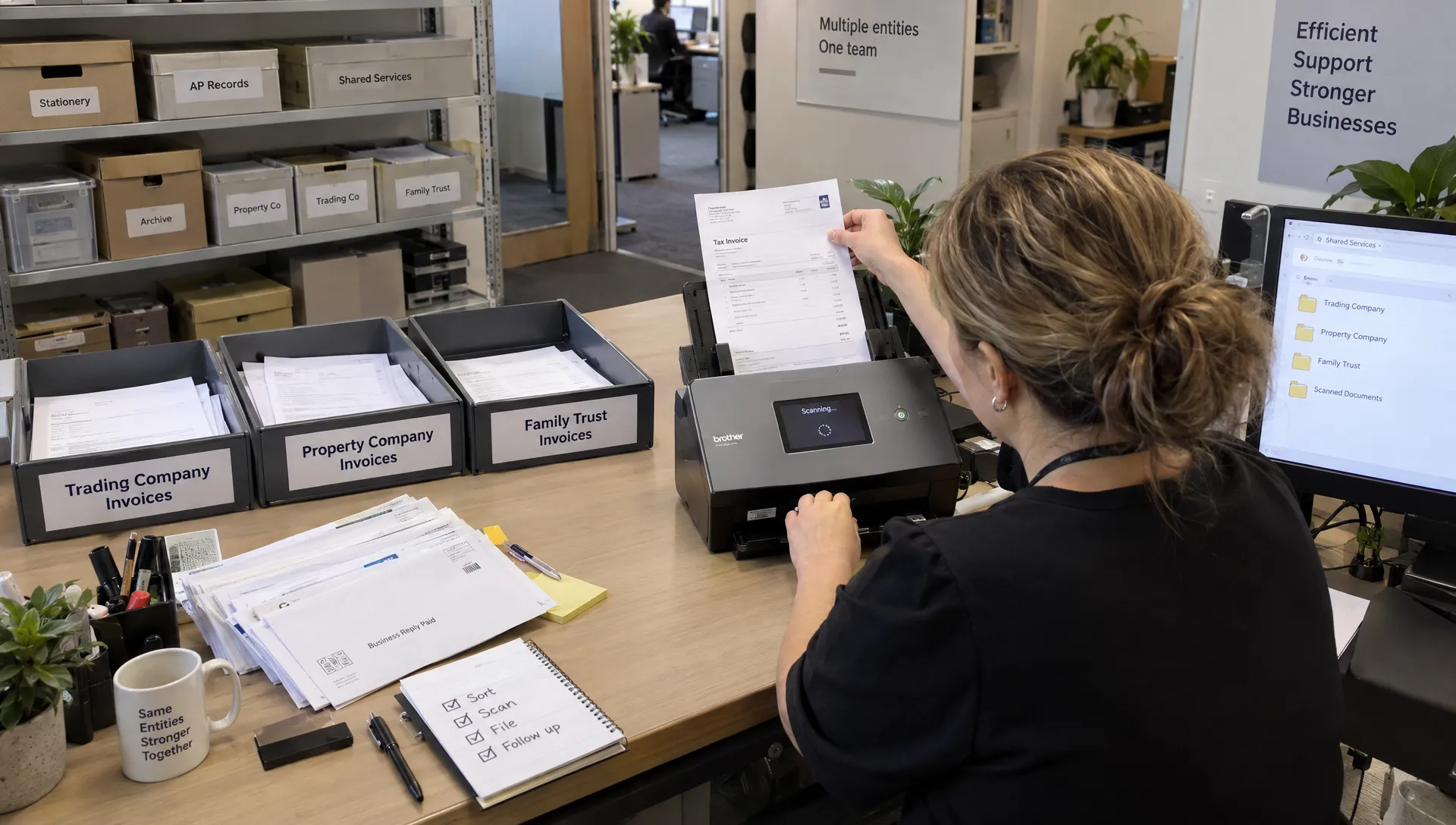
A profitable operating company can still face a cash shortage when funds move between related entities without clear documentation. We see this risk in groups combining trading businesses, property holdings, family trusts and investment companies. Coordinated tax services and bookkeeping help us establish which entity owns the cash, carries the liability and must meet each reporting obligation.
We approach a multi-entity group as a connected financial system, while preserving the legal and tax boundaries between its members. The objective is not simply to lodge several returns. We need reliable entity-level records, defensible related-party transactions and a group-wide view that supports funding, investment and corporate growth.
For business owners, directors and high-net-worth families, this distinction matters. A combined profit figure can conceal an underfunded employer, an undocumented shareholder loan or a trust distribution requiring attention. We build the reporting framework around those risks before using automation to accelerate the workflow.
How we coordinate tax services and bookkeeping across a group
We work at two levels: each entity’s individual obligations and the group’s overall financial position. Neither level can replace the other.
At entity level, we establish accurate transaction records, reconciled balances and the relevant tax treatment. At group level, we examine how money, assets and services move between entities. This allows us to identify duplicated income, mismatched intercompany balances and liabilities that disappear from view when reports are combined incorrectly.
We also distinguish ownership from access. A director may control several bank accounts, but that does not make the funds interchangeable. A property company paying an operating company’s expenses needs an appropriate accounting treatment and supporting explanation.
Our coordinated tax services and bookkeeping connect these records to a shared reporting timetable, so directors can assess performance without losing sight of individual obligations.
We recommend a monthly management close for active groups, with additional reviews around significant transactions. The timetable should identify who prepares reconciliations, approves adjustments and resolves outstanding tax questions.
Establish an entity register and consistent accounting structure
Map responsibilities before changing the software
We begin with a current structure chart and entity register. Ownership percentages, trustees and beneficiaries matter, but operational responsibilities also need to be visible.
| Register component | What we document | Why it matters |
|---|---|---|
| Legal identity | Entity name, type, ownership and trustee relationships | Identifies the party responsible for transactions |
| Tax registrations | Relevant ABN, TFN, GST and PAYG registrations | Supports correct reporting and authorised access |
| Banking and finance | Bank accounts, facilities, guarantees and security arrangements | Clarifies cash ownership and funding exposure |
| Operational role | Employer, property owner, service provider or investment holder | Helps allocate income, costs and obligations |
| Reporting responsibilities | Preparers, reviewers and applicable deadlines | Reduces gaps between entities and advisers |
We keep sensitive identifiers within appropriately controlled records rather than circulating them in unsecured spreadsheets. The register should also distinguish an entity acting in its own capacity from a company acting as trustee.
Standardise reporting without mixing ownership
We align account categories across the group so revenue, overheads and financing costs can be compared consistently. However, we preserve separate ledgers and records for each relevant entity.
Consistent tax services and bookkeeping make it easier to compare operating performance while retaining the detail needed for each return, BAS and supporting workpaper.
We also establish a shared approach to project codes, document references and accounting periods. Standardisation reduces manual rework, but it should not force different activities into identical tax treatments. Commercial rent, trading revenue and investment income may need different handling even when they appear together in management reporting.
Control intercompany transactions before they accumulate
We treat intercompany accounts as active control accounts, not places to park transactions until year-end. Each material balance should have an identified counterparty, commercial purpose and supporting documentation.
For a loan, we examine the lender, borrower, terms, interest treatment and repayment expectations. For a management fee, we establish what services were supplied, how the charge was calculated and whether the GST treatment is appropriate. Expense allocations require a defensible basis rather than an arbitrary percentage selected to move profit.
We then reconcile both sides. If one entity records a receivable of $180,000 and the other records a payable of $165,000, we investigate the difference before relying on either balance. Timing, missing invoices and incorrect entity coding can all contribute.
Our tax services and bookkeeping review also considers whether private company payments, loans or debt forgiveness could trigger Division 7A consequences for shareholders or associates.
We assess the facts, available exceptions and relevant deadlines rather than assuming every related-party balance receives the same treatment. We refer to the Australian Taxation Office for administrative guidance alongside the applicable legislation.
Where company and trust arrangements interact, our approach to complex tax matters helps explain why specialist review should precede adjustments or restructuring.
Distinguish management reporting from tax grouping
A combined report does not create a tax group
We can prepare combined management reports to show the economic performance of related businesses. When doing so, we identify internal transactions and eliminate relevant intercompany income, expenses and balances to avoid double counting.
Those reporting adjustments do not change the underlying legal transactions. They also do not automatically allow one entity to use another entity’s tax losses or cash.
We distinguish internal management reporting from any statutory financial reporting requirements. The appropriate reporting framework depends on the entities involved and their obligations.
GST grouping and income tax consolidation are different
We assess GST grouping separately from income tax consolidation. An eligible GST group generally uses a representative member for group GST reporting, and supplies between members are generally excluded from GST under the grouping rules, subject to applicable exceptions.
For tax services and bookkeeping, we preserve the records needed to support each entity even when a group arrangement changes how particular obligations are reported.
Income tax consolidation is a different regime. An eligible wholly owned group with an Australian-resident company as head company may elect to consolidate for income tax purposes. Eligibility, joining calculations, losses and the allocation of tax liabilities require detailed assessment.
We do not recommend either arrangement simply because entities share an owner. Administrative savings must be weighed against liability exposure, compliance costs and the consequences of entities joining or leaving the group.
Review trusts, employment obligations and asset-holding entities
Trust decisions need timely, supportable records
We review trust distributions against the deed, beneficiary circumstances and applicable tax requirements. Trustee decisions must be made within the relevant timeframe, with records supporting the actual entitlement created.
Where a corporate beneficiary is involved, we examine unpaid entitlements and connected funding arrangements on their specific facts. We also consider whether arrangements involving a beneficiary’s entitlement could raise section 100A reimbursement agreement concerns.
Our review is not limited to the accounting entry. We need to understand who receives the economic benefit and how the arrangement operates in practice. We coordinate legal input where trust deeds or transaction documents require interpretation or amendment.
Employment costs can create cross-entity exposure
We use tax services and bookkeeping to connect payroll records with the correct employer, PAYG withholding, Single Touch Payroll reporting, Superannuation and potential FBT obligations.
Payroll tax requires a separate state or territory analysis. Related businesses may be grouped under applicable payroll tax rules even when wages are paid through different entities. Grouping provisions and exclusions need jurisdiction-specific review, as outlined through the national payroll tax information portal.
We also examine staff-sharing arrangements and wage reimbursements rather than assuming the entity processing payroll bears every associated obligation.
For groups containing an SMSF, we maintain strict separation between fund assets and business funds. Related-party investments, leases and transactions require their own assessment, including relevant superannuation restrictions and arm’s-length requirements.
Use AI-driven automation with entity-specific controls
We use AI-driven automation to streamline financial workflows, but speed only creates value when the underlying structure is sound. Automating an incorrect entity allocation can reproduce the same error across hundreds of transactions.
We assess where invoice extraction, transaction classification and rules-based processing can reduce manual work. We then define the exceptions that require accounting judgement, including related-party payments, unusual GST treatments and transactions involving trusts or private benefits.
Our control framework includes clear entity identification, approval responsibilities and a traceable record of adjustments. We retain human review for significant or ambiguous items rather than treating an AI suggestion as a final tax conclusion.
Well-designed tax services and bookkeeping can provide faster processing, greater accuracy and more current financial visibility when automation is supported by reconciliations and review.
We describe visibility as near-real-time only where the underlying feeds, document capture and approvals support it. An unreconciled bank feed is not a reliable financial position.
For national groups, we apply a consistent workflow across Adelaide, Sydney and Melbourne while accommodating relevant state obligations. This helps us maintain an integrated financial view without assuming that every jurisdiction has identical rules.

Turn reliable records into strategic advisory
We use the completed monthly close to answer commercial questions that annual returns alone cannot resolve. Which entity generates cash? Where is capital tied up? Can the proposed investment be funded without compromising tax payments, employee obligations or lending conditions?
We prepare entity-level cash forecasts alongside a group view. This prevents an aggregate cash balance from suggesting that funds are freely available when they belong to a different entity or are subject to restrictions.
For example, we would not treat cash held by a property company as immediately available to its related trading company. We first assess the legal basis for any transfer, financing terms, tax consequences and the effect on both entities.
Reliable tax services and bookkeeping give our strategic advisory work a defensible starting point for decisions about expansion, debt reduction and capital allocation.
We can then assess proposed changes before implementation, including acquisitions, asset transfers and new operating entities. Restructuring may involve CGT, GST, transfer duty or other costs, so we do not assume that moving an asset within a family group is tax-neutral.
Our approach to bookkeeping-led cash flow control supports this work by connecting current records with expected receipts, payments and funding needs.
Frequently asked questions
Does every entity need separate bookkeeping? We generally maintain separate records for each entity’s transactions, assets and liabilities. Shared software can support this structure, but a combined management report does not replace the records required for individual legal and tax obligations.
Can one entity pay another entity’s expenses? We first establish the commercial reason and correct accounting treatment. The payment may create an intercompany balance or require a recharge, with potential GST and other tax consequences. We do not assume common ownership makes the payment neutral.
Can group companies automatically share tax losses? We do not treat common ownership as sufficient. Income tax consolidation has specific eligibility and election requirements, and losses remain subject to relevant rules. Outside applicable arrangements, we assess each entity’s position separately.
Can automation replace the group’s accountant? We use automation to reduce repetitive processing and surface exceptions. Coordinated tax services and bookkeeping still require professional judgement for related-party dealings, trust arrangements, tax elections and strategic decisions.
Can we coordinate entities operating in several states? We support clients across Australia, including integrated service capabilities in Adelaide, Sydney and Melbourne. We combine consistent accounting processes with reviews of relevant state obligations, particularly payroll tax and transaction-related duties.
Next steps: establish a group-wide financial review
We recommend beginning with the structure and balances already in place, rather than purchasing more software before identifying the control gaps.
For an initial review, we ask clients to prepare:
- A current entity structure chart, including ownership and trustee relationships.
- Recent financial reports, intercompany reconciliations and loan documentation.
- Tax registrations, lodgement status and outstanding ATO or state revenue matters.
- Banking facilities, guarantees and plans for investment, restructuring or expansion.
We use this information to prioritise risks, establish a reporting timetable and identify where automation can remove duplicated work. Urgent compliance matters come first, followed by improvements that strengthen cash visibility and decision-making.
At Perfect Accounting & Tax Services, we bring 25 years of professional experience to tax services and bookkeeping, supported by AI-driven workflow improvement and strategic advisory.
Contact our team for a consultation to review your multi-entity structure, discuss automated accounting workflows and establish a clearer basis for funding and corporate growth.