
When business owners search for “tax accountants in my area”, we recommend looking beyond location to how an adviser reviews import transactions. GST on imported goods can affect working capital, inventory costs and BAS accuracy well before the annual tax return is prepared.
We approach import GST as a reconciliation between commercial arrangements, Australian Border Force records and the accounting ledger. An overseas supplier invoice alone rarely tells the whole story. Our review also considers who imported the goods, how customs calculated GST and whether the business can claim a corresponding credit.
At Perfect Accounting & Tax Services, we combine 25 years of professional experience with AI-assisted processes to support that review. Across Adelaide, Sydney and Melbourne, our integrated services connect transaction-level compliance with cash-flow planning and strategic advisory. We focus on establishing a defensible GST position, then using reliable financial information to support corporate growth.
How we help businesses searching for tax accountants in my area
Our first task is to establish which entity made the importation. This becomes particularly important where a group has separate trading, asset-holding and procurement entities.
Establishing the importer and credit entitlement
We compare the purchase agreement, supplier invoice and import declaration with the entity’s ABN and GST registration. We also establish whether a customs broker acted as an agent and which business imported the goods for its own purposes.
Paying a freight forwarder’s invoice does not, by itself, establish entitlement to an import GST credit. We assess the underlying importation rather than assuming that the payer or consignee is necessarily entitled.
We then examine whether the goods support a creditable business purpose. Private use and use connected with making input-taxed supplies can restrict credits. Registration, documentation and attribution requirements also need to be satisfied.
For directors comparing “tax accountants in my area”, we recommend making entity identification an explicit part of the engagement. A credit recorded against the wrong group company can create both a BAS error and misleading intercompany balances.
Recalculating GST using the customs assessment
We do not simply apply 10% to the overseas supplier invoice. For a taxable importation, GST is generally calculated on the value of the taxable importation, which can include more than the goods themselves.
What enters the calculation
As explained in the Australian Border Force guidance on GST and other import taxes, the calculation generally includes customs value, customs duty and relevant international transport and insurance costs. Wine equalisation tax is included where applicable.
We check the amounts included under customs rules, including transport and insurance to the relevant place of consignment in Australia. We do not add every logistics charge indiscriminately.
For an illustrative shipment of ordinary taxable business stock, with no wine equalisation tax or other adjustments, our calculation could be:
| Component | Illustrative amount |
|---|---|
| Customs value | A$100,000 |
| Customs duty, assumed for this example | A$5,000 |
| Relevant international freight and insurance | A$8,000 |
| Value of the taxable importation | A$113,000 |
| Import GST at 10% | A$11,300 |
The assumed duty is not a general tariff rate. Actual duty depends on classification, origin and applicable concessions.
We encourage businesses searching for “tax accountants in my area” to ask whether their adviser reconciles this calculation to the import declaration, rather than estimating credits from supplier payments.
Matching import records to the ledger and BAS
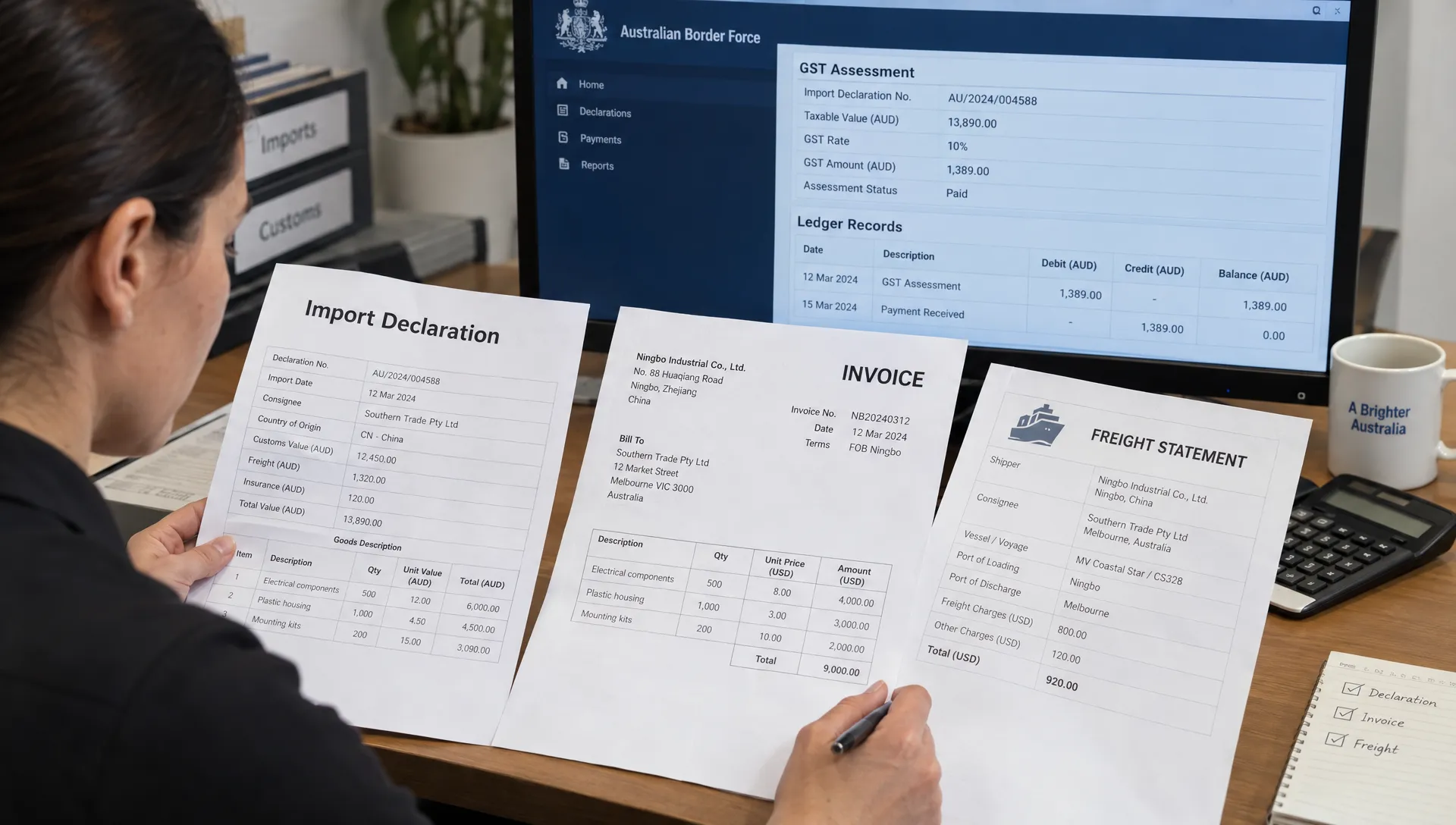
Our next step is to trace the assessed GST into the accounts. Freight forwarder statements can combine customs duty, import GST, transport charges and brokerage fees, each requiring separate treatment.
We distinguish import GST paid through a broker from GST charged on the broker’s own taxable services. We also check whether the accounts contain both a broker invoice and a separate customs entry for the same import GST.
Our core evidence usually includes:
- The overseas supplier invoice and purchase terms.
- The import declaration and customs GST assessment.
- The broker’s disbursement statement and supporting invoices.
- Evidence of payment, or relevant deferred GST records.
- The ledger entries and BAS treatment for the shipment.
We reconcile foreign-currency purchases separately from the Australian-dollar customs assessment. Exchange differences do not automatically mean the customs GST is incorrect.
For businesses reviewing “tax accountants in my area”, we regard this document trail as a practical test of review quality. We need to explain each credit, identify duplicates and support the reporting period selected. Import documentation supports the import GST claim; we do not expect an overseas supplier invoice to function as an Australian tax invoice for that amount.
Reviewing deferred GST and credit timing
Import GST can create a working-capital gap when a business pays GST at the border before recovering an eligible credit through its BAS.
The ATO’s deferred GST scheme can change that timing for approved businesses. Eligibility conditions include monthly GST reporting and electronic lodgement and payment requirements. We assess suitability rather than treating deferral as an automatic entitlement.
Deferral is not an exemption
Under the scheme, deferred import GST is reported at label 7A on the BAS. An eligible GST credit is claimed at label 1B. Where the business has full credit entitlement and the amounts fall in the same period, the corresponding entries can offset each other.
We still reconcile the deferred amount against import records. Restricted credit entitlement, incorrect entity details or missing transactions can prevent a straightforward offset.
When assessing “tax accountants in my area”, we suggest asking how the adviser distinguishes border-paid GST from deferred GST. For border-paid imports, the relevant payment and attribution rules matter; we do not determine the credit period solely from the overseas supplier’s invoice date.
Identifying transactions that need separate treatment
We avoid applying one GST rule to every overseas purchase. Shipment value, delivery arrangements and the nature of the acquisition can change the review.
Low-value goods and supplier-charged GST
For consignments generally valued at A$1,000 or less, GST is usually not collected at the border, subject to exceptions including alcohol and tobacco. GST may instead be collected by an overseas seller or platform under the low-value imported goods rules.
We check the purchaser’s registration details and business-use declarations. Where a seller has incorrectly charged GST under consumer rules, we seek correction rather than automatically treating the amount as a recoverable credit.
Delivered-duty-paid arrangements and exempt imports
Delivered-duty-paid terms can mean the overseas seller manages import clearance. We examine the contract and customs records before deciding whether our client made a creditable importation. A commercial reimbursement does not necessarily transfer GST credit entitlement.
We also check whether an importation is non-taxable under the relevant rules. A purchase should not be coded as taxable merely because it came from overseas.
Overseas services and digital purchases
Software, subscriptions and offshore professional services require a different analysis from physical goods. Reverse-charge rules may apply in certain circumstances, particularly where an acquisition is not wholly creditable.
For businesses searching for “tax accountants in my area”, we recommend separating these categories before the BAS review begins. A generic “overseas purchases” account can conceal materially different GST treatments.
Using automation without removing professional judgement
Our AI-assisted approach supports document extraction, transaction matching and exception identification. We structure automated workflows to compare shipment references, entity details and recorded GST amounts, helping our team investigate inconsistencies faster.
Automation can flag a duplicate reference or an unexpected GST amount. It cannot independently establish the legal importer or determine whether goods support input-taxed activities. We retain professional review over those conclusions.
We also separate processing status from tax approval. A document being captured successfully does not mean its GST treatment has been approved. Our approach to automated GST checks during business tax preparation explains how automation and professional review work together.
For directors comparing “tax accountants in my area”, we recommend asking how unresolved exceptions are handled, not just how quickly invoices are processed. A controlled workflow improves accuracy and speed while providing more timely financial visibility. That visibility becomes useful when assessing stock purchases, funding requirements and supplier terms.
Frequently asked questions
Can we claim import GST without an Australian supplier tax invoice? We assess the import documentation supporting the credit. For a creditable importation, the customs records are central; an overseas supplier does not need to issue an Australian tax invoice for GST assessed at the border.
Can we recover all GST paid on imported business assets? We first check registration, importer identity and business use. Private use or use connected with input-taxed supplies can restrict entitlement, even where the business paid the full customs assessment.
Does deferred GST eliminate the tax? We treat it as a timing mechanism, not an exemption. The deferred liability must be reported, and any corresponding credit requires its own entitlement assessment.
Do we need a separate accountant in every state? We support clients across Australia through integrated services in Adelaide, Sydney and Melbourne. Federal import GST rules remain consistent, while our broader review considers the business’s entity structure and other relevant obligations.
Next steps: connect import GST with financial strategy
We recommend starting with one recent shipment and tracing it from purchase order through customs clearance to the BAS. For businesses searching for “tax accountants in my area”, this gives us a concrete starting point for identifying missing records, incorrect coding or cash-flow pressure.
For an initial consultation, we suggest bringing the supplier invoice, import declaration, broker statement and relevant BAS. We can then discuss the importer’s position, credit entitlement and whether deferred GST warrants further assessment.
Our objective extends beyond correcting a return. Reliable import accounting helps us distinguish recoverable GST from inventory costs and assess the funding tied up between shipment, sale and collection. We connect that foundation with tax and cash-flow planning to support better commercial decisions.
Contact Perfect Accounting & Tax Services to arrange a consultation about import GST or learn how our automated accounting workflows can support your business.