
Our business tax return services approach an R&D claim as an evidence-led tax position, not a reward for spending money on innovation. We connect the technical work, eligible expenditure and company tax return so the claim can withstand scrutiny and support informed funding decisions.
At Perfect Accounting & Tax Services, we bring 25 years of professional experience to this process. Our focus extends beyond lodgement: we assess how the R&D Tax Incentive affects cash flow, financial reporting and the resources available for corporate growth.
What an Australian R&D claim must establish
We separate three questions before calculating any potential benefit: whether the company is eligible, whether its activities qualify and whether the expenditure satisfies the tax rules. A strong answer to one does not establish the others.
The incentive has two administrators. The Department of Industry, Science and Resources, through AusIndustry, administers activity registration and assesses activity eligibility. The ATO administers the tax offset and expenditure rules. We align the technical narrative with the financial schedules rather than treating them as independent submissions.
As the Australian Government’s R&D Tax Incentive guidance explains, registration and tax eligibility involve distinct requirements. Registration alone does not establish that every activity or dollar claimed qualifies. Equally, an accounting expense labelled “research” is not automatically eligible expenditure.
How our business tax return services assess eligibility
We begin with the claiming entity. The incentive generally applies to eligible companies, not sole traders, partnerships or trusts simply because they undertake innovative work. Incorporation, tax residency and the arrangements under which the company conducts the research require review.
Next, we examine the technical uncertainty. Core R&D activities must involve experimental work whose outcome cannot be known or determined in advance using available knowledge, information or experience. They must follow a systematic progression from hypothesis through experiment, observation and evaluation to logical conclusions, with the purpose of generating new knowledge.
Routine software configuration, ordinary product customisation and commercial uncertainty do not establish technical eligibility. An unsuccessful experiment may qualify, but we still need evidence of the required experimental process.
We also check the expenditure threshold. Generally, at least $20,000 of eligible notional deductions is required, subject to exceptions such as qualifying expenditure with registered Research Service Providers and certain cooperative research centre contributions. Overseas activities require separate consideration, including any necessary findings and their application deadlines.
Building evidence around the actual experiments
Within our business tax return services, we connect each proposed activity to contemporaneous records. A polished year-end description cannot reliably replace evidence of what the technical team actually investigated.
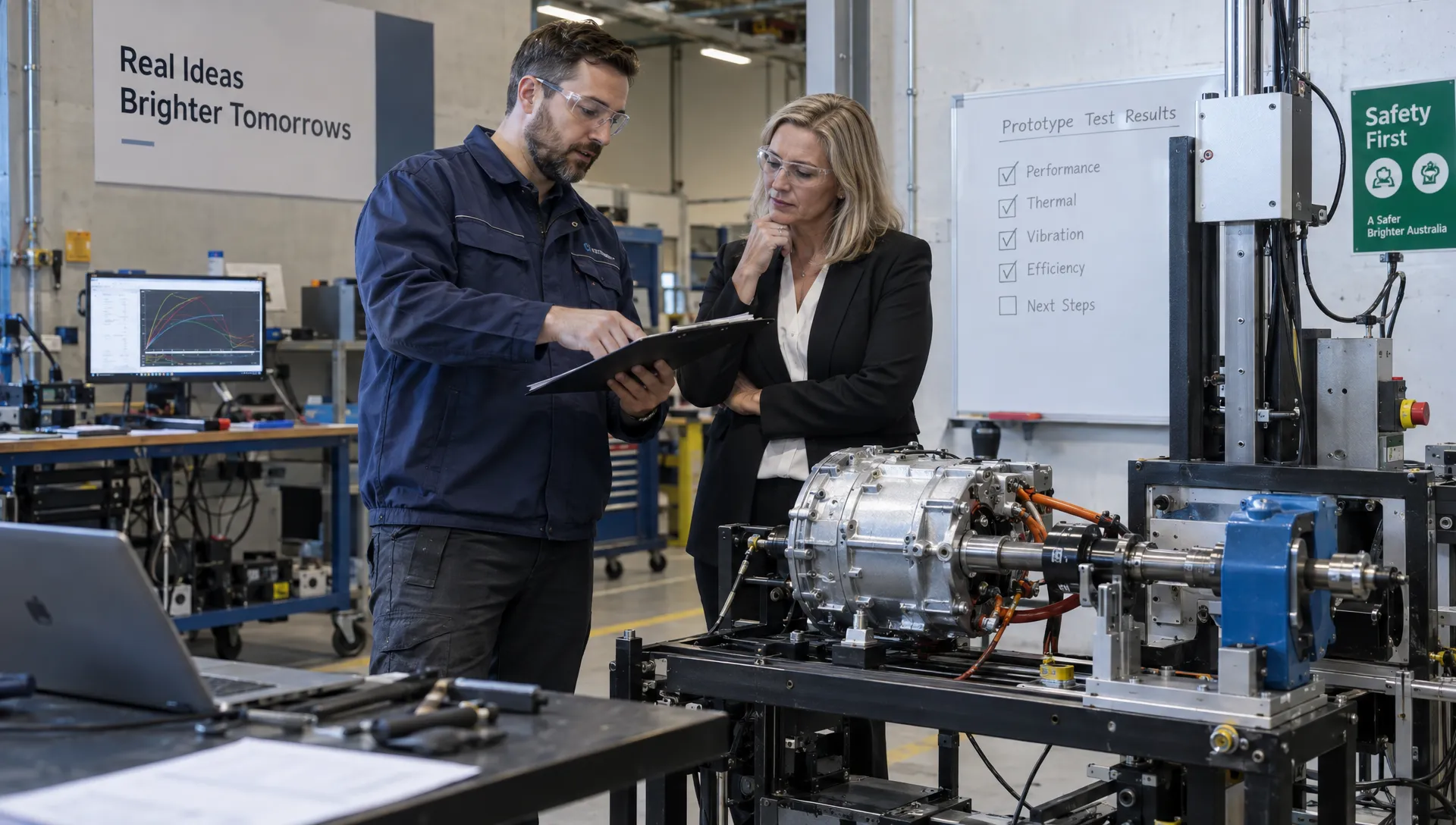
We look for a defined knowledge gap, the hypothesis tested and the method used to evaluate it. Test plans, development records, laboratory notes, version histories and results can substantiate the sequence. Failed trials can be relevant where they document a genuine experiment rather than ordinary troubleshooting.
For example, we would distinguish a software team testing an unresolved technical constraint from one implementing established functionality. The commercial objective might be similar, but the eligibility analysis is different.
We also separate core activities from supporting activities. Supporting work must be directly related to core R&D, and additional dominant-purpose requirements apply in certain circumstances, including some production-related activities.
Our preferred evidence structure is straightforward:
- Activity record: The technical uncertainty, hypothesis, experiment and findings.
- People record: Who performed the work, when it occurred and the basis for allocating their time.
- Cost record: The payroll, supplier or asset evidence supporting each expenditure category.
- Review record: The eligibility decisions, exclusions and approvals supporting the final claim.
This structure gives directors a clearer basis for approving the claim and responding to later questions.
Reconciling R&D expenditure to the accounts
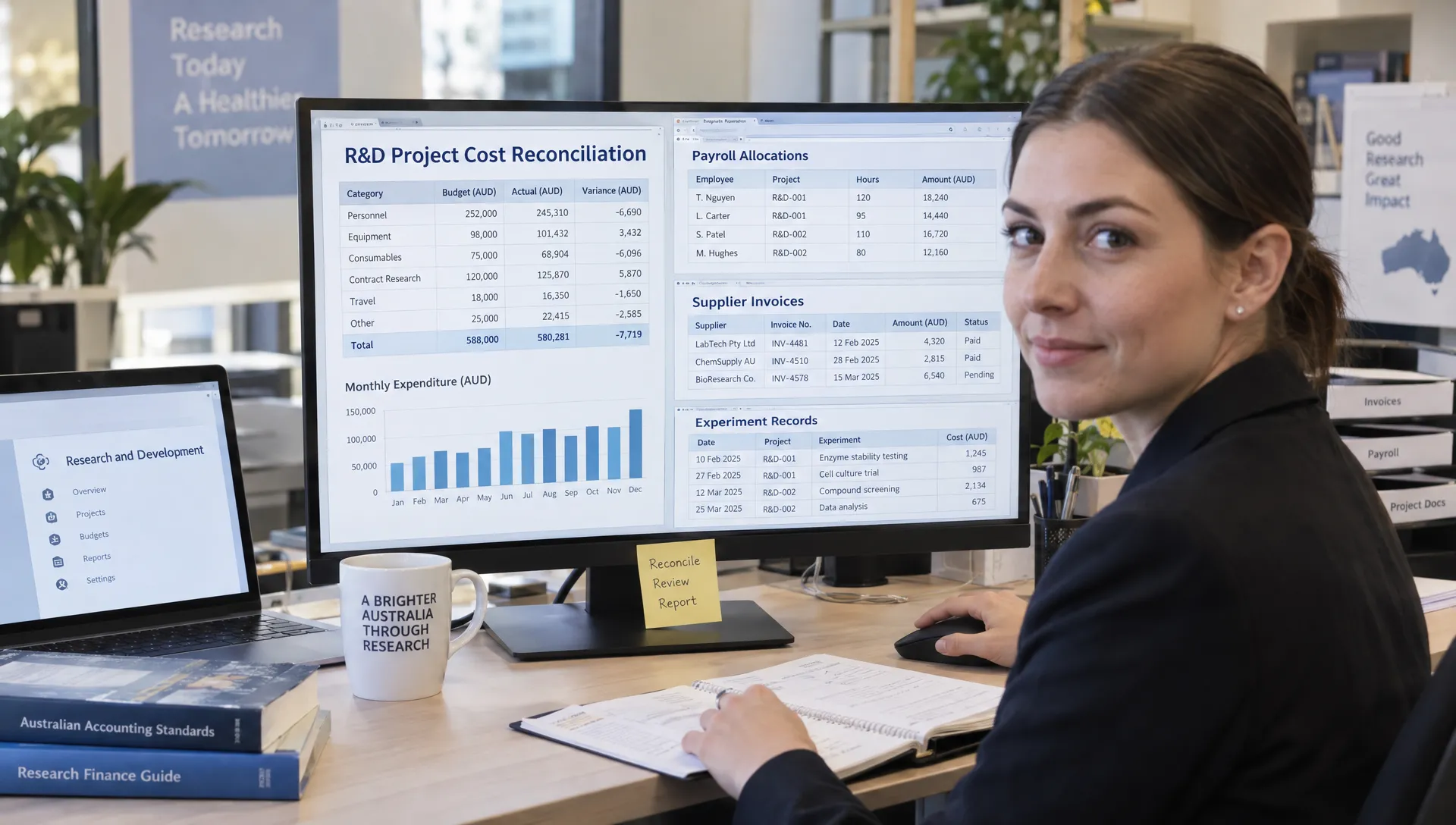
Our business tax return services reconcile the claim schedule to the general ledger, payroll records and supporting documents. We do not apply a broad percentage to a development budget without examining the underlying activities and allocation method.
| Expenditure category | What we assess before inclusion |
|---|---|
| Employee costs | Eligible activities performed, time allocation and the treatment of relevant employment costs |
| Contractor costs | Work performed, contractual rights, financial risk and whether the company conducts the R&D on its own behalf |
| Materials and consumables | Connection to eligible experiments, with feedstock adjustments considered where relevant |
| Equipment | Eligible decline in value rather than automatically claiming the full purchase price |
| Shared overheads | A reasonable, documented connection and apportionment to eligible R&D activities |
Recoverable GST is excluded from the expenditure base. We also review related-party arrangements: expenditure incurred to associates generally needs to be paid before it can be claimed under the incentive.
Grants, reimbursements and sales of products arising from experimental work can affect the calculation. We assess those adjustments rather than assuming that all funding sources can be combined without consequences.
These reconciliations also strengthen the broader accounts. Consistency between the claim, payroll, BAS records and company return helps reduce the company tax return errors that attract ATO attention.
Calculating the offset without overstating the benefit
When estimating the outcome, our business tax return services distinguish the headline offset from the additional tax benefit and the eventual cash position. We verify the rules applicable to the relevant income year before finalising the calculation.
For eligible companies with aggregated turnover below $20 million, the refundable offset is generally the company tax rate plus 18.5 percentage points. Refundability is subject to eligibility conditions, including restrictions involving control by income-tax-exempt entities. Aggregated turnover can include connected entities and affiliates, not just the claiming company’s revenue.
For companies with aggregated turnover of $20 million or more, the non-refundable offset uses R&D intensity tiers. The premium is generally 8.5 percentage points for expenditure within the 2% intensity threshold and 16.5 percentage points above it. Other limits and adjustments can also apply.
An illustrative calculation
We can illustrate the distinction using $100,000 of eligible expenditure and a company entitled to the 25% tax rate, assuming the refundable-offset conditions are met.
| Measure | Illustrative amount |
|---|---|
| Eligible R&D expenditure | $100,000 |
| Offset rate | 43.5% |
| Calculated R&D offset | $43,500 |
| Tax value of a fully usable ordinary deduction at 25% | $25,000 |
| Additional benefit compared with that deduction | $18,500 |
This comparison excludes grant, feedstock and other adjustments. We also make the necessary tax adjustments so the company does not retain both an ordinary deduction and the full offset for the same expenditure.
The $43,500 is not automatically a cash refund. The company’s tax liability, other tax positions and amounts owed to the ATO affect the final result.
Coordinating registration and company return deadlines
The annual timetable is another area where our business tax return services connect technical and financial work. R&D registration is generally required within 10 months after the end of the company’s income year.
For a standard income year ending 30 June 2026, the normal registration deadline is 30 April 2027. A different accounting period changes that calculation. Company tax return lodgement dates are separate, and a tax agent’s return lodgement arrangements do not automatically extend the R&D registration deadline.
We sequence registration and return preparation so the required registration details are available before claiming the offset. Any request for additional time needs separate assessment; we do not build the project timetable around an assumed extension.
Before lodgement, we reconcile the registered activities, expenditure schedule, R&D tax incentive schedule and company return. Material differences between the technical description and the claimed costs need resolution, not a last-minute explanatory note.
We also clarify responsibilities early. Directors and technical leaders remain essential sources of factual evidence, while our role is to coordinate the tax analysis and financial substantiation. Where specialist technical input is needed, we identify that requirement before it becomes a deadline problem.
Using AI and automation without outsourcing judgement
We integrate AI-driven automation into our business tax return services to reduce manual processing and improve the timeliness of financial information. Better source data supports faster reconciliation, more consistent treatment and earlier identification of missing records.
For R&D work, we recommend project codes that distinguish experimental activities from routine development and commercial delivery. Regular time recording and consistent supplier coding make the year-end allocation more reliable. Where the underlying systems support frequent updates, this also improves near-real-time visibility over project expenditure.
Automation does not determine whether an activity satisfies the legislation. We retain professional review over eligibility, allocation methods and tax adjustments. AI-generated explanations must never invent hypotheses, test results or technical uncertainty that the business did not document.
Data handling requires equal attention. Technical records can contain valuable intellectual property, so we consider access controls, confidentiality and the suitability of any system used to process them.
This approach turns bookkeeping into a foundation for strategic advisory. Accurate project costs help management compare budgets with actual expenditure, assess future funding needs and recognise when commercial delivery is consuming resources originally assigned to experimentation.
Connecting the claim to funding and corporate growth
We use the findings from our business tax return services to inform forward planning, rather than treating the offset as an isolated annual receipt. That includes assessing the expected benefit, likely timing and the consequences if expenditure is reduced or excluded.
A funding forecast should not depend on the earliest possible refund date. We assess cash runway against operational commitments, including payroll, Superannuation and supplier payments, with a separate scenario for a delayed or smaller benefit.
We also distinguish accounting treatment from tax treatment. Capitalising development costs in the financial statements does not, by itself, establish R&D tax eligibility. Conversely, expensing a cost does not automatically exclude it.
For businesses operating across several states, our integrated support in Adelaide, Sydney and Melbourne helps connect local operations with a consistent national tax position. This reflects our broader approach to tax services that support business growth: reliable compliance should improve management decisions, not merely complete a filing obligation.
Frequently asked questions
Can a company claim R&D for software development? We assess the specific activities, not the industry label. Software work may qualify where it meets the experimental requirements and relevant exclusions do not apply. Routine coding, integration and feature development are not automatically eligible.
Does registration mean the claim has been approved? We do not treat registration as approval of every activity or expenditure item. Our business tax return services retain the supporting analysis because activity eligibility and expenditure can still be reviewed by the relevant administrators.
Can an unsuccessful project qualify? We assess whether eligible experiments occurred, not whether the project achieved commercial success. Evidence of the hypothesis, testing and evaluation remains necessary when the outcome is negative.
Can the claim be prepared entirely after year-end? We can assess available historical records, but contemporaneous evidence provides a stronger foundation. Reconstructing staff time or technical reasoning months later creates uncertainty and may leave expenditure unsupported.
Next steps: review the claim before committing the cash
We recommend starting with the project descriptions, company structure, funding agreements and current financial records. From there, we can identify eligibility questions, evidence gaps and the work needed before registration and lodgement.
We support businesses across Australia through our integrated capabilities in Adelaide, Sydney and Melbourne. Contact Perfect Accounting & Tax Services to arrange a consultation about R&D claim preparation, strategic tax planning or automated accounting workflows that make the next claim easier to substantiate.