
An SMSF pension review should establish more than whether payments appear in the accounts. Through our professional tax services, we examine whether each pension was validly established, minimum payments were met, tax exemptions are supportable and reporting matches the fund’s records. We then connect those findings with retirement cash flow and the member’s broader financial position.
For business owners, directors and high-net-worth individuals, this matters because an apparently minor processing error can affect the tax treatment of substantial retirement assets.
How our professional tax services review SMSF pensions
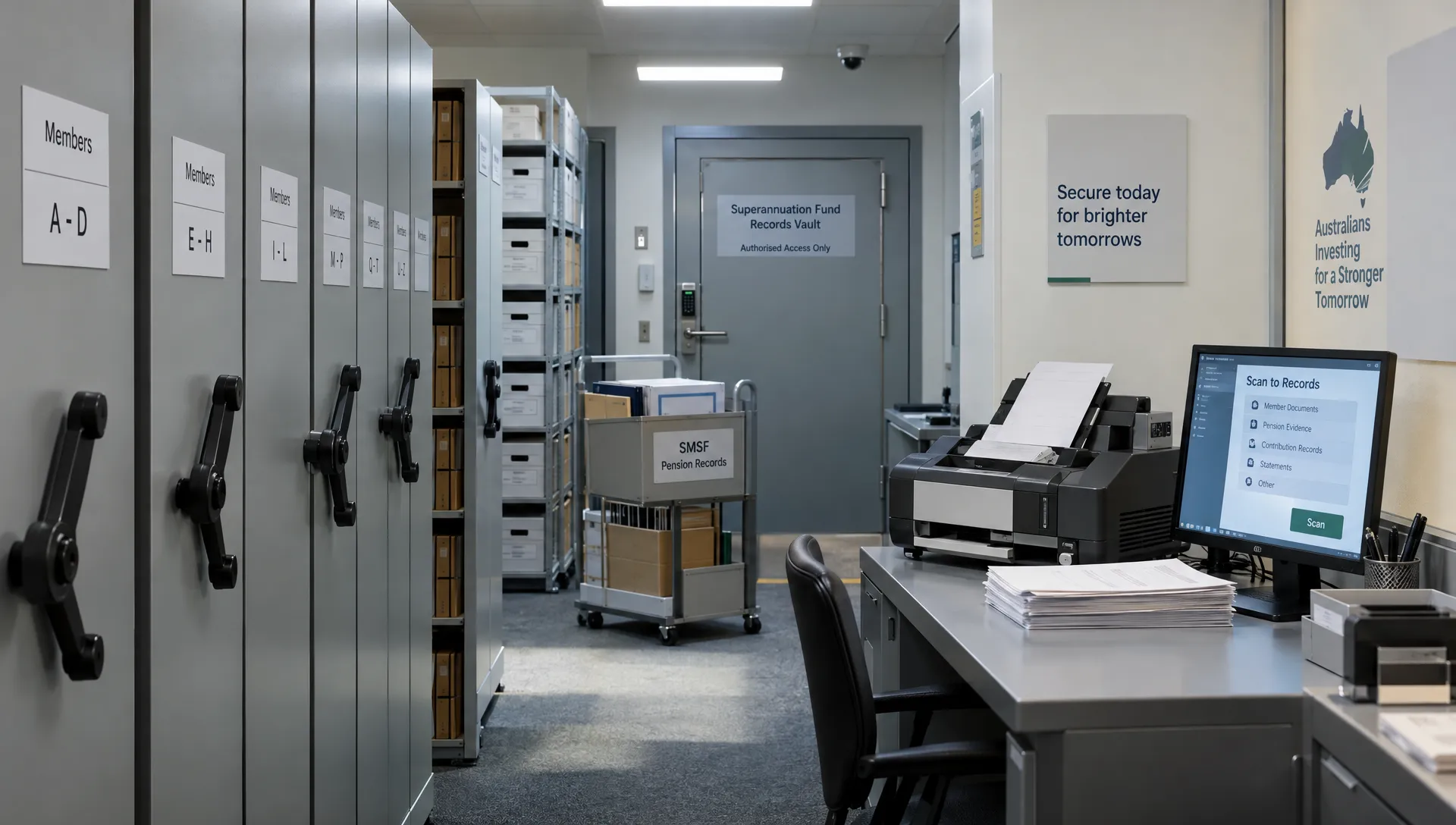
We begin by identifying every income stream, its commencement date and its governing documents. Most reviews involve account-based pensions, but transition-to-retirement income streams and death benefit pensions require different treatment.
Our starting records usually include:
- The trust deed, pension commencement documents and trustee resolutions.
- Member balances, tax components and supporting asset valuations.
- Bank statements, pension payment records and commutation instructions.
- Previous financial statements, SMSF annual returns and transfer balance account reports.
- Relevant death benefit nominations, reversionary provisions and actuarial certificates.
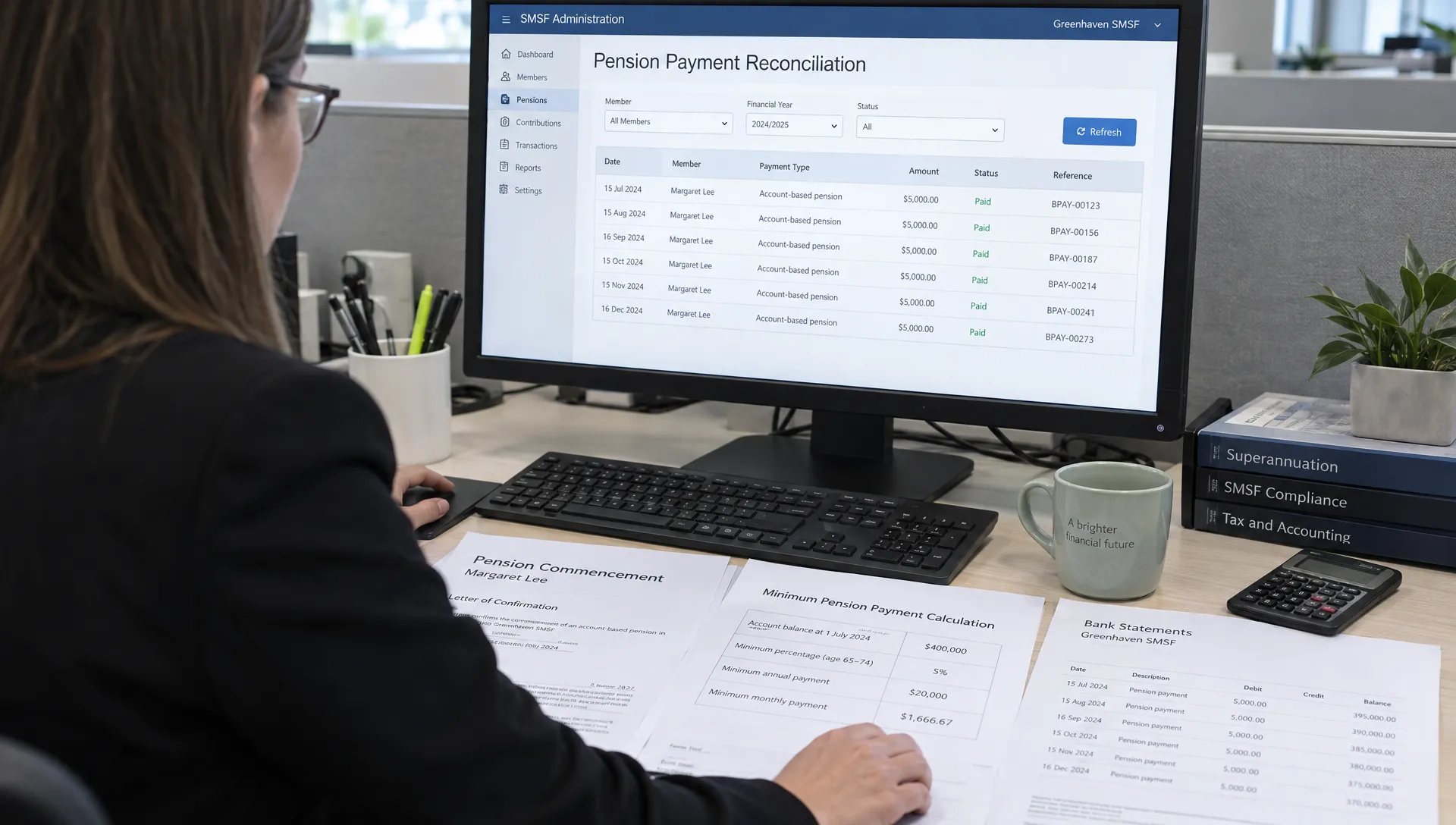
We reconcile these documents rather than assuming the accounting software tells the complete story. A payment labelled “pension” does not establish that a valid pension exists. Equally, an ATO account balance does not replace the fund’s underlying evidence.
We confirm eligibility and commencement
Our professional tax services review whether the member satisfied an appropriate condition of release when the pension commenced. Reaching preservation age alone does not necessarily provide unrestricted access to superannuation. Turning 65 generally does, while retirement-related conditions require examination of the member’s circumstances.
We also check that the opening pension balance reflects appropriate market values and that the pension’s terms are consistent with the deed and applicable standards.
Contributions cannot simply be added to an existing account-based pension. We examine whether subsequent amounts remained in accumulation phase or whether a separately documented pension commencement or restructuring occurred.
For a transition-to-retirement income stream, we assess the separate payment restrictions, including the generally applicable annual maximum of 10%. We also establish whether and when it entered retirement phase, because that affects the fund’s entitlement to exempt pension income.
We test minimum pension payments against actual cash movements
For ordinary account-based pensions, the minimum annual payment generally depends on the member’s age and the pension account balance at 1 July. Different calculations apply in the commencement year.
We check the relevant financial year against the ATO’s superannuation rates and thresholds, rather than carrying forward a percentage from an earlier year.
| Member’s age | Standard annual minimum percentage |
|---|---|
| Under 65 | 4% |
| 65 to 74 | 5% |
| 75 to 79 | 6% |
| 80 to 84 | 7% |
| 85 to 89 | 9% |
| 90 to 94 | 11% |
| 95 or older | 14% |
These are standard rates before any applicable pro-rating or legislative adjustment. We use the relevant age at 1 July or, for a new pension, at commencement.
We separate pension payments from commutations
Our professional tax services distinguish ordinary pension payments from lump-sum commutations because the distinction changes both minimum-payment testing and transfer balance reporting.
For example, assume a member aged 67 has a pension balance of $1 million at 1 July. The standard annual minimum is $50,000. If the fund pays $30,000 as pension payments and $20,000 under a valid partial commutation, the commutation does not count towards the pension minimum. The pension payments remain $20,000 short.
We trace payments to completed transactions, not merely journal entries or unsigned instructions. If a shortfall exists, we assess the consequences promptly. Failure to meet the standards can put the pension’s associated tax exemption at risk for the relevant year. Limited ATO administrative concessions may apply, but we do not assume a later top-up automatically fixes the problem.
We reconcile transfer balance caps and event reporting
Our professional tax services assess the member’s personal transfer balance cap separately from the pension’s current market value. The general cap and an individual’s personal cap are not necessarily identical, particularly where a member has already used part of their entitlement before indexation.
Investment growth within an existing retirement-phase pension does not, by itself, use additional transfer balance cap space. Conversely, ordinary pension payments generally do not create fresh cap space. A valid commutation can have a different outcome.
We reconcile commencement values, commutations and other reportable events against the member’s ATO transfer balance account, allowing for information from other superannuation funds.
All SMSFs are generally subject to quarterly transfer balance account reporting, with reportable events due within 28 days after the quarter ends. We distinguish that obligation from the annual SMSF return. Lodging one does not discharge the other.
Where an error appears, we establish whether the underlying transaction, fund accounting or previous report needs correction. Changing a report cannot retrospectively create a transaction that never occurred.
We substantiate exempt current pension income
Our professional tax services review exempt current pension income, or ECPI, as a calculation supported by evidence, not an automatic benefit attached to the word “pension”.
We first establish when each income stream was in retirement phase and whether the relevant pension standards were met. We then consider the appropriate method for calculating the exemption, including whether an actuarial certificate is required. We also assess restrictions on using the segregated method where relevant.
For funds holding both accumulation and retirement-phase interests, timing matters. A contribution, pension commencement or commutation can affect the calculation and the records needed to support it.
Expense treatment also requires attention. We assess the allocation of deductible expenditure between exempt and assessable income and examine capital gains tax consequences where assets have been sold.
We keep the fund’s tax position separate from the member’s personal tax position. Benefits from a taxed source received after age 60 are generally tax-free to the member, but that does not establish the fund’s ECPI entitlement. Non-arm’s length income and expenditure issues also require separate analysis and cannot be assumed away because a fund pays pensions.
We use automation to identify exceptions, not replace judgement
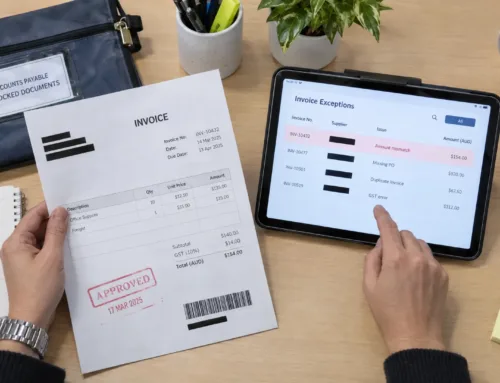
We combine AI-driven workflow automation with professional review to improve processing speed and consistency. Where digital records are available, automated checks can help identify missing transactions, duplicate entries and payments that differ from their expected pattern.
Within our professional tax services, these checks support earlier identification of pension shortfalls and reporting discrepancies. Their value depends on reliable source data and a clear review process. Automation cannot establish that a member genuinely retired or that a trustee validly authorised a commutation.
We therefore distinguish transaction processing from technical approval. Bank feeds and accounting records can support more current financial visibility, while our team validates classifications, legal documents and tax treatment. Missing feeds or unreconciled accounts must remain visible as limitations.
We also treat TFNs, identity documents and member information as sensitive. Digital transformation should improve control, not encourage trustees to place confidential records into unapproved public AI tools.
We connect pension compliance with retirement cash flow
A technically compliant pension can still create liquidity pressure. A fund holding commercial property may have substantial assets but insufficient cash when minimum payments, property expenses and loan commitments fall due.
Our professional tax services therefore consider payment timing alongside the fund’s cash resources. We model the effect of scheduled pensions, expected income, tax liabilities and foreseeable expenditure. This helps trustees identify pressure before an urgent asset sale becomes the only practical option.
Where the SMSF leases business premises to a related entity, we also examine whether rental arrangements and transactions remain appropriately documented and on arm’s length terms. Pension funding needs do not justify non-commercial dealings between the fund and the operating business.
This is where reliable compliance records become a foundation for strategic advisory. We connect retirement withdrawals with business cash requirements, succession planning and corporate growth decisions, while keeping the SMSF’s sole-purpose obligations separate from the company’s interests.
We distinguish tax and accounting analysis from regulated financial product advice. Where a proposed pension, investment or insurance decision requires licensed advice, we coordinate with an appropriately authorised adviser.
We review death benefits and document the required action
Our professional tax services also examine whether pension arrangements remain workable following a member’s death. We review reversionary provisions, beneficiary eligibility and the interaction between the deed, pension terms and any death benefit nomination.
Superannuation-law dependency and tax-law dependency are not interchangeable. That distinction can affect who may receive a pension and how a death benefit is taxed.
A reversionary pension can also create transfer balance consequences with timing rules that differ from an ordinary pension commencement. We assess the applicable event and reporting date rather than applying a generic template.
We conclude the wider review with a prioritised action record. It identifies the issue, supporting evidence, potential tax or reporting consequence, responsible person and required completion date. We separate urgent payment or reporting matters from longer-term planning opportunities.
For trustees seeking ongoing administration and compliance support, our SMSF accounting services provide the broader context for maintaining the fund’s records. We also coordinate with the independent SMSF auditor without treating our review as a substitute for the statutory audit.
Frequently asked questions
Does an SMSF pension review replace the annual audit? No. We review accounting, tax treatment and supporting records, while the independent approved SMSF auditor performs the statutory audit. We use the review to identify issues earlier and improve the evidence available for that audit.
Can we correct a missed minimum payment after 30 June? We first establish the facts and assess whether an ATO concession is available. Our professional tax services do not treat a late payment as an automatic cure. Depending on the circumstances, the failure can affect the pension’s tax treatment for the earlier year.
Does every SMSF pension need an actuarial certificate? No. We determine whether one is required by examining the fund’s interests, pension periods and applicable ECPI calculation method. We do not assume that every fund paying pensions needs a certificate or that every pension-only fund is exempt from that requirement.
Can pension withdrawals fund business expenditure? Once benefits are lawfully paid to a member, their subsequent use requires separate consideration. We distinguish that situation from the SMSF directly providing financial assistance to a member or related party, which can breach superannuation rules. Business funding arrangements need their own tax and legal assessment.
Next steps: arrange a coordinated pension review
We recommend assembling pension commencement documents, current member balances, bank records and previous transfer balance reports before the next review. Where payments or records are incomplete, we prioritise investigation rather than waiting for annual return preparation.
With 25 years of professional experience, we support clients across Australia through integrated service capabilities in Adelaide, Sydney and Melbourne. Our approach combines technical review, AI-driven workflow automation and strategic advisory to strengthen financial health.
Contact our team for a consultation to discuss an SMSF pension review or learn how our automated accounting workflows can improve the accuracy, speed and visibility of the review process.