

We see the greatest value from CPA tax advice when an Australian business is still deciding how to enter an overseas market, not after the first foreign tax notice arrives. An offshore employee, a distribution agreement or a new subsidiary can change where profits are taxed and how cash moves through the group. Our starting point is commercial: we assess whether the proposed expansion remains attractive after tax, compliance costs and working-capital demands are included.
Start before the expansion creates a tax presence
We recommend a cross-border review before binding commitments are made. Incorporation is only one trigger. Negotiating contracts through an overseas representative or relocating a founder can create questions before a foreign company exists.
We prioritise four decisions:
- Market entry: Which entity will contract with customers and bear commercial risk?
- People: Who will work overseas, under whose direction and with what authority?
- Assets: Where will intellectual property, inventory and equipment sit?
- Funding: How will the operation receive capital and return cash to Australia?
We also distinguish professional accounting qualifications from tax-agent registration. CPA is a professional designation, not a separate tax regime. Where paid Australian tax agent services are required, we recommend checking the adviser through the Tax Practitioners Board public register.
Our objective is to identify decisions that become expensive to reverse, then resolve them before contracts, staffing and systems make the structure difficult to change.
Use CPA tax advice to compare operating models
We compare entry structures against the actual operating plan. The lowest headline company tax rate rarely identifies the strongest commercial option.
| Operating model | Commercial use | Tax questions we assess |
|---|---|---|
| Australian entity sells directly overseas | Testing demand without establishing a separate company | Whether activities create a taxable presence, withholding obligations or local indirect-tax registration |
| Overseas branch | Operating abroad through the existing Australian legal entity | Profit attribution, Australian treatment of branch income and access to relevant exemptions |
| Overseas subsidiary | Building a separate local operation with its own contracts and liabilities | Corporate residence, related-party pricing, distributions and Australian controlled foreign company rules |
| Independent distributor | Accessing a market through an external business | Contract terms, genuine independence, inventory ownership and any agency-related tax exposure |
We model establishment costs, recurring compliance, available losses, cash repatriation and a possible exit. A subsidiary may support local investment but introduce additional reporting and governance. Direct selling may be operationally lighter without eliminating foreign tax obligations.
We also separate legal liability from tax treatment. A branch does not ordinarily create the same legal separation as a subsidiary. We recommend legal input alongside the tax analysis, particularly where product liability, substantial contracts or external investors are involved.
Test residence and permanent establishment separately
We use CPA tax advice to distinguish two questions: where an entity is tax resident and whether it has a taxable business presence elsewhere. These questions interact but are not interchangeable.
For corporate residence, we examine incorporation, actual management decisions and the applicable domestic and treaty rules. An overseas registration address alone does not settle the outcome. Board minutes should reflect genuine decision-making rather than attempt to manufacture it.
For permanent establishment exposure, we examine premises, personnel, contracting authority and the nature and duration of activities. A local office or certain dependent-agent arrangements can be relevant. The applicable treaty matters, and we do not assume a universal time threshold protects every business.
We check the relevant agreement through the Treasury’s Australian income tax treaty collection, then assess the facts against its provisions. Treaty protection is not automatic and may depend on residence, income type and eligibility requirements.
We also distinguish income-tax exposure from registration duties. Payroll or indirect-tax obligations can arise even where the business concludes that it has no permanent establishment. Our review therefore extends beyond whether foreign corporate income tax is payable.
Establish related-party pricing before transactions begin
We treat CPA tax advice as part of the operating design when an Australian business will trade with an overseas subsidiary or another related entity. Intercompany invoices need more support than a convenient margin selected at year-end.
We examine which entity performs the work, uses the assets and controls the relevant risks. That analysis informs pricing for management services, product sales, intellectual property licences and financing. Australian transfer pricing rules require an arm’s-length analysis where applicable. We use the ATO’s international tax guidance as a starting point for the Australian obligations.
Our recommended documentation includes agreements, pricing methodology and evidence that services or benefits were actually provided. We also assess whether international dealings disclosures or other reporting requirements apply, rather than assuming every group has identical obligations.
We review withholding tax separately. Interest, royalties and some other payments can produce different outcomes from ordinary trading receipts. The payer’s jurisdiction, treaty terms, beneficial ownership and payment character all matter.
Before a contract is signed, we recommend resolving whether its price is gross or net of withholding and who bears any additional cost. Otherwise, a commercially acceptable margin can shrink when the first payment arrives.
Model double taxation, retained profits and funding
We build CPA tax advice into the cash-flow forecast because accounting profit and available Australian cash can diverge substantially. A foreign tax payment does not necessarily produce an immediate, matching Australian tax benefit.
Australian tax residents are generally assessed on worldwide income, subject to relevant exemptions and other rules. We assess foreign income tax offset eligibility, limits and timing rather than assuming every overseas tax dollar is fully recoverable. Different income years or inconsistent treatment of the same receipt can create a cash-flow gap.
For overseas subsidiaries, we consider controlled foreign company rules where relevant. Certain income can be attributed to Australian taxpayers before a dividend is paid. Conversely, particular foreign branch income or foreign equity distributions may qualify for exemptions if the statutory conditions are met.
We then test equity against debt funding. Interest deductions can be affected by transfer pricing, thin capitalisation and debt deduction creation rules where applicable. Foreign exchange movements can also change taxable outcomes and the Australian-dollar cost of servicing debt.
Our approach to tax planning that improves cash flow treats these items as forecast inputs. We want the expansion funded for its actual tax-payment profile, not merely its expected operating expenses.
Include GST and people costs in the business case
Export sales require transaction-level analysis
We include indirect taxes in a CPA tax review because an overseas customer does not automatically make every supply GST-free. Exported goods and services have different requirements, and services can require analysis of the recipient, use and connection with Australia.
We recommend retaining evidence supporting the GST treatment and configuring transaction codes accordingly. Australian BAS reporting must remain consistent with the underlying records. Separately, foreign VAT, GST or sales-tax registration may arise under the destination jurisdiction’s rules, requiring local advice.
Overseas work changes more than payroll location
We assess PAYG withholding, Superannuation and FBT implications where employees work internationally, alongside destination-country payroll requirements. Social security agreements and certificates of coverage may be relevant in some locations, but we do not assume Australian super contributions resolve every overseas obligation.
We also review employee-versus-contractor classification and the authority held by overseas personnel. Calling a salesperson a contractor does not, by itself, settle employment status or permanent establishment exposure.
For relocating founders and high-net-worth owners, we recommend a separate personal residency and capital gains tax assessment. Citizenship, visa status and the number of travel days alone do not provide a complete answer. We include remuneration, distributions and ownership arrangements in that review.
Build reporting that supports decisions across borders
We get more value from CPA tax advice when the underlying financial records distinguish entities, jurisdictions and transaction types. A single undifferentiated overseas income account makes both compliance and commercial analysis harder.
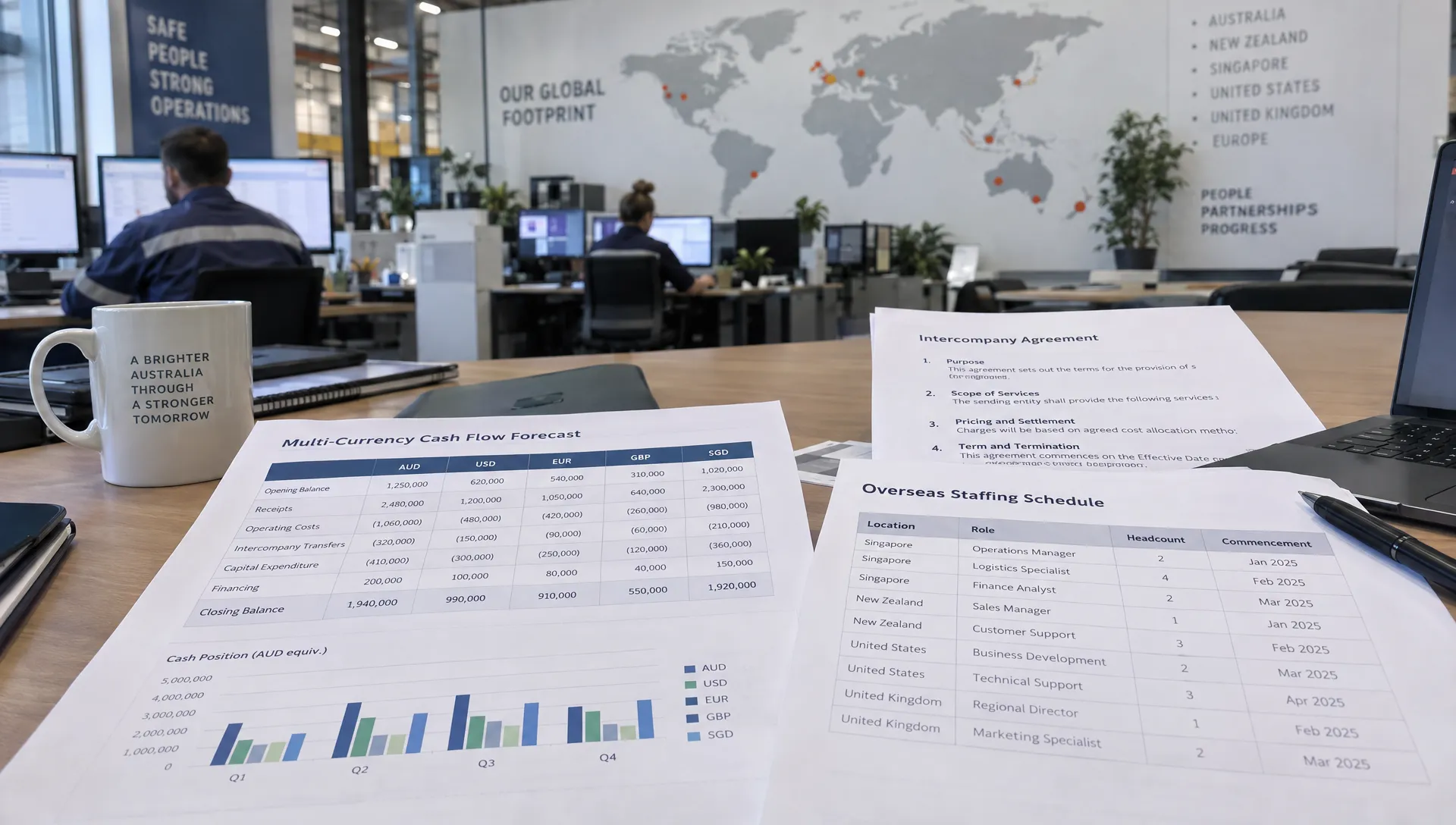
Our AI-driven processes streamline accounting workflows and support faster review, greater accuracy and more current financial visibility. For a cross-border operation, we recommend configuring those workflows around entity-level records, consistent account mapping and clear approval responsibilities. Automation can help identify unusual transactions or coding inconsistencies, while our team reviews exceptions and tax-sensitive judgements.
We do not treat AI output as a substitute for determining residence, interpreting a treaty or establishing an arm’s-length price. Those decisions require facts, documentation and professional review. Near-real-time visibility also depends on timely source data and reliable reconciliations.
We recommend a monthly close that reconciles intercompany balances, identifies withholding deductions and translates foreign-currency results consistently. Management reporting should distinguish local operating performance from exchange-rate effects and one-off establishment costs.
This turns bookkeeping and compliance into a foundation for strategic advisory. We can assess whether the expansion is generating cash, consuming capital or requiring a change in pricing before the annual tax return is prepared. We also preserve records that support future due diligence if investors or acquirers enter the picture.
Pressure-test the plan before committing capital
We can illustrate the value of CPA tax advice with a hypothetical Australian software company entering a new overseas market. Its initial plan is to sell through the Australian company, engage a local salesperson and establish a subsidiary once revenue grows.
We would first examine the salesperson’s actual role. Lead generation creates a different factual position from negotiating key terms or exercising authority to conclude contracts. We would obtain relevant local advice before treating the proposed arrangement as a low-compliance market test.
Next, we would compare direct selling with establishing the subsidiary earlier. Our model would include employment costs, indirect taxes, professional fees and the cost of moving customers or contracts into a different entity later. If intellectual property is to be transferred or licensed, we would assess that transaction separately.
We would then test three commercial cases: slower customer acquisition, delayed collections and stronger-than-expected growth. Each can change the timing of funding and the preferred operating structure.
The decision may still be to start small. The strategic benefit is that the board understands which activities are permitted under the initial model, what developments require another review and how much cash the expansion needs before becoming self-funding.
Frequently asked questions
What does CPA tax advice cover during overseas expansion? We use the term to describe tax advice from a suitably qualified accountant, with relevant registration where required. For expansion, we focus on structure, residence, permanent establishment, related-party transactions, indirect taxes and cash repatriation. Professional designation alone does not establish international tax expertise.
Does an Australian business need an overseas subsidiary before selling internationally? We do not assume a subsidiary is necessary. Direct exports, a distributor or a branch may suit the commercial plan. We assess local registration and tax obligations separately because they can arise without incorporation.
Will a tax treaty prevent the same profit being taxed twice? We assess the particular treaty and domestic relief provisions. Treaties allocate taxing rights and provide mechanisms for relief, but differences in timing, characterisation or profit allocation can still create problems. Foreign income tax offsets also have conditions and limits.
Can accounting automation handle cross-border compliance on its own? We use automation to improve processing and visibility, not to replace jurisdiction-specific advice. Reliable results require appropriate configuration, reconciled records and professional review. We recommend obtaining destination-country advice where foreign obligations are involved.
Next steps: turn the expansion plan into a financial decision
We recommend bringing the proposed operating model, draft contracts, ownership structure, staffing plan and a 12-month forecast to an initial consultation. We can then identify which decisions need CPA tax input before commitments are made and which can be managed through ongoing reporting.
Our team brings 25 years of experience to Australian accounting, tax planning and strategic advisory. We support clients across Australia through integrated services in Adelaide, Sydney and Melbourne. Where an expansion involves foreign law, we recommend coordinating the Australian analysis with appropriately qualified advisers in the destination jurisdiction.
Through our virtual CFO and advisory services, we connect tax obligations with funding, performance reporting and corporate growth. Our aim is a structure the business can operate, monitor and adapt, not simply lodge returns for.
Contact Perfect Accounting & Tax Services to arrange a consultation about cross-border expansion or to explore automated accounting workflows that support clearer financial decisions.
We provide this article as general information, not advice tailored to a particular structure, transaction or destination country.