

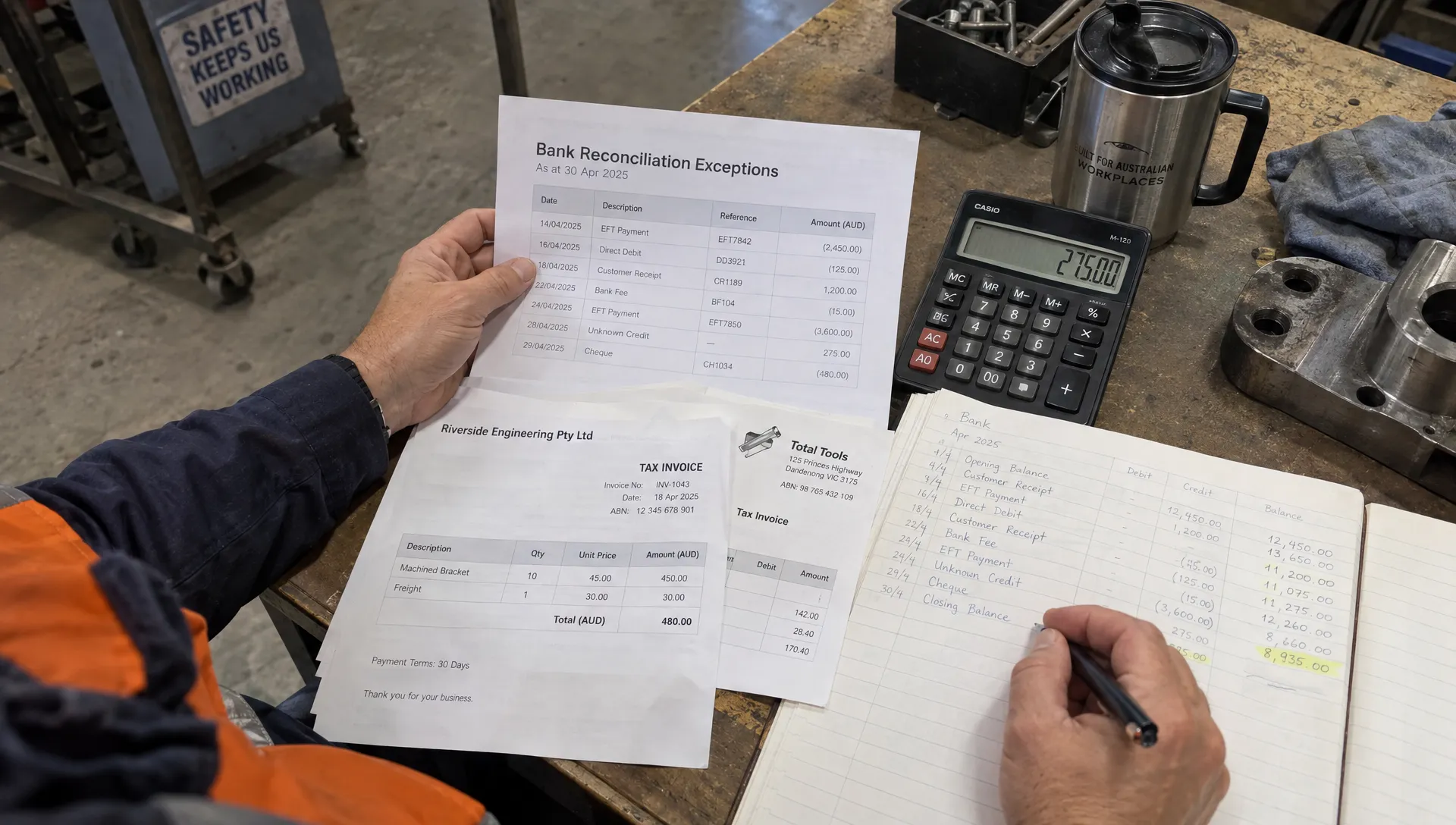
When we assess a bookkeeping services company for AI risk, we look beyond faster transaction processing. We examine what the technology can access, which decisions it can make and who remains accountable when an automated entry is wrong. For Australian business owners and directors, the real test is whether automation strengthens financial control without creating hidden tax, privacy or payment risks.
Our approach treats accurate bookkeeping as the foundation for strategic advisory and corporate growth. AI should improve processing speed, consistency and financial visibility. Those benefits only become commercially useful when we can trust the underlying records and understand their limitations.
We assess the decision, not just the software
AI-assisted bookkeeping covers very different activities. Extracting an invoice date is not equivalent to determining GST treatment, changing supplier banking details or releasing payroll. We assess each workflow according to its financial consequences and the opportunity for human intervention.
| Workflow | Main risk we investigate | Evidence we request |
|---|---|---|
| Invoice capture and coding | Incorrect amounts, entities or classifications | Source documents, validation results and correction history |
| Bank reconciliation | False matches or unresolved differences concealed by automation | Reconciliation reports and exception queues |
| GST and BAS preparation | Unsupported credits or incorrect tax treatment | Tax-code rules, supporting documents and reviewer sign-off |
| Payroll processing | Incorrect employee settings, superannuation or payment amounts | Change approvals and payroll review records |
| Supplier maintenance and payments | Fraudulent bank changes or unauthorised payments | Independent verification and approval controls |
We also distinguish deterministic rules from AI-generated recommendations. A fixed matching rule and a language model interpreting an unfamiliar invoice require different testing. A description such as “AI-powered” tells us little about either control quality or financial accuracy.
Our bookkeeping services company assessment covers six controls
We request evidence against six control areas before recommending wider automation. Demonstrations help us understand a workflow, but configuration records, completed reconciliations and documented approvals show whether controls operate in practice.
1. We verify Australian registration and accountability
We first establish the legal entity providing the service, the individuals supervising the work and the scope of their responsibilities. Professional membership can support our assessment, but it does not replace statutory registration where registration is required.
Where a bookkeeping services company provides BAS services for a fee, we check the applicable registration requirements and verify the relevant registration through the Tax Practitioners Board public register. We match the registered entity to the engagement and examine any listed conditions. We also distinguish BAS services from broader tax advice requiring appropriate tax-agent oversight.
For international comparisons, AICountant.tech’s UAE AI-assisted bookkeeping service describes automated capture, categorisation and reconciliation combined with accountant review. That is a useful service-model comparison, not evidence of Australian compliance capability. UAE VAT and Corporate Tax experience does not establish competence in Australian GST, BAS, payroll or FBT.
Our evidence request includes the engagement scope, supervisory responsibilities and relevant professional indemnity cover. We want a named person accountable for resolving exceptions, rather than an assumption that either the software vendor or an overseas processing team will take responsibility.
2. We trace where financial information travels
A cloud accounting platform may connect to document capture software, an AI provider, an integration service and an outsourced processing team. We map that chain rather than assessing only the familiar accounting brand at its centre.
We ask a bookkeeping services company to identify what information each participant receives, where processing occurs and how long information remains available. Hosting location alone is insufficient if support personnel or subprocessors can access records elsewhere.
Our review covers whether client information can be used for model training, whether that use can be disabled contractually and how deletion works across connected systems. We also examine controls over bank details, identity documents, payroll information and TFNs, including applicable TFN-specific requirements.
Where the Privacy Act applies, we assess relevant obligations under the Australian Privacy Principles, particularly cross-border disclosure and information security. We do not assume an overseas transfer is automatically prohibited or that every small business has identical privacy obligations.
Our broader approach to accounting data security and AI governance provides context. For supplier selection, however, we require evidence of actual settings, access arrangements and contractual commitments, not a privacy-policy link alone.
3. We test accounting outcomes against source evidence
We assess AI outputs using transactions with known, professionally reviewed outcomes. A clean demonstration invoice cannot establish how a system handles mixed-purpose expenditure, supplier credits or transactions involving several entities.
For a bookkeeping services company, our test set includes duplicate invoices, missing tax invoices, foreign-currency purchases, private-use components and payments that should remain unresolved until further information arrives. We include shareholder or director transactions because incorrect classifications can distort both reporting and subsequent tax work.
We assess three separate outcomes: whether the system identifies the document correctly, whether the proposed accounting treatment is appropriate and whether uncertainty reaches a reviewer. A correct amount posted to the wrong entity is still a failure.
We also check how invoice text is treated. Documents and emails are untrusted inputs. Wording inside an attachment must not override approval rules, redirect payments or change system instructions.
An AI confidence score is not our accuracy measure. We compare outputs with source evidence and record the nature of each error. A low-value coding correction and an unsupported GST credit have different consequences, so a single headline accuracy percentage can conceal material weaknesses.
4. We separate preparation from approval
Automated preparation can improve turnaround without granting unrestricted authority. We examine access rights separately for document capture, journal posting, supplier maintenance, payroll preparation and payment release.
Our assessment of a bookkeeping services company becomes more demanding as transaction permissions increase. Read-only access to bank feeds presents a different exposure from the ability to amend payee details or initiate transfers.
We look for named accounts, multifactor authentication, least-privilege access and prompt removal of departing staff. Shared credentials weaken accountability because we cannot reliably establish who approved a change.
For sensitive actions, we expect independent verification. A supplier bank-detail amendment should be confirmed through a trusted contact channel, not solely through the email requesting the change. Payroll changes and unusual journals also need approval arrangements proportionate to their consequences.
We ask how the process works in a small business where full segregation of duties is difficult. Compensating controls might include director approval, independent monthly review or bank-level restrictions. We then test whether those arrangements are workable during leave, staff turnover and urgent payment periods.
The objective is controlled delegation. We do not treat automatic payment authority as a necessary condition for useful AI adoption.
5. We examine exceptions, changes and audit trails
A workflow can pass an initial test and deteriorate after a software update, integration change or new transaction type. We therefore assess how changes are approved and how performance is monitored after implementation.
We ask the bookkeeping services company to demonstrate the path from an exception to its resolution. The record should show the original source, proposed treatment, reviewer decision and resulting ledger entry. Corrections should remain traceable rather than disappearing into an unexplained final balance.
We also examine whether approved accounting rules can change without review. A rule affecting GST treatment deserves tighter oversight than a change to an internal document label.
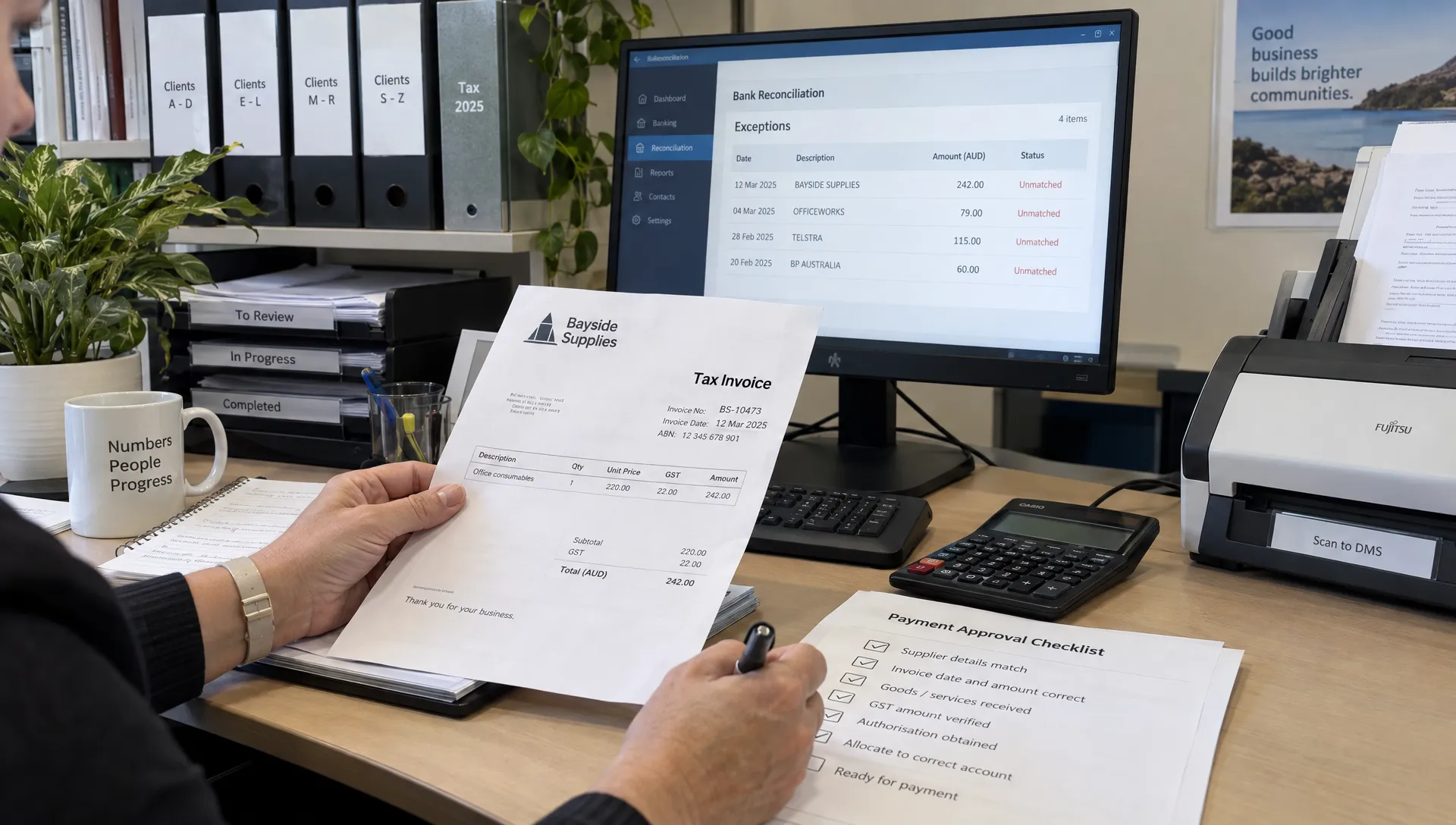
Exception reporting should reveal unresolved items and their age. A dashboard showing current bank feeds can create false confidence if reconciliations remain incomplete or suspense accounts continue growing. We distinguish data availability from completed accounting work.
Our monitoring measures include material errors, recurring corrections, outstanding exceptions and reconciliation delays. Where AI output contributes to management reporting, we also identify whether the figures are provisional or reviewed.
These controls support near-real-time visibility without presenting unfinished records as decision-ready financial information. We can then use reliable reporting for cash-flow planning, margin analysis and strategic advisory rather than spending each reporting cycle repairing unexplained differences.
6. We examine contractual responsibility and exit rights
We translate operational assurances into engagement terms. A proposal promising “fully automated bookkeeping” is incomplete unless it defines review responsibilities, exclusions, reporting frequency and escalation arrangements.
Our review covers responsibility for source-document collection, GST decisions, payroll changes, BAS preparation and lodgment. We also establish what happens when information arrives late or the business introduces a new entity, payment channel or transaction type.
We ask whether fees include exception investigation and corrections. A low processing fee can become expensive if difficult transactions sit outside scope and accumulate without resolution.
Exit arrangements matter equally. We establish ownership and administrative access to the accounting file, export availability, access to supporting documents and assistance with transferring the service. Statutory retention obligations must remain achievable after the engagement ends; deletion commitments need appropriate retention exceptions.
We also review incident notification and escalation terms. Contracts should identify contacts and responsibilities without suggesting that outsourcing transfers all directors’ obligations to the provider.
Finally, we distinguish routine financial reporting from strategic interpretation. Better records support growth decisions, but a bookkeeping engagement does not automatically include cash-flow forecasting, tax structuring or virtual CFO advice. We define those services explicitly.
We run a controlled pilot before expanding access
Before widening a bookkeeping services company’s AI permissions, we recommend a shadow-mode pilot. During this stage, automation prepares proposed outputs while the established approval process remains in place. We agree the sample, testing period and acceptance criteria before reviewing results.
We compare proposals with independently checked records and investigate discrepancies. Our sample includes ordinary transactions and deliberately selected edge cases, with sensitive information minimised where practical. We do not use live payment execution as a testing shortcut.
The pilot measures processing time saved, review effort, material errors and unresolved exceptions. Faster preparation is not a net improvement if correction work increases or month-end reconciliation becomes harder.
We then assess the reporting benefit. Our work on how bookkeeping improves cash-flow visibility explains why current reconciliations and reliable receivables matter more than a busy dashboard.
We retain a documented rollback process covering access revocation, automation suspension, outstanding-work identification and manual continuity. A pilot should demonstrate that the business can stop the workflow safely, not merely that the technology can start processing transactions.
We make the engagement decision using evidence
We use a simple assessment record to prevent strong presentation skills from outweighing weak controls. The following is a practical comparison framework, not a regulatory certification or an industry-mandated scoring standard.
| Decision | Evidence supporting our position |
|---|---|
| Proceed within agreed scope | Required registrations verified, controls demonstrated and pilot criteria met |
| Continue a restricted pilot | Gaps are understood, sensitive permissions remain disabled and remediation is assigned |
| Do not expand access | Material errors remain unexplained or accountability and data access are unclear |
| Decline or suspend the workflow | Required registration is absent, sensitive information use is undisclosed or payment controls can be bypassed |
We do not average away a critical failure. Strong reporting features cannot compensate for unauthorised payments or inappropriate disclosure of sensitive records.
Our final recommendation records the approved workflows, remaining restrictions, responsible reviewers and triggers for reassessment. Changes in ownership, integrations, subprocessors or transaction complexity can justify a fresh review.
Frequently asked questions
Does every bookkeeping services company using AI create the same risk? We assess risk by workflow, information sensitivity and authority. Document extraction with mandatory review generally creates a different exposure from autonomous posting, supplier maintenance or payment execution.
Can AI prepare BAS information without human review? We use automation to support capture, coding and exception detection. We retain appropriate professional review of GST treatment, source evidence and reconciliations before lodgment. Automation does not remove registration requirements where they apply.
Is Australian data hosting sufficient protection? We treat hosting location as one factor. We also examine overseas access, subprocessors, training permissions, retention arrangements and applicable privacy obligations.
Does this approach apply to in-house and virtual bookkeeping? We apply the same control principles to both. Outsourcing adds contractual and supplier dependencies, while an in-house team still requires access controls, competent review and monitored automation.
Next steps: discuss a controlled automation assessment
At Perfect Accounting & Tax Services, we bring 25 years of professional experience to accounting, tax and strategic advisory. Our integrated teams support businesses across Australia, including Adelaide, Sydney and Melbourne.
We combine AI-driven automation with professional oversight to improve accuracy, processing speed and timely financial visibility. Our starting point is an assessment of existing workflows, responsibilities and risks, not an assumption that every task should be automated.
Contact our team for a consultation to discuss our automated accounting workflows and how controlled bookkeeping can support stronger financial health and corporate growth.