


We fix a mistake on a lodged BAS by either revising the original statement or, where ATO rules allow, correcting it on a later BAS. When engaged as an accountant for tax filing, we first establish which tax is affected, when the error occurred and whether it increased or reduced the liability.
The critical distinction is between correcting an error and reporting a later adjustment. Choosing the wrong pathway can leave an earlier liability unresolved, duplicate a GST credit or distort the current reporting period. Our approach starts with the underlying records, not an unexplained entry on the next statement.
First, establish what actually went wrong
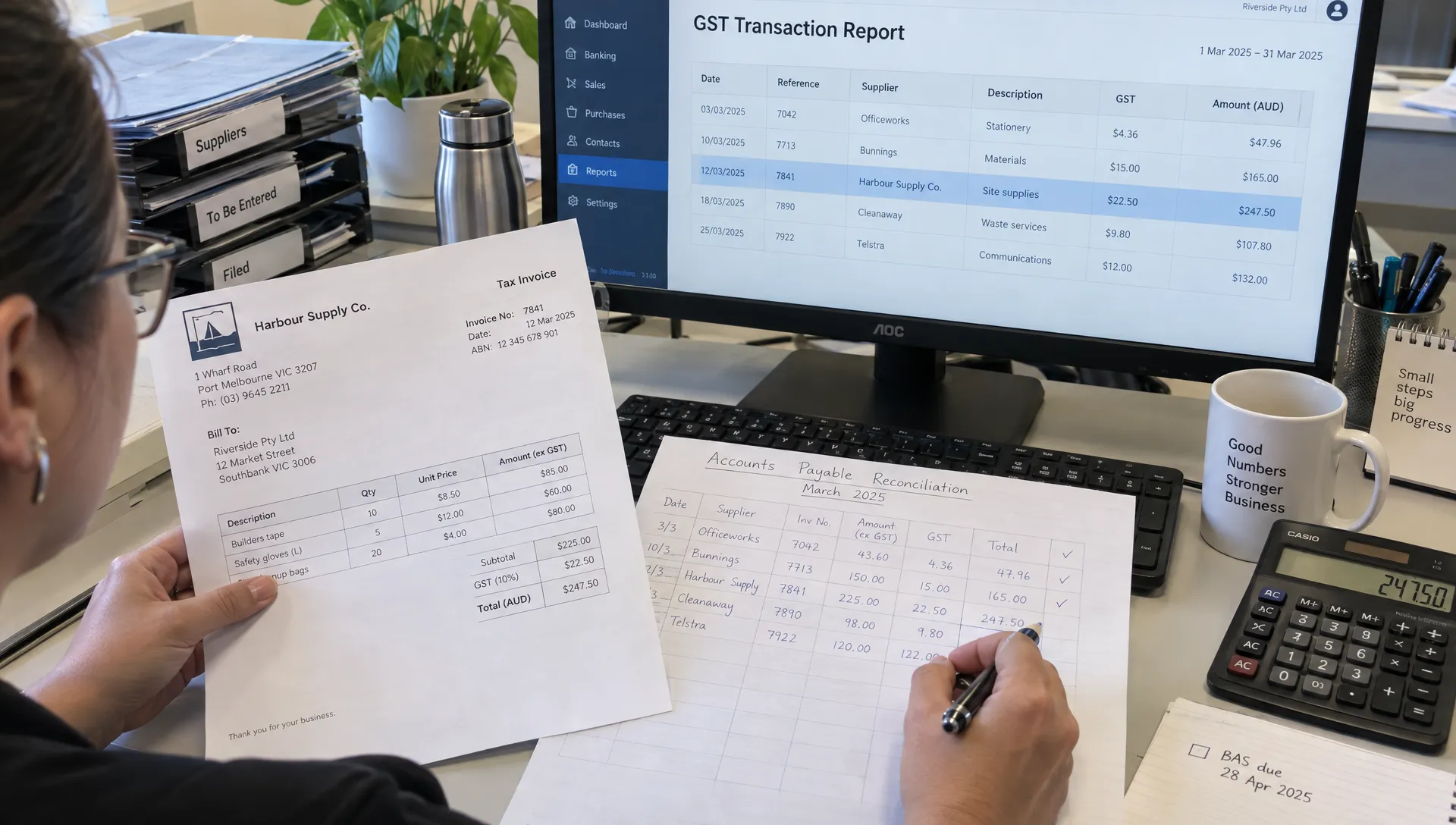
Before changing any figures, we compare the lodged BAS with the general ledger, GST transaction report, bank reconciliations and supporting documents. We also confirm whether the business accounts for GST on a cash or non-cash basis. An unpaid sales invoice does not necessarily represent missing GST under the cash basis.
Our initial review answers four questions:
- Has the BAS been lodged? We correct an unlodged draft before submission rather than treating it as a revision.
- Which component is wrong? GST, PAYG withholding and instalments have different correction rules.
- Was the original statement incorrect when lodged? A later cancellation or price change may be an adjustment instead.
- Has the ATO started relevant compliance activity? This can restrict access to later-period GST corrections.
Our work as an accountant for tax filing includes checking the cause, not simply accepting the apparent difference. A duplicated supplier bill, an incorrect tax code and an omitted taxable sale require different accounting entries, even when the dollar amounts are identical.
Choose between a BAS revision and a later-period correction
We use the ATO’s BAS guidance to determine the available pathway. We do not assume that every mistake can be carried into the next quarter.
| Situation | Our starting approach | Main issue to check |
|---|---|---|
| Error found before lodgement | Correct the records and draft BAS | Reconcile the final figures before submission |
| Eligible GST error on a lodged BAS | Consider correction on a later BAS | Apply the relevant eligibility, time and value limits |
| GST error outside later-period correction rules | Consider revising the original BAS | Check review periods and any ATO compliance activity |
| Transaction changes after correct reporting | Apply GST adjustment rules | Identify the adjustment event and attribution period |
| PAYG withholding or instalment mistake | Apply the rules for that component | Do not use GST correction thresholds |
A revision changes the original reporting period. A permitted later-period correction changes a subsequent BAS without revising the earlier one. We use one valid pathway for each error, not both.
When acting as an accountant for tax filing, we also reconcile the accounting treatment with the lodgement treatment. Recording an adjustment in software does not, by itself, revise a statement already lodged with the ATO.
GST debit errors: where the original liability was too low
A GST debit error generally means that the original net GST liability was understated. Examples include missing GST on a taxable sale or claiming the same GST credit twice.
To determine whether a later BAS can correct the error, we assess the applicable turnover-based time limit and debit-error value limit. We also check the rules concerning relevant compliance activity, recklessness and intentional disregard of the law.
Where several errors exist, we apply the ATO’s permitted netting rules rather than offsetting unrelated entries without analysis. The relevant GST turnover measure also needs checking; we do not automatically substitute profit or another turnover definition.
If later-period correction is unavailable, we assess revision of the original BAS. We check the current ATO limits at the time of correction because eligibility depends on the business and the circumstances.
GST credit errors and previously unclaimed credits
A GST credit error generally means the original net liability was too high, such as where a taxable sale was reported twice. Credit errors have different correction conditions from debit errors.
A previously unclaimed GST credit needs separate analysis. Depending on the attribution and documentation rules, it may be claimable on a later BAS without revising the original statement. We check entitlement, supporting evidence and the applicable time limit before claiming it.
Our role as an accountant for tax filing is to distinguish a genuine correction from a new claim. We also check both the GST assessment review period and any separate input tax credit deadline, which do not necessarily run from the same date.
Separate an original error from a later GST adjustment
A transaction can be correctly reported initially and change afterwards. Returned goods, a later discount or a cancelled sale may create a GST adjustment rather than reveal an error in the original BAS.
For example, if a taxable sale was correctly reported in March and a genuine price reduction occurred in June, we would examine the adjustment rules for June. We would not automatically revise March simply because the final commercial outcome changed.
Changes in creditable purpose and certain bad-debt events can also require adjustment analysis. We establish when the adjustment arose and whether an adjustment note is required.
This distinction protects the audit trail. It also keeps management reporting meaningful: an earlier processing mistake should not be confused with a current-period commercial event.
How we correct the records and lodge the change
Establish the evidence and calculate the difference
We retain the original BAS, relevant invoices, transaction reports and a calculation showing the amount originally reported against the correct amount. For repeated errors, we extend the review to other potentially affected periods.
Consider an omitted invoice of $22,000, including $2,000 GST, that should have been reported under the business’s GST accounting basis. The GST shortfall is $2,000, but that amount alone does not establish whether correction on the next BAS is allowed.
As an accountant for tax filing, we check the original due date, applicable limits and compliance status before selecting the correction period. We also identify any other affected labels rather than changing only the net amount payable.
Correct the ledger without duplicating the transaction
We match the accounting entry to the problem. A duplicated GST credit may require reversing a duplicate bill; an incorrect tax code may require correcting the tax treatment without changing the underlying expense.
We also consider locked reporting periods and previously issued financial reports. An unexplained current-period journal can make the next BAS appear correct while leaving historical accounts unreliable.
Our correction working paper records the affected transaction, original period, chosen treatment and lodgement reference. This supports future reviews and helps prevent the same error being corrected twice.
Lodge through the appropriate channel and confirm the result
Where a revision is required, we use the available ATO online process or an authorised registered agent acting within their scope. If the relevant period cannot be revised online, we confirm the appropriate alternative with the ATO.
After lodgement, we check the processed result and the activity statement account. We confirm whether the change creates an additional amount payable, a credit or an offset against existing debt.
A successful lodgement is not the end of the reconciliation. We also make sure the next BAS does not pick up the corrected transactions again.
What our accountant for tax filing review covers beyond GST
PAYG withholding and payroll reporting
For payroll-related mistakes, we reconcile wages and withholding against the relevant BAS labels and Single Touch Payroll records. We apply PAYG withholding correction rules rather than GST debit-error thresholds.
Correcting an STP report does not automatically correct a lodged BAS. Equally, changing a BAS does not resolve every employee-level reporting issue.
Where the underlying mistake affects superannuation or FBT, we review those obligations separately. We do not treat the BAS as a substitute for the correction processes that apply to other taxes or employer obligations.
PAYG and FBT instalments
We distinguish an incorrectly reported instalment from a legitimate variation based on a revised estimate. A change in expected profit does not necessarily mean the original BAS contained an error.
Before varying an instalment, we assess the calculation and potential consequences of an insufficient variation. That assessment belongs alongside cash-flow forecasting, not just form completion.
Company accounts and income tax returns
BAS corrections can expose wider inconsistencies in revenue, expenses or balance-sheet accounts. We assess whether financial statements or an already lodged income tax return also need attention.
Our review of BAS and company tax return mismatches explains why consistent records matter across reporting obligations. We resolve the underlying discrepancy rather than forcing different reports to agree through unsupported journals.
Manage interest, penalties and cash flow
If a correction increases the amount payable, we assess potential interest and penalties alongside the tax shortfall. A revised liability can have consequences linked to the original payment date, depending on the applicable rules.
We never promise that voluntary correction eliminates penalties or interest. Disclosure timing, the nature of the error and any existing ATO action can affect the outcome. Where appropriate, we consider whether a remission request is supportable.
When engaged as an accountant for tax filing, we incorporate the corrected liability into the cash-flow forecast. If payment is difficult, we address the debt separately rather than delaying an accurate correction.
Where several statements or returns are outstanding, our approach to resolving back taxes in Australia helps organise the broader compliance position. A single BAS revision may be only one part of the work required.
Use the correction to strengthen financial controls
We treat a BAS error as evidence about the reporting process. A duplicate credit may point to weak invoice controls; omitted sales may indicate a failed reconciliation between an operating system and the ledger.
Our AI-driven processes support faster reconciliation, greater accuracy and more timely financial visibility. We combine automation with professional review because software cannot, on its own, establish GST entitlement or determine the legal treatment of every transaction.
Useful controls include transaction-level reconciliations, documented GST coding decisions and review of unusual movements before lodgement. We also recommend controlled access to closed periods and a clear record of approved corrections.
Reliable bookkeeping and compliance provide the foundation for strategic advisory and corporate growth. Once the records are dependable, we can assess margins, working capital and tax funding without decisions being distorted by unresolved errors.
Frequently asked questions
Can we fix a BAS mistake on the next statement? We can do so for eligible GST errors where the ATO’s conditions are met. We must assess the error type, relevant limits and compliance status first. Other BAS components have separate rules.
How far back can we revise a BAS? Many GST assessments have a four-year period of review, but this is not a universal deadline for every correction or credit claim. We check the assessment dates, applicable exceptions and separate entitlement limits.
Does a credit from a BAS correction guarantee a cash refund? No. We check the activity statement account because a credit may be applied against existing tax debts. Processing checks may also affect when a refund becomes available.
What if the original BAS is correct but the transaction changes later? We examine the GST adjustment rules. A subsequent cancellation, discount or other adjustment event does not automatically require revision of the original BAS.
Next steps: arrange a focused BAS review
Our team at Perfect Accounting & Tax Services brings 25 years of professional experience to accounting, tax and strategic advisory. We support clients across Australia through integrated service capabilities in Adelaide, Sydney and Melbourne.
For a consultation with an accountant for tax filing and BAS correction support, we recommend preparing the lodged statement, relevant transaction reports, supporting invoices and any ATO correspondence. We can then assess the correction pathway and its wider financial impact.
Contact our team to discuss the BAS discrepancy or learn how our automated accounting workflows can strengthen reporting accuracy and financial visibility.