
For Australian business owners, tax return filing is not a once-a-year administrative task. It is the final test of your bookkeeping, BAS accuracy, payroll compliance, GST treatment, asset records, and management discipline.
When those foundations are weak, tax time becomes a scramble. When they are digitally connected and intelligently reviewed throughout the year, lodgement becomes faster, cleaner, and more strategic.
That is where artificial intelligence now has a practical role. AI does not replace professional tax judgement, and it should never be treated as a substitute for Australian tax advice. Used properly, it reduces manual handling, detects inconsistencies earlier, organises evidence, and gives business owners better visibility before the return is prepared.
Our view is straightforward: the strongest businesses are not simply filing tax returns more efficiently. They are using AI-enabled accounting workflows to improve cash flow, reduce ATO risk, and make better commercial decisions.
Why tax return filing is still complex for Australian businesses
Australian business tax is interconnected. A company, trust, partnership, or sole trader return draws information from multiple compliance areas, including income tax, GST, BAS, PAYG withholding, Single Touch Payroll, Superannuation Guarantee, FBT, depreciation, Division 7A, and sometimes capital gains tax.
For a growing business, complexity usually increases before the accounting function matures. More staff create payroll and superannuation obligations. More assets require depreciation tracking. More revenue channels create GST classification issues. More entities create intercompany loan and trust distribution considerations.
The ATO expects businesses to keep accurate records that explain all transactions relevant to their tax affairs. The ATO’s guidance on record keeping for business is clear: records need to be retained, accessible, and sufficiently detailed.
In practice, the problem is rarely one missing receipt. The real issue is fragmentation. Data sits across bank accounts, payroll systems, e-commerce platforms, loan statements, spreadsheets, point-of-sale tools, and email inboxes. By the time the accountant starts preparing the return, the business owner may be reconstructing months of activity from memory.
That is expensive, slow, and risky. We regularly see the same issues behind costly corrections, including unreconciled BAS figures, unsupported deductions, inconsistent GST coding, and weak asset records. We have explored these issues in detail in our guide to tax return mistakes that cost Australian business owners.
AI simplifies this process by moving the work forward. Instead of discovering errors at lodgement, the system helps identify exceptions as they occur.
What AI actually means in an accounting and tax workflow
In tax, AI is not a single tool. It is a combination of automation, machine learning, rules-based checks, document extraction, anomaly detection, and workflow intelligence.
A well-designed AI-enabled accounting workflow can read invoices, match payments, suggest GST codes, highlight unusual transactions, classify expenses, identify missing documents, and prepare accountant review packs. The professional accountant then applies judgement, checks tax treatment, confirms strategic implications, and finalises the lodgement position.
That distinction matters. AI can accelerate the preparation of tax-ready data. It cannot decide whether a transaction is commercially appropriate, whether a structure is optimal, or whether a complex deduction position should be taken without professional review.
| Area of tax return preparation | Traditional approach | AI-enabled approach |
|---|---|---|
| Source documents | Manual collection from emails, folders, and spreadsheets | Automated extraction and matching of invoices, receipts, and statements |
| Bank reconciliation | Line-by-line manual coding | Suggested coding with exception review |
| GST and BAS alignment | Checked late in the year | Monitored progressively against BAS lodgements |
| Deduction evidence | Requested after year-end | Stored and linked to transactions throughout the year |
| Payroll and superannuation | Reconciled close to lodgement | Compared with STP, payroll, and super records more frequently |
| Management insight | Arrives after compliance work | Supports forward-looking cash flow and tax planning |
The result is not just speed. The greater value is control.
How AI simplifies tax return filing for business owners
It reduces manual document chasing
The first bottleneck in tax return preparation is usually evidence. Invoices, receipts, loan statements, insurance schedules, motor vehicle records, and legal documents all support the numbers in the return.
AI-powered document capture can extract supplier names, ABNs, dates, GST amounts, totals, and payment references from uploaded documents. It can then match those records against bank transactions or accounting entries.
This reduces the need for year-end document chasing. It also gives directors and business owners a clearer audit trail if the ATO asks for substantiation.
For high-volume businesses, such as hospitality groups, medical clinics, online retailers, construction firms, and logistics operators, this shift is significant. Thousands of small transactions can be organised continuously rather than reconstructed after 30 June.
It improves bank reconciliation and expense classification
Poor reconciliation is one of the main reasons tax return filing becomes inefficient. If the accounting file contains duplicated income, uncategorised expenses, shareholder payments, or unreconciled transfers, the tax return will not be reliable.
AI can analyse transaction descriptions, supplier history, invoice data, and prior coding patterns to suggest classifications. For example, recurring software subscriptions, merchant fees, insurance premiums, rent, and finance repayments can be coded consistently.
This does not remove the need for accountant review. It does, however, allow our team to focus on exceptions, unusual transactions, and strategic tax treatment rather than basic data entry.
For directors, this has a practical benefit. Cleaner reconciliations mean cleaner management reports. Cleaner management reports support better decisions before tax time.
It helps align GST, BAS, and income tax data
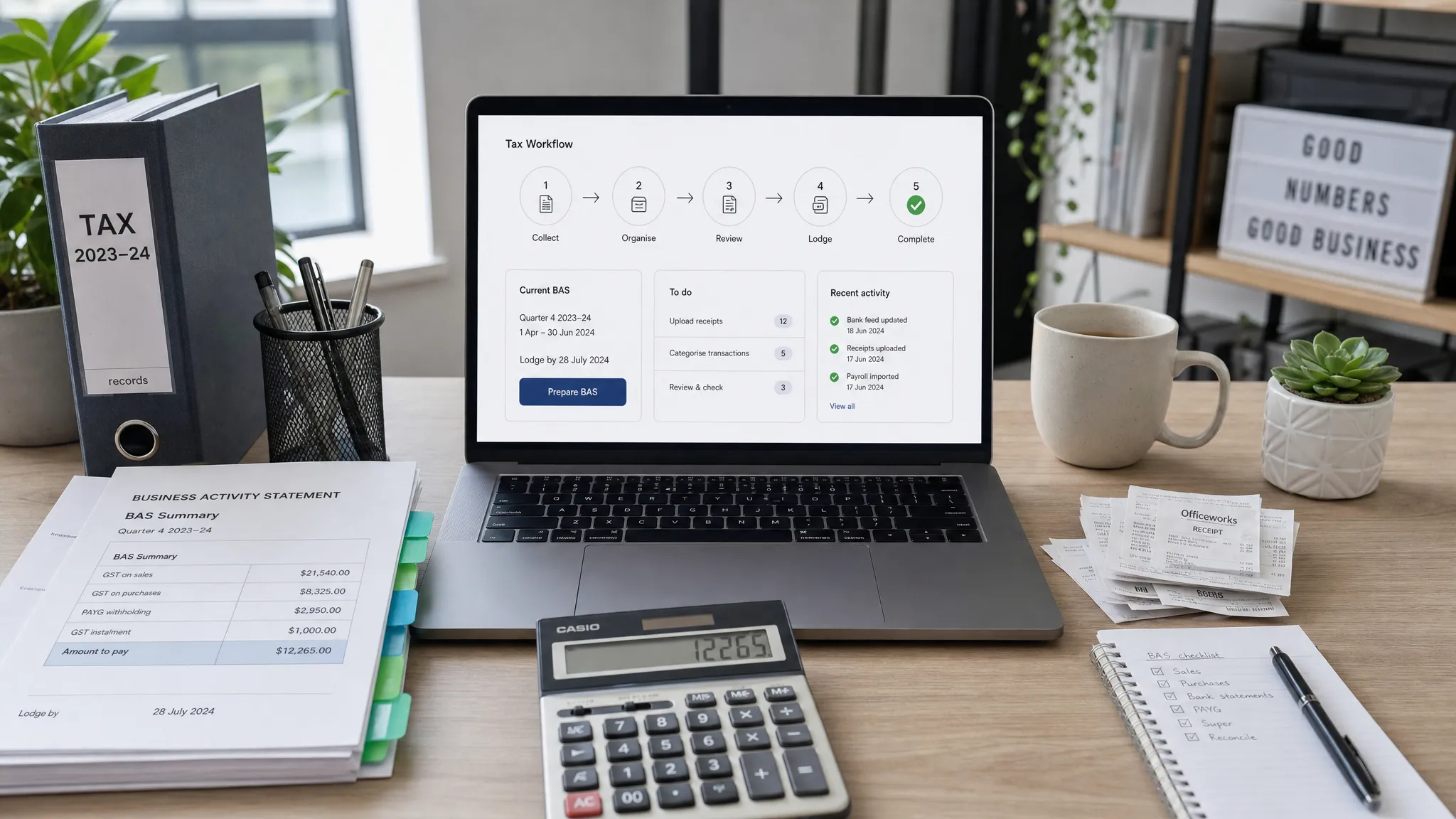
A business tax return should not be prepared in isolation from BAS lodgements. If GST turnover, expenses, PAYG withholding, or capital purchases reported in BAS do not align with the annual accounts, those differences need to be explained.
AI-enabled review processes can compare transaction-level GST coding against BAS totals. They can help identify transactions coded as GST-free, input taxed, or GST inclusive where the pattern appears inconsistent.
This is particularly useful for businesses with mixed supplies, property-related transactions, imports, exports, or complex expense categories.
The ATO’s digital systems have become increasingly data-driven. While businesses should not assume every variance is a problem, they should expect stronger matching across GST, payroll, superannuation, and income tax data over time.
It strengthens payroll, STP, and superannuation accuracy
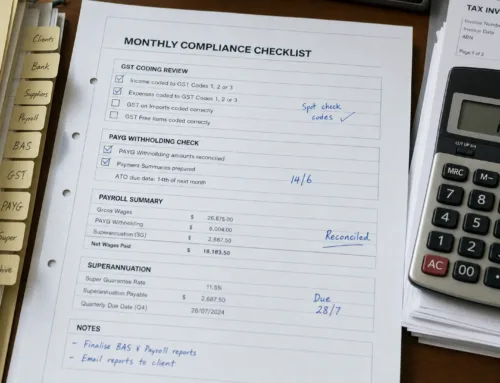
Payroll errors can flow directly into tax return problems. Wages, director fees, contractor payments, PAYG withholding, superannuation, and payroll tax records need to be consistent.
Single Touch Payroll has made payroll reporting more transparent. The ATO explains that Single Touch Payroll reports payroll information such as salaries and wages, PAYG withholding, and superannuation liability information to the ATO.
AI-assisted workflows can help compare payroll reports, accounting ledgers, STP finalisation data, and superannuation records. This helps identify anomalies before the return is finalised.
For businesses preparing for payday super and the 12% Superannuation Guarantee environment, payroll data quality is no longer just a compliance matter. It is a cash flow planning issue. If you are reviewing your 2026 obligations, our overview of business tax changes in Australia for 2026 is a useful starting point.
It improves deduction substantiation and ATO readiness
Tax deductions are not only about whether an expense was paid. The question is whether the business can prove the expense, explain its business connection, and apply the correct tax treatment.
AI can help by linking documents to transactions, flagging missing receipts, identifying private or mixed-use expenses, and highlighting unusual claims compared with the business’s normal patterns.
For example, AI may detect that motor vehicle expenses increased sharply, travel costs changed materially, or repairs and maintenance include items that may need to be capitalised. These alerts do not determine the answer. They prompt professional review before lodgement.
That is where judgement matters. Some transactions require analysis of the Income Tax Assessment Acts, GST legislation, ATO guidance, case law, and the commercial facts. AI makes the file more complete. A qualified adviser determines the correct position.
It supports better asset, depreciation, and capital allowance records
Business owners often underestimate the importance of asset records until tax time. Plant and equipment, vehicles, fit-outs, technology, machinery, and property improvements all need correct treatment.
AI-assisted workflows can help identify potential asset purchases from transaction data and supplier descriptions. They can also support asset register maintenance by grouping purchases, attaching invoices, and flagging items that may require depreciation review.
This is valuable for builders, manufacturers, medical practices, fitness studios, logistics companies, and property investors with multiple capital items.
However, tax treatment still requires care. The distinction between repairs and capital improvements can be complex. So can the treatment of motor vehicles, software development costs, low-value assets, financing costs, and property-related expenditure.
When AI surfaces the issue early, we can advise before the return is finalised, not after the ATO asks questions.
It gives directors earlier visibility over tax payable
One of the most valuable uses of AI is forecasting. If bookkeeping is current, payroll is reconciled, GST is reviewed, and liabilities are visible, business owners can estimate tax exposure earlier.
This changes the conversation. Instead of asking, “What do we owe?” after year-end, directors can ask better questions during the year:
- Are margins improving or weakening?
- Do we need to adjust PAYG instalments?
- Can we fund superannuation, GST, and income tax on time?
- Should we review pricing, wages, finance costs, or stock levels?
- Is the current structure still appropriate for growth, asset protection, and succession?
This is where compliance becomes strategic advisory. Filing the return is the endpoint. The real commercial value comes from using tax-ready data to guide decisions throughout the year.
We see this as a core expectation of modern accounting. Business owners should expect more than annual lodgement from their advisers, as we explain in our article on what small businesses should expect from modern accounting services.
Where AI should not replace professional tax advice
AI is powerful, but it has limits. Business owners should be cautious about relying on generic AI tools for tax positions without review by an Australian tax professional.
Complex areas still require human judgement, including:
- Division 7A loans and payments to shareholders or associates
- Trust distributions and beneficiary entitlements
- Personal services income rules
- FBT on vehicles, entertainment, housing, and employee benefits
- GST treatment for property, imports, exports, and mixed supplies
- Capital gains tax events and small business CGT concessions
- Contractor versus employee classification
- R&D tax incentive eligibility
- International tax, residency, and withholding issues
- SMSF compliance and related-party transactions
AI may help collect facts and identify risk areas. It should not be the final decision-maker.
Our approach is to use technology for speed and structure, then apply professional review for judgement, compliance, and strategy. That combination is where business owners receive the greatest benefit.
How to prepare your business for AI-enabled tax return filing
AI works best when the underlying accounting environment is disciplined. If the chart of accounts is messy, bank feeds are incomplete, or staff use inconsistent expense categories, automation will amplify confusion rather than solve it.
Before implementing AI-enabled workflows, business owners should strengthen the fundamentals.
| Preparation area | What to improve | Strategic benefit |
|---|---|---|
| Chart of accounts | Remove duplicated, vague, or outdated accounts | Cleaner reporting and better tax mapping |
| Bank feeds | Connect all business accounts and credit cards | Fewer missing transactions and faster reconciliation |
| Document capture | Digitise receipts, invoices, loan statements, and contracts | Stronger substantiation and reduced year-end chasing |
| Payroll systems | Reconcile STP, PAYG withholding, superannuation, and leave | Lower payroll compliance risk |
| BAS review | Compare GST coding with BAS lodgements regularly | Fewer annual adjustments and surprises |
| Asset register | Track purchases, disposals, finance, and depreciation | Better tax planning and balance sheet accuracy |
| Approval controls | Define who can approve, code, and amend transactions | Stronger governance for directors and owners |
The goal is not to build a more complicated finance function. The goal is to build a more reliable one.
For many SMEs, this can be achieved with the right cloud accounting system, clean processes, disciplined review cycles, and professional oversight. For larger or multi-entity groups, it may require more advanced workflow design, role-based approvals, consolidated reporting, and virtual CFO support.
What an AI-driven tax workflow looks like in practice
At Perfect Accounting & Tax Services, we combine AI-driven automation with experienced Australian tax review. Our work is not limited to lodging returns. We design accounting workflows that make tax compliance faster while improving decision quality for business owners and directors.
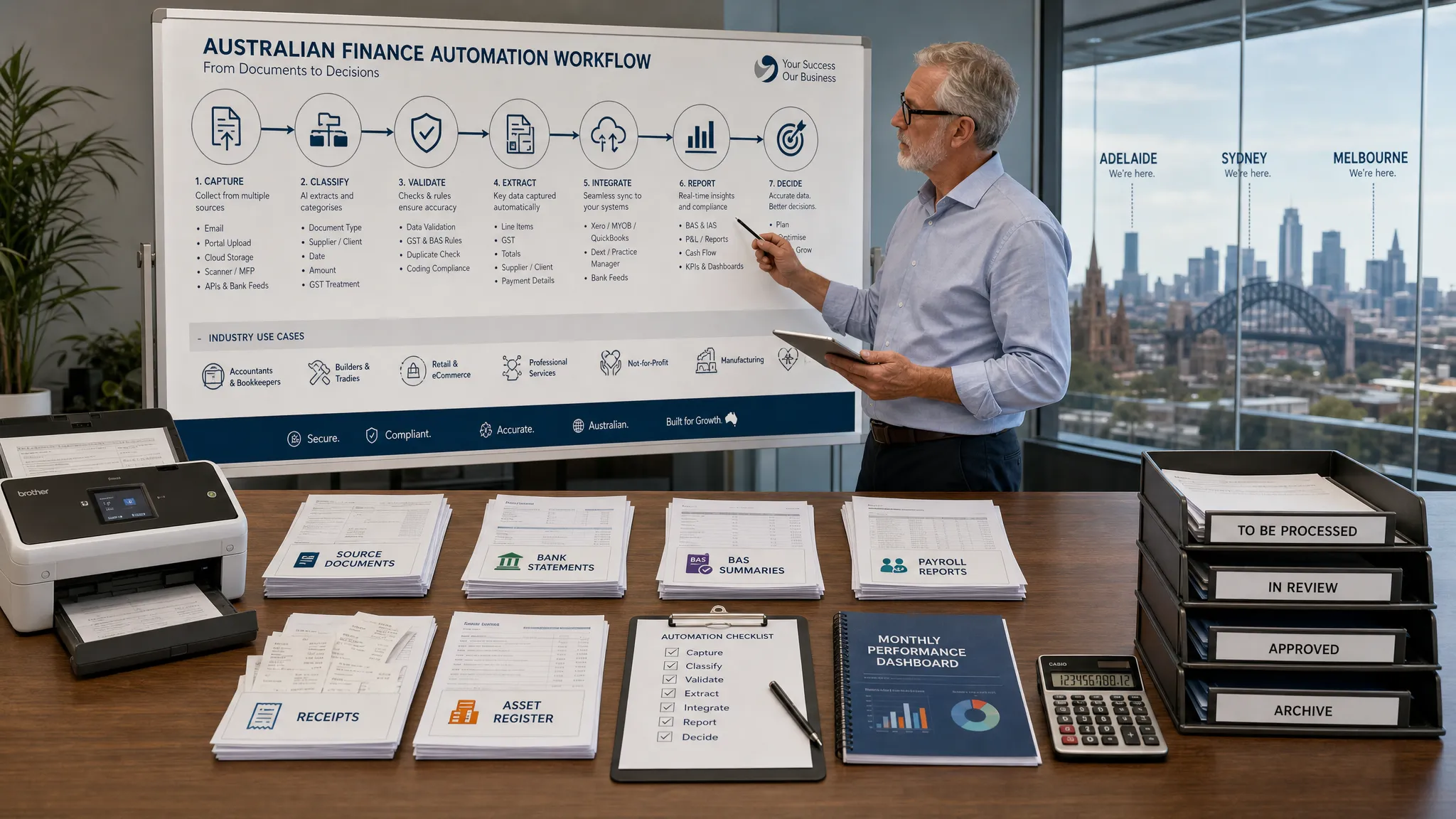
A practical workflow usually includes transaction capture, bank reconciliation, GST and BAS review, payroll alignment, document substantiation, asset register maintenance, management reporting, and year-end tax planning.
For clients operating across Australia, including Adelaide, Sydney, and Melbourne, an integrated workflow is especially valuable. It creates consistency across locations, entities, payroll teams, and reporting cycles.
This matters for businesses that are scaling, preparing for finance, acquiring assets, restructuring, expanding interstate, or planning an exit. In those situations, tax return filing is not just a compliance exercise. It is part of a broader governance and growth strategy.
Frequently Asked Questions
Can AI lodge my Australian business tax return by itself? AI can help organise data, identify issues, and prepare tax-ready records, but lodgement should still be reviewed by a qualified Australian tax professional. Business tax involves judgement, legislation, ATO guidance, and commercial context.
Is AI useful for sole traders as well as companies? Yes. Sole traders can benefit from automated record capture, expense classification, GST tracking, and deduction evidence. Companies and trusts usually gain additional value because their payroll, Division 7A, asset, and governance issues are more complex.
Will AI reduce ATO audit risk? AI cannot guarantee that the ATO will not review or audit a return. It can reduce avoidable errors by improving reconciliations, evidence, GST coding, payroll checks, and transaction visibility before lodgement.
Does AI replace bookkeeping? No. AI improves bookkeeping workflows, but it still needs correct setup, review, and governance. Poor processes, mixed personal and business transactions, or inconsistent coding will still create problems.
When should we start preparing for tax return filing? Ideally, preparation starts from 1 July and continues throughout the year. The best tax outcomes usually come from quarterly review, not last-minute reconstruction after 30 June.
Next Steps: move from annual lodgement to financial control
If your business still treats tax return filing as a year-end event, there is a better model. AI-enabled accounting can help you maintain cleaner records, reduce compliance friction, and give directors the visibility needed to make stronger decisions.
Our team can review your current accounting workflow, identify tax risk areas, and help implement automated processes that support compliance, cash flow, and strategic growth.
For a practical discussion about modernising your tax and accounting systems, contact Perfect Accounting & Tax Services. We support business owners, company directors, and high-net-worth individuals across Australia, with integrated advisory capability in Adelaide, Sydney, and Melbourne.