

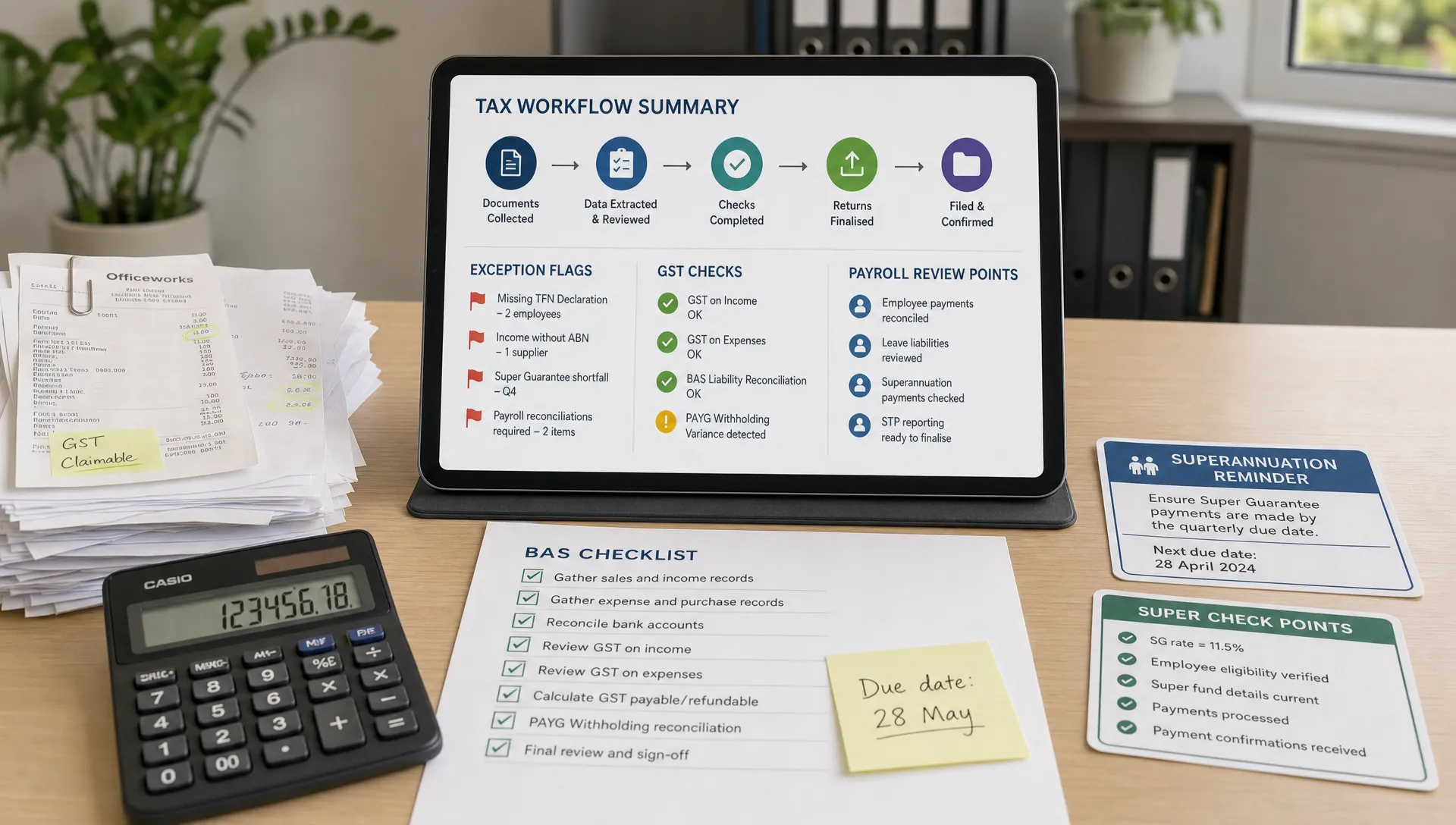
AI is changing tax management in Australia because it moves tax from a retrospective exercise to a live management discipline. For business owners, directors and high-net-worth individuals, that distinction matters. The ATO environment is increasingly data-driven, compliance windows are tighter and tax outcomes are now closely connected to cash flow, payroll, funding capacity, governance and growth strategy.
Our view is straightforward: AI should not be treated as a shortcut for professional tax judgement. Used correctly, it becomes the operating layer that improves data quality, identifies risks earlier and gives advisers the visibility needed to make better decisions before lodgement deadlines arrive.
For Australian businesses managing GST, BAS, PAYG withholding, Superannuation, FBT, Division 7A issues, trust distributions or multi-entity structures, AI-enabled workflows can materially improve control. The strongest results come when automation is paired with experienced tax strategy.
Why AI matters for tax management in Australia
Traditional tax management has often been seasonal. Records are cleaned up before BAS or year-end tax lodgement, advisers ask for missing documents and business owners receive the final tax position after many of the key commercial decisions have already been made.
That model is increasingly inadequate. Business owners now need tax visibility during the year, not just at the end of it. Rising wage compliance expectations, changing superannuation rules, non-deductible ATO interest settings and greater ATO data-matching capacity make poor record-keeping more expensive.
AI changes the rhythm. Instead of waiting for a quarterly or annual review, an AI-supported accounting system can flag unusual transactions, reconcile data faster, identify possible GST coding errors and help management understand tax exposure while there is still time to act.
This is especially valuable for businesses operating across Adelaide, Sydney and Melbourne, where growth often brings cross-state payroll, property, contractor, payroll tax and operational complexity. Our team uses automation as part of a broader advisory framework so tax data becomes useful for decision-making, not simply compliance.
From compliance burden to strategic tax control
Tax management is not just the act of preparing returns. It covers the systems, policies, data flows and review processes that determine whether the business is accurately capturing its tax position throughout the year.
For a company director or business owner, effective tax management should answer practical questions:
- Are our GST and BAS positions accurate before lodgement?
- Are wages, PAYG withholding and Superannuation being captured correctly?
- Are director loans, related-party transactions and distributions being monitored?
- Are capital purchases classified correctly for depreciation and tax planning?
- Are cash flow forecasts allowing for tax liabilities before they fall due?
AI improves the quality and timing of those answers. Instead of relying solely on manual reviews, automated workflows can scan large volumes of transactions and highlight exceptions for professional review. That gives accountants more time to focus on judgement-heavy areas such as structuring, risk management, tax planning and commercial strategy.
This is where the strategic value emerges. Better tax data supports better cash flow planning. We have written separately about how tax-efficient accounting improves cash flow, and AI strengthens that discipline by making tax obligations more visible throughout the year.
What AI actually does inside a tax management workflow
AI in tax management is most useful when it is practical, controlled and aligned to Australian tax rules. It is not about handing the tax function to a machine. It is about reducing manual friction, improving consistency and giving advisers a sharper view of risk.
At a business level, AI-enabled accounting workflows can assist with several core functions.
| Tax management area | How AI supports the process | Strategic benefit |
|---|---|---|
| Document capture | Extracts data from invoices, receipts and supplier documents | Reduces missing records and manual entry |
| Transaction coding | Suggests classifications based on supplier, account history and patterns | Improves consistency in GST and expense treatment |
| BAS preparation | Highlights GST anomalies, coding issues and reconciliation gaps | Reduces lodgement risk and improves cash flow timing |
| Payroll review | Compares wages, PAYG withholding and superannuation data across periods | Supports wage compliance and early error detection |
| Cash flow forecasting | Uses live accounting data to project upcoming tax obligations | Helps directors plan before tax liabilities mature |
| Exception reporting | Flags unusual movements, duplicate entries or inconsistent treatment | Focuses adviser attention on higher-risk items |
The key word is "supports". AI can identify patterns, but it does not understand commercial intent in the same way a senior adviser does. For example, a large payment may look like an ordinary expense, but it could be capital in nature. A shareholder payment may appear as a standard transfer, but it may raise Division 7A considerations. A vehicle cost may be deductible in part, but the FBT consequences still require analysis.
Our role is to combine automation with professional interpretation. That is how AI becomes a control system rather than a compliance gimmick.
The Australian tax areas most affected by AI
Different businesses experience AI benefits in different ways. A construction group will not have the same tax profile as a SaaS company, property developer, medical practice or family investment group. However, several Australian tax areas consistently benefit from automation.
GST and BAS accuracy
GST errors often start with coding inconsistencies. A transaction may be coded as GST-free, input taxed, taxable or outside the GST system when the treatment depends on the nature of the supply. AI can help identify recurring coding patterns and detect transactions that do not fit the usual profile.
For BAS, the main benefit is earlier review. Rather than waiting until BAS lodgement to discover unreconciled accounts or inconsistent GST treatment, AI-supported workflows can surface issues progressively. That gives management more time to correct errors, preserve evidence and avoid rushed lodgements.
For smaller operators scaling into more complex obligations, our guide on tax for small business in Australia and what owners must track explains the baseline records that need to be captured consistently before automation can deliver reliable insights.
Payroll, Superannuation and contractor compliance
Payroll is now one of the most sensitive areas of tax and accounting risk. STP reporting, PAYG withholding, superannuation obligations and contractor arrangements all need accurate source data.
AI can compare payroll data across periods and flag unusual movements in wages, allowances, reimbursements or superannuation calculations. It can also help identify discrepancies between payroll systems and accounting ledgers, which is critical when a business has multiple locations, casual staff, contractors or seasonal labour.
The professional judgement still sits with the adviser. Classifying a worker, reviewing award implications or assessing whether a contractor arrangement creates payroll tax risk cannot be reduced to a simple algorithm. Automation improves visibility, but advice determines the correct treatment.
FBT and employee benefits
FBT is an area where businesses often underestimate the record-keeping burden. Motor vehicles, entertainment, car parking, living-away-from-home allowances and salary packaging arrangements all require careful tracking.
AI-supported systems can help detect potential benefit categories by analysing descriptions, supplier names and transaction patterns. For example, repeated restaurant expenses or vehicle-related costs may be flagged for FBT review. This does not determine the FBT outcome, but it helps advisers identify issues before the FBT year closes.
Company tax, trusts and high-value structures
AI is also valuable for multi-entity groups, family businesses and high-net-worth individuals with investment structures. These arrangements often involve inter-entity loans, management fees, trust distributions, asset acquisitions, property income and related-party transactions.
The risk is rarely one isolated transaction. It is usually a pattern across entities, bank accounts and reporting periods. AI can help map those patterns so advisers can review them in context.
For directors managing more complex obligations, it is worth understanding the broader 2026 compliance environment. Our summary of business tax in Australia and what changed for 2026 outlines several issues that now affect planning and governance.
Sector examples: where AI tax management creates value
AI works best when it reflects the operating model of the business. A generic automation setup may improve bookkeeping speed, but sector-specific configuration produces better tax intelligence.
A dental or medical practice, for example, will usually have a different mix of patient payments, equipment finance, contractor arrangements, payroll obligations and GST considerations compared with a digital agency or construction contractor. A technology-enabled healthcare business such as Toorak Village Dental Care illustrates the kind of professional services environment where appointments, payment flows, equipment investment and staffing costs all need to be captured cleanly for financial reporting.
For e-commerce and dropshipping operators, the priority is often transaction volume, merchant fees, stock movement, GST, imports and platform reconciliation. For construction firms, the tax workflow needs to handle progress claims, subcontractors, retention amounts, equipment, motor vehicles and project-based reporting. For property investors and developers, the emphasis shifts to GST, capital versus revenue treatment, financing costs, entity structure and cash flow timing.
In each case, AI is not valuable because it is fashionable. It is valuable because it can process high-volume accounting data consistently and bring exceptions to the surface quickly.

The data foundation AI needs before it can work properly
AI cannot repair a weak accounting foundation by itself. If bank feeds are incomplete, supplier records are inconsistent, payroll data is unreliable or private and business expenses are mixed, automation may simply process poor data faster.
Before implementing AI-supported tax management, we focus on the data architecture. This includes chart of accounts design, document capture rules, GST treatment protocols, payroll integration, approval workflows and management reporting requirements.
Clean data governance is especially important for businesses preparing for funding, expansion, acquisition or exit. Investors, lenders and buyers do not only review profit. They review the quality of financial controls, tax compliance history and the reliability of reporting.
A practical AI implementation should define:
- Which systems hold the source data
- Who approves transactions and coding rules
- How exceptions are reviewed by a qualified adviser
- What reports directors receive each month
- Which tax risks require escalation before lodgement
Once these controls are in place, AI can provide real-time visibility without weakening governance.
AI does not replace tax judgement
We are strong advocates for digital transformation, but we do not treat AI as a substitute for professional advice. Australian tax law requires interpretation. Commercial context matters.
Consider these examples. A payment to a shareholder may require Division 7A review. A trust distribution may need to align with the trust deed and beneficiary position. A motor vehicle may have GST, depreciation and FBT consequences. A contractor arrangement may affect payroll tax, superannuation and PAYG withholding. A property transaction may raise CGT, GST or income tax issues depending on intention and structure.
AI can flag transactions for review. It cannot properly assess every legal, commercial and evidentiary factor. That is why the highest-performing tax functions use AI for data handling and advisers for strategy, interpretation and accountability.
The same applies to ATO engagement. If the ATO reviews or audits a business, clean digital records can materially improve response time and evidence quality. However, audit strategy, communication and technical submissions still require experienced professional representation.
How AI changes the role of the accountant
The accountant's role is moving away from being a historical record processor and toward being a real-time financial strategist. This is a positive shift for business owners.
When automation handles repetitive tasks, advisers can spend more time on higher-value issues such as:
- Tax planning before year-end
- Cash flow modelling for upcoming BAS and income tax liabilities
- Business structure reviews
- Profitability analysis by entity, location or project
- Virtual CFO support for growth decisions
- Scenario planning for expansion, acquisition or exit
This shift is particularly important for directors running businesses across multiple cities. Our integrated teams support clients across Australia, including Adelaide, Sydney and Melbourne, with a consistent advisory framework. That means the business can maintain centralised tax governance while still receiving advice that reflects local commercial realities.
Implementation roadmap for AI-driven tax management
A sensible AI rollout does not need to be disruptive. The aim is to improve visibility and control without creating unnecessary complexity.
A structured implementation usually follows five stages.
- Diagnostic review: We assess the current bookkeeping, BAS, payroll, GST, reporting and advisory workflow to identify risk points and manual bottlenecks.
- Data clean-up: We correct chart of accounts issues, reconcile key accounts, review GST coding and separate private, business and inter-entity transactions.
- Automation design: We configure document capture, approval processes, transaction rules and exception reporting in line with the business structure.
- Professional review layer: We define which exceptions need adviser review, including GST anomalies, payroll variances, large payments and related-party movements.
- Strategic reporting: We build tax-aware management reports so directors can see upcoming liabilities, cash flow implications and planning opportunities.
The goal is not automation for its own sake. The goal is to create an accounting environment where compliance is accurate, management information is current and strategic decisions are based on reliable numbers.
Governance, privacy and risk controls
AI must be implemented with discipline. Tax records contain sensitive business and personal information, including TFNs, payroll data, supplier records, bank transactions and sometimes SMSF or family group information.
We recommend that business owners and directors treat AI adoption as a governance project, not merely a software upgrade.
| Governance issue | Why it matters | Recommended control |
|---|---|---|
| Data access | Sensitive tax and payroll records must be protected | Limit permissions by role and review access regularly |
| Coding rules | Incorrect automation rules can create recurring tax errors | Maintain adviser-approved rules and exception checks |
| Audit trail | ATO queries require evidence, not assumptions | Preserve source documents and approval history |
| Human oversight | AI may misclassify unusual or complex transactions | Escalate exceptions to a qualified tax adviser |
| Reporting cadence | Directors need timely information | Use monthly tax-aware management reporting |
Strong governance also protects decision quality. If management dashboards are built on inconsistent coding, the business may make strategic decisions based on distorted margins, inaccurate liabilities or understated compliance risk.
What business leaders should measure after adopting AI
AI transformation should produce measurable outcomes. We encourage directors and business owners to look beyond time savings and assess whether the tax function is becoming more strategic.
Useful indicators include BAS preparation time, unreconciled transaction volume, number of GST coding corrections, payroll exception rates, timeliness of superannuation review, accuracy of cash flow forecasts and the speed of month-end reporting.
The deeper question is whether management has better control. Can the director see upcoming tax liabilities before they affect cash flow? Can the finance team identify risky transactions before lodgement? Can the adviser provide strategic input during the year, rather than after year-end?
When the answer is yes, AI has moved beyond administration. It has become part of the business's financial infrastructure.
Frequently Asked Questions
Can AI prepare Australian tax returns without an accountant? AI can assist with data capture, transaction analysis and exception reporting, but Australian tax returns still require professional judgement where structures, deductions, GST, FBT, payroll, trusts, companies or investments are involved. We use AI to improve the quality and speed of the workflow, not to remove adviser accountability.
Is AI tax management suitable for small businesses? Yes, provided the business has a clear accounting foundation. Sole traders, SMEs and growing companies can benefit from automated document capture, BAS checks, payroll review and cash flow forecasting. The setup should match the business's size, risk profile and growth plans.
How does AI help with BAS and GST? AI can identify inconsistent GST coding, missing tax invoices, unusual supplier treatment and reconciliation gaps. This helps advisers review issues earlier and reduces the risk of rushed BAS lodgements.
What are the main risks of using AI in tax management? The main risks are poor data quality, overreliance on automation, weak access controls and lack of professional review. We manage these risks through adviser-approved workflows, exception reporting and structured governance.
Can AI improve cash flow as well as compliance? Yes. When tax data is current, businesses can forecast BAS, PAYG, Superannuation and income tax obligations more accurately. That gives directors more time to manage cash reserves, investment decisions and working capital.
Next steps: how we can help
AI is transforming tax management, but the advantage does not come from software alone. It comes from combining clean data, Australian tax expertise, automation and strategic advisory discipline.
Our team at Perfect Accounting & Tax Services supports businesses, directors and high-net-worth individuals across Australia, with integrated capability in Adelaide, Sydney and Melbourne. We help clients modernise bookkeeping, BAS, payroll, tax planning and reporting workflows so compliance becomes a foundation for corporate growth.
If your business is still managing tax through spreadsheets, delayed reconciliations or last-minute lodgement cycles, now is the time to review your systems. Contact our team for a consultation and learn how our AI-driven accounting workflows can improve accuracy, speed and real-time financial visibility across your tax management process.