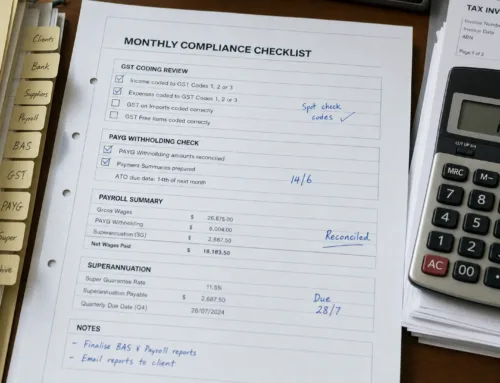


Bookkeeping is often treated as back-office administration. We see it differently. For a GST-registered business, bookkeeping is the evidence layer behind every BAS, every cash-flow forecast and every board-level decision.
A business activity statement is not created at lodgement time. It is built transaction by transaction through sales invoices, supplier bills, payroll records, bank reconciliations, merchant settlements, loan movements and GST adjustments. If those inputs are incomplete or poorly coded, BAS accuracy becomes a reconstruction exercise.
The right accounting bookkeeping services create repeatable controls. They reduce BAS risk, improve GST visibility and turn compliance data into strategic management information. For businesses across Adelaide, Sydney, Melbourne and the broader Australian market, that distinction matters.
BAS accuracy starts with transaction discipline
A BAS may include GST on sales, GST credits on purchases, PAYG withholding, PAYG instalments and other obligations depending on the entity. The ATO expects business records to explain transactions, be accessible and generally be kept for five years. Its business record-keeping guidance makes clear that accurate lodgement depends on records that are complete, reliable and able to support the amounts reported.
Common BAS issues rarely begin with the BAS form itself. They usually begin earlier in the workflow. We often see businesses claim GST credits without valid tax invoices, treat loan receipts as income, miscode GST-free or input-taxed transactions, overlook private-use adjustments, or report payroll withholding inconsistently with Single Touch Payroll data.
A strong bookkeeping system prevents those errors before they reach the BAS.
| BAS area | What bookkeeping must control | Strategic value beyond lodgement |
|---|---|---|
| GST on sales | Correct GST treatment for taxable, GST-free and input-taxed supplies | Cleaner revenue reporting and margin analysis |
| GST credits | Valid supplier invoices, correct GST codes and private-use adjustments | Better purchasing visibility and cost control |
| PAYG withholding | Payroll reconciliations, STP alignment and employee records | Accurate labour cost reporting and cash-flow planning |
| Bank and merchant receipts | Gross sales, fees, refunds, timing differences and clearing accounts | More reliable debtor and revenue insights |
| Asset purchases | Capital versus expense treatment and GST eligibility | Improved depreciation, tax planning and financing decisions |
| Director or owner transactions | Loans, drawings, reimbursements and Division 7A risk areas where relevant | Stronger governance and cleaner balance sheets |

How bookkeeping services improve BAS accuracy
Professional bookkeeping services do more than record transactions. They create a control environment around financial data. That environment is what allows directors to lodge BAS with confidence and make decisions from the same data.
Correct GST coding at source
GST coding must be consistent from the start. A payment for insurance, rent, imported services, motor vehicle expenses or merchant fees may each have different GST implications. A supplier bill may include taxable and GST-free components. Some transactions sit outside the GST system altogether.
When coding is left until quarter-end, the risk of error rises. A bookkeeper with proper GST knowledge can configure a chart of accounts, apply tax codes consistently and flag transactions requiring accountant review. This is particularly important for e-commerce operators, property investors, construction firms, professional practices, medical businesses and groups with mixed taxable and input-taxed activities.
We do not view coding as a mechanical task. It is the first line of tax governance.
Reconciliations that prove the numbers
A BAS should not be prepared from unreconciled bank feeds. Bank feeds are useful, but they are not a complete accounting system by themselves. They show cash movement. They do not always show the correct GST treatment, invoice timing, supplier evidence or business purpose.
Quality bookkeeping reconciles bank accounts, credit cards, loan accounts, merchant platforms and clearing accounts. It also checks whether sales systems, payroll systems and accounting software agree with one another. For businesses using Stripe, PayPal, Shopify, point-of-sale systems or marketplace platforms, this step is critical because deposits are often net of fees, refunds and chargebacks.
A reconciled BAS is defensible. An unreconciled BAS is vulnerable.
Payroll, PAYG withholding and superannuation alignment
PAYG withholding reported on the BAS must align with payroll records and STP reporting. If payroll is processed outside the accounting workflow, differences can emerge quickly. These may include incorrect employee classifications, missed termination payments, misallocated allowances, payroll tax exposure in relevant states, or superannuation accruals that do not match cash payments.
Although superannuation is not itself reported as a standard BAS label, payroll accuracy affects cash flow, employee obligations and director risk. With payroll reform and ATO data matching continuing to intensify, we consider payroll bookkeeping a governance issue, not just an administrative task.
Review workflows before lodgement
A good BAS process includes review before lodgement. We look for unusual GST ratios, changes in gross margin, unexpected PAYG movements, large suspense balances, unreconciled clearing accounts and significant differences from prior periods.
This review often identifies commercial issues as well as tax issues. A lower GST payable may indicate a legitimate asset purchase, but it may also indicate declining sales. A higher BAS payable may reflect growth, but it may also reveal weak cash-flow reserving. The numbers need interpretation.
Automation makes BAS stronger, but judgement still matters
AI-driven bookkeeping has changed how efficiently businesses can process financial data. Our team uses automation to reduce manual entry, improve transaction matching, accelerate document capture and identify anomalies before they become lodgement problems.
Useful automation can highlight patterns such as repeated supplier coding, missing tax invoices, transactions posted to suspense, unusual GST percentages, duplicate bills or payroll liabilities that do not reconcile. This gives business owners faster visibility and gives advisers more time to focus on judgement.
However, automation should not make unreviewed tax decisions. Whether an expense is deductible, whether GST credits are available, whether a transaction is capital in nature, whether private-use apportionment is required, or whether FBT implications exist still requires professional analysis.
Our view is simple: automation accelerates the workflow, but professional judgement protects the outcome.
The growth case for better bookkeeping
BAS accuracy is the immediate compliance benefit. Growth is the strategic benefit.
When bookkeeping is timely and clean, directors can see the financial position of the business before decisions are made, not months later. That visibility supports pricing, hiring, funding, tax planning and expansion decisions.
For example, accurate BAS data can show whether GST and PAYG liabilities are being reserved properly. It can reveal whether sales growth is translating into cash or being absorbed by debtors, inventory, wages or supplier costs. It can also show whether a business is scaling profitably or simply becoming busier.
| Bookkeeping output | BAS benefit | Growth benefit |
|---|---|---|
| Monthly reconciliations | Fewer BAS adjustments and errors | More reliable cash-flow decisions |
| GST reports | Correct GST payable or refundable position | Better pricing and margin visibility |
| Accounts receivable ageing | More accurate sales and debtor records | Stronger collection discipline and working capital control |
| Payroll reports | Accurate PAYG withholding reporting | Better labour cost and productivity analysis |
| Profit and loss by category | Cleaner GST and expense coding | Improved budgeting and cost management |
| Balance sheet review | Clearer treatment of loans, assets and liabilities | Stronger governance and finance readiness |
This is where bookkeeping becomes the foundation for strategic advisory. A virtual CFO, tax adviser or business strategist cannot provide reliable guidance from unreliable records. Clean books create the data environment required for corporate growth.
What a BAS-ready bookkeeping cycle looks like
For most growing businesses, BAS should be prepared from a monthly bookkeeping rhythm, not a quarterly scramble. This reduces errors, improves cash-flow planning and gives directors time to review the numbers.
| Timing | Practical control | Outcome |
|---|---|---|
| Weekly | Capture supplier bills, receipts, sales data and payroll inputs | Less missing evidence and fewer quarter-end surprises |
| Monthly | Reconcile bank, credit card, loan, payroll and merchant accounts | Reliable GST and cash-flow visibility |
| Before BAS preparation | Review GST coding, suspense accounts, asset purchases and payroll liabilities | Fewer BAS errors and stronger substantiation |
| Before lodgement | Compare BAS movements to prior periods and cash-flow forecasts | Better director sign-off and payment planning |
| After lodgement | Update forecasts for GST, PAYG, income tax and superannuation obligations | Stronger working capital management |
The ATO publishes BAS lodgement and payment due dates, and timing depends on the business reporting cycle and lodgement channel. As a general guide, monthly BAS is usually due on the 21st day of the following month. Quarterly BAS for standard quarters is generally due on 28 October, 28 February, 28 April and 28 July, although registered agent concessions may apply.
The practical point is not just meeting the deadline. It is knowing the expected BAS payable early enough to manage cash.
When outsourcing bookkeeping becomes strategic
Outsourced bookkeeping is most valuable when complexity, growth or risk has increased. A sole trader with a simple cost base may manage basic records internally for a period. A company with payroll, GST, multiple sales channels, inventory, directors loans, finance facilities or interstate operations needs stronger controls.
We commonly see outsourcing become strategic when businesses are scaling staff, expanding from Adelaide into Sydney or Melbourne markets, taking on investors, preparing for finance, managing ATO correspondence, catching up late lodgements, or transitioning from founder-led administration to formal management reporting.
The question is not whether the business can enter transactions internally. The better question is whether the bookkeeping process produces information that directors can rely on.
What directors should expect from professional bookkeeping services
Directors should expect more than data entry. They should expect a process that supports compliance, accountability and decision-making.
| Question to ask | Why it matters |
|---|---|
| Are GST codes reviewed regularly? | BAS errors often arise from coding assumptions that go unchecked |
| Are bank, card and clearing accounts reconciled monthly? | Unreconciled accounts distort GST, profit and cash flow |
| Are payroll records aligned with STP and PAYG withholding? | Payroll errors create BAS, superannuation and governance risk |
| Are source documents captured and retained? | GST credits and deductions require proper evidence |
| Are BAS forecasts provided before payment is due? | Directors need time to manage working capital |
| Can reports support advisory decisions? | Bookkeeping should feed strategy, not just compliance |
A provider that cannot answer these questions is unlikely to support growth effectively.
Next steps: turn BAS data into management intelligence
If BAS lodgement feels stressful each quarter, the issue is rarely the form itself. The issue is usually the bookkeeping system behind it. We recommend business owners and directors review the following areas before the next BAS cycle:
- Confirm whether all bank, credit card, loan and merchant accounts are reconciled monthly.
- Review whether GST codes are being applied consistently across income, expenses, assets and adjustments.
- Check whether payroll, STP and PAYG withholding records align.
- Ensure tax invoices and supporting documents are captured and stored correctly.
- Build a rolling forecast for GST, PAYG, superannuation and income tax obligations.
- Use BAS data to review margins, debtor collections, overheads and working capital.
Our team at Perfect Accounting & Tax Services provides integrated bookkeeping, BAS support, payroll management, advanced tax planning and strategic advisory for businesses across Australia. We combine 25 years of professional accounting experience with AI-driven automation to help clients improve accuracy, speed and real-time financial visibility.
Whether you operate in Adelaide, Sydney, Melbourne or across multiple states, we can help transform bookkeeping from a compliance burden into a strategic financial system.
To review your current bookkeeping workflow, BAS process or management reporting structure, contact Perfect Accounting & Tax Services for a consultation and learn how our automated accounting workflows can support better compliance and stronger growth decisions.
Frequently Asked Questions
How do bookkeeping services improve BAS accuracy? Bookkeeping services improve BAS accuracy by keeping transactions reconciled, applying correct GST codes, capturing tax invoices, aligning payroll records and reviewing unusual movements before lodgement. The BAS becomes an output of a controlled accounting system rather than a quarter-end estimate.
Can a bookkeeper lodge BAS in Australia? BAS services provided for a fee generally need to be handled by an appropriately registered BAS agent or tax agent under Tax Practitioners Board rules. Businesses should ensure the person preparing or lodging BAS has the right registration and professional oversight.
How often should bookkeeping be done for BAS purposes? We recommend weekly document capture and monthly reconciliations for most GST-registered businesses. Quarterly bookkeeping increases the risk of missing invoices, incorrect GST coding and cash-flow surprises.
Does AI replace BAS review by an accountant? No. AI can improve speed, document capture, transaction matching and anomaly detection, but BAS accuracy still requires professional judgement. GST treatment, deductibility, private-use adjustments, capital items and payroll issues must be reviewed carefully.
How does better bookkeeping support business growth? Better bookkeeping gives directors reliable visibility over revenue, margins, debtors, wages, GST liabilities and cash flow. That information supports pricing, hiring, financing, tax planning and expansion decisions.