

Choosing a business structure is one of the most consequential tax decisions an Australian owner will make. It affects how profits are taxed, how losses are treated, how cash can be extracted, how risk is contained, and how easily the business can bring in partners, investors or successors.
For many owners, the structure decision is made early and quickly, often when applying for an ABN, registering a business name or setting up a bank account. In our view, that is too narrow. Structure is not just an administrative choice. It is a strategic tax, asset protection and growth decision that should evolve as the business matures.
When we advise on tax for small business in Australia, we look beyond the current year return. We assess whether the structure supports the owner’s commercial objectives, ATO compliance obligations, cash flow, payroll, GST, superannuation, financing, succession and eventual exit.
Why business structure matters for Australian tax
The ATO recognises several common business structures, including sole trader, partnership, company and trust. Each structure has different legal and tax consequences, and the right option depends on the owner’s income profile, risk exposure, growth plans and family or investor arrangements.
At a practical level, your structure determines:
- Who pays tax on business profits.
- Whether profits can be retained in the business or must flow to individuals.
- How losses can be used.
- Whether PAYG withholding, payroll tax, superannuation and FBT obligations arise.
- How GST and BAS reporting is managed.
- Whether small business CGT concessions may be available on a future sale.
- How exposed personal assets may be to commercial risk.
A structure that works for a part-time consultant may not suit a business with employees, stock, equipment finance, multiple sites or investors. Similarly, a structure that minimises administration today may create tax leakage, asset protection issues or restructuring costs later.
The objective is not to find the “lowest tax” structure in isolation. The objective is to build a structure that is compliant, commercially robust and flexible enough to support corporate growth.
Sole trader: simple, direct and exposed
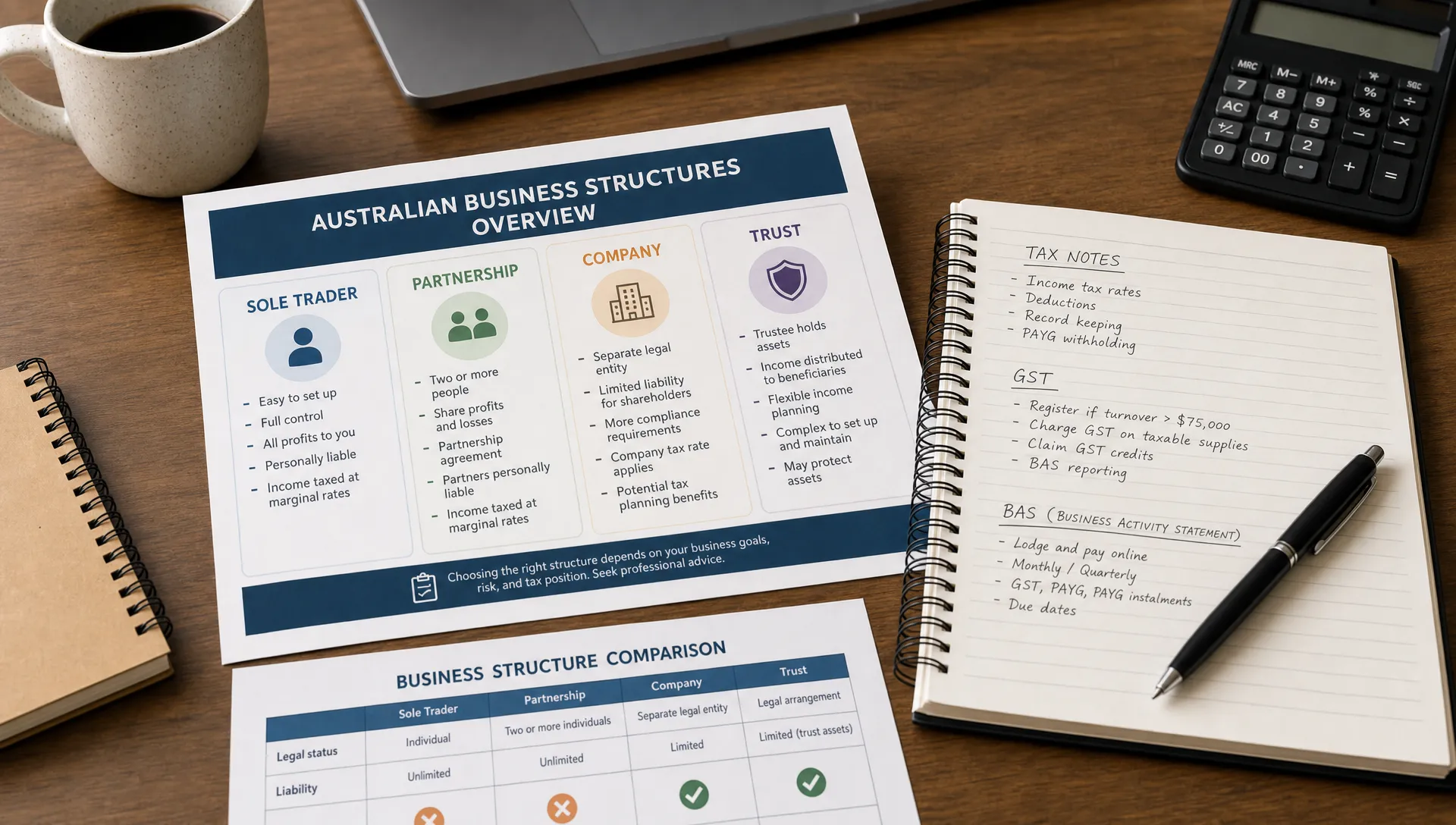
A sole trader structure is often the simplest way to begin trading in Australia. The individual owns and operates the business, usually under their own TFN, with an ABN for business dealings. Business income is included in the individual’s tax return and taxed at marginal rates.
This structure can suit consultants, freelancers, tradies, creatives, digital nomads and micro-business owners who have low commercial risk and limited need for retained earnings.
The key tax advantage is simplicity. There is no separate company tax return, no shareholder structure and generally fewer governance requirements. However, simplicity has a trade-off. The owner and the business are not legally separate. If the business incurs debts or faces legal claims, personal assets may be exposed.
From a tax planning perspective, sole traders need to watch several areas carefully. If business income grows materially, marginal tax rates may exceed the company tax rate. If the owner is providing personal services, the personal services income rules may restrict income splitting or deductions. If turnover reaches the GST registration threshold, GST registration and BAS reporting become mandatory.
We also place strong emphasis on record quality from day one. If the structure is simple but the books are poor, tax outcomes still suffer. Owners should maintain clear records of business income, deductible expenses, GST, motor vehicle use, home office costs and superannuation planning. Our separate guide on what Australian small business owners must track explains the record-keeping foundations that support stronger compliance and planning.
Partnership: shared profits, shared obligations
A partnership involves two or more people or entities carrying on a business together. The partnership itself lodges a tax return, but it does not usually pay income tax. Instead, each partner includes their share of net partnership income or loss in their own tax return.
Partnerships can suit professional collaborations, family businesses, small property ventures or groups of consultants working under a shared model. They can be commercially efficient when all parties have clear roles and aligned expectations.
The risk is that many partnerships are formed informally. Without a well-drafted partnership agreement, disputes can arise over profit sharing, capital contributions, drawings, tax liabilities, client ownership and exit rights.
For tax purposes, partners must understand that their taxable share may not match the cash they physically withdraw. If profits are reinvested but still allocated to partners, tax may be payable without equivalent cash distributions. GST, BAS, PAYG withholding and superannuation obligations also need to be managed at the entity level where applicable.
From a strategic perspective, we rarely assess a partnership only by its current tax outcome. We also assess whether it can support future growth, staff hiring, banking requirements, asset ownership, succession and potential conversion into a company or trust structure.
Company: separate taxpayer, stronger governance and retention capacity
A company is a separate legal entity. It can own assets, enter contracts, employ staff and pay tax in its own right. For many growing Australian businesses, a company structure provides a stronger platform for risk management, reinvestment and expansion.
Companies are taxed at the applicable company tax rate. Many base rate entities are taxed at 25%, while other companies may be taxed at 30%, depending on their circumstances. Directors should confirm the correct rate each year, as eligibility depends on turnover and passive income composition.
A company can retain after-tax profits for working capital, equipment, hiring, technology investment or expansion. This can be valuable for businesses that want to reinvest rather than distribute all earnings to owners. However, extracting company profits requires careful planning. Owners may receive salaries, director fees, dividends or loan repayments, each with different tax and compliance consequences.
Companies also introduce additional obligations. Directors must manage ASIC requirements, PAYG withholding, superannuation, Single Touch Payroll, FBT where benefits are provided, and Division 7A where private company funds are used by shareholders or associates. A company bank account is not a personal spending account. Poor separation between company and personal funds can create tax risk quickly.
For company directors, structure should be reviewed alongside remuneration strategy, franking credits, director loans, asset purchases and cash flow forecasting. We have covered this in more detail in our article on company tax planning tips for Australian directors.
Trust: flexible distributions, but higher complexity
Trusts are widely used in Australia for family businesses, investment groups and asset protection planning. The most common structure for private businesses is a discretionary trust, often with a corporate trustee.
A trust is not “tax free”. Broadly, trust income is distributed to beneficiaries, who are then taxed based on their own circumstances. This can provide flexibility, but only where the trust deed permits it and the arrangement is commercially and legally sound.
Trusts require disciplined administration. Trustee resolutions usually need to be prepared before 30 June. The trust deed must be reviewed before distributing income, streaming capital gains or franked dividends, admitting beneficiaries or changing control. Losses are generally trapped in the trust and cannot simply be distributed like profits.
Trusts can be powerful, but they are not suitable for every business. A trust may be inappropriate where external investors require ordinary shares, where profits need to be retained in a simple corporate structure, or where the cost of compliance outweighs the benefits.
In our experience, trusts work best when owners understand that flexibility comes with governance. The tax outcome depends on accurate records, timely resolutions, appropriate beneficiary arrangements and a clear understanding of family, asset protection and succession objectives.
Comparing common Australian business structures
| Structure | How income is generally taxed | Strategic strengths | Key risks or limitations |
|---|---|---|---|
| Sole trader | Taxed to the individual at marginal rates | Simple, low setup cost, direct control | Personal liability, limited income planning, marginal tax pressure as profits grow |
| Partnership | Net income allocated to partners and taxed in their hands | Shared ownership, relatively simple for small groups | Partner disputes, joint obligations, taxable profit may differ from cash drawings |
| Company | Company pays tax as a separate taxpayer | Profit retention, governance, growth funding, risk separation | Director duties, Division 7A, FBT, payroll and ASIC compliance |
| Trust | Beneficiaries generally taxed on distributed income | Distribution flexibility, succession and asset planning | Complex deed rules, trustee resolutions, trapped losses, higher administration |
This comparison is a starting point, not a substitute for tailored advice. The same structure can produce very different outcomes depending on turnover, industry, debt, family circumstances, payroll, property ownership and exit strategy.
Tax areas your structure changes beyond the annual return
Many owners focus on income tax first. That is understandable, but incomplete. Structure affects several interconnected tax and compliance areas.
GST and BAS reporting
GST registration is generally required once annual GST turnover reaches the registration threshold. For most businesses, that threshold is $75,000, while non-profit organisations have different rules. Once registered, the structure determines which entity reports GST and lodges BAS.
This matters when a business has multiple trading entities, related-party transactions, property activities or cross-state operations. Poorly mapped GST flows can cause errors in BAS reporting, input tax credit claims and cash flow forecasting.
PAYG withholding and superannuation
When a business employs staff, payroll becomes a major compliance area. The employing entity must manage PAYG withholding, superannuation guarantee, Single Touch Payroll and employee records.
Structure also affects owners. A sole trader does not employ themselves, while a company may pay a director salary or wages. Trusts and companies need clarity on who is being paid, in what capacity, and whether superannuation applies.
With payday super scheduled to commence from 1 July 2026, payroll system accuracy and cash flow discipline are becoming even more important. Businesses should ensure payroll data, superannuation clearing processes and bank funding cycles are aligned well before the deadline.
Fringe benefits tax
FBT can arise where employers provide benefits to employees or their associates, including cars, entertainment, expense payments or certain loan arrangements. Companies and trusts with employees, including working directors in some cases, need to assess FBT exposure carefully.
The structure does not remove the need to review benefits. It changes who provides the benefit, who receives it, and how it should be reported.
Capital gains tax and future sale planning
Structure can materially affect the tax outcome when a business asset is sold. Australian small business CGT concessions may be available in some circumstances, but the rules are technical. Eligibility can depend on turnover, net asset value, active asset use, ownership period, connected entities and significant individual tests.
The best time to plan for an exit is not when a buyer appears. It is years earlier, when the structure, ownership percentages, asset locations and accounting records can still be organised strategically.
Asset protection and commercial risk
Tax efficiency should never be assessed separately from risk. A builder, medical specialist, logistics operator, property developer or e-commerce importer may have very different exposure from a home-based consultant.
A company or trust with a corporate trustee may help separate business risk from personal assets, but structure alone is not a complete asset protection strategy. Contracts, insurance, financing arrangements, director guarantees and related-party loans must also be reviewed.
How structure affects growth strategy
A business structure should support how the owner plans to make money, retain money and eventually extract value.
Profit retention and reinvestment
If a business needs to reinvest heavily in stock, equipment, staff, technology or interstate expansion, a company can be attractive because after-tax profits may remain in the entity. This can support working capital and reduce the need to distribute all profits annually.
However, company profits are not automatically the owner’s personal funds. Dividends, wages and loans must be managed properly. Poorly documented drawings can trigger Division 7A issues, unexpected tax or cash flow pressure.
Family wealth and succession
For family-owned businesses and high-net-worth groups, structure often intersects with estate planning, asset protection and intergenerational wealth transfer. Trusts may provide flexibility, but they need careful governance. Companies may be easier for equity ownership and succession, but share transfers can create tax and duty implications.
We typically review control mechanisms, appointor roles, shareholder agreements, unit holdings, wills and enduring powers of attorney alongside tax considerations. A technically efficient tax structure can still fail if control passes to the wrong person or if the succession pathway is unclear.
Raising capital and admitting investors
A startup, SaaS business, property syndicate or scaling professional firm may eventually need external capital. Investors often prefer company structures because shares are familiar, governance is clearer, and equity rights can be documented through shareholder agreements.
Trust structures can be less attractive for some investors, depending on the type of trust, distribution rules and control provisions. Restructuring later may be possible, but it can trigger income tax, CGT, stamp duty and commercial issues.
Multi-city and cross-state operations
Businesses operating across Adelaide, Sydney, Melbourne and other Australian markets need structure and systems that support consistent reporting. Payroll tax, workers compensation, state-based registrations, leases, employment arrangements and local compliance requirements can quickly become fragmented.
Our team approaches structure design with national scalability in mind. The aim is to keep compliance coherent while giving directors real-time visibility over performance by entity, location and business unit.
When it may be time to review or restructure
A structure that was appropriate at launch may become inefficient or risky as the business grows. We generally recommend a formal structure review when there is a material change in profit, risk, ownership or growth plans.
Common triggers include:
- Profit consistently exceeding what the owner needs for personal living costs.
- Hiring employees or engaging a significant contractor workforce.
- Taking on commercial leases, equipment finance or director guarantees.
- Adding business partners, investors or family members.
- Purchasing property or high-value assets.
- Expanding across states or opening multiple locations.
- Preparing for sale, merger, succession or retirement.
- Experiencing ATO scrutiny, late lodgements or cash flow stress.
Restructuring should never be rushed. Some small business restructures may access rollover relief, but eligibility must be carefully tested. There may also be GST, CGT, stamp duty, employment, contract assignment and financing consequences.
This is why we prefer to model restructuring options before implementation. The cheapest structure to set up is not always the cheapest structure to operate, fund or exit.
The digital layer: structure needs real-time financial visibility
Modern tax planning depends on timely data. If books are months behind, GST coding is inconsistent or payroll is reconciled late, structure advice becomes reactive.
We use AI-driven automation to improve the speed and accuracy of accounting workflows. That means transactions can be coded more consistently, exceptions can be identified earlier, and directors can make decisions with clearer financial visibility. Automation does not replace professional judgement. It gives advisers and business owners better data to work with.
For example, a company director should not discover a Division 7A loan issue after year-end. A trust should not realise in July that distribution decisions were not supported by accurate profit data before 30 June. A growing employer should not wait until BAS preparation to discover superannuation or PAYG withholding errors.
Digital accounting workflows allow compliance to become the foundation for strategic advisory. When entity-level data is current, we can forecast tax, model remuneration, assess cash flow, monitor GST and plan capital expenditure before decisions become urgent.
For business owners who want year-round oversight, we have also outlined what a business tax accountant should be reviewing throughout the year, including BAS, payroll, GST, superannuation and tax planning checkpoints.
Practical decision framework before choosing a structure
Before choosing or changing a structure, we recommend working through a structured review rather than focusing on tax rates alone.
Key questions include:
- What level of annual profit is expected over the next three years?
- Does the owner need to withdraw all profits, or will profits be reinvested?
- What commercial risks exist in the industry, contracts or assets?
- Will the business employ staff or engage contractors?
- Is the business likely to register for GST or operate across multiple states?
- Are family members, partners or investors involved?
- Will the business own property, intellectual property, stock or equipment?
- Is there a likely sale, succession event or restructure in the medium term?
- Are current accounting systems accurate enough to support tax planning?
The answers often point to a preferred structure, or at least reveal where further modelling is needed. In some cases, the current structure is still suitable but needs better bookkeeping, payroll controls and tax forecasting. In other cases, the structure itself is holding the business back.
Frequently Asked Questions
What is the best structure for small business tax in Australia? There is no single best structure. A sole trader may suit a low-risk consultant, while a company or trust may be more appropriate for a growing business with employees, retained profits, commercial risk or succession needs. The right structure depends on tax, legal, cash flow and strategic factors.
Does a company always reduce tax for a small business owner? Not always. A company may pay tax at a lower rate than the owner’s marginal rate, but extracting profits through wages, dividends or loans creates further tax considerations. Division 7A, PAYG withholding, superannuation and FBT must also be managed.
Can I start as a sole trader and restructure later? Yes, many businesses start as sole traders and restructure as profits, risk or complexity increase. However, restructuring can trigger tax, GST, stamp duty, contract and financing issues. It is better to review options before the business becomes difficult to move.
Is a trust better than a company for tax planning? A trust can provide distribution flexibility, but it is more complex and must be administered correctly. A company may be better for retaining profits, admitting investors and building a scalable governance framework. The best option depends on the business model and ownership objectives.
How often should business structure be reviewed? We recommend reviewing structure at least annually as part of tax planning, and immediately before major changes such as hiring staff, buying property, admitting investors, expanding interstate or preparing for sale.
Next steps: align structure, compliance and growth
Business structure shapes far more than your annual tax return. It influences cash flow, risk, funding, payroll, succession and the value you can ultimately extract from the business.
Our team supports business owners, directors and high-net-worth individuals across Australia, with integrated advisory capabilities in Adelaide, Sydney and Melbourne. We combine technical tax expertise with AI-driven accounting automation so clients can move from reactive compliance to real-time financial management and strategic planning.
If you are unsure whether your current structure still supports your goals, contact Perfect Accounting & Tax Services for a consultation. We can review your entity structure, tax position, accounting workflows and growth plans, then help you build a compliant and scalable framework for the next stage of business.