
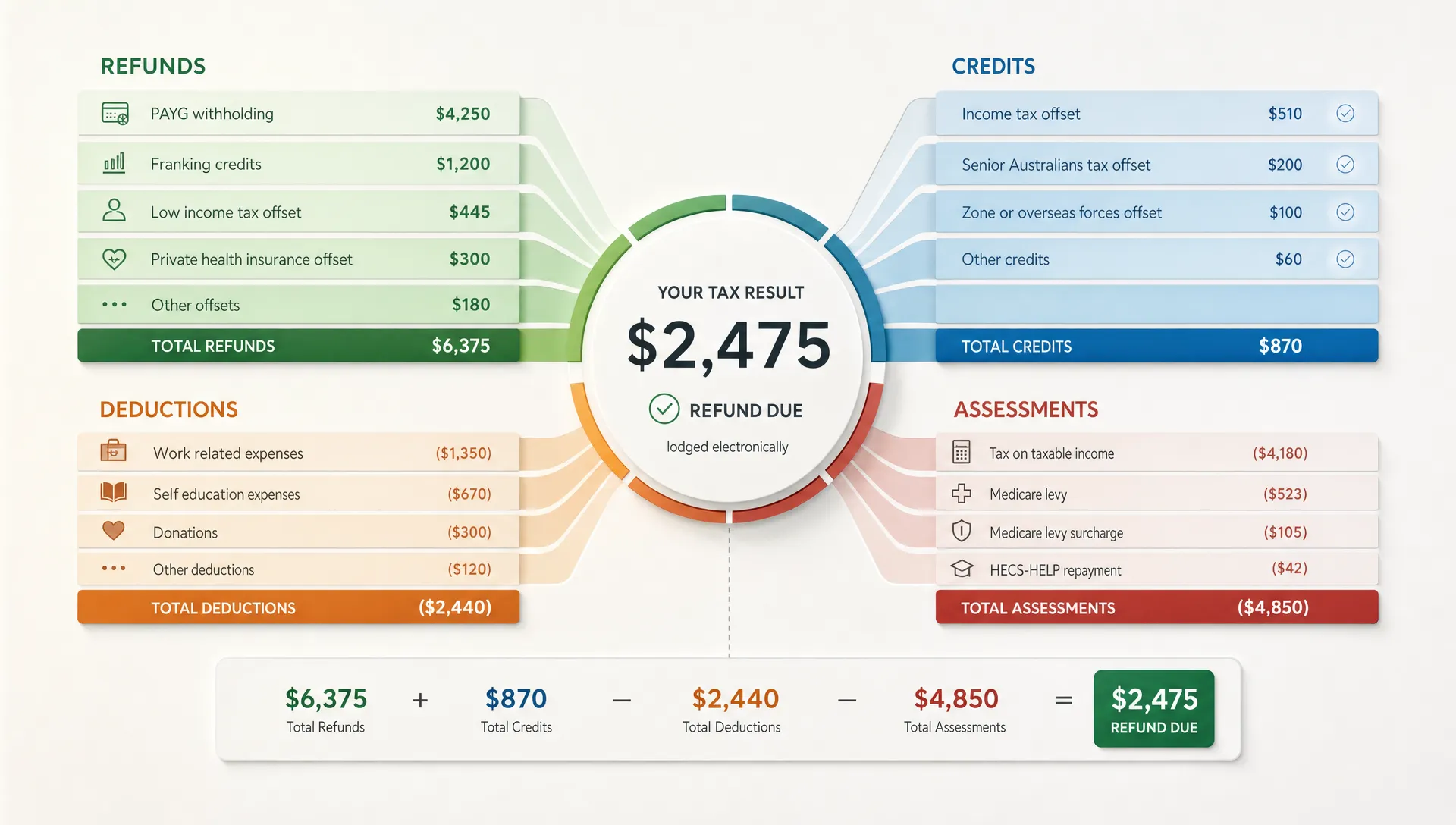
A tax refund is not a bonus from the ATO. It is the result of a reconciliation between the tax you have already paid during the year and the tax you actually owe after income, deductions, offsets, Medicare levy, HELP repayments and other adjustments are calculated.
When clients ask, “tax return Australia how much could I receive?”, our answer is always the same: the refund depends on your structure, your records and how accurately tax was withheld or prepaid during the year. For business owners, company directors and high-net-worth individuals, a large refund can also signal a cash-flow inefficiency. Money held by the ATO for months is money that could have been deployed into working capital, debt reduction or investment.
Our role is to help clients across Australia, including Adelaide, Sydney and Melbourne, understand the refund position before lodgement and use that insight to improve financial decision-making.
What determines your tax refund in Australia?
At a high level, your refund or tax payable is calculated using this logic:
Tax already paid or credited minus final tax liability equals refund or amount payable.
For employees, tax already paid usually means PAYG withholding from wages or salary. For sole traders, investors and business owners, it may also include PAYG instalments, franking credits, foreign tax credits or other credits recognised in the return.
Your final tax liability is calculated after the ATO assesses taxable income, allowable deductions, tax offsets, Medicare levy, Medicare levy surcharge where applicable and compulsory repayments such as HELP, VET Student Loan or other study and training support debts.
The most important drivers are:
| Refund driver | How it affects your result | Strategic issue to review |
|---|---|---|
| PAYG withholding | More tax withheld during the year can increase the chance of a refund | Excess withholding can reduce cash flow during the year |
| Deductions | Valid deductions reduce taxable income | Poor records can mean missed claims or ATO risk |
| Tax offsets | Offsets reduce tax payable and can improve the refund outcome | Eligibility can change each year |
| Medicare levy and surcharge | These can increase final tax payable | Private health cover and income thresholds matter |
| HELP or study debt repayments | Compulsory repayments can reduce or eliminate a refund | Repayment income is broader than taxable income |
| Business or investment income | Extra income can turn a refund into tax payable | PAYG instalments and planning should be reviewed |
A refund should never be viewed in isolation. We look at the broader pattern: whether PAYG withholding is calibrated correctly, whether deductions are properly substantiated and whether business or investment income has been planned before 30 June.
The current tax rate context for 2025-26 returns
For 2025-26 tax returns lodged in 2026, resident individual tax rates apply on taxable income after deductions. The Medicare levy is generally calculated separately.
| Taxable income for Australian residents | Tax payable before Medicare levy |
|---|---|
| $0 to $18,200 | Nil |
| $18,201 to $45,000 | 16c for each $1 over $18,200 |
| $45,001 to $135,000 | $4,288 plus 30c for each $1 over $45,000 |
| $135,001 to $190,000 | $31,288 plus 37c for each $1 over $135,000 |
| $190,001 and over | $51,638 plus 45c for each $1 over $190,000 |
These rates make your marginal tax rate important. If you are in the 30% bracket, a $1,000 deduction generally reduces income tax by about $300, not by $1,000. Medicare levy, HELP repayments and other factors can change the final impact.
We recommend reviewing the latest rate settings before making distribution, bonus, salary sacrifice or trust planning decisions. Our detailed guide to tax rates in Australia for 2026 explains the broader tax environment for individuals and businesses.
Why two people on the same income can receive different refunds
Two taxpayers can earn the same salary and receive very different outcomes. The difference usually comes down to withholding, deductions, offsets and other obligations.
For example, assume an Australian resident employee earns $85,000, has $3,000 of allowable deductions and had $21,000 withheld through payroll. Their taxable income becomes $82,000. Using 2025-26 resident rates, income tax before Medicare would be approximately $15,388. Add a Medicare levy of approximately $1,640 and the total becomes about $17,028 before any other adjustments. If there is no HELP debt or other liability, the refund could be around $3,972.
If the same person had a HELP debt, private health insurance surcharge exposure or additional investment income, the refund could be much lower. If they had under-withheld because they worked multiple jobs and claimed the tax-free threshold twice, they may owe tax instead.
The tax-free threshold is particularly important for employees with more than one payer, directors drawing wages from their own company and professionals who change jobs during the year.
Common deductions that can increase a refund
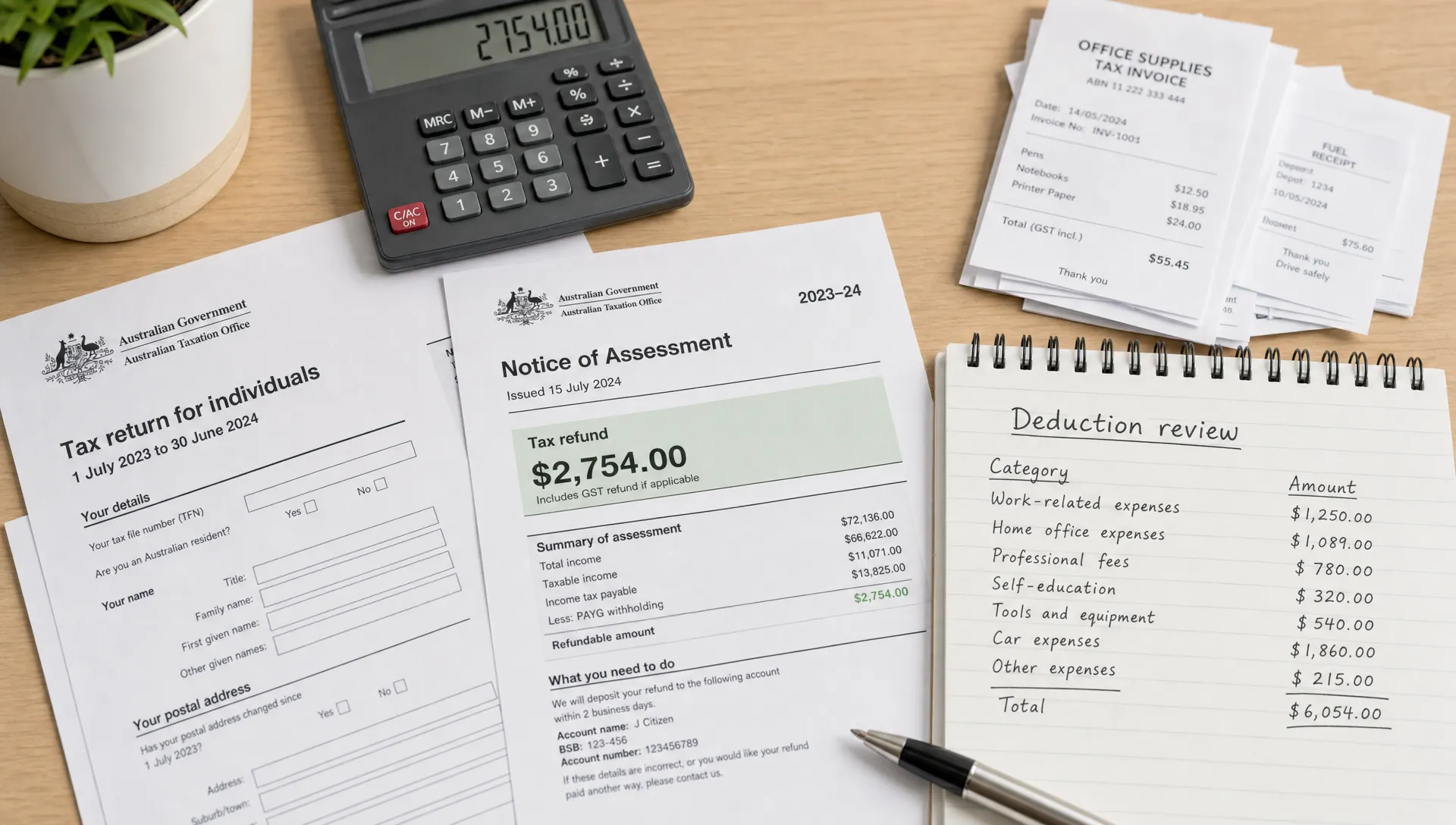
Deductions are one of the most misunderstood parts of an Australian tax return. A deduction must be connected to assessable income and properly substantiated. Private expenses, estimates and unsupported claims can create ATO exposure.
Common deduction areas include:
- Work-related professional expenses, including subscriptions, licences, professional indemnity insurance and continuing education
- Home office costs, where records support the method used
- Motor vehicle and travel expenses, subject to strict substantiation rules
- Tools, equipment, software, devices and depreciation where there is a genuine work or business connection
- Tax agent fees, income protection insurance and deductible donations to registered deductible gift recipients
- Investment property costs such as interest, rates, repairs, agent fees and depreciation where correctly classified
- Sole trader and business expenses, including trading stock, contractor costs, business insurance, accounting systems and eligible asset claims
For business owners, GST registration adds another layer. If you have claimed GST credits through BAS, your income tax deduction is generally based on the GST-exclusive amount. This is a common area where integrated bookkeeping and tax workflows prevent double counting.
Business owners, directors and investors need a broader refund strategy
For employees with simple salary income, a refund estimate may be straightforward. For business owners, company directors and investors, the refund position is usually tied to a wider tax and cash-flow strategy.
Sole traders and freelance professionals
Sole traders report business income in their individual tax return. A refund may arise if PAYG instalments were too high or if deductions reduced taxable income more than expected. A tax payable amount may arise if profits grew but instalments did not keep up.
This is where tax planning becomes more valuable than year-end compliance. Our article on small business tax return planning in Australia explains why early forecasting can protect cash flow and reduce lodgement stress.
Company directors
Company directors may receive salary, director fees, dividends, trust distributions or loan account movements. Each has different tax consequences. A refund may be reduced by Division 7A issues, unfranked dividends, unpaid PAYG instalments or personal services income considerations.
We often see directors focus on the individual refund while overlooking the company’s tax position, BAS obligations, payroll tax risk or superannuation guarantee compliance. A coordinated review gives a clearer picture of the total group tax outcome.
Property investors and landlords
Investment property can increase or reduce a refund depending on the cash-flow profile of the asset. Negative gearing may reduce taxable income where deductible expenses exceed rental income. Positively geared properties can increase tax payable.
The key is classification. Repairs, initial repairs, capital works, depreciating assets and borrowing costs are treated differently. High-net-worth investors and commercial landlords should also consider GST, CGT, land tax and entity structure before making major acquisitions or disposals.
Healthcare, creative and specialist professionals
Industry context matters. A medical specialist, dental practitioner, architect, consultant or creative director may have a deduction profile that differs from a PAYG employee in a standard office role. For example, a clinician working in a Brisbane practice environment, such as CP Dental’s dentistry services in Brisbane, may need to consider professional development, registration, equipment and work-related insurance records in a way that reflects their actual income-producing activities.
The principle is consistent across sectors: the claim must be connected to earning income and supported by evidence.
Why your refund may be lower than expected
A lower-than-expected refund does not always mean something is wrong. It may mean your withholding was accurate. From a strategic perspective, that can be a positive outcome because it means less of your money was locked away until lodgement.
Common reasons refunds fall short include:
- Additional income from bank interest, dividends, managed funds, crypto assets, rental properties or foreign sources
- HELP, VET Student Loan or other compulsory repayment obligations
- Medicare levy surcharge for higher-income taxpayers without appropriate private hospital cover
- Incorrectly claiming the tax-free threshold with multiple employers
- PAYG instalments set too low for sole traders or investors
- Disallowed deductions due to missing records or private use apportionment
- Capital gains from shares, property, crypto assets or business interests
For company directors and business owners, a low refund can also reflect timing differences. Profit may sit in a company, trust or SMSF rather than the individual return. A personal refund estimate should therefore be reviewed alongside company tax, trust resolutions, superannuation contributions and investment entity records.
Can myTax estimate your refund accurately?
ATO myTax can be suitable for taxpayers with straightforward salary income, simple deductions and pre-filled data. It is less reliable as a strategic tool when your affairs include business income, trust distributions, capital gains, rental properties, foreign income, crypto transactions, director loan accounts or complex deduction claims.
Pre-fill data is helpful, but it is not a substitute for review. It may not capture all deductible costs. It can also arrive late or require verification against your own records. Our guidance on when to use myTax and when to get professional help sets out the distinction in more detail.
From our perspective, the issue is not whether software can lodge a return. The issue is whether the return reflects the correct tax position and supports your wider financial strategy.
How our AI-driven workflows improve refund visibility
Modern tax advisory should not rely on a shoebox of receipts at year-end. We use AI-driven automation and digital workflows to streamline data capture, reconciliation and review. This gives clients faster visibility over likely refund or payable positions before lodgement.
For a business owner, that visibility supports better decisions around PAYG instalments, superannuation contributions, asset purchases, debt management and profit distributions. For high-net-worth individuals, it supports planning around investments, trusts, SMSFs and capital gains.
The practical benefit is simple: fewer surprises. When bookkeeping, BAS, payroll and tax planning are connected, the refund estimate becomes part of a live financial management process rather than a once-a-year calculation.
Practical steps to estimate your refund before lodging
Before lodging your return, we recommend a structured review rather than relying on guesswork.
First, confirm all income sources. This includes salary, director fees, business income, interest, dividends, rental income, capital gains, foreign income and distributions from trusts or partnerships.
Second, reconcile tax already paid. Review PAYG withholding, PAYG instalments, franking credits and foreign tax credits. Business owners should also check whether BAS lodgements align with income tax records.
Third, prepare deduction evidence. Keep invoices, receipts, logbooks, bank statements, loan statements, depreciation schedules and working-from-home records where relevant. The ATO’s focus is not only whether a claim is reasonable, but whether it can be substantiated.
Fourth, identify adjustment items. Medicare levy surcharge, HELP repayments, private health insurance details, spouse income, superannuation contributions and capital gains can materially change the outcome.
Finally, model the result before lodgement. If the estimate shows a large payable amount, there may still be time to manage cash flow, review instalments or correct records before the return is filed.
Frequently Asked Questions
How much tax refund will I get in Australia? Your refund depends on tax withheld or prepaid, taxable income, deductions, offsets, Medicare levy, study debt repayments and other adjustments. There is no standard refund amount that applies to everyone.
Does a higher income mean a bigger tax refund? Not necessarily. Higher income usually means higher tax payable. A higher refund generally occurs when too much tax was withheld or when deductions and credits reduce the final tax liability.
Do deductions give me the full amount back? No. A deduction reduces taxable income. If your marginal tax rate is 30%, a $1,000 deduction usually reduces income tax by about $300 before other adjustments.
Can sole traders receive a tax refund? Yes, but it depends on PAYG instalments, business profit, deductions and other personal tax factors. A profitable sole trader with low instalments may owe tax rather than receive a refund.
Why did I receive a tax bill instead of a refund? Common reasons include investment income, insufficient PAYG withholding, HELP repayments, Medicare levy surcharge, capital gains or PAYG instalments that were too low.
When should I get professional help with my refund estimate? We recommend professional advice if you own a business, receive trust distributions, hold investment property, trade crypto assets, have foreign income, operate through multiple entities or need strategic tax planning before 30 June.
Next steps: turn your refund estimate into a financial strategy
A refund estimate is useful, but the real value comes from understanding what it says about your broader financial position. If your refund is large, we review whether withholding or instalments are too high. If tax is payable, we identify the cause early and build a cash-flow plan around it.
Our team can assist with:
- Personal, business and investment tax return preparation
- PAYG withholding and PAYG instalment reviews
- BAS, GST, payroll and superannuation compliance
- Company, trust, SMSF and property investor tax planning
- AI-driven accounting workflow integration for clearer real-time financial visibility
- Strategic advisory for business growth, restructuring and corporate decision-making
Perfect Accounting & Tax Services supports clients across Australia, with integrated capabilities in Adelaide, Sydney and Melbourne. If you want to know how much tax refund you could receive, and how to use that information strategically, contact our team for a consultation.
We will help you move beyond annual lodgement and build an automated accounting workflow that supports accuracy, compliance and better financial decisions throughout the year.