
Choosing a tax filing office in Australia is not simply about finding someone to lodge a return before the deadline. For business owners, company directors, investors and high-net-worth individuals, the right adviser should reduce compliance risk, improve decision-making and turn tax data into a strategic asset.
In our experience, the best outcomes come when clients stop asking, “Who can file this quickly?” and start asking, “Who can help us understand our position, manage ATO obligations and plan the next financial year with confidence?”
When Australians search for a tax filing office, they are usually looking for a registered tax agent or accounting firm that can handle income tax returns, company tax, BAS, GST, payroll, Superannuation, FBT and ATO communications. The difference between a basic lodgement provider and a strategic accounting partner can be substantial.
Start with your risk profile, not the cheapest quote
A salary-only employee with one payment summary and standard deductions may only need a straightforward lodgement process. A company director, property investor, SMSF trustee or business owner has a different risk profile.
Before choosing a tax filing office, define what you need the firm to protect and improve. This may include ATO compliance, cash flow visibility, deductible expense substantiation, GST reporting, payroll accuracy, Division 7A exposure, FBT obligations or tax planning across entities.
For example, a growing construction firm in Adelaide, an e-commerce business selling nationally, and a Sydney-based medical specialist may all need tax lodgement. However, their reporting systems, GST treatment, payroll complexity and advisory needs are very different.
A strong tax office should ask detailed questions before quoting or lodging. If a provider is ready to file without understanding your business structure, income streams, finance arrangements and ATO history, that is a risk signal.
Verify registration with the Tax Practitioners Board
In Australia, anyone providing tax agent services for a fee must generally be registered with the Tax Practitioners Board (TPB). This is not a formality. Registration helps ensure the adviser meets education, experience, professional conduct and insurance requirements.
You can check whether a tax agent or BAS agent is registered through the TPB public register. We recommend doing this before handing over TFNs, financial statements, payroll data or ATO correspondence.
A registered tax agent can provide tax advice and lodge tax returns with the ATO. A registered BAS agent can provide BAS services, such as GST, PAYG withholding and some payroll-related compliance services, but may not be authorised to handle broader income tax advice unless also registered as a tax agent.
| Credential or capability | Why it matters | What to check |
|---|---|---|
| TPB registration | Confirms legal authority to provide tax agent or BAS services | Search the TPB register by name or registration number |
| Professional experience | Indicates ability to manage complex structures and ATO issues | Ask about similar clients and industries |
| Professional indemnity insurance | Helps protect clients if professional errors occur | Confirm coverage is in place |
| Australian tax expertise | Ensures advice aligns with ATO rules and local obligations | Avoid providers using overseas terminology or generic templates |
| Advisory capability | Moves the engagement beyond annual lodgement | Ask how tax data supports planning and growth |
If you are unsure whether you need a basic preparer or a more strategic adviser, our guide to tax preparers vs accountants explains the difference in an Australian lodgement context.
Match the tax office to your structure and industry
Tax is not one-size-fits-all. The right tax filing office for a sole trader consultant may not be the right fit for a family trust, property development group, SMSF trustee or multi-site hospitality business.
A capable Australian tax office should understand the practical mechanics of your structure. That includes how income is generated, how expenses are substantiated, how GST applies, how wages and Superannuation are processed, and how profits are distributed or reinvested.
| Your situation | Look for a tax office with experience in | Strategic focus |
|---|---|---|
| Company director | Company tax, PAYG withholding, Division 7A, director loans | Profit extraction, cash flow and governance |
| Sole trader or consultant | Business deductions, GST registration, quarterly BAS | Clean records and sustainable tax planning |
| Property investor | Rental income, interest deductibility, repairs vs improvements | Asset-level profitability and evidence management |
| SMSF trustee | SMSF compliance, contributions, pension phase reporting | Risk control and retirement strategy alignment |
| E-commerce operator | Multi-channel income, inventory, GST, platform fees | Margin visibility and automated reconciliation |
| Employer | Payroll, Superannuation, PAYG withholding, FBT | Workforce compliance and cash flow forecasting |
In 2026, payroll and Superannuation compliance remain major focus areas for Australian employers. With payday super now reshaping employer processes from 1 July 2026, businesses should choose a tax office that can connect payroll systems, bank data and reporting workflows rather than treating payroll as a once-a-quarter reconciliation.
Assess the office’s technology and automation capability
A modern tax filing office should not rely solely on spreadsheets, email attachments and manual year-end clean-ups. Those methods increase the risk of missed deductions, duplicate entries, GST coding errors and late discovery of cash flow problems.
We see digital transformation as a core part of tax quality. AI-driven automation can help categorise transactions, detect anomalies, reconcile bank feeds, flag missing documentation and give directors a clearer view of financial performance before year-end.
The point is not technology for its own sake. The point is faster, cleaner and more reliable financial information. When your accounting workflows are automated properly, your tax return is no longer a rushed historical exercise. It becomes the final output of a disciplined financial management system.
When evaluating a tax office, ask how it uses technology to improve accuracy and visibility. The answer should cover more than “we use cloud accounting software.” You want to understand how the firm manages data capture, document retention, bank reconciliations, BAS preparation, payroll reporting and review controls.
A strong process should make it easier to answer these questions at any time of year:
- Are GST and BAS obligations up to date?
- Are payroll and Superannuation amounts reconciled?
- Are director loans or related-party transactions being monitored?
- Are deductions supported by appropriate records?
- Are cash flow and tax instalments aligned with actual profit?
The ATO expects taxpayers to keep appropriate records, generally for five years, and digital records can help meet that obligation when they are complete, accessible and accurate. The ATO record-keeping guidance is a useful benchmark for business owners reviewing their systems.
Look for advisory discipline, not just lodgement capacity
A tax filing office that only contacts you at lodgement time may help meet a deadline, but it will rarely optimise your financial position. For business owners and high-net-worth clients, tax decisions are often made months before the return is prepared.
Strategic advisory looks at timing, structure, cash flow, risk and documentation. It considers whether your business is accumulating profits efficiently, whether your group structure remains appropriate, whether asset purchases are commercially justified, and whether tax planning aligns with expansion, succession or exit objectives.
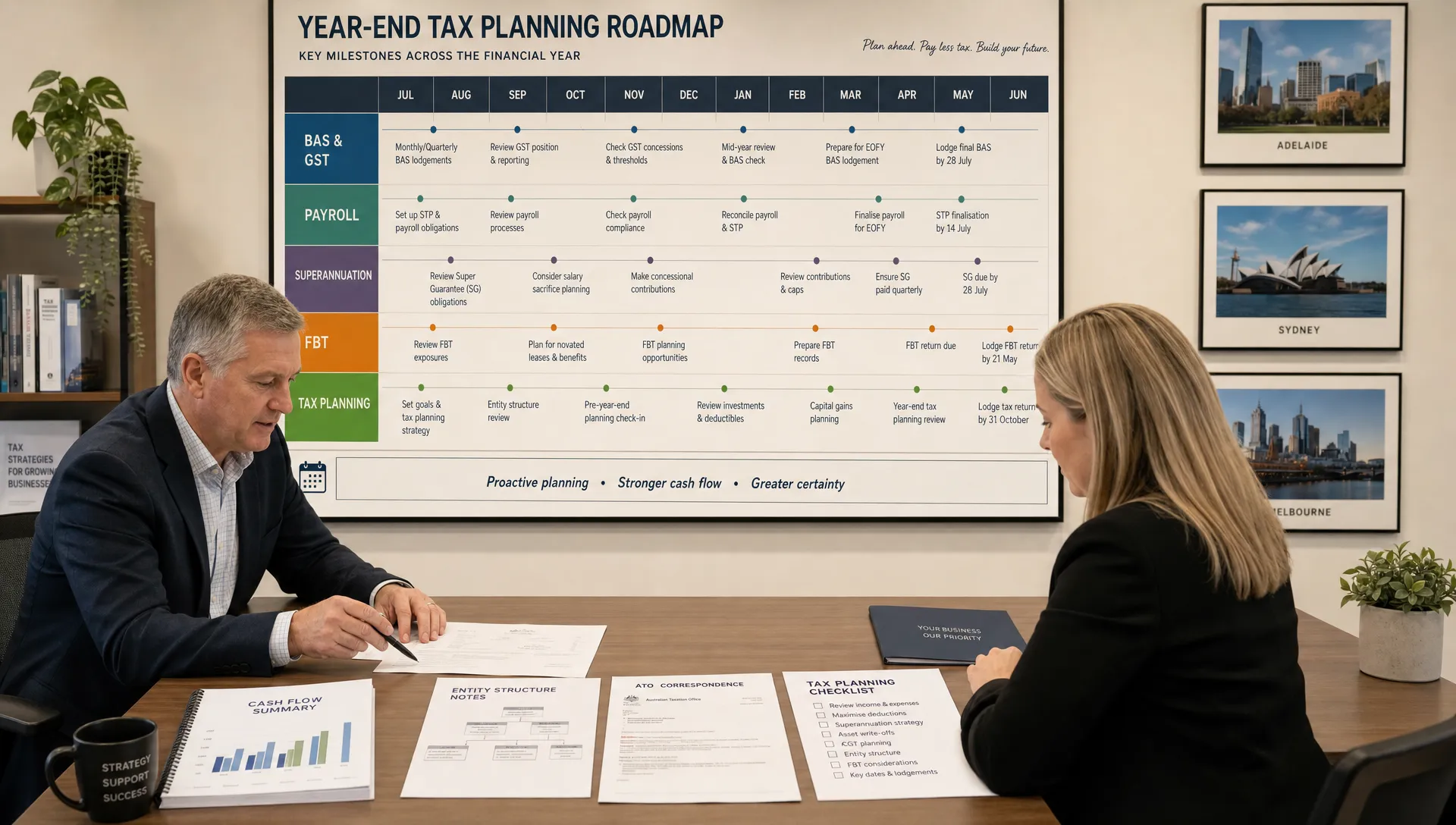
For company directors, this can include reviewing remuneration strategy, dividends, loan accounts, FBT exposure and GST treatment before 30 June. For property investors, it may involve reviewing interest costs, depreciation schedules, ownership structures and capital gains tax implications before a transaction occurs.
If your tax affairs involve multiple entities, significant assets or ATO complexity, lodgement should be the end of the process, not the beginning. We have explored this distinction further in our article on when tax return filing services make strategic sense.

Ask the right questions before you engage
The first consultation should reveal how the tax office thinks. A compliance-only provider may focus narrowly on the forms required. A stronger adviser will ask about business goals, systems, risks, prior-year issues and future decisions.
Use the following questions to assess whether the firm is suitable for your situation:
- Are you registered with the Tax Practitioners Board? Confirm the individual or firm has the correct registration for the services you need.
- Who will review the work before lodgement? Understand whether a senior accountant or tax adviser reviews complex matters.
- What industries and structures do you commonly advise? Look for experience with your type of income, assets and obligations.
- How do you handle BAS, GST, payroll, Superannuation and FBT? Ensure the firm can manage the full compliance picture, not just income tax.
- How do you use automation and AI in your workflow? Look for accuracy, review controls and real-time visibility, not vague technology claims.
- How do you communicate with the ATO on behalf of clients? Clarify authorisation, response times and escalation processes.
- What tax planning happens before 30 June? A serious adviser should have a proactive year-end planning process.
- How do you protect sensitive financial data? Ask about secure portals, access controls and document retention.
The quality of the answers matters. If the response is generic, rushed or unclear, the relationship may become transactional rather than strategic.
Understand how the office deals with ATO issues
Many clients approach a tax office only after receiving an ATO letter, overdue lodgement notice, audit request or payment arrangement issue. At that point, technical accuracy and communication discipline are essential.
A suitable tax filing office should be able to identify the real issue before responding. Is the ATO querying income matching? Is there a GST discrepancy? Has payroll reporting failed to reconcile with activity statements? Are prior-year returns overdue? Is the client exposed because records are incomplete?
We recommend choosing a firm that can reconcile the facts before engaging with the ATO. Fast replies are not always good replies. A rushed response can create inconsistencies that are difficult to unwind later.
If you are already dealing with the ATO, our guide on how to deal with the ATO without costly mistakes outlines a disciplined approach to verification, records and communication.
Consider national capability and local context
Australian tax law is national, but business conditions are local. A Melbourne creative agency, a Sydney corporate group and an Adelaide property developer may operate under the same ATO framework, yet face different commercial pressures, state-based duties, payroll tax considerations, industry practices and financing conditions.
For many businesses, the ideal tax office combines national technical capability with local commercial understanding. Our team supports clients across Australia, with integrated service capability in Adelaide, Sydney and Melbourne. This matters for directors and investors who operate across state borders or hold assets in multiple jurisdictions.
The practical question is not whether the adviser is physically nearby. The better question is whether the adviser can collaborate efficiently, access accurate records, understand your operating environment and provide timely advice when decisions need to be made.
With secure digital workflows, remote advisory meetings and automated accounting systems, location should not limit the quality of advice. However, local knowledge remains valuable when dealing with business networks, property markets, industry conditions and state-based compliance interactions.
Watch for warning signs
Not every tax office is suitable for complex or growth-focused clients. Some providers are built for high-volume, low-complexity returns. That may be appropriate for simple taxpayers, but it can be risky for directors, investors and businesses with multiple obligations.
Be cautious if you notice the following signs:
- The firm promises maximum refunds without reviewing records.
- The adviser does not discuss TPB registration or engagement terms.
- The process relies heavily on email attachments with no secure document workflow.
- BAS, GST, payroll and Superannuation are treated as separate from tax planning.
- No one asks about your business structure, loans, assets or related entities.
- The office only communicates during tax season.
- The adviser cannot explain how deductions are substantiated under ATO expectations.
A good tax office should be commercially practical, but also evidence-based. Tax advice that cannot be supported by records, legislation or ATO guidance can expose you to penalties, interest and unnecessary stress.
Compare service model, not just fees
Fees matter, but they should be assessed against complexity, risk and value. A low-cost return that misses GST errors, payroll issues, FBT exposure or director loan problems can become expensive later.
When comparing offices, ask what is included. Does the fee cover review of prior-year issues? BAS alignment? ATO correspondence? Tax planning? Financial statements? Company, trust or SMSF reporting? Advice on record-keeping systems?
A transparent tax office should explain the scope of work before engagement. It should also tell you what is outside scope, so there are no surprises if additional advisory work is required.
For sophisticated clients, we generally recommend comparing firms across four dimensions: compliance quality, advisory capability, technology workflow and relationship depth. Price should be considered only after those fundamentals are clear.
| Evaluation area | Basic provider | Strategic tax filing office |
|---|---|---|
| Lodgement | Prepares and submits returns | Reviews tax position in context |
| Records | Requests documents at year-end | Uses digital workflows throughout the year |
| BAS and GST | May treat separately | Reconciles with income tax and cash flow |
| Payroll and Superannuation | May review only if requested | Integrates payroll compliance into advisory |
| ATO support | Reactive | Structured, evidence-based and proactive |
| Business growth | Limited discussion | Uses financial data to support decisions |
How to prepare before contacting a tax filing office
The more organised your records, the more strategic the first meeting can be. Instead of spending the consultation reconstructing basic information, your adviser can focus on risk, planning and opportunities.
Before contacting a tax office, gather your recent tax returns, BAS lodgements, financial statements, payroll reports, bank statements, loan statements, investment summaries and ATO correspondence. If you use cloud accounting software, ensure your access permissions, bank feeds and reconciliations are current.
For companies and trusts, also prepare details of shareholders, beneficiaries, director loans, inter-entity transactions and asset purchases. For property investors, include rental statements, loan interest summaries, repair invoices, depreciation schedules and settlement documents for acquisitions or disposals.
For employers, payroll reports, Superannuation payment confirmations and any FBT-related information should be available. These records help the adviser assess whether employment obligations are aligned with ATO and Superannuation requirements.
Preparation also helps your adviser identify whether automation can improve your workflow. In many cases, the biggest improvement is not in the tax return itself. It is in the monthly or quarterly accounting process that feeds the return.
Frequently Asked Questions
What is a tax filing office in Australia? A tax filing office is commonly understood as a tax agent or accounting firm that prepares and lodges tax returns. In Australia, paid tax agent services should generally be provided by a registered tax agent listed with the Tax Practitioners Board.
Should I choose a local office or an online accounting firm? Choose based on capability, registration, communication and systems. Local context can be useful, but a digitally enabled Australian firm can support clients nationally if it has secure workflows, strong review processes and relevant expertise.
How do I know if a tax office is legitimate? Check the TPB public register, confirm the scope of services, ask who reviews the work and ensure the firm uses secure processes for TFNs, financial records and ATO communications.
Can a tax filing office help with BAS and GST? Yes, if the adviser is appropriately registered and experienced. Businesses should ensure BAS, GST, PAYG withholding, payroll and income tax are considered together, because errors in one area often affect another.
When should I contact a tax office before year-end? Ideally, contact your adviser well before 30 June. Year-end planning is more valuable when there is still time to review profit, deductions, Superannuation, FBT, asset purchases and cash flow.
Next steps: choose a tax office that strengthens your financial position
The right tax filing office should give you more than a completed return. It should provide confidence that your records are accurate, your ATO obligations are under control and your financial data is supporting better decisions.
Our team at Perfect Accounting & Tax Services works with business owners, company directors, investors and high-net-worth individuals across Australia. With 25 years of professional experience and integrated capability in Adelaide, Sydney and Melbourne, we combine Australian tax expertise with AI-driven accounting workflows to improve accuracy, speed and financial visibility.
If you are reviewing your current tax adviser, dealing with late lodgements, preparing for growth or looking to automate your accounting process, we can help you assess the right path forward.
Contact our team for a consultation and learn how our automated accounting workflows can turn tax compliance into a stronger foundation for strategic advisory and corporate growth.