
Reducing tax in Australia is not about chasing aggressive deductions in June. For business owners, company directors and high-net-worth individuals, the better approach is to reduce tax through planning that is commercially sound, well documented and aligned with ATO expectations.
We see the strongest outcomes when tax planning is treated as part of strategic financial management, not as a once-a-year compliance exercise. Clean books, accurate BAS reporting, payroll discipline, superannuation planning, asset decisions and cash flow forecasting all contribute to a lower-risk tax position.
This article is general information only. The right strategy depends on your structure, income profile, assets, risk tolerance and future plans.
Use a risk filter before choosing any tax strategy
A lower tax outcome is only valuable if it survives scrutiny. The ATO has extensive data-matching capability across banks, Single Touch Payroll, superannuation funds, property transactions, share registries, cryptocurrency exchanges and government agencies. That means weak claims are easier to detect than ever.
Before we recommend a tax planning strategy, we usually apply three filters:
- Is the position supported by legislation, ATO guidance or a reasonably arguable interpretation?
- Does the transaction have a genuine commercial purpose beyond saving tax?
- Can the client prove the claim with records, contracts, calculations and timing evidence?
The key distinction is between tax planning and tax avoidance. Tax planning uses the law as intended. Tax avoidance attempts to manufacture a tax benefit through artificial or circular arrangements. In Australia, the general anti-avoidance rules under Part IVA can apply where a scheme is entered into mainly to obtain a tax benefit.
| Lower-risk tax planning | Higher-risk behaviour |
|---|---|
| Claiming deductions for business expenses supported by invoices and business use records | Claiming private expenses through a business without evidence of business purpose |
| Paying deductible superannuation contributions before 30 June within the relevant cap | Backdating contribution paperwork or assuming a contribution is deductible before it reaches the fund |
| Choosing a structure that fits ownership, risk, funding and succession objectives | Restructuring only to divert income with no commercial rationale |
| Reviewing stock, bad debts and depreciation using accurate records | Writing off assets, debts or stock without evidence |
| Preparing valid trust distribution resolutions before the required date | Creating distributions after year-end to suit the tax result |
Build the tax position from clean, real-time records
The safest way to reduce tax starts with accurate data. If the accounting file is incomplete, late or manually coded without review, tax planning becomes guesswork. Guesswork increases the risk of missed deductions, overclaimed deductions, BAS mismatches and ATO questions.
Our preference is to build tax planning from a live financial position. That means bank feeds, supplier invoices, payroll data, GST coding, superannuation obligations, loan accounts and asset registers are regularly reconciled. AI-assisted workflows can help detect anomalies, duplicate transactions, unusual GST treatment and coding patterns that do not match prior periods.
This matters because many tax savings are found in the details. A missed software subscription, unclaimed interest apportionment, incorrect motor vehicle treatment or unreconciled director loan account can change the tax result materially. For small business owners, the foundation is knowing exactly what must be tracked throughout the year, which we cover in our guide to tax for small business in Australia.
Real-time records also support better advisory decisions. If we can see margin pressure, wages as a percentage of revenue, GST liabilities, stock movement and debtor ageing during the year, we can advise earlier. That shifts accounting from tax lodgement to strategic advisory and corporate growth planning.
Select the right structure for commercial reality
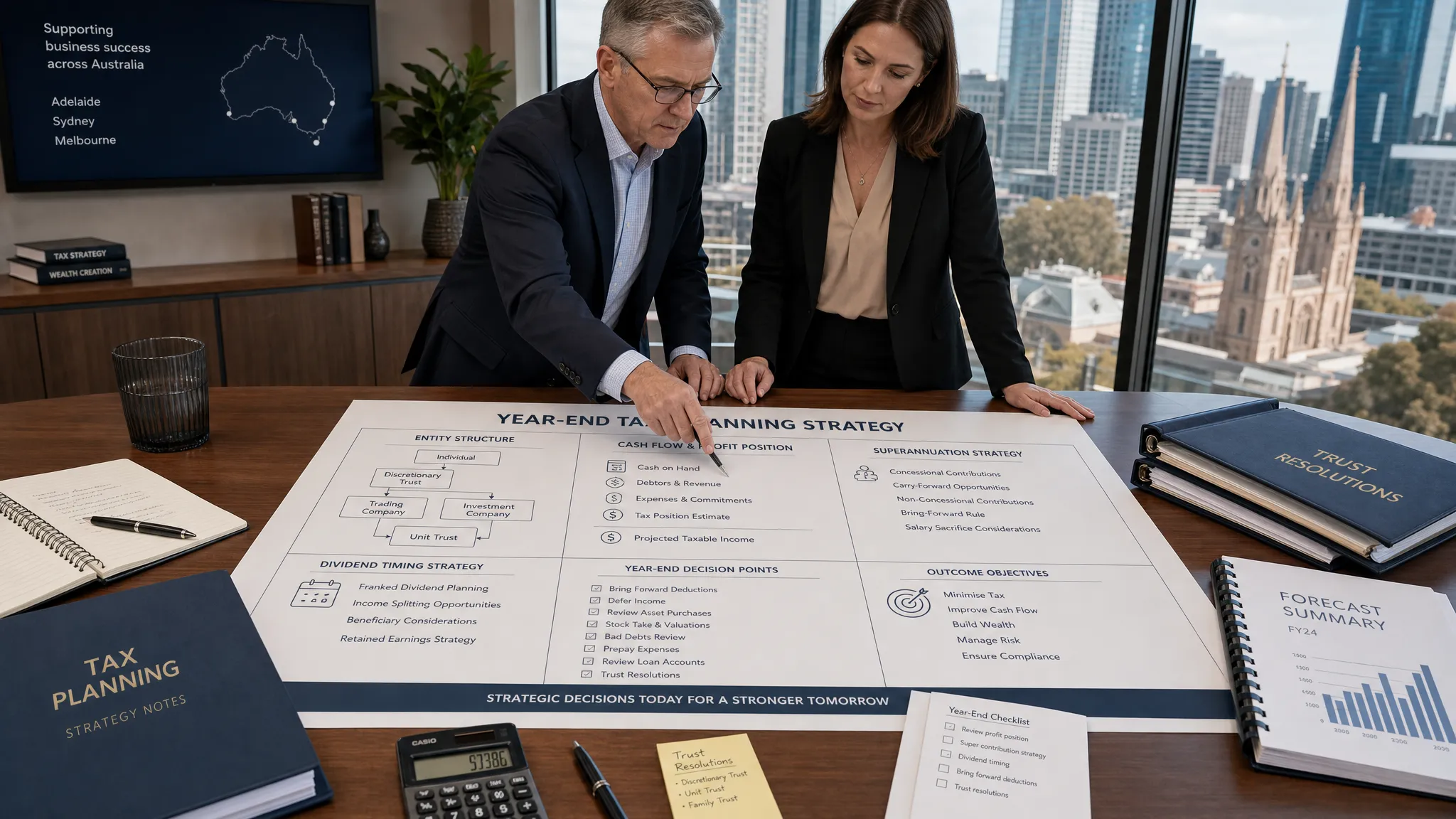
Business structure is one of the most important tax planning decisions in Australia. A sole trader, company, discretionary trust, unit trust, partnership or SMSF will each produce different tax, asset protection, succession and compliance outcomes.
A company may provide access to a corporate tax rate, but company profits are not the end of the tax story. Dividends, franking credits, Division 7A, director loans and retained earnings all need to be managed. A trust may provide distribution flexibility, but the trust deed, beneficiary entitlements, unpaid present entitlements and annual resolutions must be handled correctly.
For directors, the question is not simply how to pay less tax this year. It is how to balance salary, dividends, superannuation, working capital, retained profits, future investment and exit planning. We discuss these issues in more depth in our article on company taxes in Australia.
A restructure should never be undertaken purely for tax. It should be supported by commercial drivers such as investor readiness, risk separation, succession planning, funding, asset protection, operational scale or preparation for sale. The tax outcome should be a consequence of a sound structure, not the only reason for it.
Time income and deductions with discipline
Timing can reduce tax without increasing risk, provided it reflects the law and the actual accounting basis of the taxpayer. The most common mistake is assuming that any payment made before 30 June automatically creates a deduction. It does not.
For businesses, we usually review the following areas before year-end:
| Planning area | What to consider | Risk control |
|---|---|---|
| Prepayments | Some eligible small businesses may claim certain prepaid expenses earlier if the rules are satisfied | Confirm eligibility, period covered and business purpose |
| Bad debts | A debt may be deductible if it was previously included as assessable income and is genuinely bad | Record recovery attempts and write it off before year-end |
| Trading stock | Obsolete, damaged or slow-moving stock may affect taxable income | Keep stocktake records, valuation support and write-down evidence |
| Asset purchases | Depreciation or instant asset rules may apply depending on current law and eligibility | Do not buy assets only for tax, confirm the deduction timing before committing cash |
| Income recognition | Income may be derived in different periods depending on the taxpayer and contract terms | Ensure treatment matches accounting method and legal entitlement |
Before making year-end decisions, it is important to confirm current tax rates, thresholds and business rules. Our 2026 overview of tax rates in Australia can help frame the discussion, but tailored advice is still essential.
A practical reminder is that a deduction does not equal a refund of the full amount spent. If a company spends $10,000 on a deductible item, it reduces taxable income by $10,000, not tax payable by $10,000. The cash flow impact must still make commercial sense.
Use superannuation deliberately, not retrospectively
Superannuation can be one of the cleanest ways to reduce tax in Australia, but only when contribution caps, timing and documentation are managed properly.
For employees, salary sacrifice arrangements can reduce taxable salary while increasing retirement savings. For business owners and investors, personal deductible contributions may be available, subject to eligibility, contribution caps and the requirement to lodge a valid notice of intent with the super fund.
Employer superannuation contributions are generally deductible when they are received by the fund, not merely when they are accrued in the accounting system. This distinction is critical near 30 June. Directors also need to ensure Superannuation Guarantee obligations are met correctly, especially as payday super reforms increase the importance of payroll accuracy from 1 July 2026.
Carry-forward concessional contributions may assist eligible taxpayers with unused concessional cap amounts from prior years, but this is not a simple year-end lever. The total super balance, prior year caps, current year contributions and available cash flow all need to be reviewed before acting.

Treat GST, payroll and FBT as risk controls
GST does not directly reduce income tax, but poor GST treatment can increase risk and damage cash flow. We regularly see issues where GST credits are claimed without valid tax invoices, private expenses are incorrectly treated as creditable acquisitions or BAS figures do not reconcile to the annual accounts.
A lower-risk tax profile depends on BAS consistency. If income reported in activity statements does not reconcile with the tax return, the ATO may ask questions. Automated reconciliation workflows reduce this risk by comparing accounting records, BAS lodgements, payroll data and year-end tax schedules before lodgement.
Payroll is equally important. Wages, PAYG withholding, Superannuation Guarantee, contractor payments and Single Touch Payroll reporting must align. Misclassifying employees as contractors can create tax, superannuation and payroll tax exposure.
FBT should also be planned, not ignored. Motor vehicles, entertainment, car parking, employee benefits and salary packaging can be tax effective in the right circumstances, but they require evidence. Logbooks, employee declarations, reimbursement records and FBT calculations should be maintained throughout the FBT year, which ends on 31 March.
Reduce tax on investments and property without triggering ATO concern
For investors and high-net-worth individuals, tax reduction often involves property, shares, managed funds, trusts, SMSFs and capital gains planning.
Rental property deductions are an area of active ATO scrutiny. Interest, repairs, travel, depreciation, capital works and mixed-use expenses must be treated correctly. Repairs may be deductible, while improvements are often capital in nature. Interest may need to be apportioned if borrowings have mixed private and investment purposes.
Capital gains tax planning requires timing and evidence. Individuals and trusts may access the CGT discount if the asset has been held for at least 12 months, while companies generally do not receive that discount. Small business CGT concessions can be powerful, but the eligibility tests are complex and require careful review of turnover, assets, ownership, active asset status and connected entities.
For SMSF trustees, the risk threshold is higher. The sole purpose test, arm’s length dealings, contribution rules, related-party transactions and investment strategy requirements must be respected. Tax benefits inside superannuation should never override trustee duties.
Consider higher-value strategies only with stronger governance
Some tax planning opportunities are valuable but require deeper technical support. These include research and development claims, employee share schemes, business restructures, international expansion, trust distribution planning, succession strategies, deductible financing reviews and donations to deductible gift recipients.
The risk is not that these strategies are inherently wrong. The risk is poor design, poor documentation or using a strategy that does not fit the facts. For example, an R&D claim must be supported by eligible activities and evidence, not just the fact that a business built software. A donation must meet the rules for deductible gift recipients and must not simply be a disguised private benefit.
For growing companies, the tax plan should be integrated with board reporting, cash flow, debt covenants, investor expectations and exit planning. A strategy that saves tax but weakens the balance sheet may not be a good strategy.
Create an ATO-ready tax governance file
The best tax plans are easy to explain. If the ATO reviews the position, the file should show what was done, why it was done, when it was done and how the tax treatment was calculated.
A strong tax governance file may include:
- Signed contracts, invoices, receipts and bank payment evidence
- Board minutes or director notes supporting major decisions
- Trust distribution resolutions prepared by the required date
- Division 7A loan agreements and repayment schedules where relevant
- Motor vehicle logbooks and FBT declarations
- Superannuation contribution records and notices of intent
- Asset purchase documents, depreciation schedules and stocktake records
- Loan statements showing purpose and interest apportionment
- Valuations for property, business assets or related-party transactions
This level of documentation does more than protect the tax return. It improves decision quality. When records are complete, advisers can identify trends, forecast tax liabilities, model cash flow and support strategic decisions before problems become expensive.
Frequently Asked Questions
What is the safest way to reduce tax in Australia? The safest approach is to plan early, keep accurate records, claim only legitimate deductions, use the right structure and ensure every position has a commercial basis. Superannuation planning, timing of deductions, correct asset treatment and clean BAS reconciliations are often lower-risk areas when handled properly.
Can a company reduce tax by retaining profits? Retaining profits in a company may defer additional personal tax, but it does not remove tax from the system. Directors must consider dividends, franking credits, Division 7A, working capital, shareholder loans and future extraction of profits. The right answer depends on cash flow and long-term strategy.
Are superannuation contributions a low-risk tax strategy? They can be, provided contribution caps, timing and documentation are correct. Contributions must generally be received by the fund before 30 June to be deductible for that year. Personal deductible contributions also require a valid notice of intent and acknowledgement from the fund.
Does buying assets before 30 June always reduce tax? No. The deduction depends on the asset, the taxpayer’s eligibility, the depreciation rules and the date the asset is first used or installed ready for use. Spending money purely to get a deduction can harm cash flow and may not produce the expected tax outcome.
What records matter most if the ATO reviews a claim? The most important records are those that prove the amount, timing, business purpose and calculation method. Invoices, contracts, bank records, logbooks, payroll reports, BAS reconciliations, trust resolutions and loan documents are commonly required.
Next steps: reduce tax with controlled risk
Our team helps businesses, directors and high-net-worth individuals across Australia reduce tax through structured, evidence-based planning. We combine 25 years of accounting and advisory experience with AI-driven automation to improve accuracy, speed and real-time financial visibility.
Whether you operate in Adelaide, Sydney, Melbourne or across multiple states, we can review your structure, BAS and GST position, payroll and superannuation systems, director remuneration, investment entities and year-end tax planning opportunities.
If you want to reduce tax without increasing ATO risk, contact Perfect Accounting & Tax Services for a consultation and ask our team how automated accounting workflows can turn compliance into a stronger foundation for strategic advisory and corporate growth.