


When we act as your individual tax accountant for crypto losses, we start with three questions: who owned the assets, what happened to them and which Australian tax rules apply? A falling portfolio balance does not automatically create a deduction. Selling at a loss, losing access to a wallet and holding assets on a failed exchange can produce different outcomes.
We also look beyond the crypto portfolio. For business owners, directors and high-net-worth investors, a loss may affect capital gains planning, liquidity and the accuracy of earlier returns. It generally cannot be used to reduce salary or business income simply because the investment performed poorly.
Our approach combines technical analysis with digitally organised evidence. We use that foundation to identify legitimate claims, avoid unsupported deductions and improve visibility across personal investments and business interests. In this guide, we explain what needs reviewing before a crypto loss belongs in an Australian tax return.
What an individual tax accountant needs to establish
We first distinguish investing in crypto assets from carrying on a crypto trading business. Transaction volume alone does not settle that question. We assess the commercial purpose, businesslike organisation, repetition, scale and surrounding circumstances.
For an individual holding crypto as an investment, disposals generally fall under capital gains tax (CGT). Capital losses can reduce capital gains, but they cannot ordinarily reduce wages, rental income or business profits.
Where activity genuinely constitutes a trading business, revenue and trading stock rules may apply instead. We also consider the non-commercial loss rules, which can defer deductions against other income. We cannot simply select whichever classification produces the smallest tax bill.
Ownership matters just as much. A director's personal crypto losses cannot automatically offset gains made by their company, trust or self-managed superannuation fund. We trace the legal and beneficial ownership rather than relying solely on whose email address appears on an exchange account.
We also check whether an asset was genuinely a personal-use asset. Losses on personal-use assets are disregarded for CGT purposes. We do not assume that paying for something with crypto makes a previously investment-focused holding personal use.
Identify a tax event, not just a price decline
Our role as an individual tax accountant includes separating realised losses from movements shown on a portfolio dashboard. For an investor, a decline in market value generally does not create a capital loss while the asset remains held.
We commonly review disposals involving sales for Australian dollars, crypto-to-crypto exchanges, spending crypto and gifts. Receiving no cash does not mean there was no CGT event. Exchanging one token for another can crystallise a gain or loss in Australian-dollar terms.
Transfers between wallets under the same beneficial ownership generally do not dispose of the transferred asset. However, we examine associated fees and more complex arrangements separately. Bridging, wrapping, liquidity pools and decentralised finance transactions require analysis of the rights surrendered and received, not just the transaction label.
We use the ATO's guidance on crypto asset investments as a starting point, then apply the relevant rules to the actual transaction history.
Timing also matters. A disposal on 1 July generally falls into a different income year from a disposal on 30 June. We cannot ordinarily move a later sale into an earlier return because the price had already fallen before year-end.
Calculate the loss before estimating the tax benefit
We calculate a capital loss by comparing capital proceeds with the asset's reduced cost base. Acquisition records, relevant transaction costs and reliable Australian-dollar valuations support that calculation. We check fees carefully so the same expense is not counted twice.
When engaged as an individual tax accountant, we also reconcile the result with gains elsewhere in the same taxpayer's portfolio. Crypto capital losses are not restricted to offsetting crypto capital gains.
Consider an illustrative Australian-resident investor with no other gains or losses:
| Calculation | Amount |
|---|---|
| Crypto reduced cost base | $40,000 |
| Crypto capital proceeds | $25,000 |
| Capital loss | $15,000 |
| Separate eligible share capital gain, before discount | $35,000 |
| Remaining capital gain after applying the loss | $20,000 |
| Net capital gain after an available 50% CGT discount | $10,000 |
We assume the shareholding satisfies the discount requirements, including the minimum ownership period. Capital losses are applied before the CGT discount, not after it. The $15,000 loss is not a $15,000 tax refund.
We carry any unused net capital loss forward for application against future capital gains. For individuals, these losses generally have no expiry date, but substantiation remains essential. The ATO's capital gains tax guidance explains the broader framework.
Treat stolen crypto and exchange failures separately
We do not treat every inaccessible balance as an immediately deductible loss. The legal position and prospects of recovery can determine whether a loss has crystallised and in which income year.
Lost keys, scams and theft
As an individual tax accountant, we investigate whether the asset is genuinely lost, whether ownership can be established and whether recovery remains possible. A temporarily inaccessible wallet is not necessarily a lost asset for tax purposes.
We seek wallet addresses, acquisition evidence, incident dates, transaction hashes and records of recovery attempts. For theft or scams, police reports and correspondence with exchanges or investigators may support the evidence, but a report alone does not establish the tax outcome.
Insolvent or frozen exchanges
We examine the platform's terms, administrators' reports and any rights to repayment or distributions. A frozen account or exchange collapse does not automatically establish a capital loss equal to the displayed balance.
Depending on the arrangement, the relevant asset may include a contractual claim or another legal right. We may need to establish when that right ends or another relevant event occurs. We also consider later recoveries when assessing the consequences.
Where ownership or recovery rights are uncertain, we coordinate with legal advisers rather than forcing a premature loss into the return. That distinction can prevent an unsupported claim and a later amendment.
Build an evidence file that survives reconciliation
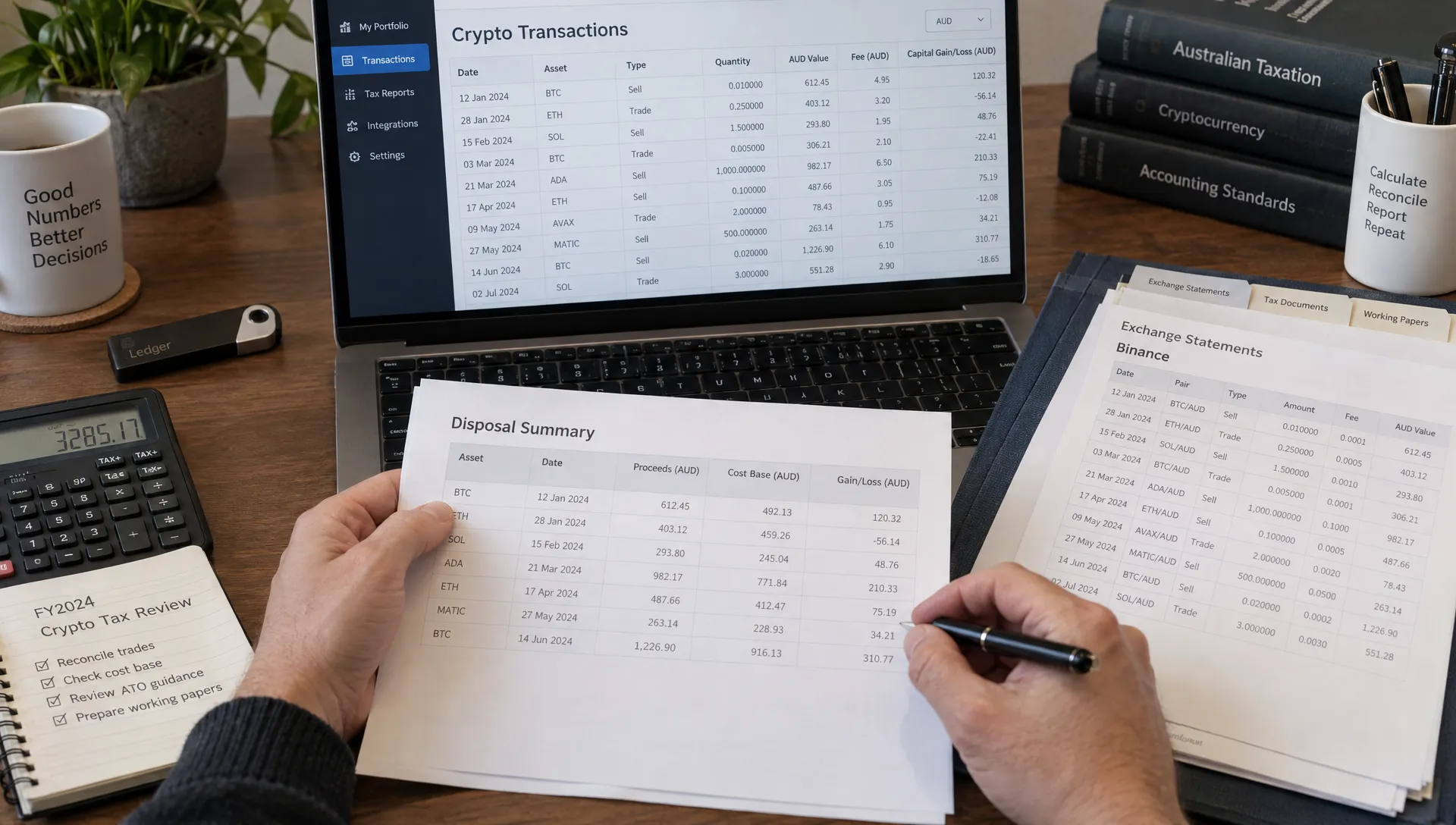
We need more than an annual profit-and-loss screenshot. Exchange reports can omit external wallets, decentralised transactions, historical acquisition costs and activity on closed accounts.
Our work as an individual tax accountant becomes more reliable when we can trace each disposal back to its acquisition and reconcile transfers across the complete portfolio. We request:
- Complete transaction exports: Trade histories, deposits, withdrawals, fees and opening balances from every relevant exchange.
- Wallet evidence: Public addresses and transaction hashes, with a clear record of which wallets belong to the taxpayer.
- Australian-dollar valuations: A consistent, supportable valuation method for transactions recorded in other currencies or tokens.
- Loss-event documents: Scam correspondence, administrator updates, recovery records and evidence of lost access where relevant.
- Earlier tax records: Previous crypto calculations, lodged returns and schedules of carried-forward capital losses.
We never need a seed phrase or private key to review tax records. We recommend read-only access where appropriate and secure document exchange rather than sending sensitive information through ordinary email.
We generally retain CGT records for at least five years after the relevant disposal, and longer where needed to substantiate carried-forward losses. We also preserve original exports alongside any software-generated report so calculations remain traceable if a platform closes or changes its reporting format.
Use AI-driven processes without outsourcing judgement
Our approach combines AI-driven automation with professional review to improve speed, consistency and visibility. For crypto portfolios, we prioritise structured source data and reconciliation before relying on any calculated result.
As an individual tax accountant, we remain responsible for reviewing the assumptions behind the output. Automation can support transaction organisation and highlight exceptions, but it cannot determine legal ownership or resolve an uncertain DeFi arrangement without analysis.
We focus review effort on missing acquisition costs, unmatched transfers, duplicate imports and balances that do not reconcile. Real-time financial visibility is useful only to the extent that connected data is current and complete. We do not confuse a live market valuation with a verified tax position.
For business owners accepting crypto through an online store, we also recommend including finance requirements in website project briefs. When engaging a website development and automation agency such as Digidatale, those requirements might include exportable payment references, timestamps and refund records. We assess the Australian tax treatment separately from the website implementation.
We use this digital foundation to support Strategic Advisory and Corporate Growth. Reliable records help us assess liquidity, tax provisions and investment exposure without treating personal capital losses as operating cash or assuming an expected tax benefit is immediately available.
Avoid decisions that create a second tax problem
We review proposed loss realisation alongside the commercial objective. Selling an investment because its risk no longer suits the portfolio is different from arranging transactions primarily to manufacture a tax benefit while maintaining substantially the same exposure.
When advising as an individual tax accountant, we consider the ATO's wash-sale concerns and Australia's general anti-avoidance rules. We do not treat a fixed waiting period as an automatic safe harbour. Transactions involving related parties also require scrutiny of market value and genuine changes in ownership.
We separately review staking rewards and other crypto receipts. Amounts assessable as ordinary income do not disappear merely because the tokens later fall in value. A subsequent capital loss generally cannot offset that ordinary income directly.
Earlier omissions need attention too. If a previous return excluded token swaps, rewards or disposals, we assess whether an amendment or voluntary disclosure is appropriate. We do not place historical transactions into the current year simply to make the records balance.
Where directors hold crypto alongside property, trust distributions or foreign investments, our approach to managing complex personal income helps connect the loss calculation with the wider tax position.
Choose advice that covers the full decision
We recommend checking Tax Practitioners Board registration before engaging anyone to prepare and lodge a tax return for a fee. We also recommend asking how the adviser handles missing data, disputed ownership and uncertain transactions.
The value of an individual tax accountant lies in the analysis supporting the return, not just producing a software report. We encourage clients to request a clear engagement scope covering the relevant years, exchanges, wallets and any prior-year corrections.
We also clarify whether the work includes calculating losses, reviewing recovery rights, preparing the return and advising on future disposals. Complex reconstruction or legal coordination may require a separate scope. We prefer identifying that early rather than presenting a seemingly complete calculation built on unresolved assumptions.
For business owners, we connect personal tax planning with company cash flow and investment decisions while maintaining the separation between entities. Accurate compliance becomes a foundation for strategic advice, not an isolated annual filing exercise.
Frequently asked questions
Can crypto capital losses reduce salary income? We generally cannot offset an investor's capital losses against salary, interest or rental income. We apply them against capital gains and carry unused amounts forward. Genuine business losses require a separate analysis, including any non-commercial loss restrictions.
Can we claim a loss while the crypto is still held? We generally cannot claim an investment capital loss solely because the market price has fallen. We first need a relevant CGT event. Lost assets and extinguished rights require their own evidence and timing assessment.
Can an individual tax accountant claim losses from a collapsed exchange immediately? We cannot assume an immediate claim is available. We review ownership, creditor rights, recovery prospects and the event that may crystallise the loss. An account balance becoming inaccessible is not enough by itself.
Does selling crypto for another token count as a disposal? We generally treat a crypto-to-crypto exchange as a disposal of the asset given up. We calculate the Australian-dollar proceeds and acquisition value, even when no money reaches a bank account.
What if transaction records are incomplete? We first reconstruct activity from available exchange exports, public blockchain records and bank statements. We document gaps and assess whether the evidence supports a defensible calculation. We do not substitute invented acquisition costs or unsupported estimates.
Next steps: arrange a focused crypto loss review
We recommend starting with complete transaction exports, prior returns and a short explanation of any missing assets or inaccessible accounts. Our guide to preparing for a tax consultation can help organise the broader financial information.
At Perfect Accounting & Tax Services, we draw on 25 years of professional experience and AI-driven processes to support clients across Australia, including integrated service capabilities in Adelaide, Sydney and Melbourne.
Contact our team for a consultation to assess your crypto loss position or discuss our automated accounting workflows. We will establish the scope of review, identify evidence gaps and connect the tax outcome with your wider financial health.
We provide general information in this guide. Our advice depends on the ownership, residency, transaction history and law relevant to each engagement.