

We distinguish the tax office in Australia from a tax agent by separating government administration from independent professional advice. The Australian Taxation Office (ATO) administers federal tax and superannuation laws. Our role as advisers is to help clients understand their obligations, assess lawful options and manage their financial position.
For business owners, company directors and high-net-worth individuals, that distinction determines where an enquiry belongs. An account-access problem, an investment restructuring decision and an unexpected tax debt require different responses. We explain how we allocate those responsibilities, choose the right contact channel and turn reliable compliance records into better commercial decisions.
The ATO administers the system; advisers work for their clients
We treat the ATO as the administrator and regulator, not as an outsourced finance department. It processes returns, maintains tax accounts, collects revenue and undertakes compliance activity. It also publishes guidance and provides assistance with tax administration.
Our advisory role starts with the client's circumstances, objectives and supporting records. We assess how the law applies, prepare relevant submissions and explain the financial consequences of available options.
| Matter | ATO responsibility | Adviser responsibility |
|---|---|---|
| Income tax returns | Process returns and administer assessments | Prepare and lodge accurate returns within the engagement scope |
| Tax debts | Administer collection and payment arrangements | Assess affordability and assist with proposals |
| GST and BAS | Administer reporting and payment obligations | Review treatment, reconcile records and prepare lodgements |
| Reviews and audits | Examine compliance and make decisions | Evaluate evidence and represent authorised clients |
| Business planning | Explain relevant tax administration | Integrate tax, cash flow and commercial objectives |
We also recognise that the ATO can issue private rulings on specified facts. Independent advice and an ATO ruling serve different purposes, and some transactions warrant both.
Which matters belong with the tax office in Australia?
We first identify whether the issue concerns federal taxation or a state or territory obligation. Sending a matter to the wrong authority can delay a transaction or leave a deadline unresolved.
The ATO administers income tax, GST, PAYG withholding, FBT and superannuation guarantee obligations. State and territory revenue authorities generally administer payroll tax, land tax and transfer duty, subject to their respective legislation.
For a group operating across Adelaide, Sydney and Melbourne, we assess each obligation separately. National operations do not create a single payroll tax or property-duty regime. We coordinate the federal position with the relevant state rules rather than assuming one registration or lodgement covers everything.
What registered tax agents do, and what clients retain
When we deal with the tax office in Australia on a client's behalf, we distinguish professional authority from government employment. A registered tax agent is not an ATO employee, and registration does not imply ATO endorsement of every recommendation.
We recommend checking the relevant individual or entity on the Tax Practitioners Board public register. Registration category matters: a registered BAS agent has a different permitted scope from a registered tax agent. We explain the broader distinction in our guide to Australian tax accountant qualifications.
An engagement should establish which entities, taxes, periods and advisory matters are included. We also clarify who maintains source documents, approves returns, monitors notices and authorises payments.
Appointing an agent does not remove the taxpayer's underlying obligations. Directors and business owners still need to provide complete information, review material assumptions and ensure funds are available when liabilities fall due. Where client-to-agent linking applies, we guide the authorisation process without asking clients to share their personal login credentials.
A practical example: business travel with private expenditure
We separate tax administration from advice most clearly when a transaction mixes commercial and personal purposes. Consider an Australian director combining overseas business meetings with a private appointment at a Dubai dermatology and laser clinic.
We would distinguish the private treatment from substantiated business expenditure and assess any mixed-purpose travel costs. If a company pays private expenses, we would also examine whether FBT, Division 7A or another treatment applies to the particular arrangement.
An invoice establishes what was purchased; it does not, by itself, establish deductibility. We would not expect the tax office in Australia to make that commercial allocation for the director during a general account enquiry. Our role is to analyse the facts before the transaction is reported.
How we choose the right ATO contact channel
We start with the ATO's official contact guidance, rather than directory listings, sponsored search results or contact details contained in unexpected messages. We check current hours, service availability and identification requirements before making contact.
| Enquiry | Channel we generally consider first | Preparation we recommend |
|---|---|---|
| Individual account or return enquiry | ATO online services through myGov, or the individuals enquiry line on 13 28 61 | Relevant income year, notice and identity information |
| Business tax account, BAS or GST enquiry | Online services for business, or the business enquiry line on 13 28 66 | ABN, reporting period and account details |
| TFN application or recovery | Official ATO TFN guidance and the applicable identity process | Documents required for the relevant application pathway |
| Superannuation enquiry | ATO online services or the relevant fund, depending on the issue | Fund details, contribution dates and employment records |
| Review, audit or disputed assessment | The official notice and an authorised adviser | Notice date, response deadline and supporting evidence |
We use the specific contact instructions on a genuine ATO notice where appropriate, after independently verifying its authenticity. We also identify language or accessibility requirements early and check the official guidance for interpreting assistance or National Relay Service access.
Online access is different for individuals, businesses and agents
We separate three access pathways. Individuals generally use ATO online services linked to myGov. Business access generally uses Online services for business, with myID and Relationship Authorisation Manager establishing identity and authority. Registered agents use their own authorised professional access.
When accessing the tax office in Australia digitally, we distinguish myGov, the government service account, from myID, the digital identity app. Confusing the two can lead to unnecessary access problems.
We never need a client's myGov password or one-time security code to act as their authorised agent. Instead, we establish the appropriate authority and check that the correct entity is linked.
We also distinguish a lodgement receipt from final resolution. A submitted return, a processed assessment and a payment allocated to the correct account are separate events. Our review process needs to account for each, particularly where a group has several entities or outstanding periods.
Can we walk into an ATO office?
We do not treat an ATO street address as confirmation that public counter service is available. ATO buildings are not general walk-in tax-advice centres. Before attending any location, we check the current official service arrangements, including whether the particular service is available in person and whether an appointment is required.
The ATO's national office is in Canberra, with offices in multiple Australian cities. We do not assume that the nearest office can resolve a specific account issue, or that a nearby Services Australia centre can handle a business tax dispute.
For most matters, we begin with the appropriate online or telephone channel. Where identity assistance or an in-person service is relevant, we confirm the location, required documents and booking arrangements before recommending travel.
How we turn compliance records into strategic advice
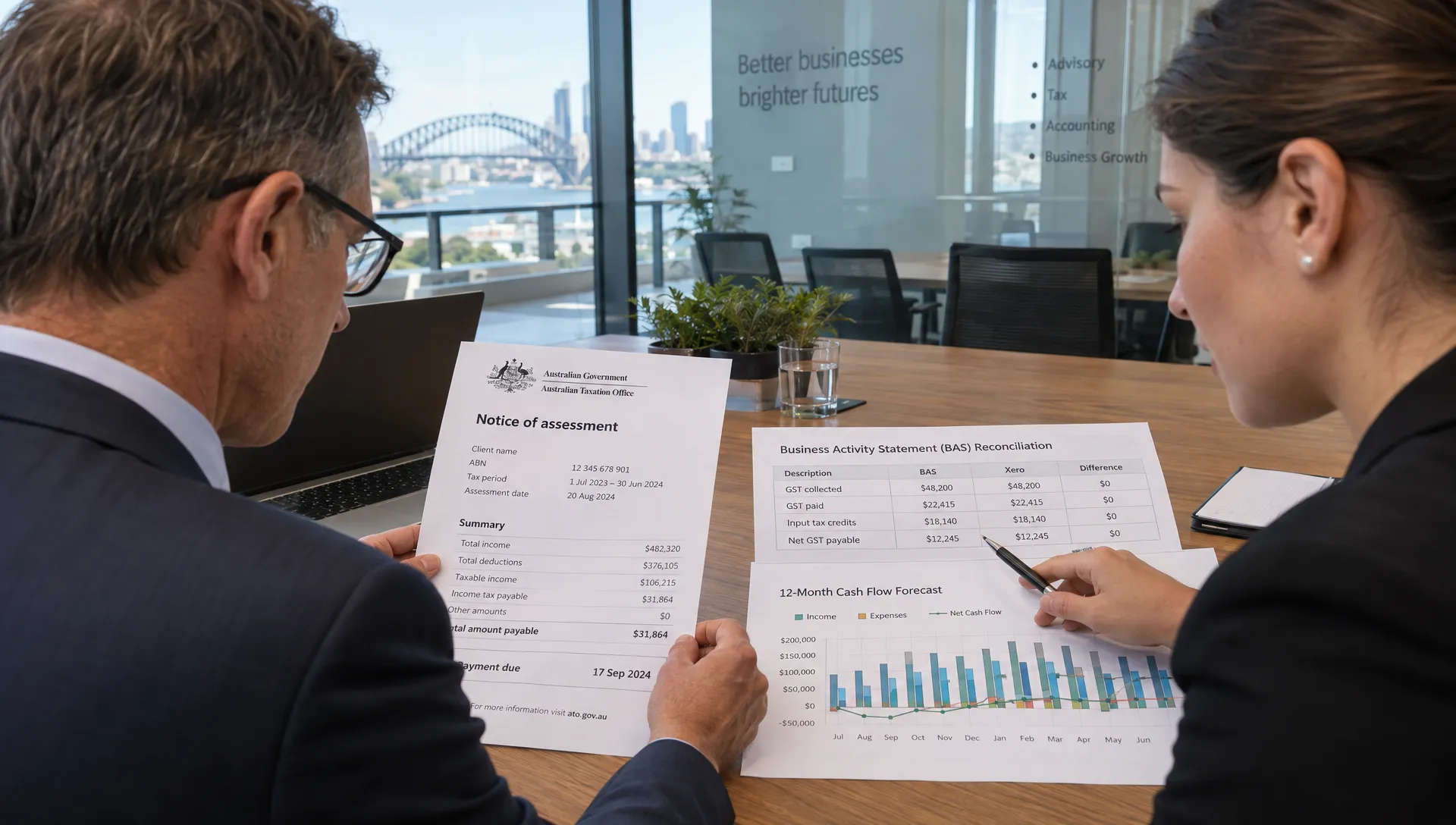
We regard correspondence with the tax office in Australia as one part of financial management, not the complete picture. A lodged BAS may satisfy a reporting obligation while leaving a business exposed to an approaching cash shortage.
Reliable bookkeeping gives us the foundation to compare tax liabilities with receivables, payroll, superannuation and financing commitments. That allows us to identify funding pressure before a payment deadline and assess whether distributions or discretionary spending remain appropriate.
Our AI-driven approach supports greater processing accuracy, speed and real-time financial visibility. Where source data is complete and integrations are properly maintained, automated workflows can reduce manual handling and make current information available sooner. We pair that efficiency with reconciliation and professional review rather than treating software output as a tax conclusion.
We connect this work to tax planning that manages risk, including the timing and structure of commercial decisions. Compliance establishes the evidence base; strategic advisory uses that evidence to support financial health and corporate growth.
Automation still needs controls
We do not assume a transaction is deductible because software has assigned an expense category. Private expenditure, GST treatment, asset purchases and related-party transactions require appropriate review.
We look for a traceable path from source document to accounting entry, lodgement and payment. Access permissions and approval responsibilities also matter. Faster processing only creates value when the underlying records and decisions remain dependable.
How we verify contact and manage problems
Before sharing information with anyone claiming to represent the tax office in Australia, we independently verify the contact through an official channel. Familiar branding, a convincing caller or knowledge of an existing debt does not prove authenticity.
We treat unexpected login links, requests for security codes and demands for unusual payment methods as warning signs. We avoid sending TFNs or identity documents through unverified email addresses, text messages or web forms.
Once a communication is verified, we distinguish the issue requiring action. An overdue lodgement needs a different response from an incorrect assessment or an unaffordable debt. We check the notice date, applicable deadline, underlying records and available response pathway.
A payment arrangement does not resolve a disputed assessment. Equally, an objection does not automatically suspend recovery. We assess payment, dispute and lodgement obligations separately, and we do not promise that the ATO will approve an arrangement or remit interest or penalties.
Where a director penalty notice, legal demand or other time-sensitive document is involved, we prioritise immediate review rather than leaving it in a routine bookkeeping queue.
Frequently asked questions
Is the ATO the same as a tax accountant? No. We distinguish the government agency administering tax law from an independent professional advising a client. A tax accountant providing regulated tax agent services for a fee generally needs the relevant TPB registration, unless an exemption applies.
Can we contact the ATO without appointing an agent? Yes. Individuals and authorised business representatives can use the applicable official channels. We recommend professional assistance where an enquiry involves disputed facts, complex structures, substantial liabilities or material transaction decisions.
Does the tax office in Australia charge a tax-agent fee? The ATO does not charge a professional preparation fee for using myTax to lodge an eligible individual return. Independent agents set their own fees. Tax liabilities, interest and penalties are separate from preparation fees.
Does appointing an agent automatically extend every deadline? No. We check eligibility under the relevant lodgement program and confirm the actual due date. Previous lodgement history, the entity type and the timing of appointment can affect the position.
Next steps: clarify responsibility before the next deadline
Our team brings 25 years of professional experience to accounting, tax and strategic advisory. We support clients across Australia through integrated service capabilities in Adelaide, Sydney and Melbourne.
We begin by reviewing the relevant entities, outstanding obligations, access authorities and quality of financial records. From there, we can identify immediate compliance priorities and opportunities to improve automated workflows, reporting visibility and planning.
Contact Perfect Accounting & Tax Services for a consultation to clarify an ATO matter or discuss how our automated accounting approach can support better financial decisions. We assess advice against each client's circumstances; this article provides general information only.