
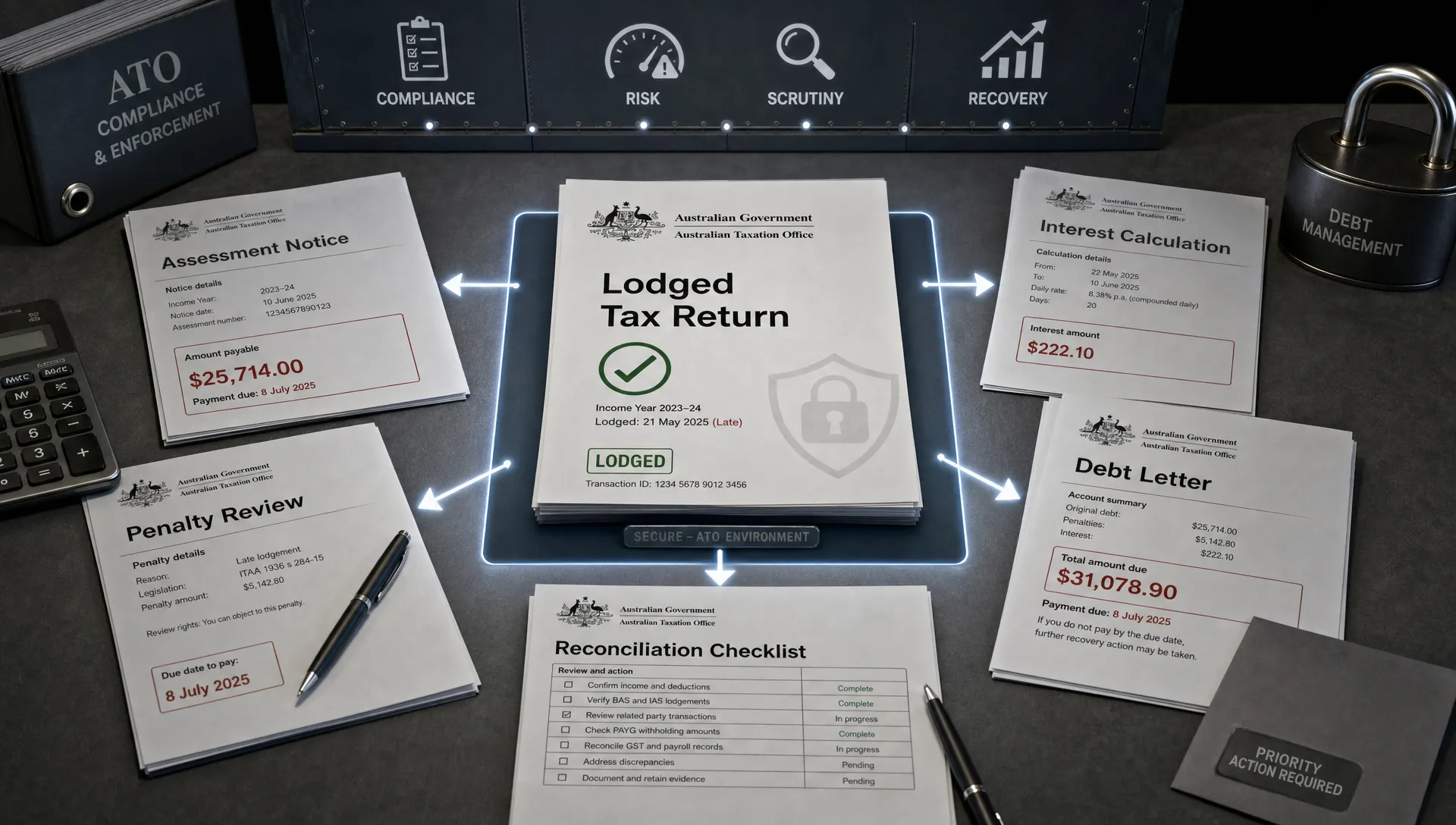
When a tax return is lodged late, the issue does not necessarily end when the return goes in. It moves into a different phase: ATO assessment, penalty review, debt management and compliance risk profiling.
For business owners, company directors, trustees and high-net-worth individuals, the strategic question is not only whether the return has been lodged. It is whether the late lodgement has affected cash flow, lending capacity, ATO visibility or future governance.
In our experience, a late filing tax return is best treated as a control issue, not just an administrative delay. Once the return has been filed, the right response is to confirm the ATO position, quantify any penalties or interest, correct the underlying workflow failure and rebuild real-time visibility over tax obligations.
The first thing that happens: the ATO assesses the return
After a late tax return is lodged through a registered tax agent, myTax or business accounting software, the ATO receives the return and runs it through its assessment and data-matching systems. The fact that the return is late does not stop the assessment process, but it can change the level of attention given to the taxpayer's broader compliance history.
For individuals and simpler entities, the ATO may issue a notice of assessment after routine processing. For companies, trusts, SMSFs and groups with GST, payroll, investments or inter-entity transactions, the ATO may compare the return against BAS, Single Touch Payroll, bank interest, dividend records, property data, superannuation information and prior year patterns.
| What happens after lodgement | What it means | Strategic action |
|---|---|---|
| ATO receives the return | The return is formally lodged and enters processing | Keep lodgement receipts and confirm the period covered |
| Data is matched | ATO systems compare the return with third-party and internal data | Reconcile income, GST, PAYG withholding, payroll and investment records |
| Notice of assessment is issued | The ATO confirms refund, payable amount or nil balance | Review the assessment against the lodged return and your ledger |
| Penalty or interest may be applied | Late lodgement and unpaid tax are considered separately | Assess remission options and payment strategy |
| Refund may be offset or delayed | Credits can be applied to existing debts or held pending checks | Check all ATO accounts, not only the income tax account |
The key point is that filing late starts the formal post-lodgement phase. It does not automatically resolve penalties, unpaid amounts or other overdue obligations.
Late lodgement is separate from late payment
Many taxpayers assume that if they lodge late and immediately pay the amount owing, the matter is finished. That is not always correct. The ATO treats lodgement obligations and payment obligations as related but separate issues.
Late lodgement relates to the failure to submit the return by the required due date. Late payment relates to unpaid tax, GST, PAYG instalments, PAYG withholding, superannuation-related liabilities or other amounts after they become due.
This distinction matters because a return can be lodged late and still result in different outcomes:
- A refund may be due, but the ATO may still consider a failure to lodge on time penalty.
- A tax debt may arise, and general interest charge may apply until the debt is paid.
- A nil return may still trigger compliance follow-up if the ATO expected income, GST or payroll activity.
- A company may lodge its income tax return, but still have overdue BAS, PAYG withholding or superannuation obligations.
From a strategic advisory perspective, we prefer clients to lodge first and negotiate from a position of transparency. Waiting until cash flow improves usually increases risk, because the ATO cannot properly assess the position while returns remain outstanding.
Penalties and interest the ATO may consider
The ATO may apply a failure to lodge on time penalty when a return is lodged after its due date. According to the ATO guidance on failure to lodge on time penalties, the penalty is generally calculated by penalty units for each 28-day period, or part of a period, that the document is overdue, subject to caps and higher multipliers for larger entities.
The current dollar value of a penalty unit can change over time, so we always verify the applicable rate for the relevant period rather than relying on outdated assumptions. Larger businesses, significant entities and taxpayers with repeated non-compliance can face materially higher exposure than an individual with an isolated late return.
The ATO does not apply penalties in every case. It may consider the taxpayer's compliance history, the reason for the delay, whether the taxpayer contacted the ATO, whether the delay was outside the taxpayer's control and whether the late lodgement formed part of a wider compliance issue.
General interest charge, usually called GIC, is different. GIC can accrue daily on unpaid tax debts, with rates set quarterly by the ATO. The ATO's general interest charge rates are separate from failure to lodge penalties. This means a taxpayer can face both a late lodgement penalty and interest on unpaid tax.
How a late return changes your compliance risk
The ATO has become increasingly data-driven. Late lodgement is not reviewed in isolation. It is considered alongside patterns across your tax file number, ABN, director profile, related entities and activity statements.
For a business owner, the risk usually increases when the late tax return does not align with other reported data. Examples include income reported in BAS but not properly reflected in the income tax return, payroll shown through Single Touch Payroll but inconsistent wages deductions, GST credits that do not match supplier documentation or director drawings that have not been properly managed.
This is why we treat late lodgement recovery as a reconciliation project. The return itself is only one output. The more important exercise is to prove that the underlying records support the position taken. If you are concerned about data mismatches, our guide to tax return mistakes that cost Australian business owners explains several errors that often become more visible once the ATO reviews a late return.
From our perspective, late lodgement plus poor records is far more concerning than late lodgement alone. A well-reconciled late return gives the ATO less reason to escalate. A late return with weak evidence can invite questions, amended assessments or audit activity.
What changes for companies, trusts, SMSFs and directors
For individuals with straightforward salary income, a late return may be a contained issue. For companies, trusts, SMSFs and directors, the consequences can be broader.
A company tax return connects to BAS, GST, PAYG instalments, PAYG withholding, payroll, superannuation, Division 7A, director loan accounts and financial statements. If one return is late, it is common for related obligations to be behind or unreconciled as well. Directors should be particularly careful where PAYG withholding, GST or superannuation guarantee charge is unpaid, because those obligations can create personal exposure through the director penalty notice regime.
Trusts need accurate distribution resolutions and beneficiary reporting. Late lodgement can create timing issues where beneficiary returns depend on trust income allocations. Property investors and developers also need careful capital gains tax, GST and interest deductibility analysis, especially where records were assembled after the event.
SMSF trustees have an additional governance layer. A late SMSF annual return can affect the fund's compliance profile and create issues with rollovers, contribution processing or ATO communications. For high-net-worth families, the practical risk is not only penalties. It is the disruption to investment decisions, lending approvals, estate planning and group-wide tax governance.
If the late return produces a refund
A refund after a late lodgement is not always paid directly into your nominated bank account without further action. The ATO may offset the credit against existing tax debts, other ATO accounts or certain government debts. It may also delay release if there are outstanding lodgements or if the return requires verification.
For business owners, a delayed refund can create cash flow pressure if the refund was expected to fund wages, supplier payments, BAS, superannuation or loan commitments. We recommend treating expected refunds conservatively until the notice of assessment is issued and the payment is received.
Refund outcomes should also be reviewed carefully. A large refund arising from a late return may be legitimate, but it can also indicate overpaid PAYG instalments, incorrect GST coding, duplicated deductions or poor tax planning. The strategic opportunity is to identify why the refund arose and whether future instalments, pricing, drawings or working capital settings should be adjusted.
If the late return produces a tax debt
If the late return results in tax payable, the ATO will issue an assessment showing the amount due. If the debt is already overdue or becomes overdue, GIC may accrue until it is paid. Ignoring the debt after lodging the return is one of the most expensive mistakes a taxpayer can make.
For viable businesses, we typically analyse three areas immediately: current cash flow, upcoming BAS and superannuation obligations, and the realistic repayment capacity of the business. A payment arrangement that looks manageable on paper can fail if it does not account for seasonal revenue, payroll cycles, stock purchases, debtors or director drawings.
Where appropriate, a payment plan can be considered. However, a payment plan is not a substitute for accurate reporting. The ATO is more likely to engage constructively where the taxpayer has lodged all outstanding obligations, maintained current lodgements and provided a credible repayment proposal.
If you need to communicate with the ATO after late lodgement, it is important to be precise, consistent and evidence-based. We have outlined practical principles in our article on how to deal with the ATO without costly mistakes, which is particularly relevant when penalties, payment plans or reviews are involved.
A practical recovery sequence after filing late
Once a late tax return has been lodged, we recommend moving quickly from compliance cleanup to control improvement. The objective is not only to close the old year. It is to prevent the same failure from recurring.
| Recovery step | Why it matters | Outcome to aim for |
|---|---|---|
| Review the notice of assessment | Confirms the ATO's assessed position | Clear understanding of refund, debt, penalties and due dates |
| Reconcile all ATO accounts | Identifies BAS, GST, PAYG, income tax and superannuation exposures | One complete view of tax obligations |
| Check supporting documents | Reduces audit and amendment risk | Evidence-backed income, deductions and offsets |
| Assess penalty remission options | Determines whether there is a reasonable basis to request relief | Targeted remission request, not a generic appeal |
| Build a payment strategy | Protects cash flow and reduces collection escalation | Sustainable payment plan or funding decision |
| Automate future controls | Prevents repeat late lodgement | Real-time visibility over tax deadlines and liabilities |
This is where technology becomes valuable. AI-assisted accounting workflows can identify missing bank transactions, unusual GST codes, payroll anomalies, unreconciled director loans and BAS-to-tax return variances faster than manual review alone. Our role is to combine that automation with professional judgement, so the client receives accurate compliance and a clearer strategic picture.
When professional assistance becomes critical
A late return is worth professional attention when the numbers are complex, the ATO has issued notices, there are multiple years outstanding or the taxpayer controls a company, trust, SMSF or investment structure. It is also important where the late return intersects with refinancing, business sale preparation, divorce, estate administration, overseas relocation or an ATO review.
Professional advice is not only about getting the return lodged. It is about reviewing risk before communication with the ATO, checking whether the tax position is defensible and identifying whether the late lodgement reveals a deeper system problem.
For growing businesses and directors, tax return filing services can make strategic sense when lodgement is connected to governance, forecasting, group structure and commercial decision-making. If you are still preparing to resolve an overdue position, our article on what to cover in a tax consultation before you lodge can help you organise the right records before taking action.
Frequently Asked Questions
Will the ATO fine me automatically after I file a tax return late? Not always. The ATO may apply a failure to lodge on time penalty, but it can consider the circumstances, compliance history and whether you took steps to resolve the issue. We recommend reviewing any penalty notice carefully before deciding whether to seek remission.
What if my late tax return results in a refund? You may still need to wait for ATO processing, and the refund may be offset against existing debts or delayed if other lodgements are outstanding. A refund does not automatically remove the compliance risk of late lodgement.
Should I delay lodging until I can afford to pay the tax debt? Generally, no. Lodging the return gives the ATO visibility of the actual position and allows you to consider payment arrangements. Delaying lodgement often increases penalties, interest and compliance risk.
Can a tax agent help reduce penalties or interest? A registered tax agent can help assess whether there are grounds to request remission, prepare supporting evidence and communicate with the ATO. Remission is not guaranteed, so the request must be based on facts rather than assumptions.
Does a late tax return affect business finance or lending? It can. Lenders, investors and purchasers often ask for up-to-date tax returns, financial statements and ATO account status. Late lodgement can delay finance approvals, due diligence and business transactions.
What if I have several years of overdue tax returns? Multiple overdue years should be handled through a structured lodgement plan. We usually prioritise gathering records, reconciling ATO accounts, identifying high-risk years and communicating with the ATO before collection pressure escalates.
Next steps and how we can help
After filing a tax return late, the priority is to regain control. That means confirming the ATO assessment, quantifying penalties and GIC, addressing any tax debt, checking whether remission is available and correcting the process that caused the delay.
Our team at Perfect Accounting & Tax Services supports business owners, directors, investors and high-net-worth individuals across Australia, with integrated capabilities in Adelaide, Sydney and Melbourne. We combine 25 years of professional experience with AI-driven automation to improve accuracy, speed and real-time financial visibility.
We can assist with late tax returns, ATO engagement, BAS and GST reconciliation, company and trust compliance, SMSF reporting, payment strategy and advisory workflows that turn compliance into a stronger foundation for corporate growth.
If you have lodged late, received an ATO notice or are concerned about overdue returns, contact our team for a confidential consultation. We will help you understand the numbers, manage the risk and build a more reliable automated accounting workflow for the future through Perfect Accounting & Tax Services.