
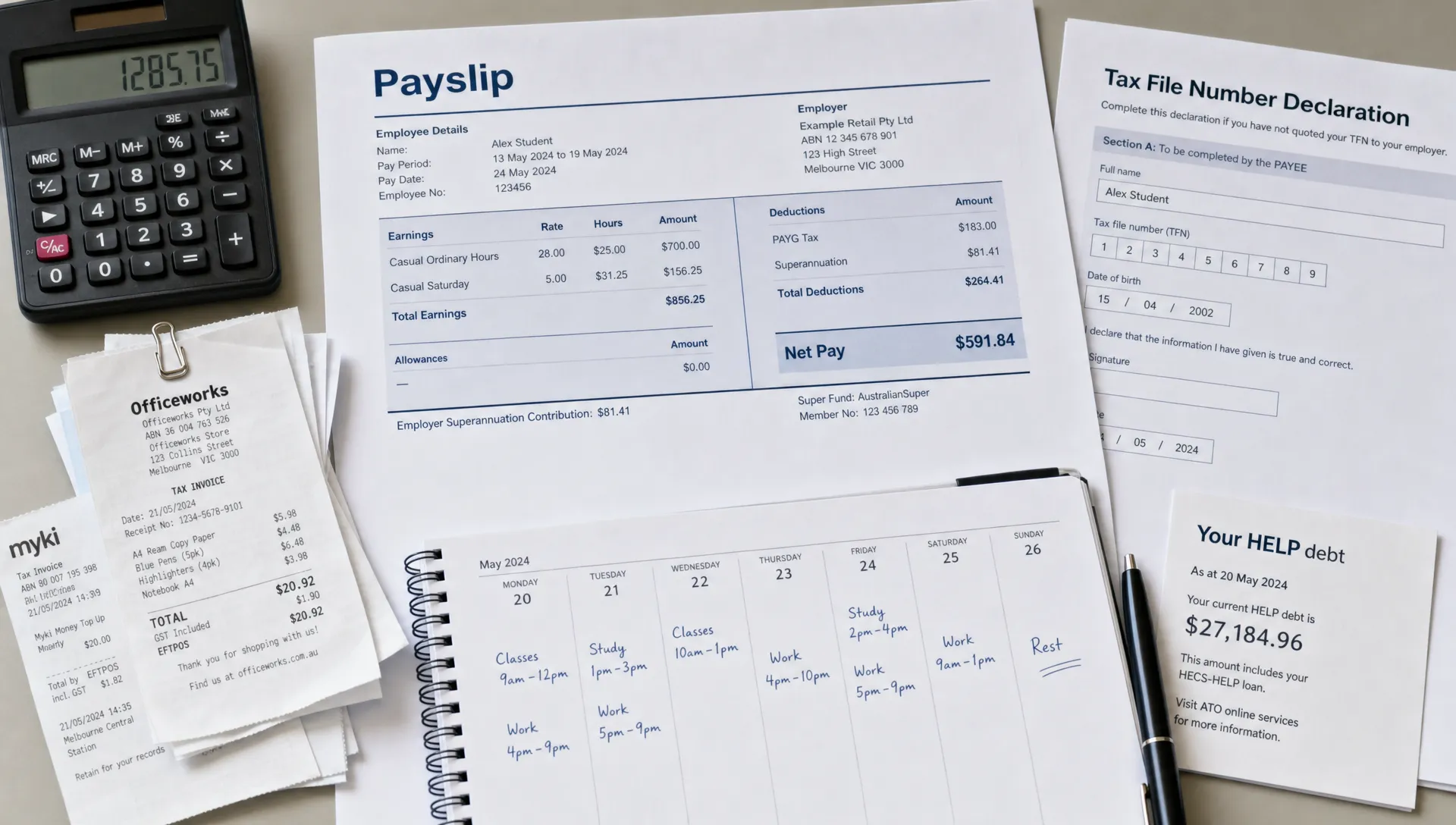
Student workers often assume tax becomes simple because they are studying. In Australia, that is rarely the case. Student status does not create a separate tax system. Casual wages, side income, superannuation, HELP debts, residency status, and deductions all interact under ordinary ATO rules.
We see this from two angles. For students and parents, the priority is avoiding over-withholding, missed refunds, and unexpected tax debts. For business owners and company directors employing students, the priority is compliant payroll, correct superannuation, accurate Single Touch Payroll reporting, and defensible records.
The strategic point is simple: student tax in Australia is not just about lodging a tax return. It is about building reliable financial records early, then using that data to make better employment, study, cash flow, and business decisions.
Student status does not make income tax-free
A student who works casually is taxed on assessable income in the same way as other individual taxpayers, subject to residency and income type. Casual wages are assessable. So are tips, bonuses, commissions, allowances, and paid training income.
There are some education-related payments that may be treated differently, such as certain scholarships, bursaries, or government support payments. However, wages from a cafe, retail store, warehouse, office, clinic, construction site, or professional practice are generally taxable employment income.
The modern payroll system also means the ATO usually has strong visibility. Employers report wages, PAYG withholding, and superannuation through Single Touch Payroll. By the time a student opens myTax, much of the income data may already be pre-filled. That does not mean it is automatically complete or correct. It means the return must be reconciled properly before lodgement.
The tax-free threshold and multiple casual jobs
For Australian tax residents, the tax-free threshold is a central issue. In broad terms, the first $18,200 of taxable income may be tax-free for residents, before Medicare levy and other settings are considered.
The most common mistake is claiming the tax-free threshold from more than one employer at the same time. A student with two casual jobs may feel each pays only a modest amount, but the ATO looks at total annual taxable income. If both employers withhold as though they are the only payer, the student can face an unexpected tax bill.
In most cases, a student should claim the tax-free threshold from the employer paying the highest regular income, then not claim it from secondary employers. There are exceptions, and withholding variations may be appropriate in specific cases, but they should be considered deliberately.
For a deeper explanation of how this works, we have outlined the practical mechanics of the tax-free threshold in Australia and why it does not remove other tax obligations.
| Student casual worker scenario | Likely tax consequence | Practical risk |
|---|---|---|
| One casual job, total annual income below the threshold | PAYG withheld may be refundable | Return still may be needed if tax was withheld |
| Two or more casual jobs | Total income is aggregated | Under-withholding if the threshold is claimed twice |
| No TFN provided to employer | Higher withholding may apply | Cash flow pressure until corrected |
| HELP or student loan debt | Compulsory repayment may apply once income exceeds the annual threshold | Refund may be reduced or tax payable may increase |
| Non-resident for tax purposes | No tax-free threshold generally applies | Incorrect residency assumptions can create tax debt |
| ABN side income plus casual wages | Business income must be included | No PAYG may have been withheld on ABN income |
PAYG withholding, STP, and superannuation for casual students
Casual employment does not remove payroll obligations. Employers must withhold PAYG tax correctly, report through STP, and apply superannuation rules where required.
For students aged 18 or over, superannuation guarantee generally applies to ordinary time earnings, including casual work, regardless of how little they earn in a month. For students under 18, super generally applies only if they work more than 30 hours in a week. The super guarantee rate is 12 percent for the 2025-26 financial year.
This matters for directors and business owners because student-heavy workforces often operate in high-turnover environments, including hospitality, retail, logistics, clinics, agencies, events, and construction support. Small onboarding errors compound quickly. A missing TFN declaration, misclassified worker, unpaid super contribution, or incorrect award interpretation can become a compliance issue long after the student has left.
Our view is that payroll compliance should not be treated as an administrative afterthought. It is a data asset. When payroll is digitised properly, management can see labour cost, super exposure, rostering patterns, and cash flow impacts in real time. That visibility supports better pricing, staffing, and growth decisions.
Deductions casual student workers often get wrong
Deductions are another high-risk area. A student can only claim a deduction where the expense is incurred, directly connected to earning assessable income, not private in nature, and not reimbursed by an employer. Evidence must be retained.
The ATO pays close attention to deductions that look inconsistent with income level, occupation, or work pattern. Casual workers often overclaim because they treat ordinary study or lifestyle costs as work costs.
| Expense type | Often deductible? | Key condition |
|---|---|---|
| Compulsory uniform with employer logo | Often yes | Must be occupation-specific or compulsory, not ordinary clothing |
| Protective clothing and safety gear | Often yes | Must protect against work-specific risk |
| Laundry for eligible work clothing | Sometimes | Must relate to deductible work clothing |
| Phone and internet use | Partly | Only the work-related percentage, based on a reasonable method |
| Car travel between home and work | Usually no | Ordinary commuting is private |
| Travel between two jobs on the same day | Sometimes | Must be directly between workplaces |
| Tools or equipment | Sometimes | Must be used for work, with depreciation rules where relevant |
| Self-education expenses | Sometimes | Must connect to current income-earning work, not merely future career plans |
| Meals during ordinary shifts | Usually no | Private unless specific overtime allowance rules apply |
The self-education point is particularly important. A nursing student working casually in retail cannot usually deduct university costs simply because study improves future earning capacity. A student already employed in a field where the course maintains or improves current work skills may have a stronger position, but the facts matter.
ABN side income changes the analysis
Many students now combine casual employment with freelance, platform, or gig income. This may include tutoring, design, coding, delivery work, content creation, e-commerce, photography, virtual assistance, or consulting.
The key difference is withholding. Casual wages usually have PAYG withheld by the employer. ABN income often arrives gross, with no tax withheld. That means the student may need to set aside tax, track deductions, consider PAYG instalments, and monitor whether GST registration becomes relevant. The GST registration threshold is generally $75,000 in annual GST turnover for businesses and sole traders.
ABN work also raises classification issues. A business should not simply ask a student to get an ABN to avoid payroll obligations if the relationship is legally employment. Sham contracting risk is real, particularly where the business controls hours, work method, tools, and integration into the team.
Digital businesses can also create cross-border complexity. If a student monetises content, affiliate commissions, or research around overseas commercial markets, such as the US shipping container and modular build market, the Australian tax treatment will depend on residency, who earned the income, business structure, and where the economic benefit is received.
Where a student side hustle becomes recurring and commercial, it should be treated as a business system, not a casual hobby. Our guide to sole trader and tax setup from day one explains the foundational registrations, record keeping, and cash flow disciplines that prevent small problems becoming ATO issues.
International students and tax residency
International students need careful analysis. Visa status and tax residency are not the same thing. A student may be an Australian resident for tax purposes depending on facts such as length of stay, living arrangements, intention, family ties, and ordinary behaviour in Australia.
If treated as an Australian tax resident, the student may access resident tax rates and the tax-free threshold. If treated as a foreign resident, different rates apply and the tax-free threshold generally does not. Working holiday makers are subject to separate settings.
International students also need to consider foreign income, overseas bank interest, online income, and payments from offshore platforms. Where an Australian tax resident earns foreign income, it may need to be declared in Australia even if it was paid overseas.
We also encourage employers to separate tax compliance from visa compliance. Tax residency determines tax treatment. Work rights determine whether the student can lawfully perform the work. Both matter, but they are assessed under different rules.
HELP debts, Medicare levy, and student cash flow
Students with HELP, VET Student Loans, or similar study debts may have compulsory repayment obligations once repayment income exceeds the annual threshold. Employers may withhold extra amounts where the student has correctly disclosed the debt through payroll forms.
Problems arise where the student forgets to disclose the debt, changes employers, works multiple jobs, or earns ABN income. The result may be a reduced refund or a tax bill on assessment.
Medicare levy can also affect the final outcome. A student may assume low income means no additional liability, but Medicare levy rules, family circumstances, private health settings, and residency status can all influence the assessment.
From a cash flow perspective, students should not treat every payslip as fully available spending money. Where income is variable, a modest tax reserve is prudent, especially if there is ABN income, multiple employers, or study debt.
What employers hiring student casuals should tighten
For business owners, the student workforce is often operationally flexible but compliance-sensitive. The ATO, Fair Work, and superannuation systems are increasingly data-led. Payroll errors are easier to detect and harder to explain away.
At a minimum, employers should review the following:
- TFN declarations and onboarding records are complete before the first pay cycle.
- STP reporting aligns with payroll categories, allowances, and termination codes.
- Superannuation eligibility is tested correctly for under-18 and over-18 employees.
- Award classification, casual loading, penalty rates, and allowances are documented.
- Contractors with ABNs are reviewed for employment classification risk.
- Payroll data is reconciled to BAS, general ledger accounts, and cash payments.
This is where automation changes the quality of compliance. Our AI-driven workflows can identify anomalies across payroll, BAS, superannuation, and ledger data faster than manual review. More importantly, the output can inform strategic advisory: labour cost ratios, roster efficiency, margin pressure, and growth capacity.
Before lodging a student casual tax return
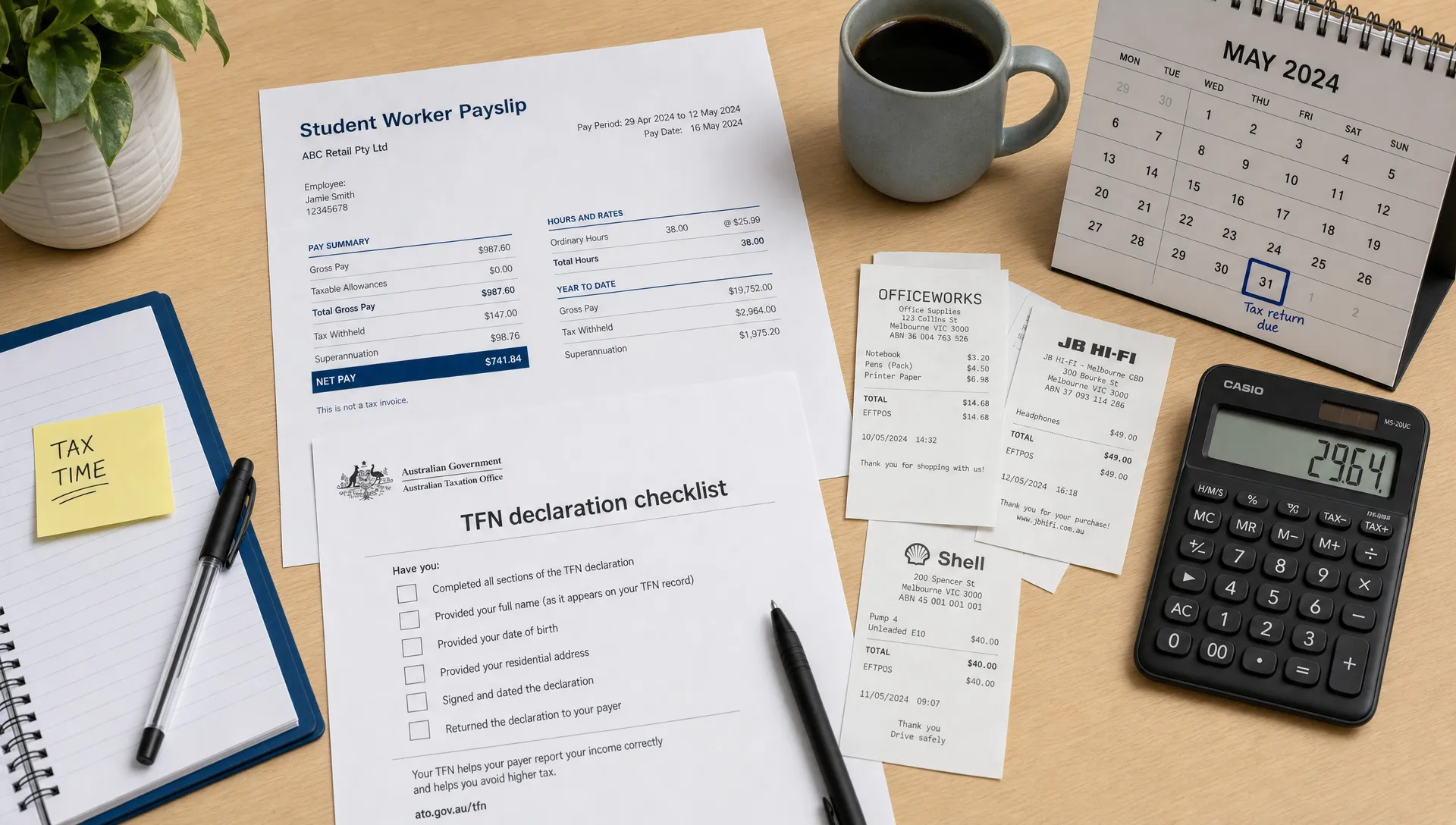
A clean return starts with clean data. Before lodging, we recommend checking that all income statements are marked tax ready, bank interest has been included, side income has been reconciled, deductions are substantiated, and HELP or student loan details are correct.
Students with simple affairs may be comfortable using myTax. However, professional support becomes more valuable where there are multiple jobs, ABN income, foreign income, residency questions, investment income, rental property interests, trust distributions, crypto transactions, or late lodgements. We have explained the decision point in our article on when to use myTax and when to get help.
Record keeping should not be left until June. Receipts fade, platforms close accounts, payslip access changes, and memory becomes unreliable. Digital capture, bank feeds, cloud storage, and automated categorisation reduce risk while giving students and families better visibility throughout the year.
Frequently Asked Questions
Do students pay tax in Australia? Yes. Students pay tax on assessable income under ordinary Australian tax rules. Casual wages, side income, investment income, and some allowances may need to be declared.
Can a casual student claim the tax-free threshold? An Australian tax resident can generally claim the tax-free threshold from one employer, usually the main employer. Claiming it from multiple employers can result in under-withholding.
Does a student need to lodge a tax return if they earned less than $18,200? They may still need to lodge if tax was withheld, they had business income, they had reportable fringe benefits, they had foreign income, or the ATO requires a return. Otherwise, a non-lodgment advice may be appropriate.
Is superannuation payable to casual student workers? Generally, yes for employees aged 18 or over. For employees under 18, super generally applies if they work more than 30 hours in a week.
Are university fees deductible for student casual workers? Not automatically. Self-education expenses must be sufficiently connected to the student’s current income-earning work, not merely future employment ambitions.
Next steps: turn compliance into better financial visibility
Student tax issues often look small until multiple jobs, ABN income, HELP debts, foreign income, or payroll errors are added together. Our role is to bring structure, accuracy, and strategic interpretation to that data.
Perfect Accounting & Tax Services supports individuals, families, business owners, and company directors across Australia, with integrated capability in Adelaide, Sydney, and Melbourne. We combine 25 years of professional experience with AI-driven accounting workflows to improve accuracy, speed, and real-time financial visibility.
If you are a student casual worker, a parent assisting a working student, or an employer managing a student workforce, contact our team for a consultation. We can review your tax position, strengthen payroll systems, and help transform compliance into a foundation for better financial decisions and long-term growth.