

We build a tax preparation business for sustainable growth by designing controls before adding clients, staff or software. Registration establishes the legal foundation, but disciplined client acceptance, documented review and secure information handling determine whether a practice can scale without accumulating risk.
Our approach draws on 25 years of professional experience: compliance should produce reliable information for strategic advisory, not simply completed returns. For practice owners and directors, that means connecting technical quality with workflow capacity, commercial discipline and financial visibility. Automation can accelerate those connections, provided professional judgement remains accountable and every material decision has an evidence trail.
Define the service model before choosing technology
We begin with a written service map. Income-tax preparation, BAS services, payroll, FBT compliance and strategic advisory involve different responsibilities, evidence requirements and review skills. We define which services sit inside the practice, which require specialist support and which fall outside the engagement.
We also segment clients by complexity rather than turnover alone. A modest business with related-party transactions, trusts or overseas interests can require more technical work than a larger business with straightforward operations. Our pricing and allocation decisions should reflect that complexity.
For an Australian client with Canadian business interests, we would assess overseas support, such as Reach Professional’s Canadian taxation services, under a separately defined scope. Overseas assistance does not replace Australian registration requirements or our review of Australian tax obligations.
Before expanding a tax preparation business, we document its target clients, permitted services, escalation triggers and exclusions. That prevents growth from quietly introducing work beyond the team’s competence.
We then select software against those requirements. Workflow tools should support the operating model rather than dictate it, particularly where multiple entities, specialist reviewers or interstate teams are involved.
Establish registration controls for a tax preparation business
We verify the registration requirements before providing paid tax-agent services. These generally require registration with the Tax Practitioners Board (TPB), unless an exemption applies. BAS-agent registration has a narrower permitted scope and does not substitute for tax-agent registration.
We check the position of the operating entity and the practitioners responsible for the work. Company and partnership registration requirements need their own assessment; employing a registered individual does not automatically resolve every entity-level obligation.
Our compliance register should capture registration status, renewal dates, applicable continuing professional education requirements and professional indemnity insurance. We assign responsibility for checking these items rather than relying on an annual reminder.
We also build a documented quality management system around current TPB obligations. It should address competence, supervision, confidentiality, conflicts, accurate representations and the management of identified deficiencies. A policy document has limited value unless staff can demonstrate how it operates on actual engagements.
We treat registration and quality management as operating controls within a tax preparation business, not administrative tasks completed once at establishment. Before changing ownership, adding services or restructuring the practice, we reassess whether the registration and supervision arrangements remain appropriate.
Control client acceptance, identity and authority
We complete an acceptance assessment before substantive work begins. It should establish the client’s identity, the relevant entities, the authority of the person instructing us and any conflicts or integrity concerns.
We distinguish an individual taxpayer from a company, trust or partnership. A director’s identity alone does not establish authority for every associated entity. For complex groups, we maintain an entity map showing ownership, trustees, authorised contacts and engagement coverage.
Where ATO client-to-agent linking applies, we confirm that the client has completed the required nomination process. We do not request their personal login credentials or bypass the prescribed authorisation process.
Our engagement letter then records scope, responsibilities, fees or the pricing basis, required records and the treatment of additional work. We explain how missing information affects completion dates and when specialist advice may be necessary.
We strengthen a tax preparation business by making acceptance a genuine decision point, with permission to decline or pause unsuitable engagements. Warning signs include inconsistent ownership information, pressure to claim unsupported deductions or requests to conceal transactions.
For established clients, we refresh the assessment when circumstances change. A new overseas operation, business acquisition or trust distribution can alter the risk profile even when the annual engagement appears unchanged.
Build review gates into every return
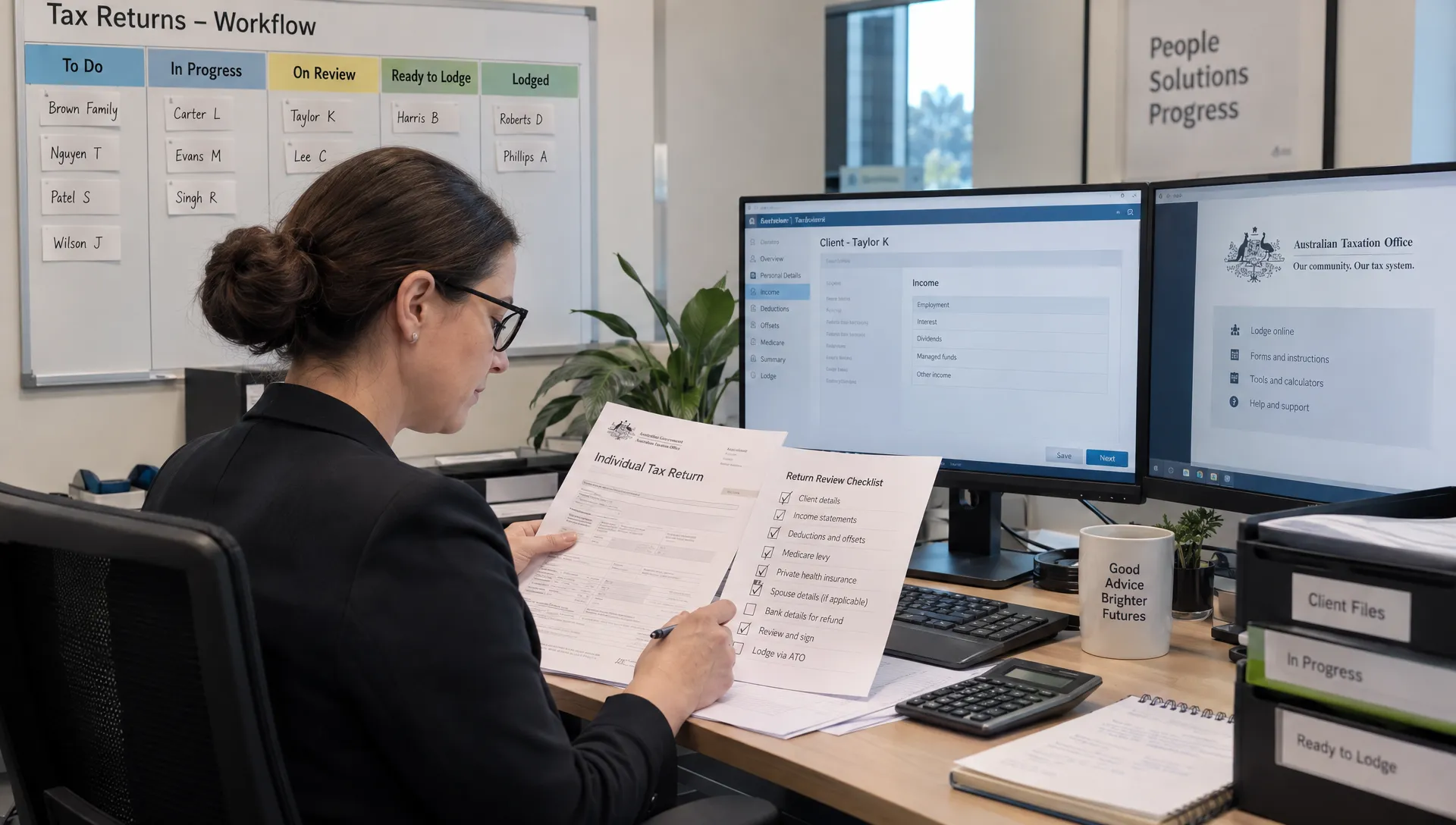
We separate preparation, review, client approval and lodgement wherever the team structure permits. In a smaller practice, we compensate for limited segregation through documented checklists, independent review of higher-risk matters and deliberate separation between preparation and final approval.
The following framework gives each stage a clear release condition:
| Control gate | Evidence we require | Release condition |
|---|---|---|
| Financial data | Reconciled accounts, supporting schedules and explanations for unresolved items | Material discrepancies resolved or appropriately addressed |
| Technical review | Documented treatment of significant tax issues and supporting authority | Assigned reviewer signs off within their competence |
| Client approval | Final return information and recorded approval from the authorised client representative | Approval obtained before lodgement |
| Lodgement | Correct entity, reporting period and approved return version | Submission result captured and exceptions investigated |
| Completion | Lodgement records, client communication and relevant payment information | Outstanding actions assigned and tracked |
We apply risk-based review depth. Trust distributions, Division 7A exposures, property transactions and unusual deductions deserve more scrutiny than routine entries. Materiality guides attention, but it does not justify ignoring a legal requirement.
A well-controlled tax preparation business also prevents version confusion: the return lodged must match the version reviewed and approved. We restrict final submission access and preserve the approval record.
Our pre-lodgement consultation framework helps structure the discussion around unresolved issues. We also distinguish successful transmission from ATO endorsement of the return’s tax positions; a lodgement receipt does not remove the need for sound evidence.
Use AI to accelerate processing, not delegate accountability
We use AI-driven automation to streamline financial workflows and improve the speed of information handling. The strongest applications assist with document extraction, transaction classification, missing-information checks and the identification of unusual movements.
We design these processes around explicit limits. An extracted amount must reconcile to its source. A suggested GST treatment must remain reviewable. An anomaly flag should prompt investigation rather than automatically change the accounts.
We do not treat AI-generated tax interpretations as authoritative. Before relying on a material position, we verify the relevant law, current ATO guidance and the client’s circumstances. Professional accountability stays with the responsible practitioner.
Within a tax preparation business, automation should reduce repetitive handling while making exceptions more visible. We therefore record the source document, any automated output, subsequent corrections and the person approving the final treatment.
We assess tools before deployment using representative files, including incomplete documents and unusual transactions. We measure extraction errors, missed exceptions and review effort rather than accepting a vendor’s accuracy claim at face value.
Our AI-driven approach can support greater accuracy, faster processing and more timely financial visibility. However, real-time reporting is only useful when feeds are current, reconciliations are maintained and material adjustments are reflected. We label draft information clearly so directors do not mistake an unreviewed dashboard for a final financial position.
Protect TFNs, client records and system access
We treat TFNs, identity documents and financial records as sensitive information throughout their lifecycle. Our controls cover collection, access, transfer, storage and disposal, including the applicable TFN handling rules and privacy obligations.
We apply multi-factor authentication, individual user accounts and access based on job responsibilities. Shared credentials weaken accountability and make it harder to establish who viewed, changed or exported information.
Before introducing an AI tool or outsourced processor, we assess contractual safeguards, data location, subcontracting arrangements and whether client information may be retained or used to train models. We do not place identifiable client information into an unapproved public AI service.
Security in a tax preparation business extends to operational resilience. We maintain tested backups, an incident response process and procedures for promptly disabling access when staff or contractors leave.
Our retention schedule distinguishes tax records, engagement evidence, employment records and other obligations. We do not apply a single deletion date to every document category.
We also verify sensitive change requests through a separate, trusted channel. A convincing email asking us to change bank details or redirect a refund is not sufficient evidence of authority. These checks protect the client and the practice without depending solely on staff recognising a suspicious message.
Manage capacity and commercial controls together
We forecast workload using the actual service mix, not just client numbers. Complex reviews, incomplete records and specialist escalations consume capacity that a simple return count will miss.
Our scheduling model works backwards from applicable deadlines and includes time for client responses, technical review and correction. We do not assume every client will qualify for the same tax-agent lodgement arrangements. We confirm the relevant dates and monitor overdue work separately.
We also protect review capacity during peak periods. Adding preparers without adding sufficient supervision can increase unfinished work rather than completed engagements.
We monitor a tax preparation business through a small set of useful measures: overdue jobs, first-review rework, unresolved exceptions, unbilled work in progress and actual effort against the engagement budget. Each measure should have a named owner and a defined response.
For example, repeated rework may indicate weak onboarding or inadequate training. Persistent budget overruns may reveal an unsuitable fixed-fee scope. A growing review queue may require different scheduling rather than faster preparation.
We use clear approval rules for fee variations, write-offs and refunds. Those commercial controls matter because a practice that cannot recover the cost of careful work will eventually face pressure to compromise quality. Sustainable margins fund competent staff, secure systems and the time required for defensible advice.
Convert compliance information into strategic advisory
We use reconciled financial information to support decisions about cash reserves, working capital and future tax commitments. This is the strategic value of strong controls: directors receive information that is both timely and sufficiently reliable to act on.
We keep advisory work distinct from return preparation. An engagement to lodge a return does not automatically authorise restructuring advice, investment recommendations or a broader business review. We define the advisory scope and confirm any additional expertise or authorisations required.
A tax preparation business becomes more valuable when recurring exceptions inform better decisions. Repeated cash shortages around BAS payments may indicate a reserve-management problem. Owner transactions may expose weaknesses in governance. Payroll and Superannuation reconciliations may identify liabilities that need attention before cash is committed elsewhere.
Our team connects that foundation with financial control and proactive growth support, including strategic advisory and virtual CFO services.
Across Australia, our integrated service capabilities in Adelaide, Sydney and Melbourne support consistent accounting and advisory delivery. National operations still require us to identify relevant state-based obligations, such as payroll tax, rather than assume that one location’s treatment applies everywhere. Shared workflows support consistency; local requirements remain part of the review.
Frequently asked questions
Can we build a tax preparation business with bookkeeping experience alone? We cannot assume bookkeeping experience establishes eligibility to provide paid tax-agent services. We need to assess TPB registration requirements, qualifications, relevant experience and the proposed entity structure. BAS services also have their own registration and permitted-scope requirements.
Can AI prepare and lodge returns without professional review? We should not design that as our control model. Automation can assist with preparation and checking, but we retain responsibility for technical judgements, client authority and the final return. We verify significant outputs before relying on them.
How do we maintain independent review in a small practice? We use documented review steps, separate preparation from final approval in time and arrange suitably qualified external review for higher-risk work where appropriate. We assess confidentiality, conflicts and responsibility before sharing client information with another practitioner.
Which controls should we prioritise before taking more clients? We prioritise registration and scope, client identity and authority, technical review, approval before lodgement and secure access. We then address capacity planning and commercial controls so growth does not overwhelm those foundations.
Next steps: strengthen the operating model before scaling
We recommend a staged implementation rather than purchasing several new systems at once.
First 30 days: We map registration obligations, service boundaries and the client lifecycle. We identify missing approvals, uncontrolled access and work that exceeds the team’s competence.
Days 31 to 60: We introduce documented review gates, secure information exchange and a central deadline register. We test a limited automation workflow against existing manual results and resolve discrepancies before broader deployment.
Days 61 to 90: We review capacity, pricing and exception trends. We use those findings to refine the quality management system and define where strategic advisory can add measurable value.
At Perfect Accounting & Tax Services, we combine accounting, tax and strategic advisory with AI-driven workflow improvement. We invite practice owners and business directors to contact our team for a consultation about stronger financial controls, automated accounting workflows and an operating model that supports sustainable corporate growth.