
Growth is rarely limited by ambition. In our experience, it is more often limited by unclear numbers, delayed reporting, weak cash-flow visibility, and tax decisions made after the fact.
That is where Perfect Accounting and Tax Services takes a different position. We do not treat accounting as a year-end administrative task. We treat it as the financial operating system behind growth, risk control, funding readiness, and strategic decision-making.
For Australian business owners, company directors, investors, and high-net-worth individuals, the commercial environment is increasingly complex. GST, BAS, payroll, Superannuation, FBT, trust distributions, company tax, property transactions, SMSF obligations, and ATO scrutiny all sit alongside normal business pressures. When these areas are managed reactively, they slow growth. When they are structured properly, they create financial clarity.
Our team supports clients across Australia, with integrated service capability in Adelaide, Sydney, and Melbourne. We combine 25 years of professional accounting and tax experience with AI-driven automation, structured advisory, and practical commercial judgement.
Growth starts with financial control
Before a business can scale, it needs reliable financial control. That means the numbers must be complete, timely, reconciled, and usable. Many businesses grow quickly without strengthening their accounting systems, only to discover that their reporting no longer supports the complexity of the operation.
We focus first on the foundations: bookkeeping quality, GST coding, BAS preparation, payroll accuracy, Superannuation obligations, supplier management, debtor visibility, and management reporting. These functions may appear operational, but they directly influence cash flow, tax planning, funding capacity, and the confidence of directors.
The ATO sets clear expectations around business records, including keeping accurate records that explain transactions and support tax positions. The ATO’s record-keeping guidance reinforces why strong documentation is not optional. We go further by structuring records so they also support management decisions, not just compliance.
| Financial foundation | Growth impact | Strategic question it helps answer |
|---|---|---|
| Accurate bookkeeping | Reduces decision-making errors | Are margins and costs being measured correctly? |
| BAS and GST controls | Protects cash flow and compliance | Are GST liabilities visible before lodgement? |
| Payroll and Superannuation systems | Reduces employee and ATO risk | Are labour costs scalable and compliant? |
| Management reporting | Improves commercial visibility | Which products, divisions, or locations are driving profit? |
| Tax planning records | Supports proactive structuring | Can we reduce tax risk before year-end? |
This is also why we encourage business owners to think beyond basic compliance. If you want a broader view of what modern firms should deliver, our article on what small businesses should expect from modern accounting services expands on the shift from retrospective reporting to year-round financial management.
We turn compliance data into strategic intelligence
Compliance data is often underused. A BAS lodgement, payroll report, or year-end tax return contains valuable information about pricing, margins, working capital, staff costs, asset investment, and growth risk.
Our role is to convert that information into insight. We assess whether revenue is growing profitably, whether expenses are rising ahead of income, whether debtors are tightening cash flow, and whether tax obligations are being forecast early enough. This is where accounting becomes a strategic asset.
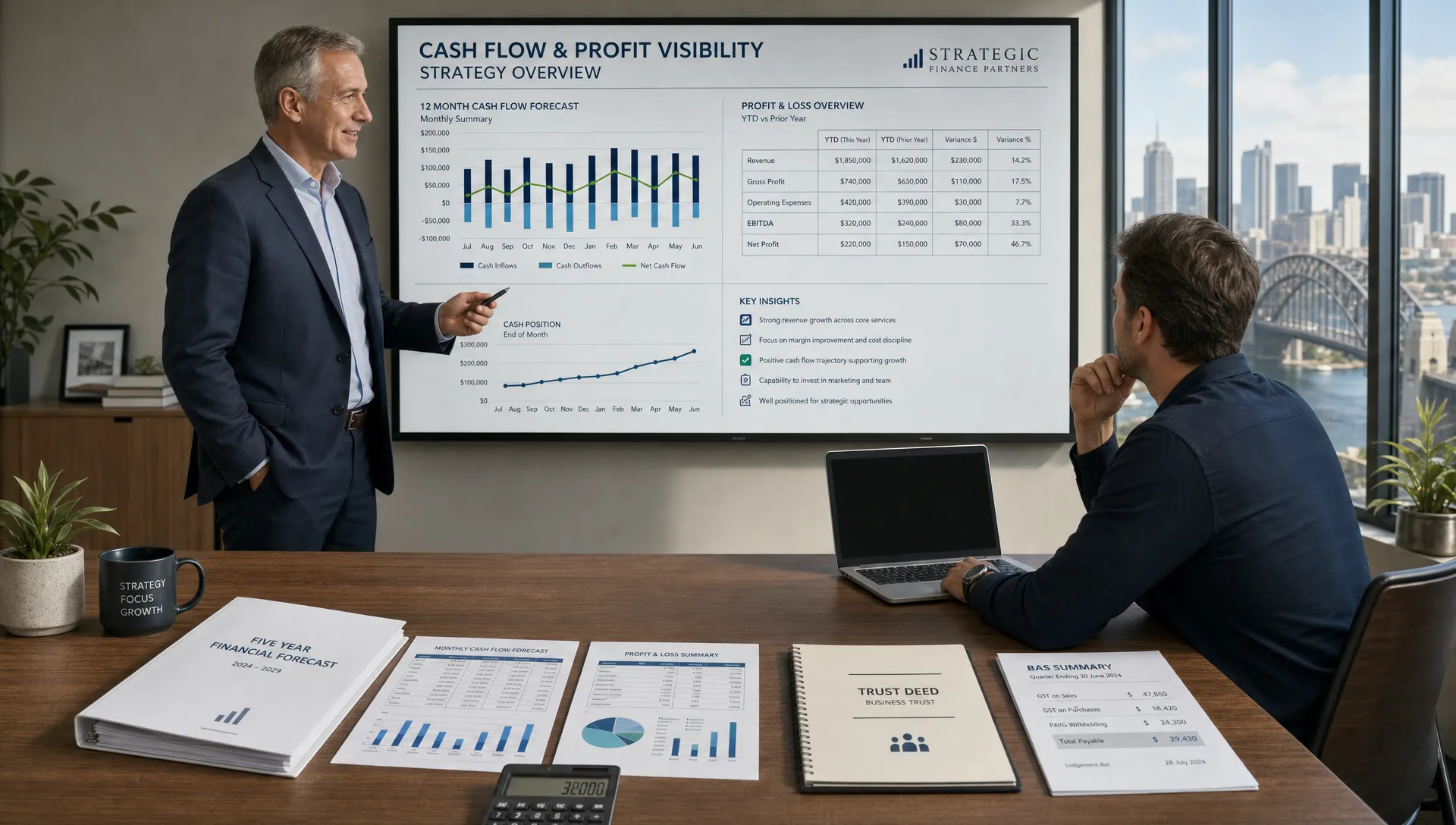
For example, a business may appear profitable on paper but still experience cash pressure because GST, PAYG withholding, Superannuation, loan repayments, and supplier terms are not being forecast together. We help directors see those obligations in advance, so they can make better decisions around hiring, stock purchases, equipment finance, dividends, drawings, and expansion.
We also use AI-driven automation to reduce manual handling and improve consistency in repetitive workflows. Automation is not a substitute for professional judgement. It is a control layer that helps identify anomalies, speed up reconciliations, and improve the timeliness of financial information.
When accurate data is available sooner, advisory discussions become more useful. Instead of asking, “What happened last quarter?”, we can ask, “What should we change next month?”
Tax planning must be connected to commercial strategy
Tax planning should never be treated as a last-minute exercise. By the time financial statements are finalised, many options may already be limited. Effective tax planning is forward-looking, commercially grounded, and aligned with the structure of the business or investment group.
We consider issues such as company and trust structures, director remuneration, Division 7A exposure, GST treatment, FBT obligations, capital gains tax, asset purchases, losses, family group arrangements, SMSF compliance, and property-related tax implications. For high-net-worth individuals and family groups, we also assess how business, investment, and succession objectives interact.
The purpose is not aggressive tax minimisation. The purpose is lawful, strategic, well-documented planning that supports business resilience and long-term wealth creation.
A growing company may need to retain profits for expansion, manage tax instalments, restructure debt, or prepare for external investment. A property investor may need to understand GST, CGT, land tax interactions, financing costs, and record-keeping obligations. A director preparing for exit may need several years of planning before a sale, merger, or succession event.
In all cases, we aim to make tax part of the growth conversation, not a separate compliance event. We explore this strategic shift further in our article on when a tax professional becomes a strategic advantage.
Virtual CFO support for sharper growth decisions
As businesses expand, directors often need a higher level of financial leadership before they are ready to appoint a full-time CFO. Our Virtual CFO support is designed for that stage.
We help business owners interpret performance, test growth assumptions, prepare cash-flow forecasts, evaluate funding needs, and improve management reporting. This is especially valuable for SMEs, family-owned businesses, professional services firms, property groups, technology companies, medical practices, construction businesses, and multi-location operators.
Virtual CFO work often focuses on questions such as:
- Is growth improving profit, or only increasing revenue?
- Do current margins support hiring, expansion, or capital investment?
- What cash reserves are needed for BAS, PAYG, Superannuation, tax instalments, and loan commitments?
- Which divisions, locations, clients, or service lines should receive more investment?
- Is the business financially prepared for funding, acquisition, succession, or sale?
We use accounting data, commercial context, and structured review processes to help directors make decisions with greater confidence. Our work is practical. We do not believe in reports that look impressive but fail to change decisions.

Scalable systems for businesses operating across Australia
Growth often creates geographic complexity. A business that begins in one suburb may eventually operate across multiple cities, employ staff in different states, or manage clients and suppliers nationally. Each step increases the need for consistent accounting processes.
We support clients across Australia, including integrated service delivery in Adelaide, Sydney, and Melbourne. That national perspective matters when businesses need coordinated reporting, state-based payroll tax awareness, multi-entity bookkeeping, consolidated management accounts, and consistent BAS and GST processes.
For cross-state businesses, the challenge is not only compliance. It is comparability. Directors need to know whether a Sydney operation is more profitable than a Melbourne division, whether an Adelaide team has better cost control, or whether regional expansion is improving the overall return on capital.
We design accounting workflows that make this analysis possible. Clean chart of accounts design, consistent coding rules, cloud-based documentation, automated reconciliations, and regular review cycles all contribute to better national visibility.
AI-driven automation improves speed, accuracy, and visibility
We take a practical approach to automation. The objective is not to replace the accountant. The objective is to remove repetitive friction so our team and our clients can focus on higher-value decisions.
AI-driven processes can assist with transaction categorisation, exception detection, document capture, workflow routing, reconciliation support, and reporting preparation. When paired with professional review, these tools improve the quality and timeliness of the finance function.
| Automation area | Practical benefit | Professional control required |
|---|---|---|
| Bank feed review | Faster reconciliation cycles | Review unusual transactions and coding rules |
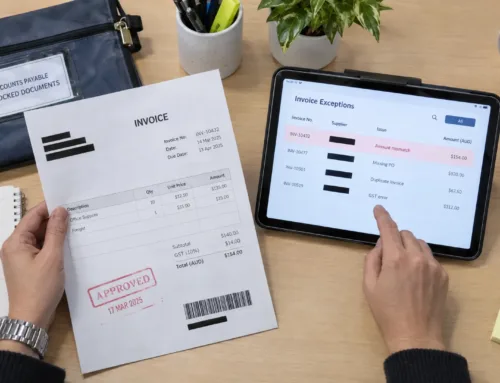
| Document capture | Better evidence retention | Confirm GST treatment and supplier details |
| Payroll workflow checks | Fewer processing errors | Review awards, Superannuation, and PAYG settings |
| BAS preparation support | Earlier visibility of liabilities | Validate GST coding and ATO lodgement position |
| Management reporting | Faster decision cycles | Interpret results and recommend action |
This approach is particularly useful for growing businesses because delays compound quickly. If reports are three months behind, the business may continue making decisions based on outdated assumptions. If the data is current, management can respond while there is still time to adjust.
Automation also supports governance. Directors need confidence that records are retained, approvals are traceable, and financial processes can withstand review. When systems are well-designed, the business becomes easier to manage, easier to finance, and easier to scale.
We support growth at each business stage
Different growth stages require different financial priorities. We tailor our accounting, tax, and advisory work to the stage the client is in, rather than applying a generic model.
For early-stage businesses, we focus on correct setup, GST registration decisions, TFN and ABN-related requirements, payroll systems, bookkeeping discipline, and cash-flow awareness. A poor setup can create expensive clean-up work later.
For established SMEs, we focus on profitability, BAS accuracy, management reporting, payroll and Superannuation controls, tax planning, and better use of technology. At this stage, the finance function must support decisions, not just record transactions.
For scaling companies, we support forecasting, funding readiness, multi-entity structures, internal controls, board reporting, and Virtual CFO advisory. Growth increases both opportunity and risk, so financial governance must mature quickly.
For mature businesses and high-net-worth clients, we support succession planning, asset protection considerations, trust and company tax planning, SMSF compliance, investment structuring, and preparation for exit events. The goal is to protect what has been built while positioning the next phase strategically.
If your current accounting support is not helping you make better decisions, our article on how a business services accountant supports better decisions outlines the broader advisory role business owners should expect.
What working with our team looks like
When we begin supporting a growth-focused client, we generally start by assessing the quality of the existing financial system. We review bookkeeping processes, lodgement history, GST and BAS treatment, payroll settings, Superannuation workflows, tax planning position, management reports, and the way directors currently receive financial information.
From there, we identify gaps that affect growth. These may include inconsistent coding, late reconciliations, unclear margins, weak debtor reporting, undocumented director loans, poor cash-flow forecasting, or no structured advisory rhythm.
We then prioritise improvements based on commercial impact. Not every issue has equal urgency. A late BAS process may need immediate correction. A chart of accounts redesign may be important for reporting. A tax planning review may be required before 30 June. A Virtual CFO framework may be needed before funding discussions.
Our process is collaborative. We work with business owners, directors, internal finance staff, bookkeepers, and external stakeholders where required. Our objective is to create a finance function that is accurate, compliant, efficient, and commercially useful.
Frequently Asked Questions
How does Perfect Accounting and Tax Services help businesses grow? We support growth by improving financial control, tax planning, cash-flow visibility, compliance systems, and strategic decision-making. Our work combines accounting discipline with advisory insight and AI-driven automation.
Is this only for large companies? No. We work with sole traders, SMEs, family-owned businesses, professional firms, property investors, and growing companies. The level of support depends on complexity, risk, and growth objectives.
Can automation replace my accountant? No. Automation improves speed, consistency, and visibility, but professional judgement is still essential. We use AI-driven workflows to support analysis, compliance, and advisory work, not to remove human review.
Do you support clients outside Adelaide? Yes. We support clients across Australia, with integrated service capability in Adelaide, Sydney, and Melbourne. This is particularly useful for businesses with multi-city operations or national growth plans.
When should a business seek strategic tax advice? Ideally before major decisions are made. Business expansion, asset purchases, property transactions, restructuring, hiring, funding, succession, and exit planning can all have tax consequences that should be reviewed early.
Next steps: Build a finance function that supports growth
Growth requires more than annual tax returns. It requires accurate records, disciplined compliance, clear reporting, proactive tax planning, and strategic financial leadership.
Our team at Perfect Accounting and Tax Services helps Australian businesses and high-net-worth clients turn accounting into a growth platform. We bring together 25 years of experience, AI-driven automation, and practical advisory support across Adelaide, Sydney, Melbourne, and the broader national market.
If your current accounting process is slow, reactive, or disconnected from your growth plans, now is the time to review it. Contact our firm for a consultation and learn how our automated accounting workflows can provide greater accuracy, faster reporting, and stronger strategic visibility for your next stage of growth.