


Month-end close is where financial discipline becomes visible. For Australian businesses, it is the process that turns bank transactions, invoices, payroll, GST, accruals and management adjustments into reliable financial information. When the close is slow or inconsistent, directors make decisions using stale numbers. When it is streamlined, the business gains earlier insight into profit, cash flow, tax exposure and operational risk.
We see month-end close as more than an accounting deadline. It is a strategic control point. The right accounting solutions reduce manual work, tighten review processes and create a repeatable rhythm for reporting. For business owners, company directors and high-net-worth individuals managing complex structures, that rhythm supports better decisions across tax planning, financing, hiring, investment and growth.
Why month-end close matters in Australian businesses
A month-end close is not simply the act of reconciling accounts. It is the point where financial data is validated, adjusted and translated into management insight. In an Australian context, it also underpins BAS preparation, GST accuracy, payroll integrity, Superannuation obligations, FBT monitoring and ATO readiness.
If the month-end close is weak, issues accumulate quietly. GST codes may be inconsistent. Payroll liabilities may not reconcile. Accruals may be missed. Intercompany balances may drift. Directors may rely on profit figures that exclude key costs. By the time the annual tax return is prepared, the business is often correcting months of preventable errors.
A strong close process gives leadership earlier answers to practical questions:
- Are margins improving or being eroded by labour, supplier costs or discounts?
- Is cash flow aligned with reported profit?
- Are BAS and GST positions supported by clean transaction data?
- Are payroll, Superannuation and contractor obligations reconciled?
- Are growth decisions being made from reliable financial reports?
This is why we position month-end close as a foundation for strategic advisory. Compliance is essential, but the higher value comes from using clean financial information to improve financial health.
The common causes of a slow month-end close
Most delayed closes are not caused by one major failure. They are usually the result of small inefficiencies repeated every month.
Manual data entry is a major cause. When invoices, receipts and bank transactions are processed by hand, the finance team loses time and increases the risk of coding errors. Inconsistent chart of accounts usage creates another problem. If similar transactions are coded differently across months, trend reporting becomes unreliable.
Late supplier invoices, unreconciled bank feeds, unclear approval workflows and missing payroll adjustments also slow the process. For groups operating across Adelaide, Sydney, Melbourne and other Australian locations, the complexity increases further. Different teams, entities, cost centres and state-based operational requirements can create fragmented data.
The close becomes even more difficult where bookkeeping is treated as a back-office task rather than a management system. We have written more broadly about this shift in expectations in our article on what small businesses should expect from modern accounting services, where real-time visibility and advisory support are now essential rather than optional.
How accounting solutions streamline month-end close
Modern accounting solutions improve month-end close by combining automation, structured workflows and professional review. The objective is not to remove judgement from accounting. The objective is to remove repetitive friction so accountants and directors can focus on exceptions, risk and strategy.
1. A defined close calendar creates accountability
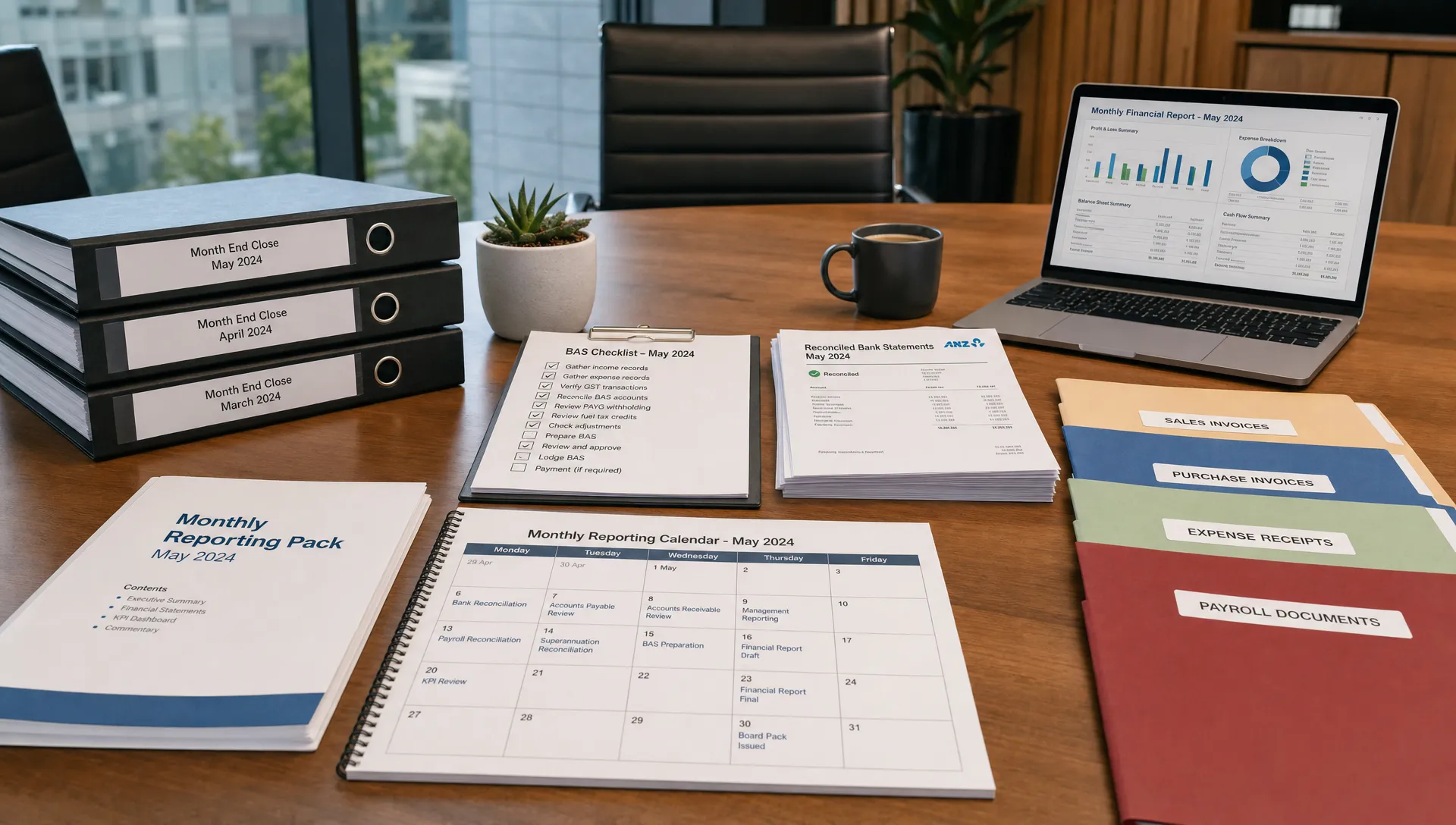
A streamlined close starts with a calendar. Each task should have an owner, deadline and review point. This includes bank reconciliations, accounts payable cut-off, accounts receivable review, payroll reconciliation, GST checks, accruals, depreciation, loan reconciliations and management reporting.
Without a clear calendar, month-end close depends on memory and urgency. With a calendar, the business creates a repeatable operating rhythm. This is especially important for directors who need reporting packs within a fixed timeframe after month end.
For many businesses, we recommend separating tasks into three categories: daily automation, month-end validation and strategic review. Daily automation keeps transaction data current. Month-end validation confirms completeness and accuracy. Strategic review turns the numbers into decisions.
2. Automation reduces manual processing and coding errors
AI-driven accounting workflows can significantly reduce the time spent capturing invoices, matching payments and coding recurring transactions. Bank feeds, rules-based coding and document capture tools allow the finance function to process higher volumes with greater consistency.
However, automation should never operate without oversight. In our view, the strongest model is automation plus accountant review. AI can identify patterns, flag anomalies and accelerate processing, while experienced accountants assess commercial substance, GST treatment, deductibility and reporting implications.
This matters because Australian tax and accounting outcomes often depend on context. A transaction may look routine, but its GST, FBT or deductibility treatment can vary depending on how and why the expense was incurred. Automation improves speed. Professional judgement protects accuracy.
3. Real-time reconciliations prevent month-end bottlenecks
Traditional month-end processes often fail because reconciliation is left until the end. Modern accounting solutions allow bank, credit card, loan, clearing account and payroll reconciliations to be maintained throughout the month.
This shifts the close from a clean-up exercise to a confirmation exercise. By the time month end arrives, the finance team is not starting from scratch. It is reviewing exceptions, confirming cut-off and finalising adjustments.
Real-time reconciliation also improves fraud detection and financial control. Unusual payments, duplicate supplier invoices, unmatched receipts and unexpected balance movements are easier to identify when accounts are reviewed regularly rather than retrospectively. We explore this broader control mindset in our article on how accounting professionals improve financial control.
| Month-end bottleneck | Accounting solution | Strategic impact |
|---|---|---|
| Manual invoice processing | Document capture and automated coding | Faster accounts payable close and fewer input errors |
| Unreconciled bank accounts | Daily or weekly bank feed reconciliation | Earlier detection of missing or unusual transactions |
| Inconsistent GST coding | Standardised tax codes and review rules | Cleaner BAS preparation and reduced ATO risk |
| Delayed payroll checks | Payroll and Superannuation reconciliation workflows | Better liability reporting and employee cost visibility |
| Late management reports | Automated reporting templates with accountant review | Faster decisions on cash flow, margins and growth |
4. GST and BAS data becomes cleaner before lodgement
For Australian businesses registered for GST, month-end close directly affects BAS quality. If transaction coding is inconsistent, BAS preparation becomes reactive. The finance team must investigate historical entries, supplier invoices and GST treatment under pressure.
The ATO guidance on business activity statements makes it clear that businesses must report obligations accurately and lodge on time. A streamlined close supports this by keeping GST data clean each month, rather than waiting until the BAS period ends.
This is particularly valuable for businesses with mixed supplies, imports, motor vehicle expenses, entertainment, property transactions or cross-border activity. These areas often require more careful GST review. When the underlying data is current and well structured, BAS preparation becomes a controlled process rather than a deadline scramble.
5. Payroll, Superannuation and FBT are reviewed earlier
Payroll is one of the most sensitive areas of month-end close. Errors can affect employees, ATO reporting, Superannuation obligations and management reporting. With Single Touch Payroll, payroll data is increasingly visible to the ATO in near real time, which makes accuracy and reconciliation even more important.
A strong month-end process reviews gross wages, PAYG withholding, super liabilities, leave provisions, contractor payments and payroll clearing accounts. It also considers whether benefits provided to employees may create FBT exposure.
For businesses with multiple sites, rotating rosters, commissions, bonuses or director wages, payroll should not be treated as a separate administrative function. It should be integrated into the month-end close so employee costs are properly reflected in profit, cash flow and tax planning.
6. Accruals and provisions make reports commercially meaningful
Cash-based reporting can be misleading for growing businesses. A company may look profitable because supplier invoices have not yet been entered, or it may appear weaker because revenue has not been accrued. Month-end close should correct these timing issues.
Accruals, prepayments, depreciation, loan interest, work in progress, inventory adjustments and provisions help align financial reports with commercial reality. This is where accounting solutions must be configured to match the business model.
A construction firm may need project-based work in progress. A professional services firm may need accrued revenue and labour utilisation analysis. An e-commerce business may need inventory, merchant fee and freight reconciliations. A property investor may need loan, rental income and expense allocation checks across entities.
When these adjustments are systemised, management reports become more useful. Directors can assess true performance rather than temporary timing distortions.
What a streamlined close can look like
Every business is different, but a well-designed month-end close usually follows a structured pattern. The timing depends on transaction volume, entity complexity and reporting requirements.
| Close phase | Typical focus | Outcome |
|---|---|---|
| Before month end | Supplier invoice capture, payroll preparation, bank feed review | Fewer missing transactions at cut-off |
| Days 1 to 3 | Bank reconciliations, accounts payable, accounts receivable, payroll checks | Core ledgers updated and reconciled |
| Days 3 to 5 | GST review, accruals, prepayments, depreciation, loan reconciliations | Financial statements reflect the month accurately |
| Days 5 to 7 | Management reporting, variance analysis, director review | Leadership receives decision-ready insight |
| After reporting | Process improvements and advisory actions | Close quality improves month by month |
The key is not speed alone. A fast close that produces unreliable reports is not a success. The objective is a close that is timely, accurate and decision-useful.
The strategic value of faster month-end reporting
When month-end close is streamlined, the business gains more than administrative efficiency. It gains a clearer operating system.
Directors can see margin pressure earlier. Business owners can respond to cash-flow constraints before they become urgent. High-net-worth individuals with multiple entities can monitor debt, investment income and tax positions more effectively. Finance teams can spend less time chasing documents and more time interpreting performance.
This is where month-end close connects directly to Virtual CFO advisory. Once the numbers are reliable and current, advisory conversations become more practical. We can assess pricing, staffing, working capital, debt structure, tax planning and growth opportunities using evidence rather than estimates. Our broader approach to this is outlined in how Perfect Accounting and Tax Services supports growth.
Selecting the right accounting solutions for month-end close
Technology alone will not fix a weak process. The best outcomes come from aligning software, automation, controls and advisory review.
When assessing accounting solutions, directors should focus on practical capability rather than software features in isolation. The system should support accurate transaction capture, efficient reconciliation, GST and BAS readiness, payroll integration, reporting consistency and secure document management.
We also recommend reviewing whether the finance workflow can scale. A process that works for a sole director business may fail once the organisation adds employees, entities, interstate operations, inventory, finance facilities or external investors. For businesses seeking capital, preparing for sale or expanding nationally, month-end close quality becomes a governance issue.
The right accounting solution should answer three questions clearly:
- Can we close the month faster without sacrificing accuracy?
- Can directors trust the reports enough to make decisions?
- Can the process support future growth, audit readiness and tax planning?
If the answer is uncertain, the business may not have an accounting problem. It may have a systems design problem.
Our approach to automated month-end close
Our team combines 25 years of professional accounting experience with AI-driven automation and strategic advisory. We support Australian businesses by designing workflows that reduce manual processing, improve reconciliation discipline and provide clearer financial visibility.
We do not view automation as a replacement for professional judgement. We use it to strengthen the accounting function. Our role is to ensure that data flows correctly, exceptions are reviewed, compliance obligations are addressed and directors receive information they can rely on.
With integrated service capability across Adelaide, Sydney and Melbourne, we support local SMEs, growing national companies and complex private groups that need consistent accounting standards across locations and entities. That national perspective is particularly valuable where businesses operate across state lines or require centralised reporting for directors, lenders or investors.
Frequently Asked Questions
What is month-end close in accounting? Month-end close is the process of finalising and reviewing financial records for a completed month. It usually includes reconciliations, GST checks, payroll review, accruals, depreciation, management reporting and variance analysis.
How do accounting solutions speed up month-end close? Accounting solutions speed up month-end close by automating transaction capture, improving bank reconciliation, standardising workflows, flagging exceptions and producing consistent reports. The strongest results come when automation is combined with experienced accountant review.
Why is month-end close important for BAS and GST? BAS accuracy depends on clean GST coding and complete transaction records. A disciplined month-end close helps identify GST errors earlier, supports accurate BAS preparation and reduces the risk of last-minute corrections before lodgement.
Can automation replace an accountant during month-end close? No. Automation can reduce manual processing and improve speed, but accountants are still needed to review judgement-based areas such as GST treatment, accruals, FBT exposure, tax planning, commercial risk and management interpretation.
How often should directors review month-end reports? Directors should review financial reports every month, especially where the business has employees, debt, inventory, growth plans, tax complexity or multiple entities. Regular review helps identify issues early and supports better strategic decisions.
Next steps: streamline your month-end close
If your month-end close is slow, manual or inconsistent, it is likely affecting more than reporting speed. It may be limiting your ability to manage cash flow, monitor tax exposure, control risk and make confident growth decisions.
We can help you review your current close process, identify automation opportunities and design an accounting workflow that supports compliance and strategic advisory. Our team works with businesses and private groups across Australia, including Adelaide, Sydney and Melbourne, to build accurate, efficient and scalable finance systems.
Contact Perfect Accounting & Tax Services to arrange a consultation and learn how our automated accounting workflows can give you faster month-end reporting, stronger financial control and clearer visibility for the decisions ahead.