

We approach sole trader deductions as a financial decision, not simply a receipt-collection exercise. Our tax accountant help focuses on identifying legitimate business costs, separating private spending and establishing when each deduction can be claimed.
For Australian sole traders, deductible expenses commonly include business insurance, software, professional fees, vehicle costs and eligible home-office expenses. Equipment, trading stock and personal Superannuation contributions require different treatment. We explain the main categories below, including the evidence needed to support a claim and the implications for cash flow.
The tests we apply before claiming an expense
We start with the connection between an expense and the business income it helps generate. Paying through a business account does not, by itself, make a purchase deductible.
We apply four checks:
- Business purpose: The expense must relate to earning assessable business income and must not be excluded by a specific rule.
- Private use: We exclude the personal portion of mixed-use expenses, such as phones, vehicles and internet services.
- Timing and classification: We establish whether the cost is immediately deductible, subject to prepayment rules or treated under capital expenditure provisions.
- Evidence: We retain records that substantiate the amount, business purpose and calculation method.
These principles follow the ATO’s guidance on business deductions.
A deduction reduces taxable income; it is not a dollar-for-dollar refund. Its value depends on the sole trader’s overall tax position. We use tax accountant help to establish the correct treatment before estimating a tax saving, particularly where GST credits or private use affect the calculation.
Common expenses a sole trader can claim
We assess the following categories regularly. The business connection and supporting evidence remain essential, even where the expense appears routine.
| Expense category | What may be deductible | Main qualification |
|---|---|---|
| Advertising | Website promotion, paid advertising and marketing services | Must relate to the business |
| Software and subscriptions | Accounting software, industry tools and business subscriptions | Separate private use and review prepayments |
| Insurance | Professional indemnity, public liability and relevant business cover | Private insurance requires separate assessment |
| Professional fees | Accounting, tax preparation and business advice | Capital-related legal and advisory costs may receive different treatment |
| Business premises | Commercial rent, electricity and cleaning | Exclude private use and separate capital improvements |
| Finance costs | Interest and fees on business borrowings | Loan principal repayments are not deductible |
| Training | Courses maintaining or improving existing business skills | Education for a new occupation is generally not deductible |
| Repairs | Restoring business assets to working condition | Improvements and initial repairs may be capital |
We also check whether an expense relates to the current income year. A payment made shortly before 30 June is not automatically an immediate deduction.
Our tax accountant help examines the substance of each transaction rather than accepting the category selected in accounting software. That distinction matters when a payment combines services, equipment and private benefits.
Vehicles, travel and meals
For an eligible car, we compare the cents-per-kilometre method with the logbook method. Different rules apply to vehicles outside the tax definition of a car, including some larger commercial vehicles.
The cents-per-kilometre method is limited to 5,000 business kilometres per car each income year. We use the ATO rate applicable to that year and retain a reasonable basis for calculating business travel. The rate already covers costs such as fuel, registration, insurance and depreciation, so we do not claim those again separately.
Under the logbook method, we establish the business-use percentage through a valid, representative logbook, generally covering at least 12 continuous weeks. We also retain odometer readings and records of actual expenses.
Travel between home and a regular workplace is generally private. Exceptions require careful assessment, including where home is genuinely the business’s principal place of business.
We direct tax accountant help towards substantiating the journey’s purpose as well as its distance. Business parking and tolls may be separately deductible, but traffic fines are not.
For overnight business travel, accommodation and reasonable meal expenses may qualify. Ordinary lunches and client entertainment generally do not become deductible simply because business is discussed.
Working from home
We distinguish running expenses from occupancy expenses before calculating a home-based business deduction.
Running expenses can include additional electricity, phone and internet costs, cleaning of a dedicated work area and the decline in value of business equipment. We assess the ATO fixed-rate method against actual costs using the rules and rate for the relevant income year.
For a fixed-rate claim, we retain records of all hours worked from home and evidence of the expenses covered by the rate. A representative diary alone does not establish a full year’s working hours. Costs included in the rate cannot be claimed again separately.
Occupancy expenses include rent, mortgage interest, council rates and similar property costs. These generally require part of the home to have the character of a place of business, rather than merely being convenient for occasional administration.
Our tax accountant help considers the property consequences alongside the annual deduction. Using an owned home as a place of business can affect the main-residence capital gains tax exemption. Choosing not to claim an occupancy deduction does not necessarily avoid that outcome.
Where personal services income rules apply, additional restrictions can prevent deductions for certain home occupancy expenses. We assess those rules before recommending a claim.
Tools, equipment, repairs and trading stock
A laptop, commercial oven or piece of machinery may support the business for several years. We therefore distinguish purchasing an asset from paying an ordinary operating expense.
Depending on eligibility and the legislation applying to the relevant income year, an asset may qualify for an immediate deduction or require depreciation over time. We check the enacted instant asset write-off rules, turnover requirements and when the asset was first used or installed ready for use. We do not rely on an old threshold or an announced proposal.
The ATO’s depreciation and capital expenditure guidance provides the framework, but the outcome depends on the asset and the business.
We also distinguish repairs from improvements. Restoring existing equipment may be deductible immediately, while upgrading its capability may create capital expenditure.
For retailers and e-commerce businesses, stock purchases require trading stock calculations. Unsold inventory does not necessarily produce the same immediate deduction as stock already sold.
We recommend tax accountant help before major purchases so the expected deduction, GST treatment and cash outflow can be assessed together. Spending unnecessarily to obtain a deduction still leaves the business with less cash.
Employees, contractors and personal Superannuation
We can generally claim genuine employee wages, eligible employer Superannuation contributions and contractor payments connected with the business, subject to the relevant requirements. PAYG withholding compliance can also affect deduction entitlement for certain payments.
Employee Superannuation requires particular attention to payment timing. Recording an amount as payable in payroll does not, by itself, establish that a tax deduction is available. We review the applicable payment and deduction rules before finalising the claim.
A sole trader cannot deduct a salary paid to themselves. Money withdrawn for personal use is an owner’s drawing, regardless of how the bank transaction is labelled. Payments to family members must reflect genuine work and satisfy the applicable deduction rules.
Personal Superannuation contributions sit outside ordinary employee payroll expenses. A sole trader may be eligible to claim a personal deduction, but contribution caps, age-related conditions and taxable income need review.
We also check that a valid notice of intent is lodged with the fund within the required timeframe and acknowledged before the deduction is claimed. A bank transfer into Superannuation alone does not complete the process.
How GST changes the deduction calculation
We calculate income tax deductions separately from GST credits. Where a GST-registered sole trader is entitled to an input tax credit, the deductible expense generally excludes that credit.
Consider an eligible software expense of $1,100 including $100 GST, with 80% business use. Assuming the expense is deductible in the current year and the business is entitled to the corresponding GST credit, we calculate:
| Calculation | Amount |
|---|---|
| Total payment | $1,100 |
| Business portion, including GST | $880 |
| Eligible GST credit | $80 |
| Income tax deduction | $800 |
The remaining private portion is not deductible.
If the sole trader is not registered for GST, there is no GST credit. The deductible business portion may instead include the GST paid, subject to the ordinary deduction rules.
We reconcile these amounts between the accounting records, BAS and income tax return. Our tax accountant help prevents a common error: claiming a GST credit through the BAS while also deducting the same GST as part of the expense.
The distinction also improves cash forecasting. A GST credit and an income tax deduction affect different obligations and may deliver their benefits at different times.
Expenses we exclude or treat separately
We do not treat every payment from a business bank account as a business deduction. Personal groceries, family holidays, private school fees and household spending remain private even when paid from business funds.
Ordinary clothing is generally not deductible, including conventional suits and shoes worn for client meetings. Protective clothing, occupation-specific clothing and qualifying uniforms require separate consideration.
We also exclude government fines and personal income tax payments. ATO general interest charge and shortfall interest charge incurred on or after 1 July 2025 are not deductible. This treatment differs from interest on qualifying business borrowings.
Loan repayments require a split between principal and interest. The principal reduces the debt; it is not itself an operating expense. The use of borrowed funds, rather than the property offered as security, generally determines whether interest has a deductible business connection.
Donations to eligible deductible gift recipients may qualify as personal deductions, but they are not automatically business advertising expenses. Sponsorship arrangements need their own commercial assessment.
We examine the transaction’s purpose and legal character before deciding where it belongs in the tax return. This keeps business profitability separate from personal tax adjustments and financing movements.
How we make tax accountant help evidence-led
We build deduction claims from source documents, business explanations and consistent calculations. A bank statement may prove payment, but it may not establish what was purchased or why it was business-related.
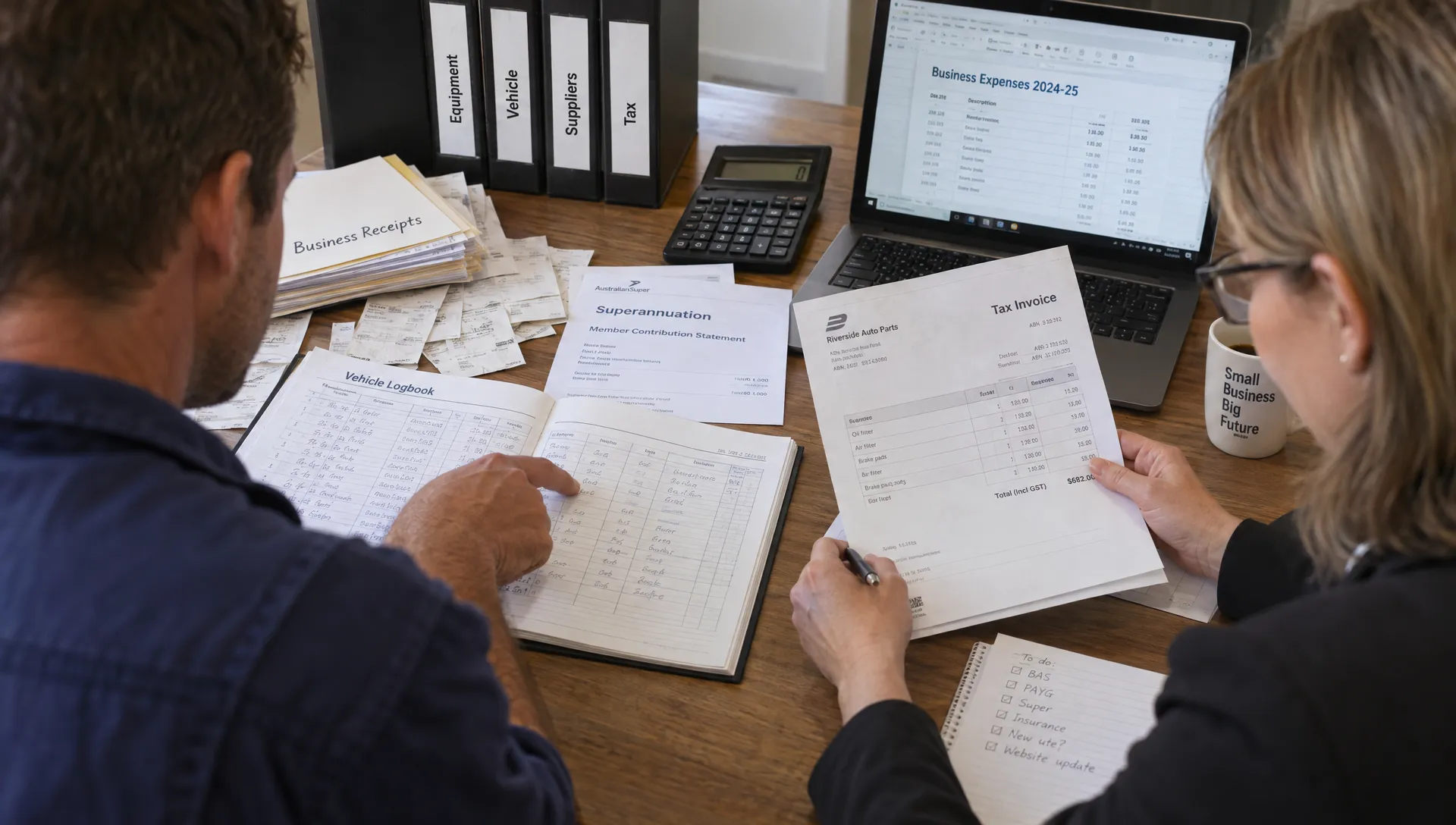
For mixed-use expenses, we retain the allocation method alongside invoices and receipts. Useful evidence includes vehicle logbooks, work-from-home hours, itemised phone records, travel itineraries and explanations of unusual transactions.
Most business records must generally be retained for at least five years. Some records, including those supporting capital assets or carried-forward losses, may need to be kept longer. We assess the retention period by record type rather than applying a blanket deletion date.
We recommend digital document capture and regular reconciliation to reduce missing evidence. Our AI-driven approach combines automation with professional judgement, improving processing speed, consistency and financial visibility without treating an automated category as tax advice.
Our guide to bookkeeping that supports tax and business growth explains the wider financial foundation. We use tax accountant help to turn those records into defensible deductions, reliable margins and better-informed business decisions.
When deductions need a broader strategic review
Some deduction questions cannot be resolved by reviewing a receipt alone. We assess the surrounding tax rules where income comes mainly from personal effort, the business makes a loss or activities are changing substantially.
Personal services income: Where the PSI rules apply, certain deductions are restricted. We establish whether the income is PSI and whether the personal services business tests or another relevant exception are satisfied before applying those restrictions.
Business losses: A sole trader’s deductible expenses may exceed business income. Non-commercial loss rules can defer the loss rather than allow it to offset salary or investment income immediately.
Business expansion: New premises, substantial equipment purchases or a move into a different activity can introduce capital expenditure and timing issues. We model the after-tax cash position before commitments are made.
We explain these warning signs further in our guide to when DIY sole trader accounting becomes too risky. At this stage, our tax accountant help connects compliance with strategic advisory and corporate growth, rather than simply maximising the current year’s expense total.
Frequently asked questions
Can a sole trader claim expenses paid from a personal account? We assess the underlying expense, not just the account used. A genuine business expense may qualify if the business purpose, amount and payment are supported. We record it correctly without treating the account transfer as another expense.
Can a sole trader claim without a receipt? We assess whether other reliable evidence establishes the expense and satisfies the applicable substantiation rules. A bank entry alone may be insufficient. We do not assume a general receipt-free allowance applies to business expenses.
Can we claim an expense that is partly private? We claim only the deductible business portion, using a reasonable, supportable allocation. Different expense categories can require different methods, so one estimated percentage should not automatically be applied across the business.
Is professional advice worthwhile for a straightforward business? We focus tax accountant help where it can resolve uncertainty or improve decisions. Mixed-use vehicles, home occupancy costs, equipment purchases, PSI and business losses are common reasons for a targeted review, even when transaction volumes are low.
Next steps: review deductions before lodging
We recommend reviewing the largest expenses, mixed-use allocations and unusual transactions before preparing the return. Missing invoices, unsupported percentages and equipment purchases deserve attention first.
At Perfect Accounting & Tax Services, we support clients across Australia through integrated accounting, tax and advisory services in Adelaide, Sydney and Melbourne. We combine 25 years of professional experience with AI-driven automation to improve accuracy, speed and timely financial visibility.
Contact our team at Perfect Accounting & Tax Services for a consultation. We can review sole trader deductions and discuss automated accounting workflows that strengthen compliance, financial health and future growth.