

We reduce business tax legally before 30 June by forecasting taxable profit, claiming properly supported deductions and meeting the conditions for available concessions. For sole trader tax Australia-wide, we also assess the owner’s other income, because business profit is taxed personally rather than through a separate company return.
The objective is not the lowest possible tax bill at any cost. We aim to preserve working capital, improve after-tax returns and avoid transactions that create more expense than value.
Our planning framework below addresses 30 June 2027, the end of the 2026/27 financial year. We check year-specific legislation before recommending concessions, particularly equipment write-offs and superannuation contribution limits.
What does legally reducing business tax involve?
We distinguish between three outcomes: permanently reducing tax, bringing a deduction forward and deferring income to a later financial year. Each has a different effect on cash flow and financial health.
A necessary business expense may reduce taxable profit. An eligible super contribution may reduce personal taxable income but restrict access to the money. Accelerating depreciation may improve current-year cash flow without increasing the total deductions available over an asset’s life.
We reject arrangements involving fabricated expenses, backdated documents, undeclared cash receipts or artificial income splitting. A transaction must reflect commercial reality and satisfy the relevant tax rules.
Before spending, we ask whether the business would still benefit without the deduction. Spending $10,000 to save $3,200 in tax still leaves $6,800 less cash available.
Sole trader tax Australia: start with total taxable income
We calculate a sole trader’s business profit by subtracting allowable deductions from assessable business income, then account for other income and relevant adjustments. Salary, investment income and rental results can materially change the final assessment.
Owner drawings are not deductible wages. Leaving money in the business bank account does not prevent the underlying profit from being taxed.
For an Australian resident individual, the ATO’s resident income tax rates for 2026/27 are:
| Taxable income | Income tax, excluding Medicare levy |
|---|---|
| $0 to $18,200 | Nil |
| $18,201 to $45,000 | 15 cents for each dollar over $18,200 |
| $45,001 to $135,000 | $4,020 plus 30 cents for each dollar over $45,000 |
| $135,001 to $190,000 | $31,020 plus 37 cents for each dollar over $135,000 |
| Over $190,000 | $51,370 plus 45 cents for each dollar over $190,000 |
The tax-free threshold applies to total taxable income, not separately to employment and business earnings. Medicare levy, offsets and other income-tested obligations can alter the outcome.
A company requires separate analysis. We do not recommend incorporation solely because its headline tax rate appears lower. Our comparison of sole trader and company structures explains the wider implications, including access to business funds.
Which expenses should we review before 30 June?
Claim existing entitlements before creating new expenditure
We begin with expenses already incurred but missing from the accounts. These can include business subscriptions, professional fees, merchant charges and the supported business portion of mixed-use costs.
For sole trader tax in Australia, the deduction must relate to earning assessable income and satisfy the applicable rules. Private expenditure remains private, even when paid from a business account.
Our guide to sole trader tax deductions covers expense categories in detail. The year-end priority is different: identify omitted claims, confirm business-use percentages and retain the evidence before finalising the forecast.
We also distinguish between an expense being paid and being deductible. Timing depends on the accounting basis properly applicable to the business and any specific tax provisions. A bank transfer alone does not establish an entitlement.
Bring forward necessary costs only where the rules allow
We assess planned expenditure against commercial need, deduction timing and available cash. Necessary repairs, professional advice or operational purchases may warrant completion before year-end, but capital improvements require different treatment.
Eligible small businesses may obtain an immediate deduction for certain prepaid expenses under the 12-month rule. Broadly, the eligible service period must not exceed 12 months and must end by the close of the following income year. We confirm the business’s eligibility and any exclusions before relying on that treatment.
We do not recommend delaying invoices merely to move income into July. Income recognition depends on when income is derived under the applicable rules, not simply when an invoice is issued.
Can super contributions reduce the year-end tax bill?
For sole trader tax in Australia, deductible personal super contributions can be effective where contribution capacity and liquidity permit. However, the funds generally become subject to superannuation preservation rules, so this is not a substitute for maintaining working capital.
We review employer contributions from any employment, salary sacrifice and proposed personal deductible contributions together. These amounts generally count towards the concessional contributions cap.
Unused concessional cap amounts from up to five previous financial years may be available where eligibility conditions are met, including a total super balance below $500,000 at the previous 30 June. We verify available amounts rather than assuming the full carry-forward balance can be used.
The fund generally needs to receive the contribution by 30 June. Sending money on the final business day may be too late. We establish an earlier processing deadline based on the fund’s arrangements.
A personal deduction also requires a valid notice of intent and fund acknowledgement within the required timeframes. We check these requirements, including before relevant rollovers or withdrawals, against the ATO’s personal super contribution guidance.
Review equipment, debtors and stock before signing off
Equipment purchases require more than a June invoice
We check the legislated asset deduction rules applying to 2026/27, the business’s eligibility and the asset’s business-use percentage. We do not assume that an instant asset write-off threshold from an earlier year still applies.
Where a concession requires an asset to be first used or installed ready for use by year-end, ordering or paying a deposit is insufficient. Delivery delays can change the deduction year.
Our assessment of sole trader tax in Australia also separates the asset deduction from its funding. Loan principal repayments are generally not deductible, and an equipment purchase may require depreciation rather than an immediate deduction.
Bad debts and stock adjustments need evidence
We review aged receivables for genuinely unrecoverable debts. Where the relevant conditions are satisfied, a bad debt generally needs to be written off before year-end to support that year’s deduction. An overdue invoice alone is not enough, and an amount never included in assessable income will generally not produce the same deduction.
For stock-based businesses, we document quantities, damage and obsolescence, then apply an available valuation method correctly. Unsupported reductions to closing stock are not legitimate tax planning.
Worked example: a deduction’s real after-tax value
We use the following example to show why planning must include employment income and cash flow, not just business turnover.
Our hypothetical sole trader is an Australian resident for the full 2026/27 year. We assume $30,000 of employment income and $60,000 of business profit before a further $10,000 of necessary, immediately deductible operating expenditure. The expenditure is GST-exclusive where input tax credits are available.
We also assume eligibility for the small business income tax offset, sufficient eligible business income for its $1,000 maximum in both scenarios, a standard 2% Medicare levy and no other adjustments, offsets, study loan repayments or Medicare levy surcharge.
| Calculation | Without additional expenditure | With additional expenditure |
|---|---|---|
| Employment income | $30,000 | $30,000 |
| Net business income | $60,000 | $50,000 |
| Total taxable income | $90,000 | $80,000 |
| Resident income tax | $17,520 | $14,520 |
| Small business income tax offset | ($1,000) | ($1,000) |
| Medicare levy | $1,800 | $1,600 |
| Combined tax and levy | $18,320 | $15,120 |
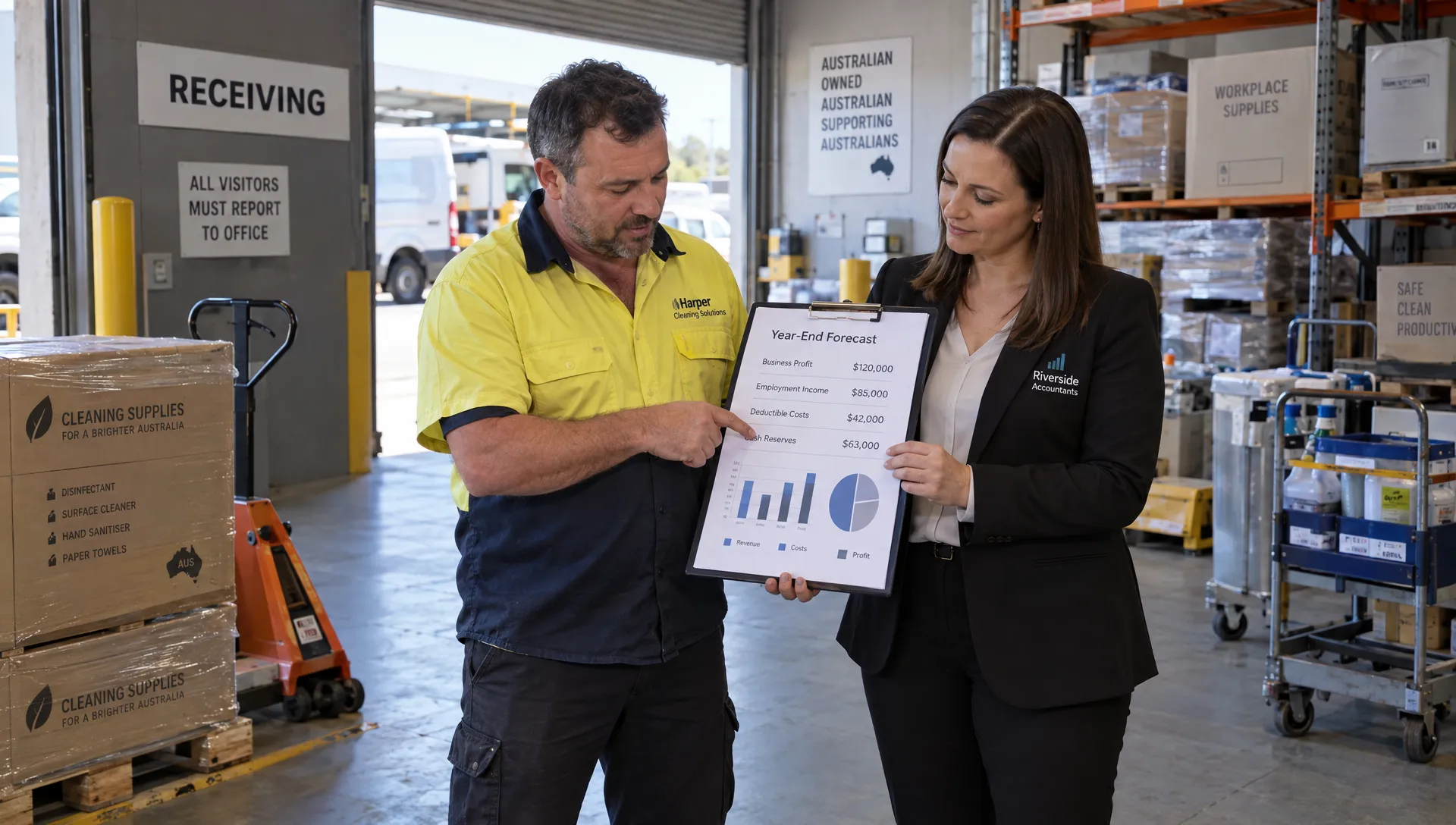
The expenditure reduces tax and Medicare levy by $3,200, leaving an after-tax cost of $6,800. We would recommend it only if the business benefit justifies that remaining cost.
This example of sole trader tax in Australia also illustrates why offsets need individual calculation. The small business income tax offset is subject to eligibility rules and is not automatically $1,000 for every business owner.
Separate tax savings from lodgement and payment obligations
Income tax returns and PAYG instalments
We report sole trader business income through the owner’s individual income tax return using their TFN, including the relevant business information. An ABN does not create a separate taxable entity.
Self-lodged individual returns are generally due by 31 October following the income year. Registered tax agent deadlines depend on eligibility, lodgement history and the applicable program. We confirm the actual deadline rather than assuming an extension.
PAYG instalments are prepayments towards the final income tax liability, not deductible business expenses. We reconcile them against the forecast so that the expected balance payable is visible before lodgement.
Where expected income has genuinely fallen, varying instalments may improve cash flow. We retain a reasonable basis for the variation because an excessive reduction can create interest exposure. Reducing an instalment does not itself reduce the final tax assessment.
GST and BAS require a separate forecast
When planning sole trader tax in Australia, we keep GST separate from income tax. GST registration generally becomes compulsory when GST turnover reaches or is expected to reach $75,000, subject to the rules and exceptions. Certain activities, including ride-sourcing, have different registration requirements.
GST turnover is not taxable profit. A business with substantial expenses may still need to register and lodge BAS even where its income tax liability is modest.
Where GST credits are available, we generally exclude the creditable GST component from income tax deductions. We also reserve GST collected for payment rather than treating the full bank balance as available cash.
Employee payroll, superannuation and any FBT obligations require their own review. A 30 June income tax plan does not replace their separate reporting and payment deadlines.
Use reconciled records as the foundation for strategic advisory
We cannot make reliable year-end decisions from unreconciled bank feeds or a profit report containing private transactions. We first reconcile bank accounts, loans, receivables, payroll and tax balances, then identify adjustments requiring evidence or professional judgement.
Our AI-driven processes reduce manual handling and support faster, more accurate reporting. Combined with timely source data and professional review, automation helps provide more current financial visibility. It does not determine whether an expense is legally deductible or replace supporting records.
We turn that bookkeeping foundation into strategic advisory by comparing projected tax with working capital needs, debt commitments and planned investment. For a growing business, this connects compliance with sustainable corporate growth rather than treating the return as an isolated annual task.
For sole trader tax in Australia, separate business banking and reliable digital records make this process more efficient. We generally retain tax records for at least five years, with longer retention where asset, loss or other rules require it.
A practical timetable before 30 June
We work backwards from year-end so that transactions are completed properly, rather than rushed through on the final day.
| Timing | Our planning priority | Business decision supported |
|---|---|---|
| April to May | Reconcile records and forecast total taxable income | Establish the likely tax liability and cash reserve |
| May to early June | Review super capacity, planned expenditure and asset eligibility | Compare tax benefits with liquidity needs |
| Before processing cut-offs | Complete approved contributions and eligible purchases | Meet receipt, delivery and documentation requirements |
| Before 30 June | Finalise supported bad debt decisions and stock records | Substantiate year-end deductions and valuations |
| After year-end | Reconcile final results, instalments and supporting evidence | Lodge accurately and plan payment obligations |
We can begin this process earlier where income is volatile, assets are significant or several entities are involved. Earlier modelling gives us more options and reduces dependence on last-minute transactions.
Frequently asked questions
Can we claim every purchase made before 30 June? No. We assess business purpose, private use, capital treatment and timing. Some purchases are depreciated, while others may not be deductible at all. A receipt establishes expenditure, not automatic deductibility.
Can we offset a sole trader loss against salary income? We first apply the non-commercial loss rules. A business loss may need to be deferred rather than deducted against employment or investment income. We do not assume that making a loss creates an immediate refund.
Does transferring money to a personal account reduce business profit? No. We treat sole trader drawings as movements of the owner’s funds, not deductible expenditure. Tax generally follows taxable profit rather than the amount withdrawn.
Should we pay family members to reduce tax? We only recommend payments for genuine work, with commercially supportable remuneration and appropriate records. We also assess PAYG withholding, superannuation and personal services income rules where relevant. Artificial allocations of income can be challenged.
Next steps: build a documented year-end plan
We recommend starting with current financial reports, year-to-date employment and investment income, super contribution records and a list of planned expenditure. From there, we can quantify the expected benefit of each action and protect the cash needed to operate.
At Perfect Accounting & Tax Services, we support clients across Australia through integrated service capabilities in Adelaide, Sydney and Melbourne. We combine tax planning, strategic advisory and AI-driven accounting processes to improve financial visibility and support informed growth decisions.
To review sole trader tax in Australia before the next 30 June, contact our team for a consultation. We can assess the available strategies and explain how our automated accounting workflows support a more reliable year-end planning process.