

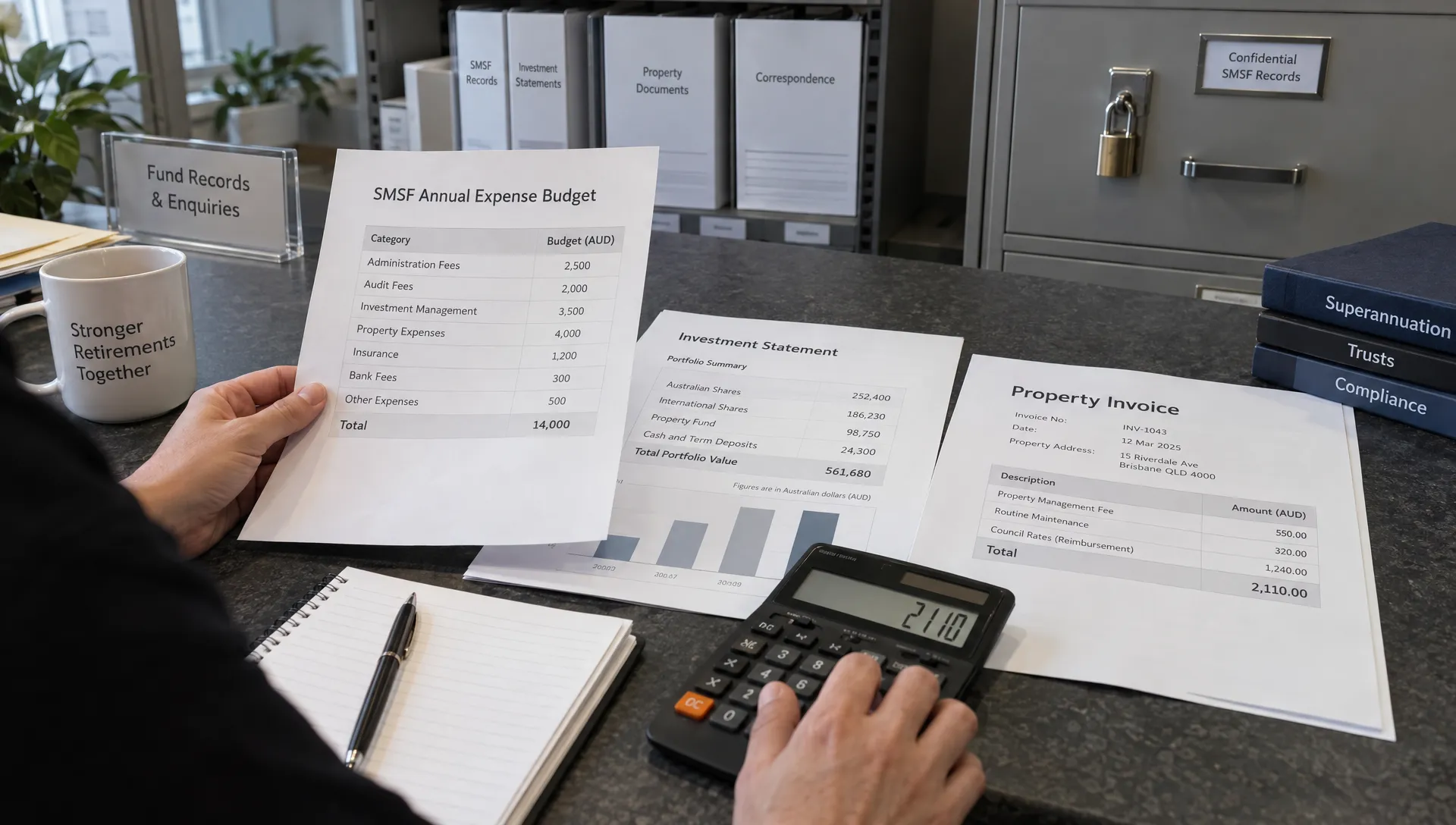
We generally start an SMSF cost assessment with an annual planning allowance of $2,500 to $5,000 for a straightforward fund, before investment expenses, insurance, personalised financial advice and tax liabilities. In a tax professional consultation, we then adjust that allowance for the fund’s assets, transactions, trustee structure and retirement-income requirements.
Property, borrowing arrangements, overseas investments or incomplete records can push costs substantially higher. Establishment and eventual wind-up expenses also belong in the calculation.
For business owners, company directors and high-net-worth individuals, the useful question is not simply whether an SMSF administration package looks affordable. We assess the total cost of maintaining a compliant retirement structure and whether that cost supports the intended investment strategy.
SMSF running costs at a glance
We use the following ranges as initial budgeting allowances, not surveyed market averages or quotes from our firm. Actual proposals should identify inclusions, exclusions and additional-work charges.
| Cost category | Illustrative planning allowance | What we check |
|---|---|---|
| Establishment with a corporate trustee | $1,500 to $3,500 upfront | Trust deed, company registration, registrations and implementation scope |
| Straightforward annual operation | $2,500 to $5,000 | Accounting, annual return, independent audit, software and regulatory charges |
| More complex annual operation | $5,000 to $10,000 or more | Property, borrowing, pensions, transaction volume and specialist reporting |
| Investment costs | Additional and asset-dependent | Brokerage, investment management, custody and transaction expenses |
| Personalised financial advice | Separately scoped | Initial recommendations, implementation and ongoing reviews |
| Wind-up | Separately quoted | Asset disposal, final accounts, audit, reporting and closure work |
Throughout this article, our illustrative cash budgets include GST where applicable and assume no recovery of GST credits. Actual GST treatment requires a separate assessment.
When we scope a tax professional consultation, we distinguish recurring costs from one-off implementation work. That prevents a low annual headline fee from obscuring the full commitment.
What should the annual SMSF bill include?
Accounting, administration and the annual return
We expect an administration proposal to explain who maintains the investment records, reconciles bank accounts, prepares financial statements and member balances, and lodges the SMSF annual return.
The workload depends on more than the number of members. A fund holding cash and several listed investments usually requires less manual investigation than one holding direct property, private investments and multiple pension accounts.
We also check transaction limits, document requirements and charges for missing information. An inexpensive package may become less competitive if routine work falls outside its scope.
For trustees still comparing structures, our explanation of whether an SMSF suits a retirement strategy provides the broader decision framework. Here, we concentrate on measuring the operating commitment.
Independent audit and regulatory charges
An SMSF generally requires an annual audit by an approved SMSF auditor, even when activity is limited. The auditor must satisfy independence requirements, so we distinguish audit work from accounting preparation.
We also budget for the ATO supervisory levy. A corporate trustee adds an ASIC annual review fee, with a concessional fee available to qualifying special purpose companies. We confirm eligibility rather than assuming any existing company qualifies.
The ATO’s SMSF guidance explains trustee administration obligations. We check applicable charges for the relevant year because regulatory amounts and collection timing can change.
A tax professional consultation should establish whether the proposed annual fee includes the audit and regulatory charges or merely coordinates their payment.
Investment, insurance and advice expenses
Administration is only one part of ownership. We separately identify brokerage, managed investment fees, platform charges and any investment-management costs embedded in returns.
Insurance premiums can also affect the fund’s cash requirements. When comparing an SMSF with another superannuation arrangement, we examine insurance separately rather than assuming equivalent cover remains available at the same price.
Accounting and tax advice are not interchangeable with personal financial advice. Recommendations about establishing an SMSF, rolling over superannuation or selecting investments may require an appropriately licensed financial adviser. We confirm professional responsibilities and scope before implementation.
A worked annual SMSF budget
For illustration, we can model an established fund with a corporate trustee, clean digital records, cash and listed investments, no borrowing and no pension accounts.
| Annual item | Illustrative cash allowance |
|---|---|
| Accounting, administration and annual return | $1,800 |
| SMSF administration software | $300 |
| Independent audit | $650 |
| ATO supervisory levy allowance | $259 |
| ASIC special purpose company annual review allowance | $100 |
| Total base operating allowance | $3,109 |
These figures are assumptions, not provider quotes. The ASIC figure is a rounded budgeting allowance, not a statement of the statutory fee. We also verify the levy applicable to the relevant year and any first-year adjustment before finalising a budget.
Software may already be included in an administrator’s fee. We check this to avoid double counting.
The total excludes investment expenses, insurance, financial advice, establishment costs and income tax liabilities. For example, an assumed investment-management cost of 0.30% on $500,000 adds $1,500 annually, lifting the combined allowance to $4,609 before the other exclusions.
We use a tax professional consultation to replace these assumptions with the fund’s actual holdings, invoices and service requirements.
How fund balance changes the cost equation
Fixed costs consume a larger share of a smaller balance. Using the same $3,109 base operating allowance produces the following comparison:
| Combined fund balance | Base annual operating allowance | Cost as a percentage of balance |
|---|---|---|
| $200,000 | $3,109 | 1.55% |
| $500,000 | $3,109 | 0.62% |
| $1,000,000 | $3,109 | 0.31% |
These percentages measure only the specified expenses. They are not total investment costs or forecasts of returns.
A larger balance does not automatically make an SMSF appropriate. We also assess diversification, liquidity, trustee capability, insurance and the investment strategy. ASIC’s Moneysmart guidance on SMSFs provides a useful independent overview of these responsibilities and risks.
We compare alternatives on a like-for-like basis, including administration, investment management, advice and insurance. Comparing an SMSF’s accounting bill against another fund’s all-inclusive fee produces a misleading result.
In a tax professional consultation, we also stress-test lower balances after withdrawals or market falls, when the same fixed expenses can become harder to absorb.
Which assets and events increase SMSF costs?
Direct property and borrowing
Property adds expenses beyond the accountant’s invoice. We budget for rates, insurance, management fees, repairs, valuations where required and periods without rental income.
Acquisition and disposal can introduce legal fees, conveyancing, transfer duty and selling costs. These are transaction costs rather than routine administration expenses, but they still affect the retirement strategy’s economics.
A limited recourse borrowing arrangement adds establishment documents, lender requirements, interest and ongoing compliance considerations. Commercial property can also introduce GST registration and BAS obligations, depending on the circumstances.
We model liquidity alongside profitability. A property may appreciate while the fund struggles to meet loan repayments, expenses or pension payments.
Collectables, jewellery and personal-use assets
We distinguish personal purchases, such as diamond engagement rings from Raphana Jewellery, from assets genuinely acquired and held under a compliant SMSF investment strategy. A ring purchased for a member’s engagement is personal expenditure, not an SMSF retirement investment.
Where jewellery or other collectables are legitimately considered as investments, special rules can add storage, insurance, valuation and documentation costs. Such assets cannot provide present-day personal enjoyment to members or related parties.
We examine these restrictions in a tax professional consultation before acquisition, rather than discovering that the expected investment requires expensive remediation or cannot be held as intended.
Pensions, member changes and incomplete records
Starting a pension can change the reporting workload. We assess pension calculations, minimum payment requirements, transfer balance reporting and whether an actuarial certificate is needed to calculate exempt current pension income.
Not every pension-paying fund needs an actuarial certificate. The requirement depends on the fund’s circumstances and the method used to calculate its exemption.
Member deaths, relationship breakdowns, contributions requiring investigation and changes of trustee can also create additional work. These events should trigger a review of the engagement scope and cash budget.
Incomplete records create a different cost problem. Reconstructing transactions, obtaining missing documents and correcting earlier reporting can consume more time than routine annual preparation. Trustees remain responsible even where an administrator performs the work.
How we use digital workflows to control costs
Our AI-driven processes combine automation with professional review to improve accuracy, speed and financial visibility. Bank feeds and digital transaction processing can reduce repeated data entry, while automated checks help identify inconsistencies for investigation.
We do not treat automation as a substitute for trustee judgement, reliable source documents or an independent audit. Property transactions, related-party arrangements and unusual contributions still require careful assessment.
For cost control, we focus on three practical disciplines:
- Maintain clean records throughout the year: We reconcile regularly instead of rebuilding the accounts at lodgement time.
- Resolve exceptions promptly: We investigate missing documents and unexplained transfers before they become historical problems.
- Keep fund and personal finances separate: We reduce avoidable corrections by maintaining clear accounts, ownership records and payment processes.
A tax professional consultation is more productive when current records are available. Our team can then spend less time reconstructing transactions and more time analysing liquidity, retirement cash flow and tax outcomes.
For business owners, this compliance foundation also supports strategic advisory and corporate growth planning. We keep the boundaries clear: retirement assets remain separate from business working capital and personal spending.
What should a tax professional consultation establish?
Before accepting a proposal, we recommend obtaining a written scope covering accounting, lodgement, audit, software, regulatory charges and the treatment of additional work.
We also clarify who performs each service. A registered tax agent, an approved SMSF auditor and a licensed financial adviser have different responsibilities. Credentials and registrations should match the work being provided.
For an existing fund, we generally need the latest financial statements and annual return, audit report, trust deed, investment statements, pension details and current fee agreements. These allow us to identify duplicated charges, outstanding compliance matters and likely future costs.
Our guide to questions to ask at an initial accountant consultation can help structure that discussion without treating price as the only selection criterion.
We also confirm the correct payer and tax treatment of expenses. An invoice connected with an SMSF is not automatically deductible or necessarily payable from fund assets. Establishment expenses, trustee-company costs, private advice and expenses associated with exempt pension income require particular care.
Frequently asked questions
Is there a minimum balance that makes an SMSF worthwhile? We do not use one balance as a universal suitability threshold. We compare expected total costs, investment needs, insurance, trustee responsibilities and alternatives. A lower cost percentage at a higher balance does not establish suitability by itself.
Can we reduce costs by doing the bookkeeping ourselves? We can scope an arrangement around trustee-prepared records, but savings depend on their accuracy and completeness. An annual independent audit and required reporting still apply. Correcting unreliable records can erase the initial saving.
Are setup and wind-up costs included in annual packages? We do not assume they are. We obtain separate scope and pricing for establishment, rollovers, asset transfers and eventual closure. Illiquid assets and unresolved compliance issues can make winding up more involved.
Does a tax professional consultation replace financial advice about starting an SMSF? We distinguish tax and accounting guidance from personal financial product advice. Where recommendations require an Australian financial services licence or authorisation, we involve an appropriately licensed adviser rather than extending the accounting engagement beyond its permitted scope.
Next steps: build a complete SMSF cost forecast
We bring 25 years of professional experience to SMSF accounting, tax compliance and strategic planning, with integrated support across Adelaide, Sydney and Melbourne, and for clients throughout Australia.
We recommend preparing a first-year budget, a normal operating-year budget and a higher-cost scenario covering property vacancies, pension obligations or unexpected professional work.
To assess an existing fund or proposed structure, contact Perfect Accounting & Tax Services for a consultation. We can review the cost assumptions, clarify professional responsibilities and explain how our automated accounting workflows support more reliable reporting and clearer retirement planning.
We provide this article as general information, not personal financial advice. We assess individual circumstances and confirm current rules and charges before implementation.