

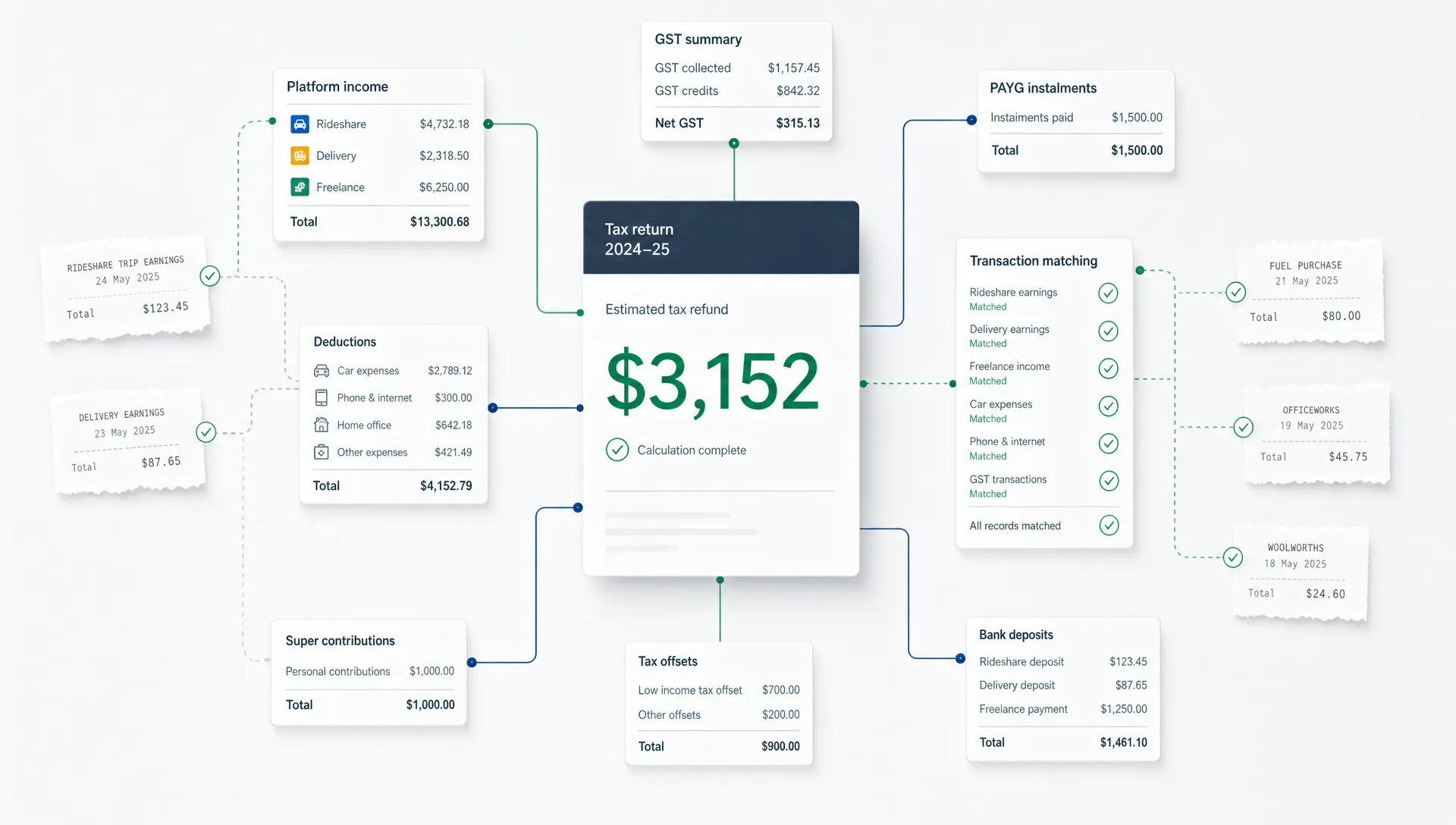
A sole trader earning from several platforms is not running several tax lives. The ATO expects one complete, reconciled view of business income, regardless of whether money arrives through Shopify, Uber, Airtasker, Upwork, Etsy, Stripe, PayPal, direct invoices, subscriptions, or marketplace payouts.
For a sole trader tax return in Australia, the key issue is not simply how much cash landed in the bank. It is whether gross income, GST, platform fees, refunds, foreign currency, business expenses, and private use have been captured correctly. That distinction is where many sole traders create unnecessary ATO risk.
We see this regularly with consultants, tradies, online sellers, content creators, digital agencies, allied health practitioners, and gig economy operators. The business may be profitable, but the reporting system is fragmented. Our role is to turn that fragmented platform data into tax-compliant records, BAS-ready reporting, and strategic financial insight.
The core rule: report the full business picture, not just payouts
Most platforms pay net amounts. They may deduct service fees, merchant fees, subscription fees, advertising charges, chargebacks, refunds, commissions, or foreign exchange costs before the money reaches your bank account.
From an Australian tax perspective, that net payout is not always the same as your assessable business income. In many cases, the more accurate approach is to record gross sales or gross fees earned, then separately record deductible platform costs and other business expenses.
This matters because relying only on bank deposits can understate income, distort GST reporting, and make profitability analysis unreliable. It also makes it harder to explain discrepancies if the ATO receives data from platforms, payment processors, banks, or other third-party sources.
A strong reporting model separates:
- Gross income earned from each platform
- GST collected on taxable supplies, if registered
- Refunds, chargebacks, and cancellations
- Platform fees and merchant fees
- Foreign currency conversion differences
- Business expenses paid outside the platform
- Private or non-deductible costs
If your foundations are still informal, we recommend reviewing what a sole trader should have set up from day one before tax time pressure begins.
Common platform income sources for Australian sole traders
Multiple-platform income is now standard. A single business may sell products through a marketplace, take direct payments through Stripe, receive consulting income through an international freelance platform, and generate advertising revenue from content.
The tax treatment depends on the nature of the income, the customer location, whether GST applies, and whether the activity is a business rather than a hobby.
| Platform or income source | Common example | Reporting focus |
|---|---|---|
| Marketplaces | Etsy, eBay, Amazon, online product stores | Gross sales, refunds, inventory, platform fees, GST treatment |
| Gig economy platforms | Uber, delivery apps, Airtasker-style services | Gross fares or service income, vehicle costs, GST obligations |
| Freelance platforms | Upwork, Fiverr, professional consulting portals | Gross fees, foreign currency conversion, platform commissions |
| Payment processors | Stripe, Square, PayPal | Avoid double counting where the processor only collects payments for another platform |
| Subscription and creator platforms | Patreon, Substack, memberships, digital downloads | Recurring income, overseas customers, GST classification |
| Direct invoices | Consulting, design, trade, coaching, health services | Invoice basis, payment timing, debtors, GST and BAS alignment |
| Advertising and affiliate income | YouTube, podcast sponsors, referral programs | Foreign income, payment thresholds, supporting statements |
The common error is treating every deposit as a separate sale without understanding the source. For example, a Shopify sale may be paid through PayPal, then deposited into a business bank account. If the bookkeeper records the Shopify sale and the PayPal deposit as income, revenue is overstated. If only the bank payout is recorded, revenue may be understated because fees have already been deducted.
How income is reported in the tax return
Sole traders report business income in their individual tax return, generally through the business income sections and related business schedules. The business is not a separate taxpayer. You are taxed as an individual on your taxable income, which includes net business income after allowable deductions.
That does not mean the reporting should be casual. The tax return should be supported by a clear profit and loss statement, reconciled bank records, platform reports, GST records where relevant, and evidence for deductions.
In practical terms, we usually work through three layers.
First, we identify the income channels. Each platform, payment processor, invoice system, and bank account needs to be mapped. This prevents missed income and double counting.
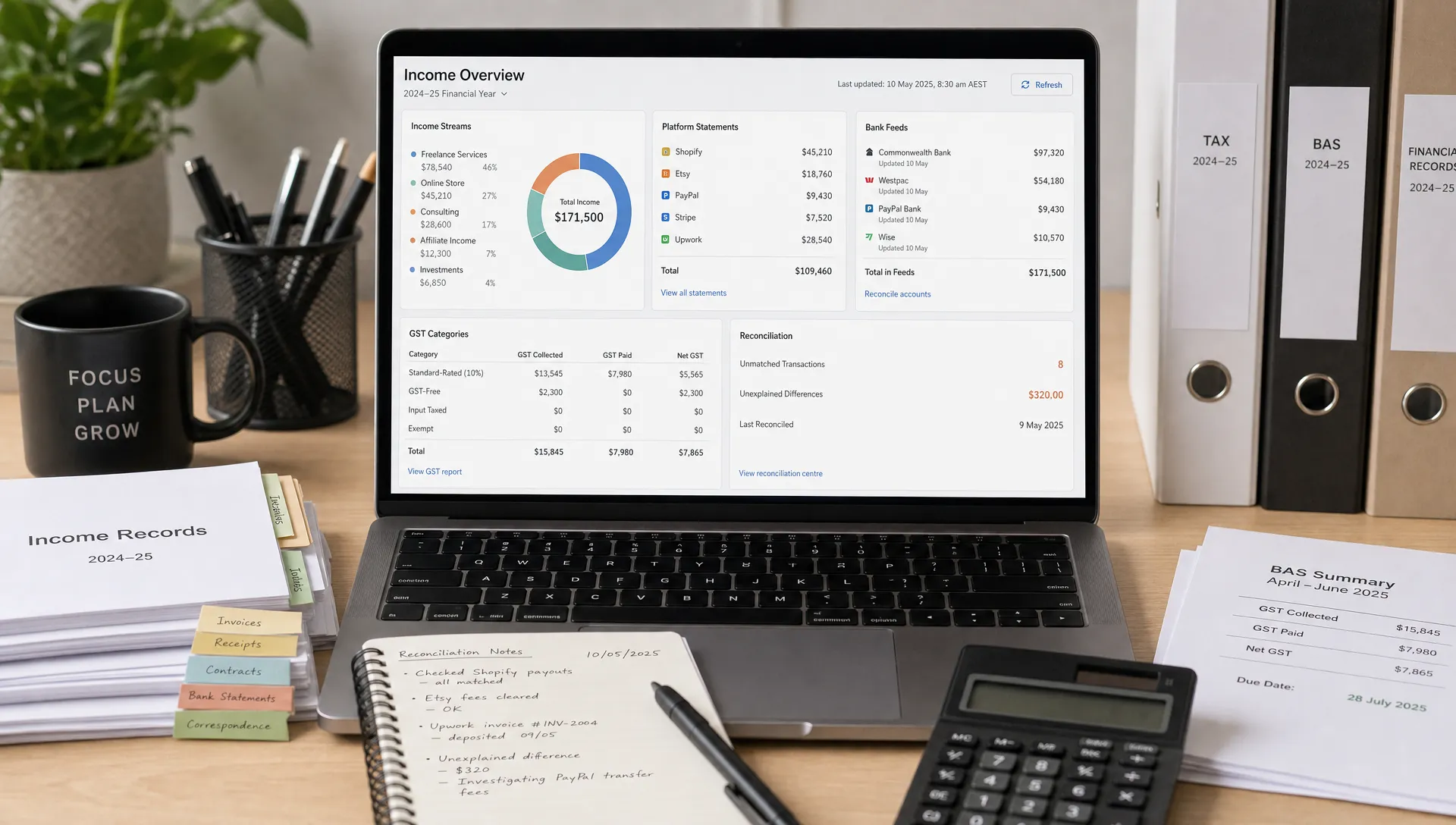
Second, we reconcile platform reports to bank deposits. We do not assume deposits equal revenue. We match gross sales, fees, refunds, tax amounts, and payout timing.
Third, we review the tax classification. We consider GST, foreign income, PSI, private use, inventory, capital assets, and whether the current structure still supports the owner’s commercial goals.
This is where compliance becomes strategic. Clean platform reporting gives you more than a lodged return. It shows which income streams carry the best margins, which platforms are eroding profitability, and where automation can release owner time.
A practical workflow for reporting multiple platforms
We recommend a structured process, especially for the 2025-26 income year and later, where platform data and ATO data matching continue to mature.
- Create a platform register: List every income source, including dormant accounts, overseas platforms, payment processors, and direct invoice channels.
- Download annual transaction reports: Obtain sales summaries, fee statements, refund reports, payout reports, tax invoices, and foreign currency statements from each platform.
- Choose one accounting source of truth: Use accounting software or a properly maintained ledger rather than spreadsheets scattered across platforms.
- Separate revenue from fees: Record gross income and claim platform charges as expenses where they are deductible and properly evidenced.
- Reconcile to bank deposits: Match payout batches to platform reports, noting timing differences around 30 June.
- Review GST and BAS alignment: Ensure BAS lodgements agree with annual records and explain any timing or classification differences.
- Retain records for ATO review: Keep business records generally for five years, including invoices, statements, receipts, and working papers.
A sole trader with multiple platforms should be able to answer a simple question: if the ATO asks how the annual income figure was calculated, can the pathway from platform sale to tax return be demonstrated?
GST and BAS issues when income comes from several platforms
GST is where platform income often becomes complex. The standard GST registration threshold for a business is $75,000 in GST turnover. However, certain activities have specific rules. For example, taxi travel and ride-sourcing generally require GST registration regardless of turnover.
If you are registered for GST, you generally report taxable sales and claim GST credits on creditable business purchases through BAS. If your platforms collect from Australian customers, sell to overseas customers, or deduct fees before payout, you need to understand the GST treatment of each transaction type.
Important GST questions include:
- Are your customers in Australia or overseas?
- Are your supplies taxable, GST-free, input taxed, or outside the Australian GST system?
- Are platform fees charged by Australian entities or offshore entities?
- Do your platform reports show GST clearly?
- Are refunds and chargebacks reducing GST correctly?
- Are BAS figures reconciling to annual business income?
For e-commerce operators, digital service providers, consultants, and creators, GST treatment can vary between domestic sales, export sales, digital products, and platform-facilitated transactions. We generally recommend reviewing GST classification before lodging BAS, not after the annual tax return exposes a mismatch.
Our broader guide on what Australian small business owners must track is a useful companion if your platform income is now large enough to require tighter controls.
Foreign platform income and currency conversion
Many Australian sole traders earn through overseas platforms. This includes software developers, marketing consultants, designers, virtual assistants, writers, engineers, online educators, and specialist advisers.
If you are an Australian tax resident, foreign business income generally needs to be reported in Australia. The fact that the platform is offshore, the client is overseas, or the payment is made in USD, EUR, GBP, or another currency does not remove the need to consider Australian tax reporting.
For example, an Australian freelance marketer may receive USD income from overseas clients through a platform. One client might be a hospitality group, a technology startup, or even a professional services firm such as a Tampa personal injury law firm. The Australian reporting question remains the same: what gross income was earned, what fees were deducted, what currency conversion rate was used, and what evidence supports the figures?
Foreign currency should be converted to Australian dollars using a reasonable and consistent method. Bank conversion records, platform payout reports, and recognised exchange rate sources can all assist, but the method should be documented. If foreign tax has been withheld, further review may be needed to determine whether any foreign income tax offset is available.
Do not confuse payment processors with sales platforms
Stripe, Square, PayPal, and similar tools often create confusion because they are payment channels, not always sales channels. If a customer buys through an online store and pays through PayPal, the sale may already be recorded in the store’s platform data. Recording the PayPal receipt again as income can duplicate revenue.
The correct treatment depends on the workflow. A payment processor may represent direct income if you invoice customers directly through that processor. Alternatively, it may simply be the settlement mechanism for another platform.
We usually build a transaction map before coding entries. The map identifies the original sale, the payment processor, the bank settlement, and any fees. This is particularly important for businesses using multiple currencies, multiple websites, and multiple merchant accounts.
Platform fees, commissions, and other deductions
Platform deductions are not lost just because they never reached your bank account. If they are genuine business costs, properly evidenced, and connected to earning assessable income, they may be deductible.
Common deductible costs for platform-based sole traders include platform commissions, merchant fees, software subscriptions, advertising spend, professional insurance, accounting fees, business-related phone and internet costs, home office expenses, vehicle expenses, stock purchases, packaging, freight, subcontractor costs, and professional development.
The strategic point is margin visibility. A platform generating high revenue may still be weak after commissions, advertising, refunds, packaging, delivery, and time cost. Once your data is properly coded, we can assess contribution margin by platform and advise whether pricing, product mix, or channel strategy needs to change.
Deductions must also be apportioned where there is private use. A laptop, mobile phone, home internet plan, vehicle, or home office space may have both business and private elements. The ATO expects reasonable evidence for the business percentage claimed.
PSI, contractors, and business structure risk
Multiple platforms do not automatically solve personal services income issues. If your income is mainly a reward for your personal skills or efforts, the PSI rules may still apply, even where income comes from more than one source.
This is relevant for IT consultants, engineers, designers, architects, health professionals, trainers, copywriters, legal consultants, project managers, and other specialist professionals. The analysis is not simply whether you have an ABN or several clients. It involves the character of the income, the contractual arrangements, the results test, unrelated clients, business premises, employees or contractors, and other factors.
As income grows, the question also shifts from “Can I lodge this return?” to “Is the current structure still fit for purpose?” A sole trader may need advice on GST, PAYG instalments, superannuation planning, asset protection, insurance, company structures, trusts, payroll, contractors, or virtual CFO support.
If your reporting is becoming reactive, our article on when to stop DIY sole trader accounting explains the warning signs we commonly see before ATO risk or cash flow pressure emerges.
ATO data matching and audit readiness
The ATO receives and analyses increasing volumes of data from banks, platforms, government agencies, payment systems, and third parties. Sole traders should assume that platform income is becoming more visible, not less.
Common ATO risk indicators include bank deposits that exceed reported income, platform sales not matching BAS turnover, GST registration issues, lifestyle indicators inconsistent with declared income, large deductions without evidence, repeated losses, and foreign platform income omitted from the return.
Audit readiness does not mean being defensive. It means having records that explain the numbers. A well-prepared sole trader should be able to provide platform statements, invoices, bank reconciliations, GST reports, expense evidence, and a clear summary of how annual income was calculated.
Our team approaches this through human review supported by AI-driven accounting workflows. Where platform exports, bank feeds, and accounting software integrations are available, we use automation to improve speed, consistency, and exception detection. The technology helps us identify missing months, duplicate deposits, unusual margins, GST anomalies, and unreconciled payouts faster than manual review alone.
The final judgement still belongs to experienced advisers. Automation provides visibility. Professional analysis turns that visibility into compliance, cash flow planning, and corporate growth strategy.
Example: how a multi-platform sole trader should think about reporting
Consider an Australian sole trader who sells digital templates through an online marketplace, consults through a freelance platform, takes direct payments via Stripe, and receives affiliate income from overseas.
A weak reporting approach would add up the amounts deposited into the bank and claim a few expenses from memory. That approach misses fees, timing differences, GST treatment, exchange rates, and potentially entire income streams if payments were held in a platform wallet.
A stronger approach would build a platform-by-platform reconciliation.
| Reporting area | Weak approach | Strong approach |
|---|---|---|
| Income | Use bank deposits only | Reconcile gross platform income to payouts |
| Fees | Ignore deducted fees | Record platform and merchant fees separately |
| GST | Estimate at year end | Classify GST throughout the year and reconcile BAS |
| Foreign currency | Use rough conversions | Document AUD conversion method and source records |
| Refunds | Treat as negative deposits only | Match refunds to original sales and GST impact |
| Strategy | Focus only on tax payable | Review margins, cash flow, pricing, and platform mix |
This is why we view tax reporting as a management tool. A properly prepared tax return is the end result of a disciplined financial system, not a last-minute reconstruction.
How AI-assisted workflows improve multi-platform reporting
Traditional bookkeeping often struggles with platform income because transaction volume is high and descriptions are inconsistent. AI-assisted workflows help classify transactions, identify exceptions, match payout batches, and surface anomalies for adviser review.
For a sole trader, this can mean faster month-end reporting, fewer manual coding errors, clearer GST visibility, better tax reserve planning, and earlier warnings when margins deteriorate. For a growing business, it creates the foundation for strategic advisory, virtual CFO support, and decisions about structure, staffing, automation, and expansion.
We support clients across Australia, with integrated service capabilities in Adelaide, Sydney, and Melbourne. That national model is valuable for sole traders who operate online, work across states, sell nationally, or manage clients in multiple jurisdictions.
Frequently Asked Questions
Do I report gross platform income or only the net payout? In many cases, you should start from gross income and record platform fees separately as expenses, rather than treating the net bank payout as revenue. The correct treatment depends on the platform reports, GST status, and transaction flow.
What if a platform has already deducted its commission? The commission may still be a business expense if it was incurred in earning assessable income and is properly evidenced. You should retain platform statements showing the gross sale, deducted fee, and net payout.
Do I need to register for GST if I earn from several platforms? If your GST turnover reaches the registration threshold, currently $75,000 for most businesses, you generally need to register. Some activities, such as ride-sourcing, have specific GST rules regardless of turnover.
How do I report income from overseas platforms? Australian tax residents generally need to report foreign business income in Australian dollars. You should retain platform records, currency conversion evidence, fee details, and any foreign withholding information.
Can I use myTax for multiple-platform sole trader income? Some simple sole traders may use myTax, but multiple platforms, GST, foreign income, PSI, contractors, inventory, or high transaction volume often justify professional support. The risk is not the software. The risk is inaccurate classification and incomplete records.
Next steps: turn platform income into strategic financial visibility
If you earn through multiple platforms, we recommend moving away from year-end reconstruction and toward an automated, adviser-reviewed workflow. This improves tax accuracy, BAS confidence, cash flow planning, and business decision-making.
Our team can help you consolidate platform data, reconcile income to bank deposits, review GST and BAS treatment, assess deductions, manage foreign income reporting, and build AI-driven accounting processes that provide clearer real-time visibility.
With 25 years of professional experience, Perfect Accounting & Tax Services supports sole traders, SMEs, company directors, and high-net-worth individuals across Australia, including Adelaide, Sydney, and Melbourne.
Contact Perfect Accounting & Tax Services to arrange a consultation and learn how our automated accounting workflows can turn multi-platform income into compliant reporting and stronger strategic decisions.