
Strong cash flow is rarely created by one decision. It comes from consistent financial discipline, accurate records, timely tax planning and the ability to see pressure points before they become urgent.
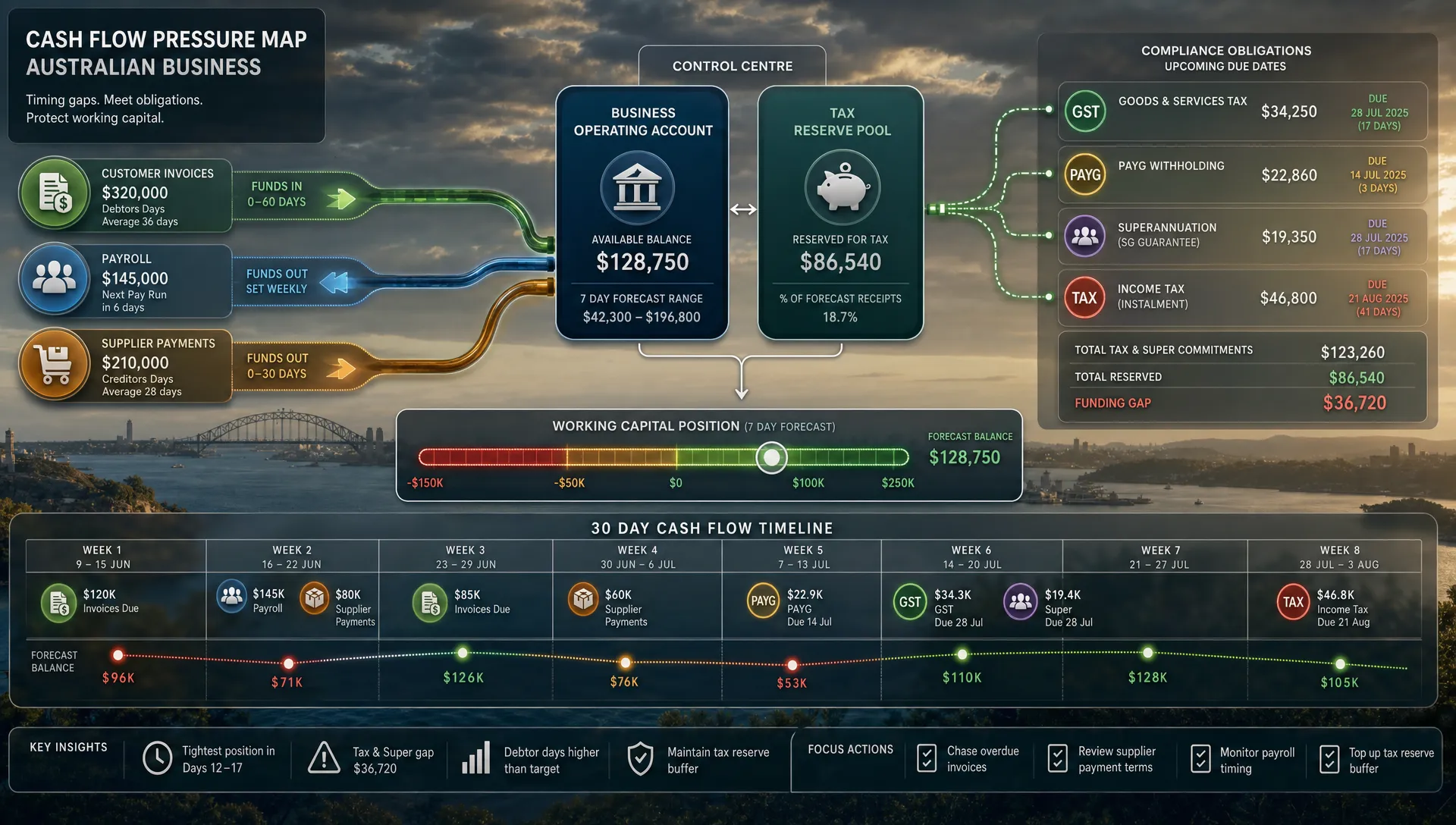
For Australian business owners, company directors and high-net-worth individuals, cash flow management is also more complex than simply watching the bank balance. GST collected on sales is not the business’s money. PAYG withholding, superannuation, income tax instalments, FBT and payroll obligations can all create timing gaps. If those liabilities are not visible early, a profitable business can still feel cash constrained.
This is where integrated tax and bookkeeping services become a strategic asset. When bookkeeping is current and tax advice is proactive, the business can forecast cash needs, protect working capital and make more confident growth decisions.
Our team sees bookkeeping and tax compliance as the financial infrastructure behind corporate growth. With the right systems, automation and advisory oversight, compliance data becomes decision-grade intelligence.
Why profitable businesses still experience cash flow stress
Profit and cash flow are connected, but they are not the same. A business can show a strong profit on its management reports while still struggling to pay suppliers, fund wages or meet ATO obligations.
This usually happens because of timing. Revenue may be recognised before customers pay. Inventory, subcontractors, software, rent, loan repayments and payroll may need to be paid before cash is collected. Tax liabilities may build quietly in the background until BAS or income tax due dates arrive.
The most common causes of cash flow pressure include:
- Slow debtor collection and weak credit control.
- GST and PAYG liabilities not being separated from operating cash.
- BAS and income tax instalments being treated as future problems rather than current obligations.
- Incomplete bookkeeping that hides margins, stock movements or unprofitable jobs.
- Payroll, superannuation and FBT obligations being reviewed too late.
- Growth being funded from working capital without a clear cash flow forecast.
This is why cash flow management must start with accurate books and proactive tax planning. If the underlying data is late, inconsistent or unreconciled, every forecast becomes less reliable.
How tax and bookkeeping services strengthen cash flow
Bookkeeping gives the business visibility. Tax planning gives that visibility structure, timing and strategic direction. When both services work together, owners and directors can move from reactive cash management to controlled working-capital planning.
1. Current bookkeeping reveals the true cash position
A bank balance alone does not show the true position of a business. It does not show unpaid BAS liabilities, superannuation accrued, invoices due from customers, supplier bills, loan repayments or upcoming tax instalments.
Current bookkeeping brings these moving parts into one financial view. Bank reconciliations, accounts receivable, accounts payable, payroll records and GST coding all need to be up to date. Without that discipline, management decisions are based on partial information.
We often advise clients to treat reconciled bookkeeping as the minimum standard for serious cash flow management. If records are not current, directors cannot confidently answer key questions such as:
- How much cash is genuinely available after GST and PAYG are set aside?
- Which customers are creating collection risk?
- Which suppliers should be prioritised to protect operations?
- Which product lines, jobs or services are consuming working capital?
- Whether the business can safely hire, purchase equipment or expand.
For a deeper view of this specific issue, we have also explained how a professional bookkeeping service improves cash flow visibility by keeping the right financial data current.
2. GST and BAS planning prevents cash surprises
In Australia, GST is usually 10% on taxable sales. That GST may sit in the business bank account temporarily, but it is ultimately payable to the ATO after GST credits are applied. If GST is treated as operating cash, the business may experience a sudden shortfall when BAS is due.
Effective tax and bookkeeping services reduce that risk by tracking GST obligations progressively, not just at lodgement time. Accurate coding of sales, purchases, imports, exports and mixed supplies is essential. So is timely reconciliation of the GST control account.
The ATO’s BAS guidance makes clear that businesses must report obligations such as GST, PAYG withholding and PAYG instalments through activity statements where applicable. From a cash flow perspective, those obligations should be forecast as soon as they arise.
A practical approach is to maintain a separate tax reserve policy. Each week or month, the business estimates GST, PAYG withholding and income tax obligations, then sets aside funds before they can be absorbed into day-to-day spending.
3. Tax planning aligns payment timing with business cycles
Tax planning is not only about reducing tax within the law. It is also about understanding when obligations are likely to fall due and ensuring the business has the liquidity to meet them.
This is particularly important for businesses with seasonal revenue, project-based billing, property development activity, professional services retainers or large equipment purchases. A construction firm in Adelaide, a Sydney-based consultancy and a Melbourne manufacturer may all have different cash cycles, but each needs forward visibility over ATO obligations.
Strategic tax planning can help assess:
- Whether PAYG instalments reflect current profitability.
- How asset purchases may affect deductions and cash flow.
- Whether business structure remains suitable for growth, profit retention and risk management.
- How dividends, director loans, trust distributions or related-party payments affect cash requirements.
- Whether FBT exposure has been identified early enough to avoid unexpected liabilities.
The objective is not to defer reality. It is to plan accurately, avoid unnecessary shocks and keep capital available for operations and growth.
The cash flow impact of integrated tax and bookkeeping
When tax and bookkeeping operate separately, important timing issues can be missed. When they are integrated, the business gains a more complete view of working capital.
| Service area | Cash flow problem it addresses | Strategic benefit |
|---|---|---|
| Bank reconciliation | Unknown cash position and unreconciled transactions | Reliable daily or weekly financial visibility |
| Accounts receivable management | Slow customer payments and debtor concentration risk | Faster collections and stronger working capital |
| Accounts payable management | Unplanned supplier pressure and missed payment priorities | Better payment scheduling and supplier confidence |
| BAS and GST reporting | GST being used as operating cash | Fewer ATO payment shocks and cleaner compliance |
| Payroll and superannuation review | Underestimated employment costs | More accurate wage, super and cash planning |
| Tax planning | Income tax and instalment surprises | Better timing of profit, drawings and reinvestment decisions |
| Management reporting | Decisions based on old or incomplete numbers | Stronger strategic advisory and growth planning |
This is where modern accounting shifts from administration to strategy. The ledger becomes a planning tool. BAS becomes a working-capital checkpoint. Tax planning becomes part of the growth model.
Automation improves speed, accuracy and cash visibility
Digital transformation has changed what business owners should expect from tax and bookkeeping services. Manual data entry, delayed reconciliations and once-a-year reviews are no longer sufficient for a business that wants financial control.
AI-driven automation can help classify transactions, detect anomalies, streamline document capture and shorten the time between a transaction occurring and management seeing its impact. Human judgement remains essential, especially for tax interpretation, structure, advisory and risk management. But automation improves the quality and speed of the information we review.
In practice, this means business owners can receive faster insights into debtor movements, margin changes, expense trends and upcoming tax obligations. Directors can identify pressure points earlier and act before cash flow becomes a crisis.

For businesses operating across Adelaide, Sydney and Melbourne, automation also supports consistency. A national or multi-location business needs standardised financial processes, common reporting definitions and clear compliance workflows. Without that structure, each location can develop its own version of the numbers, which weakens management control.
Turning compliance data into strategic advisory
The strongest cash flow outcomes come when compliance data is converted into practical decisions. This is the point where bookkeeping, tax and advisory meet.
A clean profit and loss statement is useful. A clean profit and loss statement connected to a cash flow forecast, debtor ageing report, BAS estimate, payroll summary and tax planning review is far more powerful.
We use this integrated view to help business owners assess questions such as:
- Can the business fund expansion from internal cash flow, or is external finance required?
- Are margins strong enough to support additional employees?
- Is the business carrying too much tax debt, stock or debtor exposure?
- Should directors adjust drawings, dividends or reinvestment timing?
- Is the current structure still suitable for asset protection, tax efficiency and succession planning?
This advisory approach is particularly important for scaling companies, property investors, professional practices, technology businesses and family-owned groups. These entities often have more complex cash movements, including director loans, inter-entity transactions, trusts, SMSFs, capital gains tax events and financing arrangements.
If you are assessing whether your current adviser is providing this level of value, our article on how to choose tax services that support business growth outlines the qualities that matter beyond basic lodgement.
Practical cash flow controls every business should implement
Strong cash flow depends on repeatable controls. These controls do not need to be complicated, but they must be consistent and reviewed by people who understand both compliance and commercial decision-making.
A disciplined business should maintain:
- A rolling 13-week cash flow forecast.
- Weekly or monthly bank reconciliations, depending on transaction volume.
- Aged receivables review with clear follow-up procedures.
- Aged payables review linked to supplier priority and cash availability.
- Separate tracking for GST, PAYG withholding, income tax instalments and superannuation.
- Monthly management reporting that compares actual results to budget.
- Periodic tax planning before year-end, not after the financial year has closed.
These controls create a financial rhythm. Directors know what has happened, what is due next and what decisions need to be made. That rhythm reduces uncertainty and improves confidence with lenders, investors, suppliers and internal teams.
Cash flow risks vary by industry and structure
Different businesses experience different cash flow risks. Tax and bookkeeping services should be tailored accordingly.
A professional services firm may have low inventory but high payroll and debtor exposure. A construction business may face progress claims, subcontractor payments, retention amounts and project timing risk. An e-commerce operator may need to manage GST, inventory, platform fees, international payments and advertising spend. A property investor or developer may face land tax, GST on property transactions, finance costs and capital gains tax considerations.
The structure also matters. Sole traders, companies, trusts, partnerships and SMSFs each have different tax and reporting requirements. Director loans, Division 7A considerations, trust distributions and related-party transactions can all affect cash flow if not planned properly.
This is why we do not view bookkeeping as a generic back-office task. The bookkeeping system should reflect the commercial realities of the business. The tax strategy should then interpret those numbers in context.
Warning signs your cash flow systems need attention
Many businesses wait too long before seeking support. By the time ATO debt, supplier pressure or payroll stress becomes obvious, options may be more limited.
Warning signs include frequent BAS surprises, growing unpaid debtors, unclear profit margins, late superannuation payments, inconsistent reconciliations, unexplained bank balance movements, reliance on overdrafts for routine expenses or difficulty funding tax instalments.
Another warning sign is delayed management reporting. If directors only receive meaningful financial information after the quarter has ended, they are managing history rather than steering the business.
Modern tax and bookkeeping services should reduce that lag. They should provide a clear view of past performance, current obligations and forward cash requirements.
How we can help strengthen cash flow
Our team supports Australian businesses and high-net-worth individuals with integrated tax, bookkeeping and strategic advisory services. We work across Australia, with coordinated support for clients in Adelaide, Sydney and Melbourne.
We combine 25 years of professional experience with AI-driven automation to improve workflow efficiency, reporting accuracy and real-time financial visibility. Our focus is not simply to lodge returns or process transactions. We help clients build financial systems that support better decisions, stronger compliance and sustainable corporate growth.
Depending on your needs, we can assist with bookkeeping systems, BAS and GST management, payroll and superannuation governance, tax planning, virtual CFO support, audit representation, late return assistance and multi-entity reporting. Where growth is the objective, we help turn compliance data into advisory insight.
You may also find our broader guide on how accounting professionals improve financial control useful if you are reviewing your internal finance function.
Frequently Asked Questions
How do tax and bookkeeping services improve cash flow? They improve cash flow by keeping financial records current, tracking receivables and payables, forecasting GST and PAYG obligations, identifying tax liabilities early and giving directors reliable information for working-capital decisions.
Why is bookkeeping important for BAS and GST cash flow? Bookkeeping determines how GST is coded, reconciled and reported. If GST liabilities are not visible before BAS lodgement, a business may accidentally use tax money for operating expenses and face a cash shortfall when payment is due.
Should tax planning happen before or after the end of the financial year? Tax planning is most valuable before year-end because there is still time to make commercial decisions. After year-end, many options are limited to reporting what has already occurred.
Can automation replace an accountant or tax adviser? Automation improves speed, consistency and visibility, but it does not replace professional judgement. Australian tax law, business structure, FBT, GST treatment, Division 7A and strategic growth decisions still require experienced advice.
What should directors review each month to protect cash flow? Directors should review cash flow forecasts, aged debtors, aged payables, BAS estimates, payroll and superannuation obligations, profit margins, loan commitments and upcoming tax payments.
Next steps
If cash flow feels unpredictable, the issue may not be sales. It may be the quality, timing and interpretation of your financial information.
Our team can review your current bookkeeping, BAS processes, tax planning rhythm and management reporting to identify where cash visibility can be improved. We can also show you how automated accounting workflows can reduce manual processing and give you faster insight into the numbers that drive your business.
Contact Perfect Accounting & Tax Services to arrange a consultation and learn how our integrated tax, bookkeeping and advisory approach can help strengthen cash flow across your business.