
Business tax forecasting is the difference between reacting to tax bills and managing tax as part of a deliberate growth strategy. For Australian business owners, directors and high-net-worth individuals, the issue is rarely just whether a tax return is correct. The bigger question is whether the business can see its future GST, PAYG instalments, income tax, Superannuation, payroll tax and FBT exposure early enough to make better decisions.
The right accountant improves business tax forecasting by turning historical records, current trading data and strategic assumptions into a live view of future obligations. That matters when profit is growing, margins are tightening, a major asset purchase is being considered, or directors are deciding whether to retain cash, pay dividends, restructure debt or expand interstate.
As Australian tax advisers, we see tax forecasting as a management discipline, not a once-a-year compliance exercise. Accurate forecasting gives business owners time, options and control.
Tax forecasting is not the same as tax compliance
Tax compliance looks backwards. It confirms what happened, prepares lodgements and ensures the business meets ATO and state revenue obligations. Tax forecasting looks forward. It asks what the next quarter, half-year and full financial year may look like, then translates that outlook into cash-flow and tax consequences.
Both are essential, but they serve different purposes. Compliance protects the business from penalties, interest and audit risk. Forecasting supports liquidity, pricing, investment, hiring and capital allocation.
A strong accountant for business taxes should be able to bridge both. They should understand the legislation, but also read the commercial drivers behind the numbers. Revenue growth, gross margin changes, stock levels, debtor days, contractor arrangements, director drawings and finance costs all influence the final tax position.
This is where many businesses lose visibility. Their profit and loss report may show growth, yet cash remains tight because GST, PAYG instalments, Superannuation and supplier commitments have not been forecast as one integrated system.
What the right accountant brings to business tax forecasting
A useful tax forecast is not a rough percentage applied to profit. It is a structured model built from clean data, Australian tax knowledge and commercial judgement.
1. Clean, current accounting data
A forecast is only as reliable as the data behind it. If bank reconciliations are late, GST coding is inconsistent, payroll categories are inaccurate, or director loan accounts are not reviewed, the forecast becomes a guess.
The right accountant starts by strengthening the financial base. This includes reconciling bank feeds, reviewing GST treatment, checking payroll and Superannuation records, identifying personal or private expenses, and ensuring income is recognised correctly.
We often describe this as building a single source of financial truth. Without it, business owners may make decisions from management reports that do not match BAS, payroll or year-end tax outcomes. For a deeper look at this foundation, our article on how accounting professionals improve financial control explains why reliable data is central to better governance.
2. A clear view of all Australian tax obligations
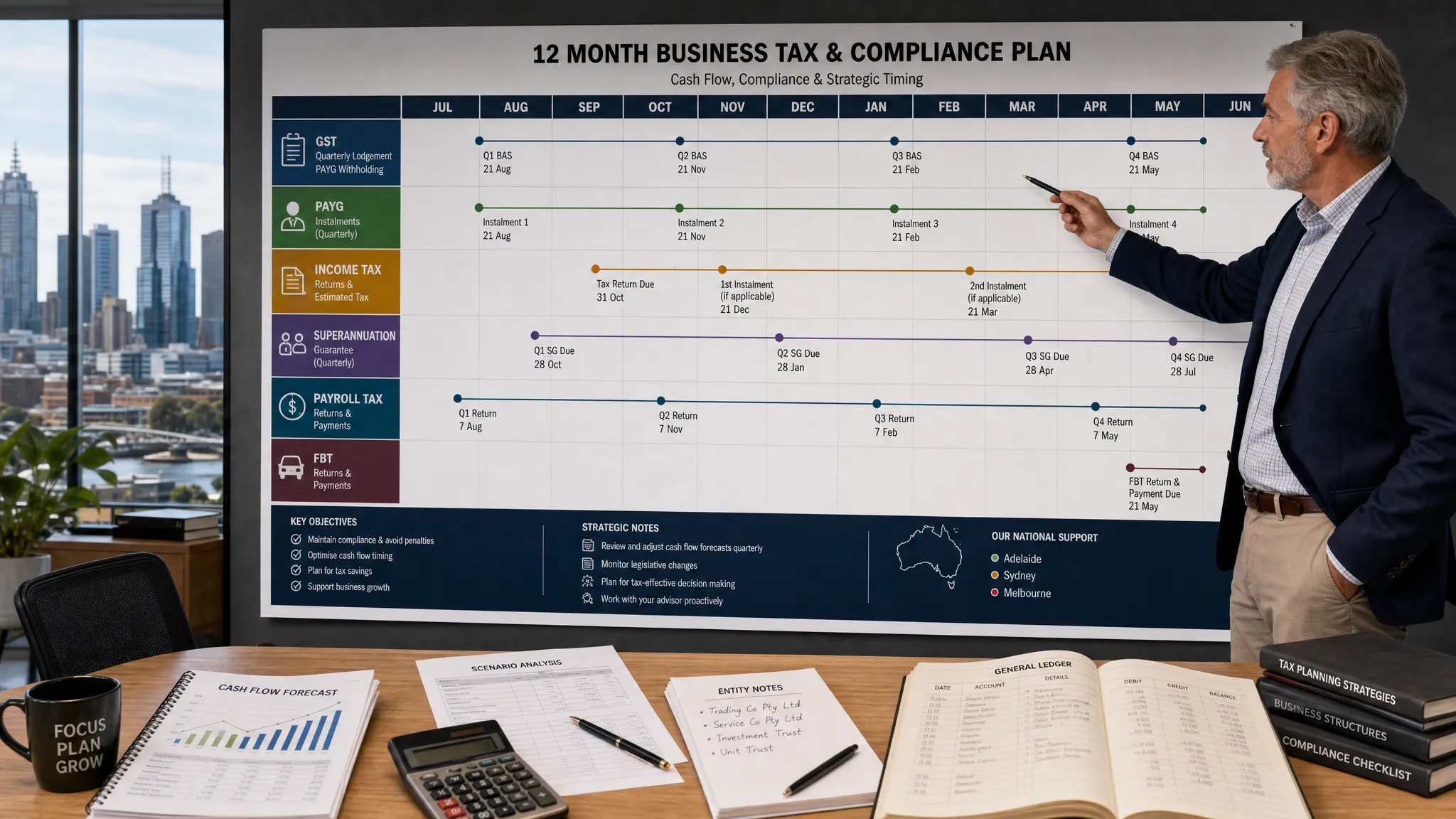
Australian business tax forecasting should not focus on income tax alone. A growing business may have several obligations falling due at different times, each with different calculation methods and cash-flow effects.
The ATO provides guidance on obligations such as GST and PAYG instalments, but applying those rules to a live business requires context. For example, a profitable company with seasonal sales may need a different cash reserve strategy from a professional services firm with steady monthly revenue.
| Forecast area | Why it matters | What a skilled accountant reviews |
|---|---|---|
| GST and BAS | GST cash flow can fluctuate sharply with sales, purchases and timing | GST coding, taxable supplies, input tax credits, BAS timing and reconciliation |
| PAYG instalments | Instalments can lag behind growth and create cash pressure | Forecast taxable income, instalment rate, variation risk and ATO payment timing |
| Income tax | Accounting profit rarely equals taxable income | Add-backs, deductions, depreciation, timing differences and tax losses |
| Payroll and Superannuation | Staff growth increases recurring compliance obligations | Superannuation Guarantee, PAYG withholding, contractors and payroll classifications |
| Payroll tax | State-based thresholds and rules affect expanding employers | Wage grouping, contractor payments and obligations across states and territories |
| FBT | Benefits can create tax exposure outside the normal income year | Motor vehicles, entertainment, employee benefits and the FBT year ending 31 March |
| Division 7A | Private company funds used by shareholders can trigger tax consequences | Loans, repayments, interest, dividends and trust distributions |
| Capital gains tax | Asset sales and restructures can create irregular tax events | Cost bases, concessions, timing, ownership structure and documentation |
The value of the forecast is not just the calculation. It is the ability to see the timing, risk and strategic options before the liability becomes urgent.
3. Conversion of accounting profit into taxable income
Many business owners look at net profit and assume tax will be calculated directly from that figure. In practice, the taxable income position may be materially different.
Depreciation rules, entertainment expenses, private-use adjustments, provisions, bad debts, trading stock, R&D claims, capital allowances and non-deductible expenses can all change the tax result. A tax forecast must adjust for those differences.
This is especially important for businesses investing in equipment, technology, vehicles or property. The purchase may improve operational capacity, but the tax treatment depends on eligibility, timing, structure and use. A good accountant will model the tax effect before the cash leaves the business, not after the invoice is paid.
Forecasting turns compliance into strategic advisory
When tax forecasting is done well, it becomes a decision-making tool. Directors can see whether the business can fund expansion, whether profit distributions are sustainable, and whether the current structure still supports the company’s growth path.
For example, a business planning to hire senior staff in Sydney, open a Melbourne office or acquire equipment for an Adelaide operation needs to understand more than the headline cost. The forecast should show the effect on payroll, Superannuation, GST, debt servicing, depreciation, state-based payroll tax exposure and projected income tax.
This is where the accountant’s role shifts from processor to adviser. We are not simply asking, “What needs to be lodged?” We are asking, “What is the business trying to achieve, and what tax and cash-flow settings will support that outcome?”
Our view is consistent with the broader advisory role described in our article on how a business services accountant supports better decisions. Forecasting provides the evidence base for those decisions.
How automation improves the accuracy and speed of tax forecasts
Modern tax forecasting is no longer limited to spreadsheets updated after quarter-end. AI-driven accounting workflows can pull data from cloud ledgers, bank feeds, payroll systems, invoicing platforms and expense tools to give a faster view of current performance.
Automation does not replace professional judgement. It improves the quality and timing of the information that judgement relies on.
At our firm, we use digital workflows to help identify anomalies, accelerate reconciliations and give clients clearer visibility over tax-related movements. This is particularly valuable for businesses with multi-location operations, e-commerce sales, large transaction volumes, contractor payments or fast-changing revenue.
The practical benefit is speed. Instead of waiting until BAS preparation or year-end accounts, business owners can see emerging tax obligations earlier. They can also test scenarios more confidently, such as the tax effect of increased wages, new finance, a major equipment purchase or changes in gross margin.

The forecasting cycle we recommend for Australian businesses
A reliable forecast should not be prepared once and forgotten. It should be refreshed as actual results come in and as business assumptions change.
For established businesses, we generally recommend a rolling forecast that looks at least 12 months ahead. For high-growth businesses, property groups, construction firms, medical practices, technology companies and businesses with significant debt or capital expenditure, a more detailed quarterly or monthly model may be required.
| Forecasting stage | What we review | Strategic value |
|---|---|---|
| Data integrity review | Reconciliations, GST coding, payroll, debtor and creditor balances | Removes errors before they distort the forecast |
| Baseline tax estimate | Current year taxable income, BAS, PAYG instalments and likely year-end position | Establishes the expected cash requirement |
| Scenario modelling | Growth, margin changes, staffing, asset purchases, finance and distributions | Shows the tax impact of strategic choices |
| Cash-flow alignment | Timing of BAS, PAYG, Superannuation, payroll tax, loan repayments and dividends | Helps prevent profitable businesses from becoming cash poor |
| Governance review | Director loans, trust distributions, documentation and ATO exposure | Reduces avoidable tax risk |
| Quarterly refresh | Actual results compared with forecast assumptions | Keeps the forecast commercially relevant |
This cycle creates discipline. It also gives directors a defensible basis for decisions, which is important where governance, financing or shareholder expectations are involved.
Forecasting for growth, not just tax reduction
There is a common misconception that tax planning is mainly about reducing tax. In our experience, high-quality tax forecasting is broader. It helps businesses pay the right amount of tax at the right time while preserving capital for growth.
A forecast may show that the business should retain cash for upcoming BAS and PAYG obligations rather than distribute profits too early. It may show that an asset purchase should be timed differently. It may show that a director’s remuneration package needs to be reviewed before FBT or Superannuation consequences become inefficient.
It can also reveal when the business is underpricing. If revenue growth is not translating into sustainable post-tax cash flow, the issue may be margin, debtor collection, stock control, wages, overheads or finance costs. Tax forecasting highlights the pressure point because it connects the tax position to the operating model.
This is why the return on professional advice should not be measured only by deductions found at year-end. The bigger return often comes from fewer surprises, better timing and stronger decision-making. We have explored this broader value in our article on why an accountant for small business taxes pays off.
Warning signs your tax forecast may be unreliable
Many businesses believe they have a forecast when they only have a budget. A budget may estimate revenue and expenses, but it may not correctly translate those numbers into tax cash flow.
Common warning signs include:
- BAS liabilities are consistently higher or lower than expected.
- PAYG instalments are not reviewed when profit changes significantly.
- Management accounts are not reconciled to lodged BAS.
- Director drawings are not monitored during the year.
- Superannuation and payroll tax are treated as afterthoughts.
- GST on unusual transactions is not checked before contracts are signed.
- Asset purchases are made without modelling tax timing and cash impact.
- Forecasts are updated only after the financial year has ended.
If any of these issues exist, the business may still be compliant, but it may not be financially controlled. That distinction matters.
What business owners should ask their accountant
The right accountant should be able to explain the forecast in commercial language. Directors do not need a technical lecture every month. They need clear insight into risk, timing and options.
Useful questions include:
- What is our expected tax position for the current financial year?
- How much cash should we reserve for BAS, PAYG instalments, Superannuation and income tax?
- Are our PAYG instalments aligned with current profitability?
- What transactions could materially change our forecast?
- Are director loans, dividends or trust distributions creating future tax risk?
- How would a new hire, equipment purchase, property transaction or interstate expansion affect tax cash flow?
- What assumptions in the forecast are most sensitive?
- How often should we refresh the forecast based on our growth rate?
An accountant who can answer these questions with current data, not just historical reports, is far more valuable to a growing business.
How forecasting supports multi-city and national businesses
Businesses operating across Adelaide, Sydney, Melbourne and regional Australia face additional complexity. Payroll tax rules, staff locations, contractor arrangements, property holdings and operating structures can create different obligations depending on where people work and where revenue is generated.
For national businesses, a fragmented accounting process can lead to inconsistent treatment across locations. One team may code transactions differently. Payroll may be managed separately from finance. Directors may not see consolidated obligations until late in the quarter.
Our integrated approach is designed to avoid that fragmentation. We support clients across Australia with consistent accounting, tax and advisory processes while recognising the practical differences between state-based obligations and local operating conditions.
This is particularly important for construction firms, professional services groups, medical practices, e-commerce operators, property investors, manufacturers, technology companies and family-owned businesses expanding beyond one city.
Frequently Asked Questions
How often should a business tax forecast be updated? For most businesses, quarterly updates aligned with BAS cycles are a practical minimum. Fast-growing businesses, companies with tight cash flow, or groups undertaking major transactions should consider monthly updates.
Can tax forecasting reduce ATO risk? Yes, when it is supported by accurate records and timely lodgements. Forecasting helps identify issues such as GST errors, PAYG instalment misalignment, Superannuation gaps and Division 7A exposure before they become larger compliance problems.
Is tax forecasting only for companies? No. Sole traders, trusts, partnerships, SMSFs and investment entities can all benefit from forecasting. The model should reflect the structure, income type, ownership arrangements and relevant Australian tax rules.
Does automation replace an accountant’s advice? No. Automation improves data capture, reconciliation speed and visibility. Professional judgement is still required to interpret tax law, assess risk, model scenarios and advise on commercial decisions.
What is the biggest forecasting mistake business owners make? The biggest mistake is treating tax as a year-end calculation rather than a recurring cash-flow obligation. GST, PAYG instalments, Superannuation and payroll tax can materially affect liquidity throughout the year.
Next steps: build a tax forecast that supports growth
A strong business tax forecast gives directors control. It shows what is coming, where cash may tighten, and which decisions will influence the final tax position. More importantly, it turns accounting data into a strategic asset.
At Perfect Accounting & Tax Services, our team combines 25 years of Australian tax and accounting experience with AI-driven automation to help businesses improve accuracy, speed and real-time financial visibility. We work with business owners, company directors and high-net-worth individuals across Australia, with integrated service capability in Adelaide, Sydney and Melbourne.
If your business is growing, investing, restructuring or simply tired of tax surprises, we can help you build a more disciplined forecasting process. Contact Perfect Accounting & Tax Services to arrange a consultation and learn how our automated accounting workflows can support better tax planning, stronger cash-flow control and more confident corporate growth.