

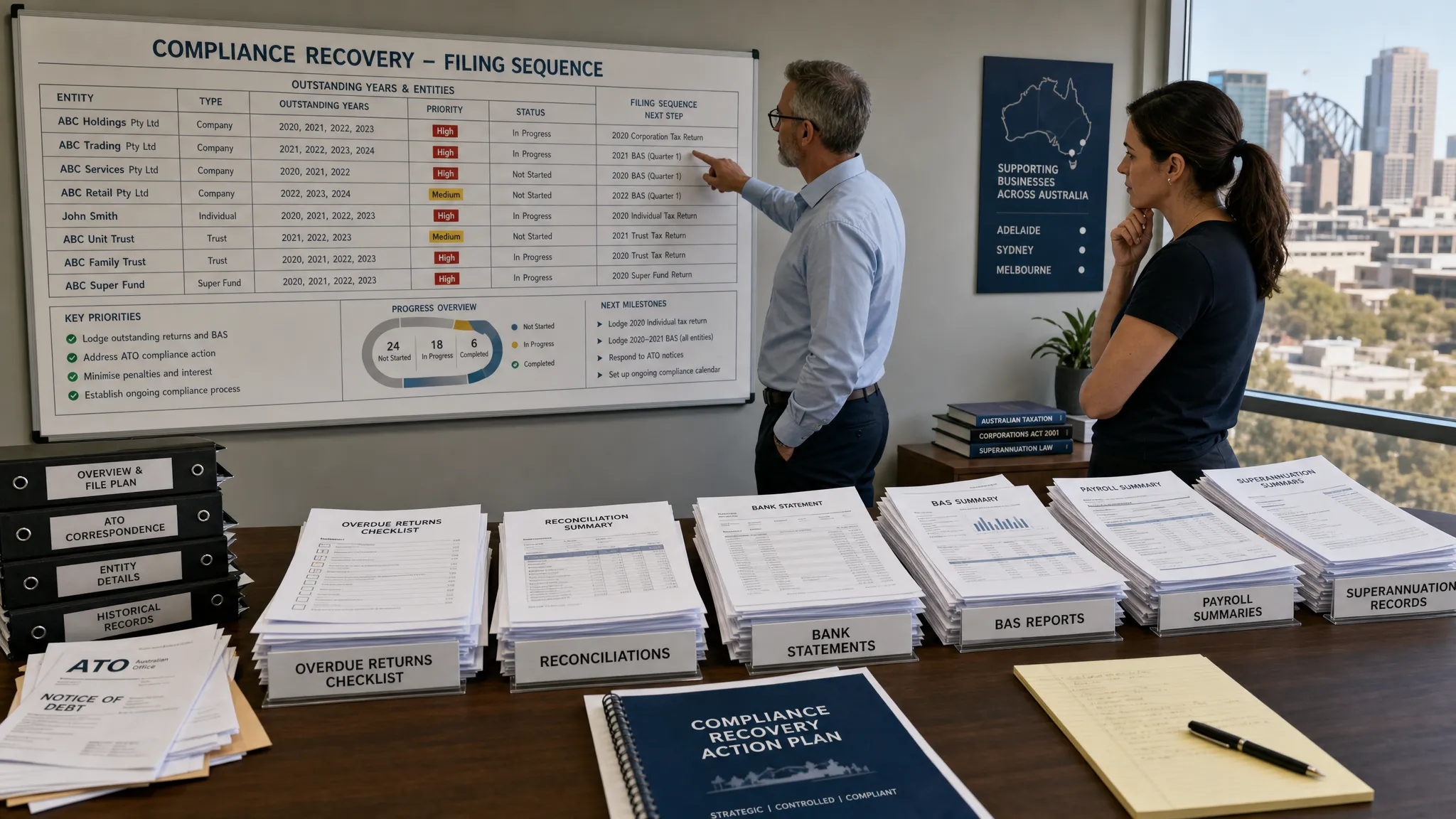
An overdue tax return is rarely just an administrative issue. For business owners, company directors and high-net-worth individuals, it can affect ATO risk settings, finance applications, director exposure, cash flow planning and the credibility of your financial records.
The faster you act, the more options you usually preserve. In our experience, the worst outcomes often occur when a late return is treated as a simple lodgement task, rather than a broader compliance and financial health issue.
If you have an overdue tax return, the objective is not only to lodge. The objective is to lodge accurately, quantify the tax position, manage ATO communication, reduce penalty exposure where possible and build a system that prevents the problem from recurring.
What counts as an overdue tax return in Australia?
A tax return becomes overdue when it is not lodged by the applicable due date. That due date can vary depending on your entity type, lodgement history and whether you are linked to a registered tax agent lodgement program.
For individuals, this may involve salary and wage income, investment income, capital gains, rental property schedules, foreign income or trust distributions. For business owners, the overdue issue may extend beyond the annual income tax return to BAS, GST, PAYG withholding, payroll reporting, superannuation obligations, FBT, taxable payments annual reports or SMSF annual returns.
That broader view matters. We often find that a late income tax return is only the visible symptom. The underlying issue may be unreconciled bank feeds, inconsistent BAS lodgements, incomplete payroll data, missing contractor information or property records that do not support deductions.
Before lodging, we recommend building a complete compliance map across every relevant ATO account. That includes the income tax account, integrated client account, GST registration status, PAYG obligations, Superannuation Guarantee exposure, FBT registrations and any prior ATO correspondence.
Why penalties can escalate quickly
The ATO can impose a failure to lodge on time penalty where a return, statement or report is lodged late. According to the ATO’s guidance on failure to lodge on time penalties, the penalty is generally calculated for each 28-day period, or part thereof, that the document is overdue, up to a maximum number of penalty units.
For small entities, the failure to lodge penalty is generally one penalty unit for each 28-day period or part period, capped at five penalty units. From 7 November 2024, one Commonwealth penalty unit is $330, which means a small-entity late lodgement penalty can reach $1,650 for a single overdue return or statement. Larger entities can face multiplied penalties.
| Time overdue | Small-entity failure to lodge penalty guide | Strategic concern |
|---|---|---|
| 1 to 28 days | 1 penalty unit | Early warning stage, act quickly before a pattern develops |
| 29 to 56 days | 2 penalty units | ATO risk profile may begin to worsen |
| 57 to 84 days | 3 penalty units | Cash flow and lodgement history concerns increase |
| 85 to 112 days | 4 penalty units | Penalty remission becomes more evidence-dependent |
| 113 days or more | 5 penalty units | Maximum small-entity penalty may apply for that obligation |
Penalties are only part of the risk. If tax is payable, the ATO may also apply general interest charge, commonly called GIC, to unpaid amounts. GIC is calculated daily and can compound the cost of delay. The ATO publishes general interest charge rates quarterly.
For company directors, overdue lodgements can create a more serious governance issue. If PAYG withholding, GST or Superannuation Guarantee Charge reporting is not maintained, director penalty risks may increase. For property investors, incomplete returns can delay refinancing. For growing companies, late tax records can disrupt due diligence, grant applications, tender submissions and investor reporting.
Step 1: Establish exactly what is overdue
The first step is not to start typing numbers into a return. The first step is to identify every missing obligation and confirm the exact years, periods and entities involved.
For a sole trader, this may include several years of income tax returns plus BAS if registered for GST. For a company group, it may involve company income tax returns, trust distribution resolutions, Division 7A records, BAS, payroll, superannuation and inter-entity loans. For an SMSF trustee, the annual return is also tied to audit completion, member balances and investment compliance.
We usually begin with an ATO position review. This means checking:
- Which returns, BAS or reports are outstanding
- Whether the ATO has issued reminders, warnings, default assessments or penalty notices
- Whether any payment arrangements are active or in default
- Whether tax debts sit across multiple accounts
- Whether prior lodgements contain errors that affect the overdue year
- Whether the client has changed structure, sold assets or entered new business activities
This review is important because lodging one overdue tax return while ignoring connected BAS or payroll issues may solve little. In some cases, the ATO’s concern is not simply that a return is late. It is that the taxpayer’s records do not reconcile across GST, payroll, income tax and superannuation.
If you have already received ATO correspondence, do not respond casually or provide estimates without checking the underlying records. We have outlined practical communication principles in our guide to dealing with the ATO without costly mistakes.
Step 2: Reconstruct the financial records before you lodge
An overdue return often involves missing data. Bank statements may be incomplete, receipts may be scattered across email accounts, payroll may have been processed manually and invoices may not reconcile to deposits.
This is where digital transformation creates a measurable advantage. Our team uses AI-driven and automated accounting workflows to accelerate document capture, transaction matching and exception review. The purpose is not to replace professional judgement. The purpose is to surface anomalies faster, reduce manual processing errors and give advisers a clearer view of the financial position.
For business owners, we focus on reconciling the underlying accounting file before finalising the return. This includes income recognition, GST coding, director loans, asset purchases, depreciation, payroll, superannuation, stock, work in progress and private use adjustments.
For investors and high-net-worth individuals, we focus on evidence. Rental property deductions, interest apportionment, capital gains tax cost bases, trust distributions, foreign income and crypto transactions all need supportable records.
| Taxpayer profile | Records to prioritise | Common risk if rushed |
|---|---|---|
| Sole trader or consultant | Bank feeds, invoices, expense receipts, motor vehicle records, home office evidence | Overstated deductions or missed income |
| Company director | BAS, payroll, PAYG withholding, superannuation, loan accounts, asset registers | GST mismatch, Division 7A issues, director exposure |
| Property investor | Rental statements, loan statements, repairs evidence, depreciation reports, settlement records | Incorrect interest claims or capital improvements treated as repairs |
| SMSF trustee | Audit records, investment reports, member balances, contributions data, pension records | Audit delay or compliance breach |
| High-net-worth individual | Trust statements, investment reports, CGT records, foreign income, private health cover data | Incomplete income disclosure or incorrect CGT treatment |
Accuracy matters more than speed alone. A late but accurate return is usually easier to defend than a rushed return that later requires amendment. Where the ATO is already reviewing the account, amendments can attract additional scrutiny.
Step 3: Decide the lodgement sequence strategically
When multiple years or entities are overdue, sequence matters. The correct approach depends on the client’s risk profile, available records, ATO deadlines, tax debt position and whether related entities need to be lodged together.
For example, a family trust return may need to be completed before beneficiaries can finalise their personal tax returns. A company return may depend on final BAS reconciliations and payroll balances. An SMSF annual return cannot be properly lodged until the audit has been completed.
We generally prioritise lodgements that unlock dependent returns, stop further penalty escalation or address urgent ATO action. However, we avoid lodging in isolation where the return relies on unresolved balances from prior years.
This is also the stage where a pre-lodgement consultation becomes valuable. Before submission, you should understand the tax payable, refund position, evidence gaps, penalty exposure and any strategic decisions still available. We discuss these issues in more detail in our article on what to cover in a tax consultation before you lodge.

Step 4: Lodge even if you cannot pay immediately
One of the most common mistakes we see is delaying lodgement because the taxpayer cannot yet pay the expected tax debt. In many cases, that decision worsens the position.
Lodgement and payment are separate issues. By lodging, you crystallise the liability, stop further failure-to-lodge escalation for that obligation and create a clearer basis for negotiating with the ATO. If you delay lodgement, the ATO may estimate liabilities, impose penalties and escalate recovery activity without a complete picture of your actual financial position.
Once the return is lodged, we can assess the payment options. These may include paying in full, entering an ATO payment plan, restructuring business cash flow, reviewing director loan positions or aligning tax payments with seasonal revenue cycles.
For a trading business, we do not look at the tax debt in isolation. We assess working capital, GST timing, payroll commitments, supplier pressure, debtors, inventory, finance covenants and upcoming BAS obligations. A payment plan that ignores future tax liabilities can fail quickly.
For high-net-worth individuals, we consider liquidity. A tax debt may be manageable, but the timing may be affected by investment realisations, property settlements, trust distributions or foreign exchange considerations.
Step 5: Request remission of penalties where the facts support it
Penalty remission is not automatic. It must be supported by facts, evidence and a credible compliance plan. The ATO will generally consider the taxpayer’s circumstances, compliance history, reasons for delay and what steps were taken to correct the issue.
Examples that may support remission include serious illness, natural disasters, system failures, ATO delay, sudden loss of key records, family crisis or circumstances outside the taxpayer’s control. Poor record-keeping alone is rarely a strong argument unless there were genuine contributing factors and a clear corrective plan.
A strong remission request usually includes:
- A concise explanation of why the lodgement was late
- Evidence supporting the reason for delay
- Confirmation that outstanding lodgements have now been completed or scheduled
- A payment proposal where tax is payable
- Details of new systems implemented to prevent recurrence
- A respectful, factual tone without speculation or blame
This is where experience matters. We do not recommend emotional or vague submissions. We prepare structured representations that align the facts with ATO remission criteria and demonstrate that the taxpayer has moved from reactive compliance to controlled governance.
GIC remission can also be considered in appropriate circumstances, particularly where delay was outside the taxpayer’s control or where prompt corrective action has been taken. However, remission is discretionary and should never be treated as guaranteed.
Step 6: Identify and correct the root cause
Fixing an overdue tax return without correcting the system that caused it is a temporary solution. The same issue will often reappear at the next BAS, payroll cycle or year-end close.
In our advisory work, we classify the root cause into one of four categories.
| Root cause | What it looks like | Long-term fix |
|---|---|---|
| Record failure | Missing invoices, unreconciled bank accounts, poor receipt capture | Cloud accounting, automated document capture, monthly reconciliations |
| Governance failure | No tax calendar, unclear responsibilities, late director review | Compliance calendar, director reporting rhythm, accountability framework |
| Cash flow failure | Tax set aside was used for operations or drawings | Tax provisioning, rolling cash flow forecasts, BAS reserve accounts |
| Structural failure | Entity structure no longer matches business activity or asset profile | Strategic tax review, asset protection review, group reporting discipline |
This is the strategic pivot. Compliance is not just about satisfying the ATO. Clean, timely accounting data allows directors to make better decisions about pricing, hiring, expansion, debt, investment and succession.
Our AI-assisted workflows are designed to improve that visibility. Automated transaction classification, exception reporting and real-time dashboards can help identify issues before they become overdue returns, BAS errors or tax debt surprises. The technology is useful because it gives our advisers and clients faster access to accurate financial data.
Common mistakes to avoid when fixing an overdue tax return
The pressure to lodge quickly can lead to expensive errors. We regularly see taxpayers create larger problems by trying to finalise late returns without proper reconciliation.
Do not guess missing income. The ATO receives data from employers, banks, share registries, cryptocurrency exchanges, managed funds, property platforms and other third parties. If your return does not align with data-matching records, the ATO may query it.
Do not claim deductions without evidence. Late lodgement does not lower the standard of substantiation. Business expenses, motor vehicle claims, home office claims, travel, repairs, depreciation and professional costs still need support.
Do not ignore BAS mismatches. If GST reported in BAS does not reconcile to income tax accounts, the ATO may question both. This is especially important for e-commerce, hospitality, construction, professional services and property-related businesses.
Do not overlook payroll and superannuation. Late or incorrect payroll reporting can create PAYG withholding issues, Single Touch Payroll discrepancies and Superannuation Guarantee Charge exposure.
Do not assume a refund means there is no risk. Even if a return produces a refund, late lodgement can still affect your compliance profile and delay other financial decisions.
We have covered broader lodgement risks in our guide to tax return mistakes that cost Australian business owners.
When you should seek professional help immediately
Some overdue tax returns are simple. Others require urgent professional intervention. We recommend seeking advice promptly if any of the following apply.
- You have multiple years overdue
- You operate through a company, trust, partnership or SMSF
- You are registered for GST and BAS lodgements are also outstanding
- You have employees, contractors or unpaid superannuation
- You have received an ATO penalty notice, garnishee warning or director penalty notice
- You have rental properties, capital gains, foreign income, crypto assets or trust distributions
- You need tax clearance for finance, refinancing, migration, tendering or a business sale
- You are unsure whether prior-year returns were correct
The more complex the structure, the more important it is to avoid isolated lodgement. A company director, for example, may need coordinated advice across income tax, BAS, payroll, superannuation, Division 7A and cash flow. A property investor may need to separate repairs from capital improvements and reconcile loan interest after refinancing. A high-net-worth individual may need trust, CGT and foreign income reporting reviewed together.
How to prevent the problem from returning
Once the overdue return is lodged, the next priority is control. We recommend a quarterly tax governance rhythm for businesses and investment groups.
That rhythm should include BAS reconciliation, payroll and superannuation checks, GST coding review, cash flow forecasting, tax provisioning and director-level reporting. At year-end, the return should be a finalisation exercise, not a forensic reconstruction.
For clients across Adelaide, Sydney and Melbourne, our integrated team supports both local compliance and national advisory needs. This is particularly important for businesses operating across states, groups with multiple entities and directors who need consistent reporting across locations.
We see overdue tax returns as an opportunity to modernise the finance function. Once the records are repaired, we can automate routine workflows, improve management reporting and convert compliance data into strategic insight.
Frequently Asked Questions
Can I still lodge an overdue tax return through a tax agent? Yes. A registered tax agent can usually help prepare and lodge overdue returns, review ATO records, identify related obligations and manage communication. The available lodgement concessions depend on your circumstances and history, so the position should be checked before relying on any extension.
Will the ATO automatically apply penalties for an overdue tax return? Not always, but you should not assume penalties will be waived. The ATO considers factors such as how late the return is, your compliance history, whether tax is payable and whether there are reasonable grounds for remission.
Should I lodge if I cannot pay the tax debt yet? In many cases, yes. Lodging confirms the actual liability and stops further failure-to-lodge escalation for that return. Payment options can then be considered separately, including a structured ATO payment plan where appropriate.
Can penalties and GIC be remitted? They can be remitted in some circumstances, but remission is discretionary. A well-prepared request should explain the reason for delay, provide evidence, show corrective action and outline how future compliance will be maintained.
What if several years are overdue? Do not lodge randomly. We recommend mapping all outstanding years and related entities first, then choosing a lodgement sequence that deals with dependencies, ATO risk and cash flow impact.
Next steps: fix the overdue return and rebuild control
If you have an overdue tax return, the best time to act is before the ATO escalates penalties, interest or recovery action. Start by identifying every outstanding obligation, reconstructing accurate records and understanding the likely tax debt before lodgement.
Our team at Perfect Accounting & Tax Services brings 25 years of Australian tax and accounting experience to late lodgement, complex tax planning and strategic advisory work. We support businesses, directors and high-net-worth individuals across Australia, with integrated capability in Adelaide, Sydney and Melbourne.
We can help you assess your ATO position, prepare overdue returns, manage penalty remission requests, structure payment discussions and implement automated accounting workflows that reduce the risk of future late lodgement.
If you are ready to resolve an overdue tax return and strengthen your financial systems, contact Perfect Accounting & Tax Services for a confidential consultation.