


We price accounting and tax services for small business around the work required, the complexity involved and the financial visibility our clients need. Turnover alone cannot tell us whether an engagement involves straightforward annual compliance or an ongoing finance function supporting employees, multiple entities and expansion.
Our approach is to separate recurring work, annual obligations, initial remediation and strategic advisory. That gives business owners and directors a clearer basis for assessing value, rather than comparing monthly fees that cover different responsibilities.
Start with the whole annual cost
We recommend comparing the complete annual commitment, not simply the advertised monthly amount. A lower recurring fee can become more expensive if year-end accounts, tax returns, software or essential reviews sit outside the engagement.
| Cost component | Work to clarify in the proposal |
|---|---|
| Initial setup or remediation | Opening balances, historical reconciliations, overdue work and system migration |
| Recurring accounting | Bookkeeping, reconciliations, BAS, payroll and agreed reporting |
| Annual compliance | Financial statements, entity tax returns and year-end adjustments |
| Strategic advisory | Forecasting, tax planning, funding analysis and virtual CFO support |
We distinguish ongoing financial management from standalone business tax filing. A return-only quote and an outsourced accounting engagement are not equivalent purchases.
How we scope accounting and tax services for small business
Entity structure and lodgement obligations
We begin with the entities involved and the obligations attached to each. A sole trader generally reports business income through an individual tax return. Companies, partnerships and trusts have different return requirements, with additional work potentially arising from distributions, related-party transactions or director and shareholder balances.
We also establish GST registration and reporting requirements. The ATO generally requires registration when GST turnover reaches $75,000, although exceptions apply, including for taxi and ride-sourcing services. We check the applicable ATO GST registration rules rather than assuming every small business has identical BAS obligations.
The number of ABNs is useful context, but it is not a complete measure of complexity.
Transaction workload and record quality
The cost of accounting and tax services for small business depends on how much professional work sits behind the transactions, not just how many appear in the bank feed.
We distinguish clean, reconciled records from records requiring investigation. Missing invoices, mixed private and business spending, unreconciled payment gateways and inconsistent GST treatment can create substantial additional work.
An online retailer may need sales, refunds, merchant fees and settlement deposits reconciled across several platforms. A consultancy with similar revenue may have fewer transactions but more complex work-in-progress or cross-border tax questions.
We therefore assess transaction sources, reconciliation requirements and exception levels together. If historical records need correction, separating that work from the ongoing fee makes the proposal easier to evaluate.
Employees, superannuation and employment obligations
We assess payroll by more than employee headcount. Pay frequency, variable hours, allowances, leave arrangements, employee changes and payroll corrections all affect workload.
The engagement also needs to identify responsibility for Single Touch Payroll reporting, PAYG withholding and superannuation processing. FBT requires separate consideration where taxable benefits are provided. Interstate operations may introduce state payroll tax and grouping issues that need additional assessment.
We clarify whether our role covers processing, review, reporting or advice. An employer retaining payroll internally requires a different level of support from a business outsourcing the function. That distinction should be visible in the fee and the responsibility schedule.
Reporting depth and strategic involvement
We treat reliable compliance records as the foundation for strategic advisory and corporate growth. However, producing a reconciled ledger is different from interpreting margins, modelling recruitment or preparing a funding forecast.
When we scope accounting and tax services for small business, we identify the decisions the reporting needs to support. Monthly management accounts, cash-flow forecasts, budget comparisons and director meetings involve different levels of preparation and judgement.
We also distinguish a report from an advisory discussion. A business planning an acquisition or opening another location may need scenario analysis rather than another historical profit-and-loss statement.
Our objective is to match the service to the decision, without charging for reporting that adds little practical value.
Choosing a fee model without hiding costs
We consider the predictability of the work before discussing the billing arrangement. Stable recurring tasks lend themselves to a different model from an unresolved historical issue or a one-off restructuring project.
| Fee model | Where it can fit | What needs clarification |
|---|---|---|
| Recurring fixed fee | Defined, repeatable accounting and compliance work | Included volumes, deliverables and scope-review triggers |
| Project fee | A clearly bounded task or implementation | Assumptions, milestones and completion criteria |
| Time-based fee | Investigative or uncertain work | Rates, estimate limits and approval points |
| Combined arrangement | Ongoing support with separate specialist projects | The boundary between recurring and additional work |
A proposal for accounting and tax services for small business should explain which arrangement applies, whether amounts include GST and whether annual work is included or billed separately.
We also look for explicit treatment of software subscriptions, additional entities, ATO correspondence, amended returns and specialist advice. These are not automatically included simply because an engagement is described as comprehensive.
A fixed fee provides budget certainty only when the scope is clear. If staffing, transaction volumes or business activities change materially, the service requirements may need to change too.
What automation changes in the pricing discussion
Our AI-driven automation is intended to streamline financial workflows, improve consistency and make current financial information available sooner. We assess where digital processes can reduce repetitive handling and where professional review remains necessary.
Automation does not make every transaction self-explanatory. A bank feed cannot determine, by itself, whether a payment is private expenditure, an asset purchase or a transaction requiring particular GST treatment. Faster processing needs appropriate review controls.
We therefore consider both the efficiency opportunity and the implementation effort. Cleaning opening balances, establishing coding rules or integrating systems may involve initial work before recurring efficiencies become achievable.
We do not assume automation should reduce the fee in every case. Our focus is whether it reduces manual effort, improves accuracy and releases capacity for forecasting, tax planning and management advice. Real-time visibility is valuable only when the underlying information is reliable enough to support decisions.
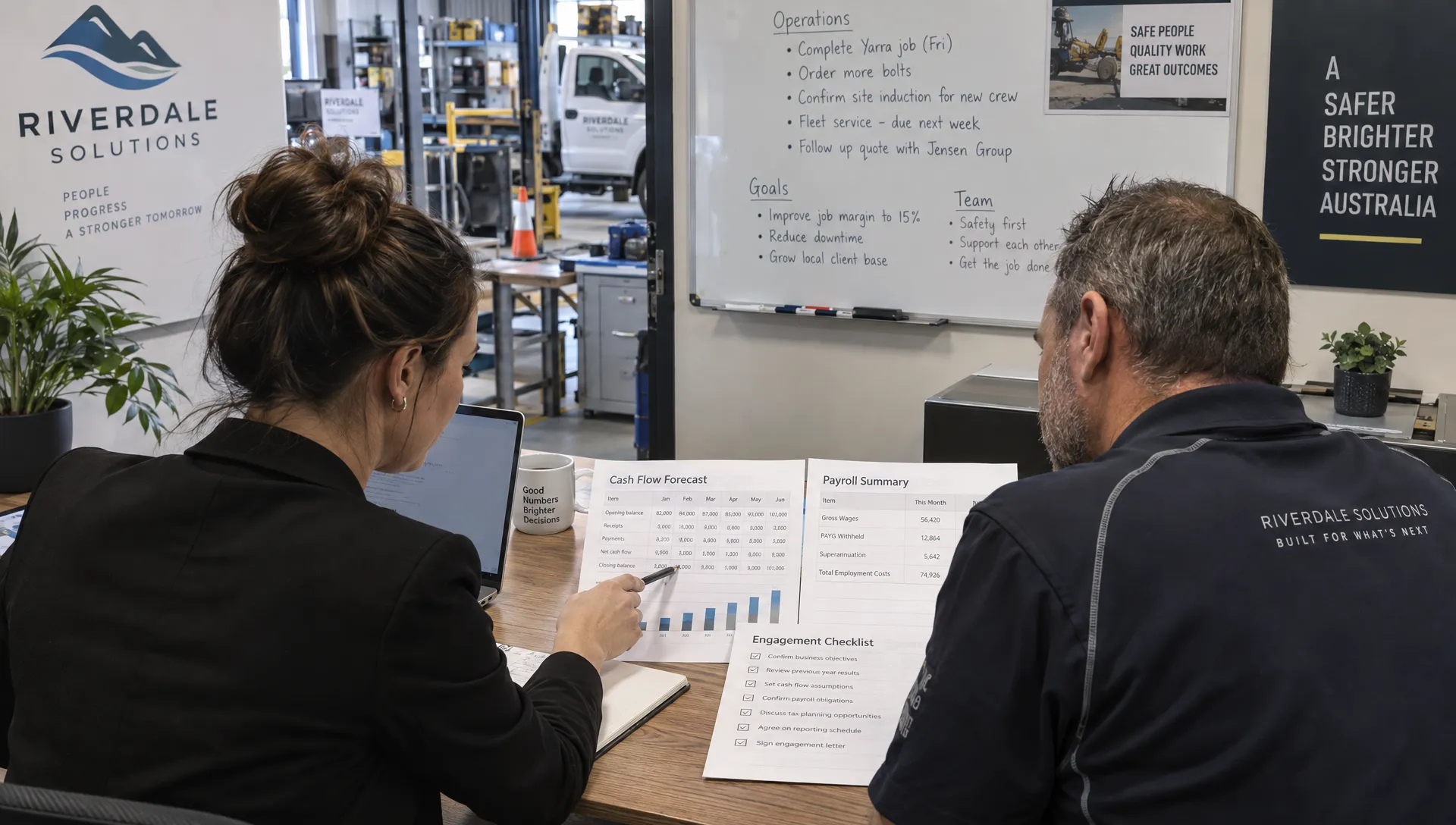
Compare proposals on responsibility, not just price
We recommend checking the provider’s registration through the Tax Practitioners Board public register. The registration needs to match the services being provided. A registered BAS agent’s scope is narrower than that of a registered tax agent, particularly for income tax work.
We also clarify who prepares, reviews, approves and lodges each document. Engaging an adviser does not remove the business owner’s responsibility to provide complete information or a director’s responsibility for company obligations.
For a practical comparison, we use these questions:
- Scope: Which entities, lodgements, reporting periods and advisory services are included?
- Responsibilities: Who supplies records, approves payroll and authorises lodgements?
- Communication: What meeting frequency, contact arrangements and response expectations apply?
- Additional work: What requires a separate quote or written approval?
- Technology: Who pays subscriptions, controls access and retains the records?
- Transitions: What onboarding, handover or termination costs could apply?
We compare accounting and tax services for small business on the same scope before judging whether one proposal offers better value. Our guide to choosing tax and accounting support explores the broader capability assessment.
Why similar businesses can receive different quotes
We can illustrate the difference with two hypothetical businesses generating similar revenue.
The first is a consulting company with a small number of monthly invoices, no employees and well-maintained records. Its requirements may centre on reconciliations, BAS, annual accounts, the company tax return and periodic tax planning.
The second is a retailer with employees, inventory, several sales channels and frequent refunds. Its accounting may require payroll processing, settlement reconciliations, stock adjustments and more frequent cash-flow analysis. If historical balances are unreliable, remediation adds another layer.
We would not treat the same turnover as evidence that these businesses need the same fee. Equally, the consultancy could require substantial advisory support if it is raising capital, expanding overseas or changing ownership.
This is why accounting and tax services for small business need a workload and decision-support assessment, rather than a price calculated solely as a percentage of revenue.
We also separate business complexity from location. Remote collaboration can suit a straightforward local business or a sophisticated national group. Local meetings alone do not establish the depth of service required.
What we need for a tailored proposal
We can make the pricing discussion more useful when we understand the current position and the intended direction. Relevant information includes the entity structure, GST status, approximate transaction volumes, employee numbers, software in use and the latest completed reporting period.
We also need visibility over overdue returns, unreconciled accounts, ATO debts or unresolved correspondence. These matters can affect both the initial workload and the order in which work should be addressed.
For the advisory component, we ask about the next major decisions: hiring, financing equipment, acquiring another business, opening interstate operations or preparing for an eventual exit. This helps distinguish essential recurring services from optional project work.
We recommend sharing sensitive financial records through an agreed secure process. Online banking passwords are not required for an initial pricing discussion.
The result should be a written proposal that identifies deliverables, assumptions, exclusions, fees and the process for approving changes. That document is the basis for a meaningful comparison and an accountable working relationship.
Frequently asked questions
What are typical accountant fees for a small business in Australia? We would not regard a single national figure as a reliable budgeting benchmark without a defined scope. For accounting and tax services for small business, we recommend comparing total annual fees against the entities covered, record quality, payroll requirements, reporting frequency and advisory involvement.
Can we keep bookkeeping internally and outsource the tax work? We can assess that division of responsibilities. The proposal should identify who reconciles accounts, reviews GST coding, processes payroll and corrects errors. Internal bookkeeping can reduce external processing, but review and year-end adjustments still require time.
Does a monthly fee include the annual tax return? We would not assume it does. Some arrangements include annual accounts and returns, while others cover recurring work only. We recommend confirming the relevant entities, financial years and lodgements in writing before comparing monthly amounts.
Will switching accountants create an additional cost? We assess whether onboarding involves only an orderly handover or requires data migration, missing records and historical corrections. We recommend confirming transition work separately, alongside software access, record ownership and responsibility for approaching deadlines.
Next steps: establish the right scope before agreeing the fee
At Perfect Accounting & Tax Services, we bring 25 years of professional experience to accounting, tax and strategic advisory. Our integrated capabilities support clients across Australia, including Adelaide, Sydney and Melbourne.
We connect accurate compliance with better financial visibility, using AI-driven automation to streamline workflows while retaining professional judgement over tax and business decisions.
To discuss accounting and tax services for small business, contact our team for a consultation. We can assess the scope required, discuss our automated accounting workflows and identify the support needed for the next stage of the business.