
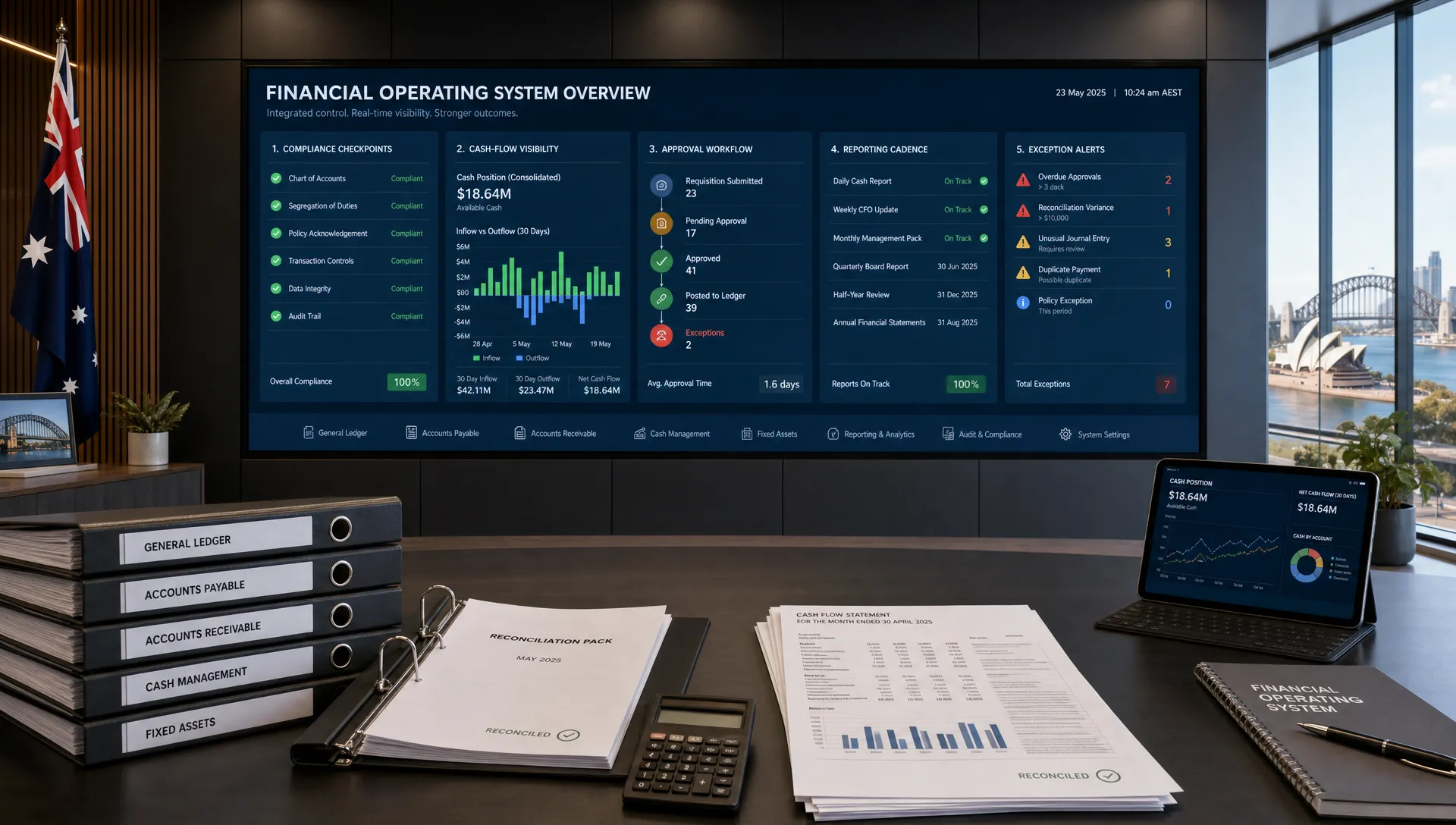
A financial accounting service should give directors, owners and investors more than clean ledgers. It should provide a dependable financial operating system, one that supports ATO compliance, strengthens governance, improves cash-flow visibility and informs strategic decisions before pressure builds.
In our work with Australian businesses, we often see the same issue: the finance function is treated as an administrative cost centre until a BAS deadline, audit query, funding requirement or acquisition opportunity exposes gaps in the underlying data. By then, the cost of poor financial control is usually higher than the cost of building the right accounting framework in the first place.
A modern financial accounting service should combine technical accounting discipline, Australian tax knowledge and intelligent automation. When delivered properly, it becomes the foundation for strategic advisory, corporate growth and better risk management across the business.
Financial accounting is not just bookkeeping
Bookkeeping records transactions. Financial accounting interprets, validates and structures those records so they can support compliance, reporting and decision-making.
That distinction matters. A business can have invoices entered, bank feeds reconciled and payroll processed, yet still lack meaningful financial control. The chart of accounts may be poorly designed. GST coding may be inconsistent. Director loan accounts may be unclear. Inventory, work in progress or accrued income may be misstated. Cash flow may look healthy until superannuation, PAYG withholding, BAS liabilities or tax instalments fall due.
A capable financial accounting service should close these gaps. It should ensure that financial information is complete, consistent and commercially useful. As we outlined in our article on how accounting professionals improve financial control, stronger accounting systems are not just about accuracy. They create the confidence required for better decisions.
The core deliverables every financial accounting service should provide
The specific scope will vary between a sole trader, an SME group, an SMSF trustee, a property investor and a national company. However, the principles are consistent. A high-quality financial accounting service should deliver the following outcomes.
| Deliverable | What it should include | Strategic value |
|---|---|---|
| Accurate financial records | Reconciled bank accounts, correctly coded transactions, supporting documentation and clear audit trails | Reduces compliance risk and supports reliable reporting |
| BAS and GST control | Correct GST treatment, BAS preparation, PAYG instalments and lodgement discipline | Protects cash flow and reduces ATO exposure |
| Payroll governance | STP reporting, superannuation obligations, leave accruals and payroll reconciliations | Reduces employee, super and ATO compliance risk |
| Management reporting | Profit and loss, balance sheet, cash-flow analysis and performance commentary | Gives owners and directors timely visibility |
| Tax planning integration | Year-round review of deductions, structures, FBT, Division 7A risks and timing issues | Moves tax from reactive lodgement to proactive planning |
| Internal controls | Approval workflows, segregation of duties, reconciliations and exception checks | Reduces fraud, error and operational leakage |
| Advisory insight | Scenario modelling, budgets, forecasting and Virtual CFO support | Supports growth, funding and strategic decisions |
These deliverables are interdependent. BAS accuracy depends on bookkeeping quality. Tax planning depends on reliable management accounts. Cash-flow forecasting depends on accurate debtor, creditor and payroll data. Strategic advisory depends on all of the above.
1. Reliable compliance with Australian obligations
Australian businesses operate in a highly structured compliance environment. A financial accounting service should help manage obligations across ATO, ASIC, payroll, superannuation and, where relevant, industry-specific reporting.
This includes BAS and GST reporting, PAYG withholding, PAYG instalments, Single Touch Payroll, superannuation guarantee, taxable payments reporting for applicable industries and FBT considerations for benefits provided to employees or directors. For companies and trusts, it may also involve governance around distributions, loans, retained earnings and director-related transactions.
The ATO requires businesses to keep records that explain all transactions and generally retain them for five years. The practical implication is clear: record keeping is not a year-end exercise. It must be embedded into daily financial workflows. The ATO’s guidance on business record keeping reinforces the need for records to be accurate, accessible and complete.
Our view is that compliance should be designed into the accounting system, not patched together at lodgement time. Digital document capture, approval workflows, automated bank rules and exception reporting can all reduce manual handling while improving accuracy.
2. Financial reports that directors can actually use
A financial accounting service should not simply send a profit and loss statement and assume the job is done. Directors and business owners need reports that answer commercial questions.
Is gross margin improving or eroding? Are overheads rising faster than revenue? Are debtors stretching payment terms? Are stock levels tying up cash? Is payroll productivity aligned with revenue? Is the business generating profit but consuming cash?
The minimum reporting pack should usually include:
- Profit and loss with comparison to budget, prior period or prior year
- Balance sheet with review of working capital, liabilities and equity movements
- Cash-flow report showing actual and forecast cash position
- Aged receivables and payables with collection and payment priorities
- Key performance indicators relevant to the industry and growth stage
For a professional services firm, utilisation and work in progress may matter most. For a property group, debt servicing, rental yield and capital expenditure may be central. For an e-commerce business, inventory turnover, merchant fees and fulfilment costs may need closer review.
This is where advisory capability becomes critical. Financial reports should not be static documents. They should trigger discussion, challenge assumptions and support timely action.
3. A clean accounting system built for scale
Many businesses outgrow their accounting setup without realising it. What worked for a sole trader often fails for a company with employees, contractors, multiple entities, interstate operations or external investors.
A strong financial accounting service should review the structure of the accounting system itself. That includes the chart of accounts, GST codes, tracking categories, payroll settings, document capture, approval processes, bank feed rules and reporting templates.
Poor system design creates downstream problems. Revenue may be grouped too broadly. Cost centres may be missing. Inter-entity transactions may be difficult to reconcile. Payroll may not map correctly to job costing or project profitability. Management reporting then becomes slow, manual and unreliable.
Modern accounting platforms can solve much of this, but only when configured correctly. Automation should not mean letting software make unchecked decisions. It should mean using technology to process routine data faster while applying professional judgement to exceptions, strategy and risk.

4. Automation that improves visibility, not just speed
AI-driven accounting workflows are valuable because they reduce latency. In traditional accounting, financial information is often reviewed weeks or months after transactions occur. In a modern environment, directors should be able to access reliable financial data much closer to real time.
Our team uses automation to streamline repetitive processes such as data capture, reconciliations, transaction classification and workflow alerts. The purpose is not to remove professional oversight. It is to free advisers from low-value administration so they can focus on interpretation, planning and decision support.
The benefits are practical:
- Faster identification of anomalies, missing documents or miscoded transactions
- Better visibility over cash flow, debtors, creditors and upcoming liabilities
- Reduced manual data entry and lower risk of processing errors
- More timely BAS preparation and year-end tax readiness
- Improved collaboration between business owners, internal teams and advisers
For growing businesses, speed matters. A director making decisions based on last quarter’s data is already behind. A financial accounting service should bring accounting closer to the pace of business.
5. Tax planning integrated throughout the year
Tax planning should not begin in June. By then, many decisions have already been made, transactions completed and opportunities lost.
A proper financial accounting service should identify tax implications throughout the year. This may include reviewing asset purchases, depreciation, trading stock, prepayments, bad debts, trust distributions, company tax rates, Division 7A exposure, FBT, capital gains tax events and superannuation timing.
For business owners and high-net-worth individuals, tax planning also needs to consider structure. The correct approach for a company group, family trust, SMSF, property portfolio or investment entity will depend on asset protection, succession planning, cash needs and long-term objectives.
The objective is not aggressive tax minimisation. It is lawful, well-documented and commercially aligned planning. A good adviser should help you understand the tax consequences before you commit to major decisions, not after the fact.
For a deeper discussion of this year-round approach, our guide on what a business tax accountant should be reviewing year-round explains why tax governance must be continuous rather than seasonal.
6. Stronger cash-flow management
Profit is important, but cash flow determines resilience. We have seen profitable businesses experience stress because debtor collections slowed, inventory expanded, tax liabilities accumulated or loan repayments increased.
A financial accounting service should help owners understand the timing of money moving through the business. That means forecasting upcoming BAS payments, PAYG withholding, superannuation, payroll, supplier commitments, finance costs and income tax obligations.
Cash-flow advisory should also distinguish between short-term pressure and structural weakness. A temporary squeeze may be solved through debtor management or payment scheduling. A structural issue may require margin review, pricing changes, cost restructuring, financing strategy or operational redesign.
This is where accounting becomes strategic. Clean historical records allow us to build credible forecasts. Credible forecasts allow directors to act early, negotiate better and avoid reactive decisions.
7. Governance and internal controls
As businesses grow, reliance on informal processes becomes risky. A director may no longer approve every invoice. Payroll may be handled by multiple people. Contractors may be onboarded quickly. Credit cards may be used across teams. Without controls, small errors can compound into material risk.
A financial accounting service should help build governance into the finance function. This can include invoice approval limits, bank payment review processes, supplier verification, payroll checks, document retention, reconciliation schedules and role-based access to accounting systems.
For companies, this also supports director duties. Directors need to understand the financial position of the business and ensure obligations are met. Well-designed controls improve confidence in the numbers and reduce exposure to fraud, error and regulatory issues.
Governance does not need to be bureaucratic. With the right digital workflows, it can be efficient, transparent and proportionate to the size of the organisation.
8. Advisory that connects numbers to growth strategy
The strongest financial accounting service will not stop at compliance. It will translate financial data into strategic options.
For example, a growing business may need to decide whether to hire employees, engage contractors, open another location, acquire a competitor, raise capital, purchase equipment or restructure debt. Each decision has accounting, tax, cash-flow and risk implications.
A financial accounting adviser should help model these scenarios. What happens to cash flow if revenue is delayed by 60 days? What margin is required to support new payroll costs? How will GST, superannuation and PAYG withholding affect the timing of cash outflows? What is the break-even point for a new division?
This is the natural bridge between accounting and Virtual CFO support. In our experience, businesses gain the most value when compliance data becomes the foundation for strategic decision-making. Our article on how Perfect Accounting and Tax Services supports growth explores this connection between accurate accounting, tax planning and advisory in more detail.
How to assess whether your current provider is delivering enough
A useful test is to ask whether your accounting service helps you see forward, not just backward. Historical accounts are essential, but they should lead to action.
Use the following questions as a practical benchmark.
| Assessment question | What a strong answer indicates |
|---|---|
| Are reconciliations completed regularly and reviewed for anomalies? | The accounts are being actively controlled, not merely processed |
| Do reports explain performance, cash flow and risks? | The service is supporting management decisions |
| Are BAS, GST, payroll and super obligations monitored throughout the year? | Compliance is embedded into the operating rhythm |
| Is tax planning discussed before year-end? | The adviser is proactive rather than reactive |
| Are digital workflows reducing manual handling? | Automation is improving speed and accuracy |
| Can the provider support growth, restructuring or multi-entity complexity? | The relationship can scale with the business |
If the answer to several of these questions is no, the issue may not be the software. It may be the service model.
What this means for Australian businesses in Adelaide, Sydney and Melbourne
Australian businesses increasingly operate across state borders, remote teams, online channels and multi-entity structures. A local-only accounting mindset is often too narrow.
Our integrated service model supports clients across Australia, with practical capability in Adelaide, Sydney and Melbourne. That national perspective matters for businesses managing interstate payroll, multiple trading locations, property interests, contractor networks or expansion plans.
We also recognise that business owners and high-net-worth individuals need discretion, continuity and strategic judgement. The right financial accounting service should adapt to complexity without making the finance function unnecessarily complicated.
Frequently Asked Questions
What is included in a financial accounting service? A financial accounting service should include accurate record keeping, reconciliations, BAS and GST support, payroll governance, management reporting, tax planning integration, cash-flow analysis and advisory insight. The exact scope should reflect the size, structure and complexity of the business.
How is financial accounting different from tax accounting? Financial accounting focuses on producing reliable financial information for management, compliance and decision-making. Tax accounting focuses on tax obligations, planning and lodgement. In a well-managed business, the two should work together because accurate financial accounts are essential for effective tax planning.
Should a financial accounting service use automation? Yes, but automation should be properly governed. AI-driven workflows can improve speed, accuracy and real-time visibility, but professional review remains essential for judgement-based matters such as GST treatment, tax planning, cash-flow interpretation and strategic advisory.
How often should management reports be reviewed? Most growing businesses should review management reports monthly. Businesses with tight cash flow, high transaction volumes, inventory, payroll complexity or rapid growth may need more frequent reporting and forecasting.
Can one accounting provider support businesses across multiple Australian cities? Yes, provided the provider has strong digital workflows, clear communication processes and Australian compliance expertise. Our team supports clients nationally, including integrated service capability across Adelaide, Sydney and Melbourne.
Next steps: turn accounting into a strategic asset
A financial accounting service should deliver control, clarity and commercial insight. It should help you meet ATO obligations, improve governance, plan tax outcomes, manage cash flow and make better strategic decisions with confidence.
If your current accounting process is still centred on deadlines rather than decisions, it may be time to review the model. Our team can assess your accounting workflows, reporting structure and compliance framework, then identify where automation and advisory support can improve accuracy, speed and visibility.
To discuss how Perfect Accounting & Tax Services can support your business, contact us for a consultation. We can help you build an accounting function that is compliant, technology-enabled and aligned with long-term corporate growth.