
A tax return consultation should not be treated as a once-a-year administrative appointment. For business owners, company directors and high-net-worth individuals, it is a strategic review point. It should confirm that your return is accurate, but it should also reveal cash flow pressure, compliance weaknesses, tax planning opportunities and structural issues that may affect growth.
We view the consultation as the bridge between compliance and advisory. The tax return is the outcome. The real value is in the questions asked before lodgement, the quality of the records reviewed and the decisions made for the next financial year.
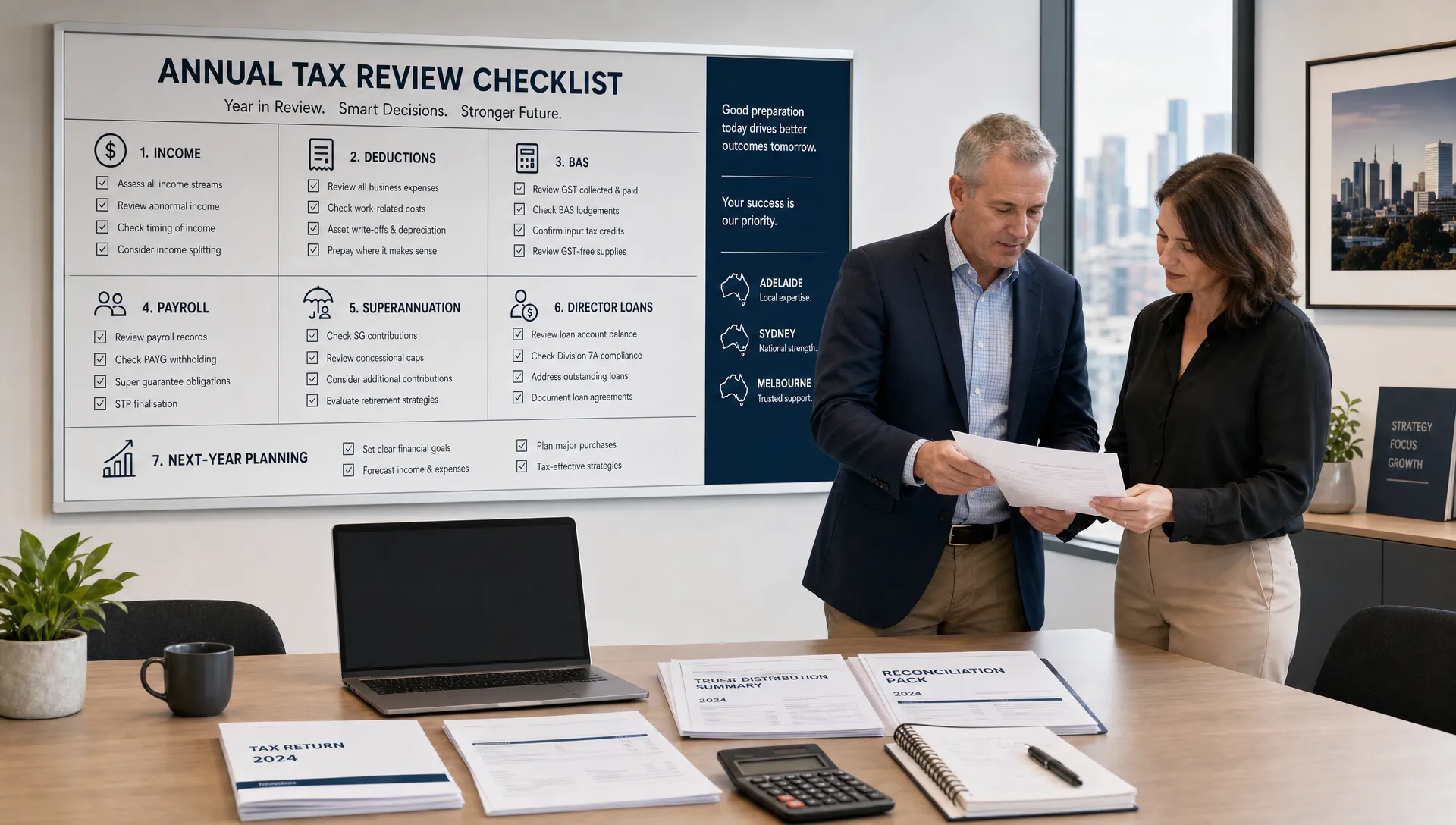
Below is a practical agenda for what to cover in a tax return consultation, with an Australian business and investment context in mind.
Start with the purpose of the consultation
Before reviewing figures, define the objective. A sole trader with straightforward income needs a different discussion from a company director managing payroll, related-party loans, GST, property assets and trust distributions.
A well-run consultation should answer four core questions:
- Is the return complete and supported by reliable records?
- Are deductions, offsets and concessions being applied correctly?
- Are there ATO, BAS, GST, payroll, Superannuation or FBT risks to address?
- What should be improved before the next reporting cycle?
This framing matters because tax is not isolated from commercial performance. Weak bookkeeping can distort margins. Poor payroll controls can create Super Guarantee exposure. Late BAS lodgements can affect cash flow and financing conversations. When we review a tax return, we are also reviewing the financial operating system behind it.
Confirm your entity structure and reporting obligations
The first technical item to cover is the structure through which income is earned or assets are held. This may include an individual, sole trader ABN, company, trust, partnership, SMSF or a combination of entities.
For business owners, we want to understand whether the structure still supports current objectives. A structure that worked at start-up stage may be inefficient once the business employs staff, expands interstate, acquires assets or brings in investors.
The consultation should cover:
- TFN, ABN, GST and PAYG withholding registrations
- Company, trust, partnership and individual lodgement obligations
- BAS lodgement history and GST treatment
- Payroll, Superannuation and Single Touch Payroll reporting
- State-based obligations such as payroll tax, where relevant
- SMSF, investment or property reporting requirements, if applicable
This is particularly important for businesses operating across Adelaide, Sydney and Melbourne, where national operations may interact with different state-based compliance requirements.
Reconcile income before discussing deductions
Many tax consultations move too quickly to deductions. We prefer to start with income because ATO data matching has become increasingly sophisticated. Bank deposits, merchant facility receipts, platform income, dividend statements, interest income and property agent reports must align with the return.
For companies and larger SMEs, we review the profit and loss statement against BAS totals, bank feeds, invoices, debtor records and any industry-specific revenue systems. For property investors, we compare rental statements, agent summaries, bond adjustments, insurance recoveries and disposal proceeds where relevant.
The key question is not simply, have we included all income? It is, can the income position be explained if reviewed?
This is where digital workflows make a significant difference. AI-assisted transaction categorisation, document capture and exception reporting can help identify unusual deposits, duplicated income, missing invoices and unreconciled clearing accounts before the tax return is finalised.
Review deductions with evidence, not assumptions
Deductions should be commercially logical, properly substantiated and connected to assessable income. During a tax return consultation, we review the nature of each major expense category rather than accepting a year-end total at face value.
Common areas requiring closer attention include motor vehicle costs, travel, home office expenses, contractor payments, repairs versus capital improvements, software subscriptions, interest deductions, professional fees and asset purchases.
For directors and high-net-worth individuals, we also consider whether expenses have been paid personally but relate to business activity, whether private use has been correctly apportioned and whether inter-entity reimbursements have been recorded properly.
The ATO generally expects taxpayers to keep records for at least five years, and records must show how claims were calculated. The ATO record-keeping guidance is clear that evidence quality matters. A spreadsheet alone may not be enough if underlying invoices, contracts or bank records are missing.
Connect the tax return to BAS, GST, payroll and Superannuation
For registered businesses, the annual tax return should not be prepared in isolation from BAS and payroll reporting. We compare annual accounts to BAS lodgements to identify GST coding errors, missed input tax credits, private-use adjustments and timing differences.
Payroll is equally important. Wages in the accounts should reconcile to Single Touch Payroll records, PAYG withholding, superannuation obligations and payroll tax thresholds where applicable. If FBT applies, the consultation should also consider whether benefits such as vehicles, entertainment, car parking or employee reimbursements have been reviewed.
This is not only about avoiding penalties. Clean payroll and BAS data improves monthly reporting, financing discussions and management decisions. If your accounting system cannot produce reliable GST, payroll and cash flow information during the year, the tax return consultation should trigger a workflow review.
For a broader view of what modern compliance should include, our article on modern tax filing services explains how lodgement should integrate with accounting systems, BAS, payroll and advisory processes.
Examine director loans, trust distributions and related-party balances
Complex tax risk often sits in the balance sheet, not the profit and loss statement. This is why a meaningful tax return consultation must review director loan accounts, shareholder advances, beneficiary entitlements, inter-company balances and trust distribution minutes.
For private companies, Division 7A can apply where shareholders or associates receive payments, loans or forgiven debts from a company. For trusts, distribution decisions need to be made correctly and documented within the required timeframe. For family groups, inter-entity balances should be commercially explainable and reconciled.
These items are easy to overlook because they may not affect headline profit. However, they can create significant tax exposure if left unresolved. If your company has multiple directors, related entities or family members involved, this section of the consultation deserves close attention.

Bring the right documents and data
The quality of your consultation depends heavily on the quality of the records provided. For complex returns, we recommend preparing a structured file before the meeting rather than sending documents in fragments.
If your affairs include multiple entities, properties, investments or SMSF interests, our guide to tax documents that matter most for complex returns provides a deeper document checklist.
| Area to review | Documents or data to prepare | Why it matters |
|---|---|---|
| Business income | Profit and loss, balance sheet, bank reconciliations, invoices, merchant summaries | Confirms completeness and supports ATO data matching |
| BAS and GST | BAS lodgements, GST reports, adjustments, tax invoices | Identifies GST coding errors and timing differences |
| Payroll | STP finalisation, wage reports, PAYG withholding, superannuation records | Reconciles employment obligations and reduces compliance risk |
| Assets | Fixed asset register, purchase contracts, finance agreements, disposal records | Supports depreciation, capital allowances and CGT calculations |
| Loans and finance | Loan statements, interest summaries, refinancing documents | Confirms deductible interest and separates private components |
| Property | Rental statements, repairs invoices, loan interest, settlement statements | Supports rental deductions, capital improvements and CGT events |
| Investments | Dividend statements, managed fund tax statements, crypto records, share trades | Captures income, capital gains and cost base information |
| Entity governance | Trust minutes, company records, director loan schedules | Supports distributions and related-party positions |
Discuss assets, depreciation and capital gains
Asset treatment is a common area where strategic advice adds value. The consultation should review whether asset purchases are correctly classified, whether depreciation methods are appropriate and whether any available concessions for the relevant income year have been considered.
For property owners, we distinguish between repairs, maintenance, capital improvements and borrowing costs. For business owners, we review plant and equipment, vehicles, technology investments, software, fit-outs and finance arrangements.
Capital gains tax also deserves a dedicated discussion if assets were sold, transferred, gifted or restructured during the year. This may include shares, business assets, commercial property, residential investment property, crypto assets or interests in trusts and companies.
We also look forward. If a business is preparing for acquisition, expansion or exit, asset registers and cost base records should be cleaned up well before a transaction occurs. Poor historical records can reduce negotiating confidence and complicate due diligence.
Identify ATO review triggers before lodgement
A tax return consultation should include a frank review of positions that may attract ATO attention. This does not mean conservative businesses should avoid legitimate claims. It means claims should be supportable, consistent and commercially credible.
Potential red flags include large deductions without documentation, inconsistent GST reporting, unexplained director loan movements, repeated losses, mismatches between payroll and accounts, private expenses claimed through the business and sudden changes in gross margin.
Where a position is technically valid but unusual, we prefer to document the reasoning before lodgement. This creates a stronger file if questions arise later.
For companies, we have outlined common issues in more detail in our article on company tax return errors that trigger ATO attention.
Turn tax outcomes into next-year strategy
The best consultations do not end with the estimated refund or payable amount. They convert the tax result into a plan for the next 12 months.
For business owners, this may include improving gross margin reporting, adjusting PAYG instalments, forecasting GST cash flow, reviewing pricing, tightening debtor management or automating expense approvals. For directors, it may involve reviewing remuneration, dividends, loan accounts and retained earnings. For investors, it may involve debt structuring, CGT planning, asset protection and timing of disposals.
This is where compliance becomes strategic advisory. If the tax return shows profit growth but cash reserves are weak, we investigate working capital. If revenue increased but net profit fell, we review costs and operational efficiency. If the business is scaling into Sydney, Melbourne or interstate markets from Adelaide, we review systems, reporting cadence and governance.
Our AI-driven workflows support this shift by reducing manual processing time and improving real-time visibility. Instead of waiting until year-end to discover issues, businesses can use automated reconciliations, document capture and exception checks to maintain cleaner data throughout the year.
Questions to ask during your consultation
A productive consultation is a two-way discussion. We encourage business owners and directors to ask questions that reveal both compliance quality and strategic direction.
Useful questions include:
- What parts of our return carry the highest review risk?
- Are our BAS, GST, payroll and Superannuation records aligned with the annual accounts?
- Are we claiming deductions correctly, or are we missing legitimate claims due to poor records?
- Do our director loans, trust distributions and inter-entity balances need attention?
- Are our accounting workflows giving us timely information during the year?
- What should we change now to improve cash flow and tax outcomes next year?
These questions move the conversation beyond lodgement. They help identify whether the accounting function is supporting growth or simply recording history.
Frequently Asked Questions
How should I prepare for a tax return consultation? Prepare reconciled accounts, bank statements, BAS records, payroll and Superannuation reports, loan statements, asset records, investment summaries and any major contracts or settlement documents. If records are incomplete, bring what you have and flag the gaps early.
Is a tax return consultation only needed before lodgement? No. Pre-lodgement review is important, but the most valuable consultations often occur during the year. This allows tax planning, cash flow forecasting and compliance corrections before deadlines create pressure.
Can a consultation reduce the risk of an ATO review? It cannot guarantee that the ATO will not review a return. However, it can reduce avoidable errors, improve substantiation and ensure positions are documented clearly before lodgement.
What if my business uses cloud accounting software? Cloud software is helpful, but it does not replace professional review. We still need to test coding accuracy, GST treatment, payroll alignment, balance sheet integrity and the commercial logic behind major claims.
Should directors attend personally? Yes, especially where there are director loans, dividends, trust distributions, related-party transactions, financing arrangements or growth plans. The tax return contains strategic information that directors should understand.
Next steps: make your consultation strategic, not reactive
A strong tax return consultation should leave you with more than a lodged return. It should give you a clearer view of risk, cash flow, business performance and the systems needed to support growth.
Our team at Perfect Accounting & Tax Services supports businesses, directors and high-net-worth individuals across Australia, with integrated service capability in Adelaide, Sydney and Melbourne. We combine 25 years of professional accounting and tax experience with AI-driven automation to improve accuracy, speed and financial visibility.
If you want your next tax return consultation to become a strategic review of your financial health, contact our team to discuss your records, compliance position and automated accounting workflows. We can help you move from year-end tax pressure to a more controlled, data-led advisory model.