
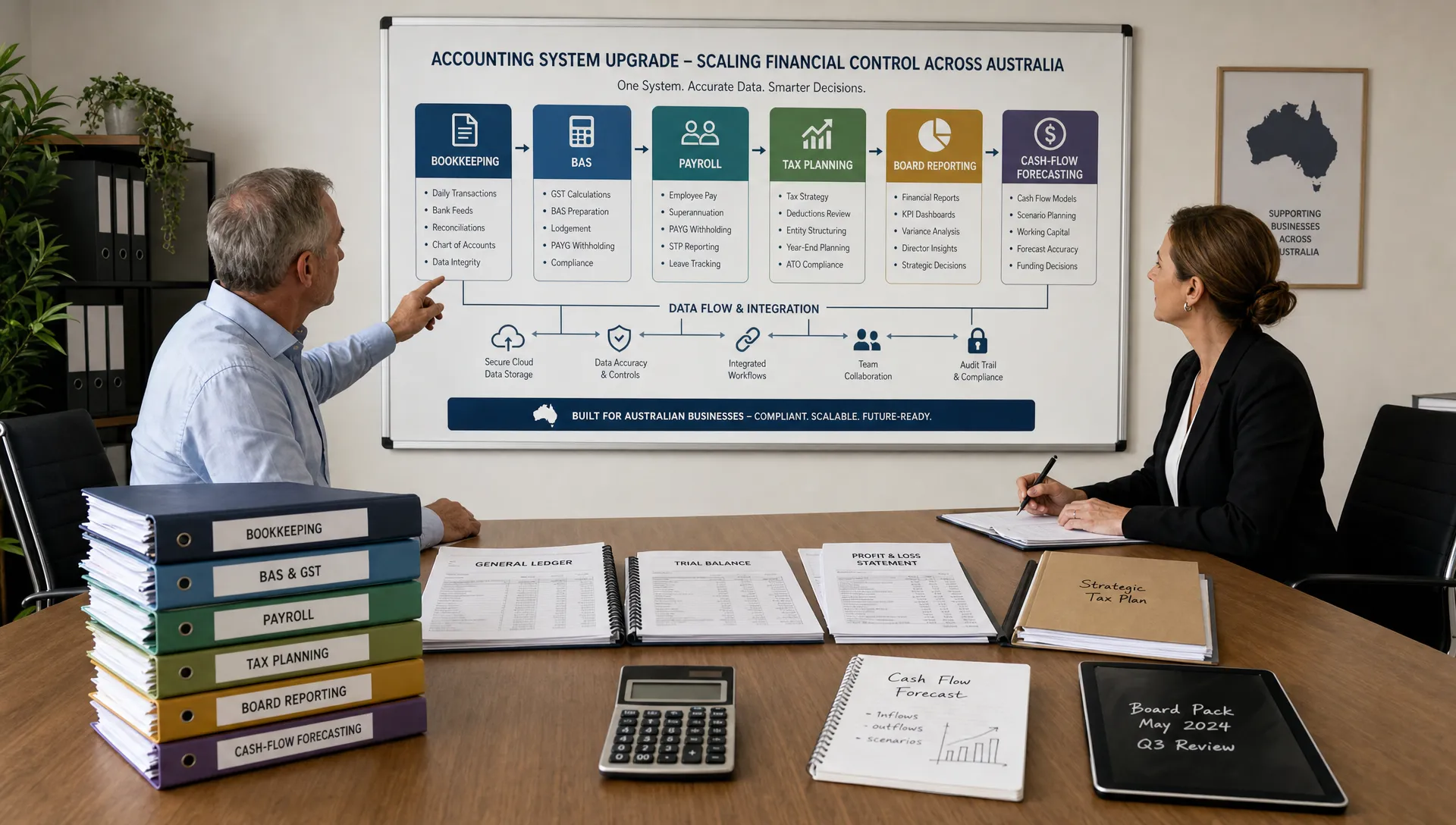
Basic bookkeeping is a necessary discipline. It records what happened, keeps invoices organised, reconciles bank transactions, and supports routine lodgements. But for a growing company, bookkeeping is only the starting point.
At a certain stage, company directors need more than tidy transaction data. They need financial systems that support tax planning, cash-flow control, payroll compliance, board reporting, funding decisions, and long-term corporate growth. That is when company accounting services need to move beyond basic bookkeeping and become a strategic function.
We see this transition most often when a company expands headcount, takes on larger contracts, opens operations in another state, purchases significant assets, or starts dealing with investors, lenders, related entities, or complex tax issues. The numbers may still be “kept”, but they are no longer being used well enough.
The difference between bookkeeping and company accounting services
Bookkeeping focuses on recording transactions accurately. Company accounting services interpret those records, test them for compliance, and turn them into business intelligence.
For Australian companies, this distinction matters because directors carry legal and tax responsibilities that extend beyond day-to-day data entry. The ATO expects businesses to keep appropriate tax records, generally for five years, while ASIC highlights that companies must maintain financial records that correctly record and explain transactions and financial position. These obligations are not just administrative. They influence director risk, tax outcomes, funding capacity, and business value.
| Function | Basic bookkeeping | Company accounting services |
|---|---|---|
| Transaction processing | Bank reconciliations, invoices, bills and receipts | Data quality controls, chart of accounts design and workflow automation |
| Compliance | Routine BAS preparation support | GST, PAYG withholding, STP, Superannuation, FBT and company tax planning |
| Reporting | Profit and loss, balance sheet and cash summaries | Management reports, KPI packs, cash-flow forecasting and board-level insights |
| Tax position | Historical data for tax lodgement | Proactive tax structuring, timing strategies and risk management |
| Growth support | Limited visibility beyond past transactions | Strategic Advisory, Virtual CFO input and corporate growth planning |
In our view, the most important shift is mindset. Bookkeeping tells a company what has happened. Professional company accounting services help directors decide what should happen next.
Warning signs your company has outgrown basic bookkeeping
A company rarely outgrows bookkeeping overnight. The warning signs usually appear gradually, then become expensive if they are ignored.
Your reports are accurate, but not useful
A profit and loss statement that arrives six weeks late is not a decision-making tool. It is a historical document. If directors are making pricing, hiring, purchasing or funding decisions without current financial visibility, the business is carrying avoidable risk.
Useful reporting should explain margins, working capital pressure, debtor exposure, tax liabilities, payroll trends, and cash-flow timing. It should also identify patterns early. For example, a rising revenue line may look positive, but if debtor days are increasing and GST obligations are building, the company may be funding growth from its own cash reserves.
This is where a more strategic accounting model becomes valuable. We have discussed this broader expectation in our guide to what small businesses should expect from modern accounting services, particularly the move from periodic compliance to real-time financial control.
BAS, GST and payroll obligations are becoming harder to manage
Basic bookkeeping may be adequate when a company has simple GST activity and minimal payroll. It becomes insufficient when the business starts dealing with multiple revenue streams, interstate operations, contractors, allowances, reimbursements, motor vehicles, or mixed GST treatment.
BAS errors can create cash-flow surprises. Payroll errors can affect PAYG withholding, Single Touch Payroll reporting, Superannuation Guarantee obligations, and employee trust. FBT may also become relevant when directors or employees receive benefits such as motor vehicles, entertainment, car parking, or certain expense payments.
The issue is not just whether lodgements are completed. The question is whether the accounting system is designed to capture the right information before lodgement time.
Directors are relying on instinct instead of financial modelling
Entrepreneurial judgement is valuable, but it should not replace disciplined analysis. Once a company is making decisions about hiring, asset purchases, debt, leases, acquisitions, new locations, or shareholder distributions, the accounting function must support scenario modelling.
Directors should be able to test questions such as:
- What happens to cash flow if revenue grows 20% but debtor days extend by 15 days?
- Can the company fund new staff without weakening working capital?
- Should profits be retained, distributed, reinvested, or used to reduce debt?
- Are director loans, related-party transactions, or Division 7A issues being monitored properly?
- What tax liabilities are building over the next quarter, not just at year-end?
If the finance function cannot answer these questions with confidence, the company has outgrown basic bookkeeping.
Why this transition matters for directors
Company directors in Australia are responsible for more than commercial performance. They must ensure the company keeps proper financial records, remains solvent, meets tax obligations, pays employees correctly, and manages stakeholder risk.
The ATO’s record-keeping guidance makes clear that records must explain transactions and support tax positions. ASIC also provides guidance on company financial reporting and audit obligations, particularly where reporting requirements apply.
For many private companies, the practical risk is not always a formal audit. It is poor visibility. If financial records are delayed, inconsistent, or disconnected from strategy, directors may miss tax exposures, cash-flow strain, margin erosion, or compliance failures until the cost is significant.

What higher-level company accounting services should include
When a company moves beyond basic bookkeeping, the accounting relationship should become more structured, proactive and forward-looking. We generally look for several core disciplines.
Stronger financial systems and automation
Manual bookkeeping can work at a small scale, but it becomes fragile as transaction volume grows. Automation helps reduce repetitive processing, improve consistency, and identify exceptions sooner.
Our AI-driven workflows are designed to streamline financial processing, reduce manual handling, and improve the speed at which useful information reaches directors. The objective is not automation for its own sake. It is better control, faster reconciliation, cleaner data, and more timely advisory conversations.
For a company director, that means less time waiting for accounts to be “caught up” and more time reviewing forward-looking insights.
Compliance that is built into the workflow
Compliance should not be a quarterly scramble. GST codes, payroll categories, contractor treatment, superannuation processes, FBT records, and tax documentation should be embedded into the accounting system.
This reduces the risk of late corrections and improves confidence in BAS, company tax return preparation, payroll reporting and year-end tax planning. It also creates a stronger audit trail if the ATO asks questions.
Management reporting for decision-making
A growing company needs reporting that explains performance, not just activity. We typically focus on profitability, cash flow, working capital, tax liabilities, debtor management, payroll ratios, gross margin, overhead trends, and balance sheet strength.
The value is not in producing more reports. The value is in producing the right reports and interpreting them in commercial context.
This is also where the role of a business services accountant becomes more important. We have explored this in more detail in our article on how a business services accountant supports better decisions.
Proactive tax planning
Tax planning should not begin after 30 June. For companies, tax planning may involve timing of income and deductions, asset purchases, loss utilisation, director remuneration, dividends, franking credits, Division 7A, trust distributions, payroll tax considerations, and group structures.
The right approach depends on the company’s circumstances. A growth-stage SaaS company, a building contractor, a medical practice, a property development group and a family-owned trading company will each have different risk profiles.
Our role is to connect tax decisions to the company’s broader strategy. That includes cash flow, governance, succession, funding, asset protection, and exit planning.
Virtual CFO and Strategic Advisory input
Not every company needs a full-time CFO. Many growing companies do, however, need CFO-level thinking at key points in the year.
Virtual CFO support can assist with budgeting, cash-flow forecasting, board reporting, funding preparation, KPI design, pricing analysis, cost control, and growth planning. For directors, this creates a bridge between compliance accounting and strategic management.
This is especially valuable for companies operating across multiple locations or markets. Our team supports clients across Australia, with integrated service capabilities in Adelaide, Sydney and Melbourne, so directors can maintain consistent financial governance even as operations expand.
When bookkeeping alone becomes a false economy
Basic bookkeeping can appear cheaper, but the comparison is often misleading. The real cost of underpowered accounting is usually hidden in delayed decisions, missed tax planning opportunities, inefficient cash management, preventable compliance errors, and weak financial governance.
A company may be outgrowing its current accounting support if any of the following are occurring:
- Directors only review financial reports at tax time.
- BAS preparation regularly involves rework or uncertainty.
- Payroll, superannuation or STP processes are not being reviewed.
- Cash-flow pressure is increasing despite sales growth.
- The company cannot produce reliable forecasts for lenders or investors.
- Related-party transactions are not being monitored carefully.
- The business is expanding across states without a unified finance process.
- The accounting file is technically reconciled, but no one is interpreting the results.
The issue is not whether the bookkeeper is competent. Many are. The issue is whether the company has reached a level of complexity that requires a broader accounting, tax and advisory framework.
How to upgrade without disrupting the business
Moving from basic bookkeeping to integrated company accounting services should be methodical. We do not recommend replacing processes blindly. We recommend reviewing them, strengthening what works, and automating what no longer scales.
A practical transition usually involves five steps:
- Review the current accounting file: We assess data quality, reconciliations, GST coding, payroll setup, chart of accounts, debtors, creditors, loans and balance sheet integrity.
- Identify compliance gaps: We review BAS, PAYG withholding, Superannuation, FBT exposure, company tax positions and record-keeping processes.
- Redesign reporting: We build reporting around director decisions, including cash flow, margins, working capital, tax liabilities and key operating metrics.
- Automate repeatable workflows: We use digital tools and AI-driven processes to reduce manual handling, improve accuracy and create more timely visibility.
- Establish an advisory rhythm: We align reporting cycles with management meetings, tax planning dates, funding decisions and growth milestones.
This approach keeps the business moving while improving financial control. It also gives directors a clearer view of what the company can afford, what risks need attention, and where growth is genuinely profitable.
The strategic outcome: accounting as a growth asset
The best company accounting services do not simply keep a business compliant. They help directors create a stronger company.
That means better data, cleaner governance, clearer tax planning, stronger cash-flow discipline, and more confident decision-making. It also means the accounting function becomes part of corporate growth, not a back-office obligation.
For directors, this shift is often a turning point. The business moves from reacting to numbers after the fact to using financial intelligence before decisions are made. That is where accounting starts to create measurable strategic value.
Frequently Asked Questions
When should a company move beyond basic bookkeeping? A company should consider upgrading when directors need timely management reports, tax planning, payroll oversight, cash-flow forecasts, multi-entity support, funding preparation, or stronger governance. If bookkeeping is only recording transactions and not supporting decisions, the business has likely outgrown it.
Are company accounting services only for large businesses? No. Many SMEs need company accounting services once their operations become more complex. This can happen through GST growth, payroll, contractors, interstate activity, asset purchases, related-party transactions, investors, or significant tax planning needs.
How does automation improve company accounting? Automation reduces manual processing, improves consistency, speeds up reconciliations, and helps identify exceptions earlier. When combined with professional review, it gives directors more reliable financial visibility and allows advisory discussions to happen sooner.
Does better bookkeeping reduce ATO risk? Better bookkeeping helps, but ATO risk is reduced more effectively when bookkeeping is supported by proper GST treatment, payroll compliance, record keeping, tax planning and review. The system must capture the right information before lodgements are prepared.
Can Perfect Accounting & Tax Services support companies outside South Australia? Yes. We support clients across Australia and provide integrated accounting, tax and advisory services with capabilities in Adelaide, Sydney and Melbourne.
Next steps: build accounting that scales with the company
If your company has outgrown basic bookkeeping, the next step is not simply to process transactions faster. It is to build a finance function that improves compliance, strengthens decision-making and supports corporate growth.
Our team at Perfect Accounting & Tax Services provides company accounting services, BAS and payroll support, advanced tax planning, Virtual CFO advisory and AI-driven workflow automation for Australian businesses. We work with directors, business owners and high-net-worth individuals who need accurate reporting, strategic insight and practical financial control.
To discuss whether your current accounting system is still fit for purpose, contact our team for a consultation and learn how our automated accounting workflows can give your company clearer visibility and stronger financial direction.