
For many Australian businesses, tax becomes urgent only when a BAS is due, a company tax return is being finalised, or the ATO sends a query. At that point, the conversation is often too narrow. The records are already written. The decisions have already been made. The cash has already moved.
That is where conventional tax solutions reach their limit.
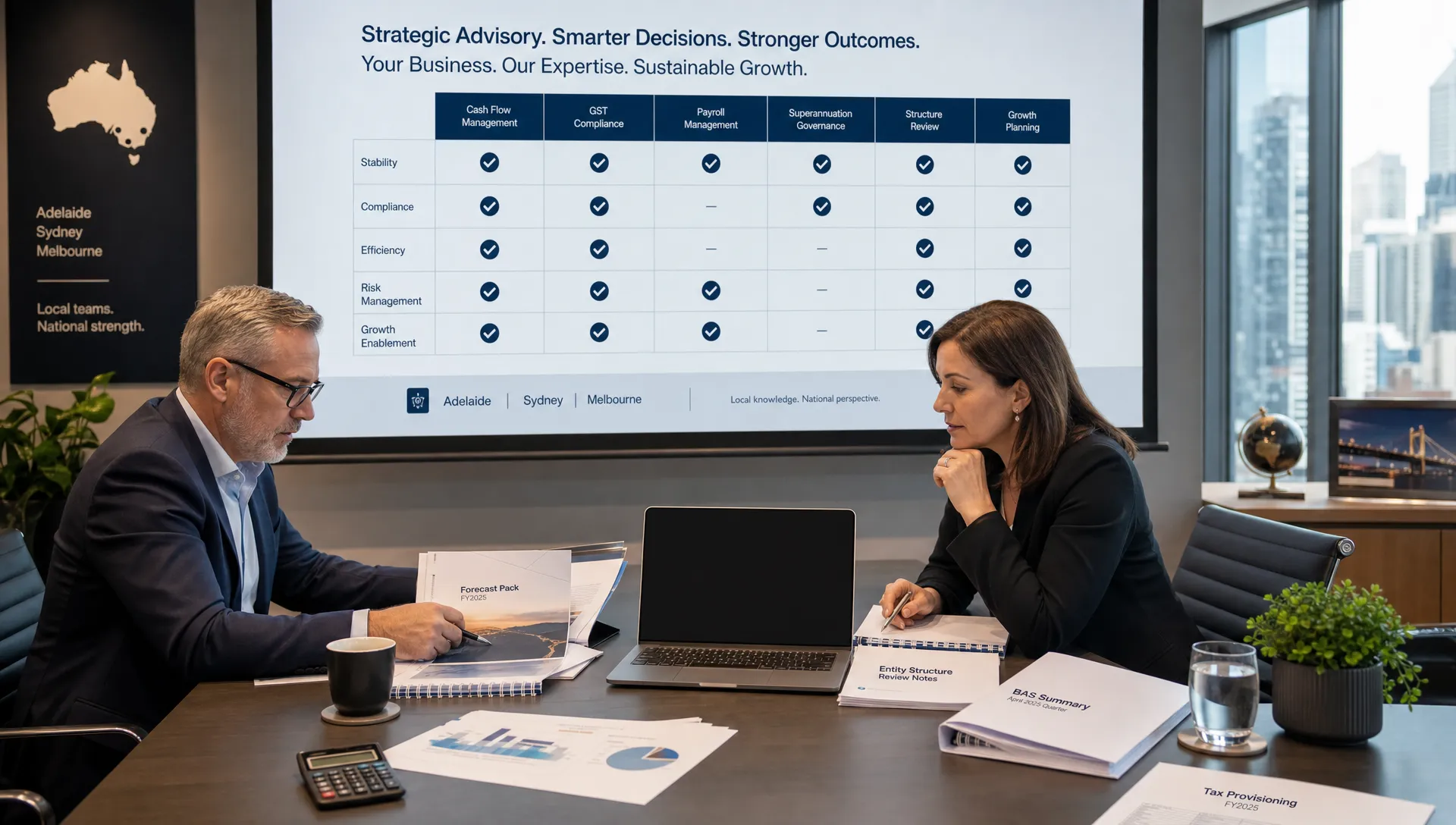
Lodgement is essential, but it is not strategy. It confirms what has happened and helps meet statutory obligations. Strategic advisory, by contrast, shapes what happens next. It turns compliance data into decisions about cash flow, growth, structure, investment, risk and governance.
In our work with business owners, company directors and high-net-worth individuals across Australia, we see the same pattern repeatedly. The best tax outcomes rarely come from last-minute deductions. They come from well-timed planning, clean data, disciplined reporting and a clear view of the commercial objective behind each tax decision.
Lodgement solves compliance. Strategic advisory solves direction.
A tax lodgement answers a technical question: what must be reported to the ATO for a specific period?
Strategic advisory asks broader questions. Is the business generating enough cash to support its tax obligations? Is GST being captured correctly? Are PAYG withholding, superannuation and payroll processes creating hidden exposure? Does the current structure still suit the group’s growth plans? Are directors making decisions using real-time financial visibility, or waiting for year-end accounts?
Both functions matter. Lodgement protects compliance. Advisory protects decision quality.
The distinction becomes especially important in Australia because tax obligations rarely sit in isolation. A company tax return is connected to BAS reporting, GST treatment, payroll, superannuation, FBT, director loans, trust distributions, asset purchases and financing decisions. If those areas are reviewed only once a year, the business may be reacting to problems rather than managing them.
This is why we view tax compliance as the foundation for strategic advisory, not the end product. Accurate bookkeeping and timely lodgements create the financial evidence base. Advisory uses that evidence to improve commercial outcomes.
When your tax solutions have outgrown basic lodgement
A straightforward lodgement process may be adequate for simple affairs. However, once a business or investment structure becomes more complex, tax solutions need to operate at a strategic level.
Common signs include:
- Your tax payable regularly comes as a surprise, even when the business appears profitable.
- Profit and cash flow are moving in different directions, with limited visibility on why.
- BAS lodgements involve frequent GST adjustments, corrections or unreconciled accounts.
- Payroll, superannuation or contractor arrangements have become more complex.
- The business is expanding across states, taking on new entities, or operating from Adelaide, Sydney, Melbourne or multiple locations.
- Directors are considering asset purchases, debt restructuring, dividends, trust distributions or succession plans.
- You hold residential or commercial property, SMSF assets, crypto assets, foreign income, or investments across multiple entities.
- The ATO has raised questions, or the business is preparing for possible review or audit activity.
None of these issues are solved properly by simply preparing a return after 30 June. They require forward planning, documented reasoning and a reporting process that gives decision-makers time to act.
If the immediate issue is whether professional lodgement support is warranted, we have also covered when tax return filing services make strategic sense. The deeper question is what should happen before the lodgement stage.
The strategic areas a tax adviser should be testing
Strategic tax advisory is not about aggressive tax minimisation. In Australia, the distinction between legitimate planning and unacceptable tax avoidance is critical. The objective is to structure affairs efficiently, comply with the law, maintain evidence and support commercial growth.
Cash flow and tax provisioning
A profitable business can still face tax stress if cash flow is poorly managed. We often see this where directors focus on revenue growth but do not forecast GST, PAYG instalments, superannuation liabilities, income tax and loan repayments together.
A strategic advisory approach builds tax obligations into cash flow planning. That means reviewing projected profit before year-end, estimating tax exposures early, identifying timing issues and aligning payment obligations with working capital.
For directors, this is not just administrative discipline. It supports better decisions about hiring, dividends, asset purchases, debt reduction and expansion.
GST, BAS and transaction quality
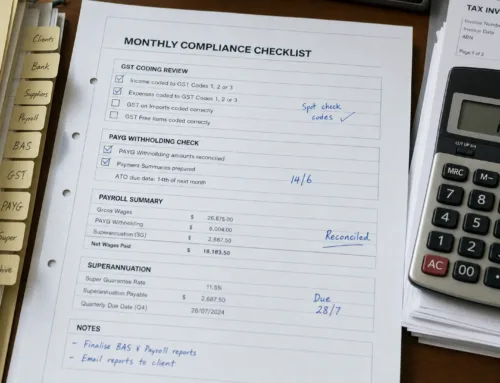
BAS lodgement is often treated as routine, but GST errors can indicate deeper process weaknesses. Incorrect GST coding, mixed-use purchases, property transactions, imports, exports and inter-entity charges can all affect reporting accuracy.
The ATO provides detailed guidance on record keeping for business, and strong records are central to defending tax positions. In our view, BAS preparation should also feed management insight. If GST coding is inconsistent, the same data may also be distorting margins, cost analysis and cash flow forecasts.
Payroll, superannuation and FBT exposure
As a business grows, employment-related obligations become more complex. Single Touch Payroll, PAYG withholding, superannuation guarantee, contractors, allowances, bonuses, motor vehicles and staff benefits all need careful review.
FBT is a good example. It is easy for a business to provide benefits without fully considering reporting implications. Vehicles, entertainment, living-away-from-home arrangements and salary packaging can affect both tax compliance and employee cost modelling.
A strategic review does not merely ask whether an amount was lodged. It asks whether the business has controls that prevent recurring errors.
Entity structure and governance
A structure that suited a sole trader or early-stage company may not suit a scaling business, property group or family investment vehicle. Trusts, companies, partnerships, SMSFs and related-party arrangements each carry different tax, legal and commercial consequences.
We do not view structure as a set-and-forget decision. It should be reviewed when ownership changes, profit increases, risk profile shifts, assets are acquired, investors enter, or succession becomes relevant. Tax advice should be integrated with legal and financial advice where required, particularly where asset protection, estate planning or family group governance is involved.
Management reporting and director decision-making
The strongest tax outcomes come from management discipline. Directors need timely numbers, not just compliant numbers. That includes visibility over gross margins, debtor days, stock movements, labour costs, project profitability, tax liabilities and funding requirements.
This is where modern tax solutions should connect with virtual CFO-style thinking. The same accounting data used for lodgement can support budgets, forecasts, board reporting, scenario modelling and growth strategy.
Where automation changes the advisory conversation
Digital transformation has raised the standard for what business owners should expect from their accounting function. Manual workflows are slower, more error-prone and often too retrospective. By the time a traditional year-end process identifies an issue, the practical opportunity to fix it may have passed.
Our team uses AI-driven automation to streamline financial workflows, improve consistency and reduce the lag between business activity and financial insight. Automation can assist with data capture, reconciliations, anomaly detection and workflow efficiency. Professional judgement remains essential, but the adviser can spend less time processing and more time interpreting.
That shift matters. When records are current, advisory becomes proactive. We can identify unusual movements, review tax provisioning, prepare for BAS obligations, assess payroll risk and support directors before decisions become irreversible.
For businesses operating across Adelaide, Sydney, Melbourne and other Australian locations, integrated digital workflows also create consistency. A national business should not have fragmented accounting visibility simply because its operations are spread across multiple offices, entities or states.

A practical framework for deciding whether you need advisory
We assess the need for strategic advisory by looking at the relationship between compliance risk and commercial complexity. The more moving parts a business or investment group has, the less appropriate a lodgement-only approach becomes.
| Strategic question | Why it matters | Advisory outcome |
|---|---|---|
| What is our likely tax position before year-end? | Surprises reduce cash flow control and limit planning options. | Forecast tax liabilities and adjust provisioning early. |
| Are BAS, GST, payroll and superannuation aligned with the accounts? | Compliance errors often indicate weak systems. | Identify process gaps and strengthen controls. |
| Does the current structure still support growth? | Structures can become inefficient as risk, profit and ownership change. | Review entities, distributions, funding and governance. |
| Are directors using current financial data? | Old data leads to reactive decisions. | Build reporting rhythms that support timely action. |
| Would our records withstand ATO scrutiny? | Evidence is critical if a position is reviewed. | Improve documentation and audit readiness. |
This framework also clarifies when a pre-lodgement conversation should happen. If you are finalising a company tax return, trust distribution, BAS or significant deduction without reviewing these questions, the process may be too narrow. We have outlined the key items to cover in a tax consultation before you lodge because the quality of that discussion often determines the quality of the outcome.
Examples where lodgement-only thinking creates risk
A growing SME with strong revenue but weak cash flow
Revenue growth can hide tax pressure. A business may be profitable on paper while cash is tied up in debtors, stock, equipment finance or expansion costs. If GST and PAYG instalments are not forecast, the director may face large quarterly obligations with insufficient cash reserves.
Strategic advisory reframes the issue. We analyse margins, working capital, tax provisioning and payment timing together. The objective is not just to lodge accurately, but to protect liquidity while the business grows.
A property investor expanding into multiple entities
Property investors often accumulate complexity gradually. One property becomes several. Personal ownership becomes a trust or company structure. Financing changes. GST may become relevant for commercial property or development activity. Land tax, capital gains tax and deductibility questions become more important.
A lodgement-only process may capture transactions after the fact. Strategic advisory considers the structure, financing, timing and evidence before major decisions are made.
A company director using the business for private expenses
Private company arrangements need disciplined handling. Director loans, reimbursements, motor vehicles, home office costs and personal expenses can have tax consequences if not managed correctly. Division 7A issues, FBT exposure and deductibility questions should not be discovered at year-end by accident.
A strategic approach sets rules, documentation and review points. That protects both the company and the director.
A technology or professional services firm preparing to scale
Tech startups, SaaS companies, consultants and professional practices often invest heavily before profit stabilises. They may need advice on contractor arrangements, employee incentives, R&D Tax Incentive considerations where applicable, international revenue, GST, software subscriptions and investor reporting.
In this environment, tax advice should support capital strategy, operational visibility and governance. It should not be limited to annual compliance.
When basic lodgement may still be enough
Strategic advisory is not required for every taxpayer at every stage. A simple salary and wage return with limited deductions may not justify a complex advisory process. A small sole trader with clean records, low transaction volume and predictable income may only need periodic check-ins.
However, the threshold changes quickly. Once you employ staff, register for GST, operate through a company or trust, hold multiple investments, claim significant deductions, receive foreign income, manage an SMSF, or plan a major transaction, advice should become more forward-looking.
The key test is whether tax decisions affect broader financial outcomes. If they do, lodgement alone is not enough.
What to ask before choosing tax solutions
Before appointing or continuing with a tax adviser, directors and business owners should ask questions that go beyond price and turnaround time.
- Do we receive advice before year-end, or only after the numbers are final?
- Are BAS, GST, payroll, superannuation and income tax reviewed together?
- Does the adviser understand our growth plans, funding needs and risk profile?
- Are digital workflows being used to improve accuracy and timeliness?
- Do we receive management insights, or only compliance reports?
- Can the adviser support us across multiple entities, locations and jurisdictions within Australia?
If you are comparing providers, it is worth assessing whether the proposed tax services support business growth rather than simply meeting annual lodgement deadlines.
Frequently Asked Questions
What is the difference between tax lodgement and strategic tax advisory? Tax lodgement reports historical information to the ATO and meets compliance obligations. Strategic tax advisory uses financial data to plan cash flow, structure, GST, payroll, superannuation, FBT and growth decisions before lodgement deadlines arrive.
Is strategic tax planning legal in Australia? Yes, legitimate tax planning is legal when it is commercially grounded, properly documented and compliant with Australian tax law. It is different from tax avoidance, which can attract ATO scrutiny and penalties.
How often should a business review its tax position? We generally prefer quarterly reviews for businesses with GST, payroll, multiple entities or growth plans. More complex groups may need monthly reporting and advisory meetings, particularly where cash flow, funding or expansion decisions are active.
Can AI automation replace a tax adviser? No. Automation improves speed, consistency and visibility, but professional judgement remains essential. AI-driven workflows help us identify issues earlier, while experienced advisers interpret the data and apply Australian tax law to the client’s commercial context.
When should we seek advice before 30 June? Ideally, tax planning should start well before year-end. Reviewing profit, deductions, asset purchases, trust distributions, Division 7A matters, superannuation and cash flow early gives directors more practical options.
How our team can help
At Perfect Accounting & Tax Services, we approach tax solutions as part of a wider financial strategy. Our team combines 25 years of professional experience with AI-driven automation to deliver accurate compliance, faster workflows and clearer financial visibility.
We support SMEs, company directors, investors and high-net-worth individuals across Australia, with integrated capabilities in Adelaide, Sydney and Melbourne. Our work covers bookkeeping, BAS, payroll, tax planning, audit support, SMSF compliance, virtual CFO services and strategic advisory.
If your current tax process is focused only on lodgement, it may be time to review whether your accounting function is supporting growth, governance and cash flow.
Contact our team at Perfect Accounting & Tax Services to arrange a consultation and learn how our automated accounting workflows can turn compliance data into strategic financial insight.