
ATO scrutiny is no longer limited to obviously aggressive deductions. In 2026, the ATO is using richer data matching, Single Touch Payroll, bank feeds, property data, digital platform reporting and historical benchmarks to test whether tax claims in Australia are commercially credible and properly substantiated.
For business owners, company directors and high-net-worth individuals, the question is not simply whether an expense feels business-related. The better question is whether the claim would still make sense if an ATO officer asked for the source documents, the commercial rationale and the apportionment method 12 months after lodgement.
We see defensible claims as part of a wider governance system. Accurate deductions reduce tax legally, but the records behind them also improve cash flow visibility, strategic advisory decisions and corporate growth planning. A deduction that cannot be explained is not a strategy. It is a risk.
The ATO's core test for deductible claims
The ATO generally looks at whether an expense was incurred in earning assessable income or carrying on a business for that purpose. The basic principle under section 8-1 of the Income Tax Assessment Act 1997 is familiar, but the practical application is where many taxpayers fall short.
The ATO's public guidance on deductions you can claim is built around three practical rules: you must have spent the money yourself and not been reimbursed, the expense must directly relate to earning income, and you must have a record to prove it. For businesses, the same logic extends into GST, BAS, payroll, superannuation, FBT and entity governance.
A claim is more likely to stand up when it satisfies four tests.
First, the expense must be real and incurred by the correct taxpayer or entity. A company cannot simply claim a cost paid by a director personally unless the accounting treatment supports reimbursement, loan treatment or another valid arrangement.
Second, there must be a clear income-producing connection. The stronger the connection between the expense and the revenue activity, the stronger the deduction.
Third, private, domestic and capital elements must be excluded or apportioned. Mixed-use items such as vehicles, phones, home internet, travel and subscriptions need evidence-based allocation.
Fourth, the records must be contemporaneous. Evidence created after an ATO query is usually weaker than records captured at the time the transaction occurred.
What makes a tax claim defensible?
A defensible claim is not necessarily the smallest claim. It is the claim that can be reconstructed from reliable records and explained consistently across your tax return, BAS, bank transactions, accounting software, payroll records and management accounts.
| Defensibility factor | What the ATO may examine | Strong evidence |
|---|---|---|
| Business nexus | Why the expense was incurred and how it helped generate income | Tax invoices, job notes, client correspondence, project records |
| Correct entity | Whether the right taxpayer claimed the expense | Bank statements, inter-entity journals, reimbursement records, loan agreements |
| Apportionment | Whether private or non-deductible use was excluded | Logbooks, usage records, floor-area calculations, diary entries |
| Timing | Whether the deduction belongs in the year claimed | Invoice dates, payment records, accrual schedules, asset registers |
| GST treatment | Whether input tax credits were claimed correctly | Valid tax invoices, BAS reconciliations, GST coding reports |
| Commercial logic | Whether the claim is reasonable for the business profile | Budgets, board minutes, contracts, industry context |
This is why we prefer to review deductions before lodgement, not after a notice is issued. A structured pre-lodgement tax consultation gives business owners and directors time to resolve weak evidence, correct BAS mismatches and identify claims that require stronger documentation.
Tax claims that usually stand up when properly documented
Ordinary business operating expenses
Recurring business expenses are often straightforward when the records are clean. These may include accounting fees, legal advice, insurance, software subscriptions, bank fees, marketing, rent, utilities, office supplies, professional memberships and contractor costs.
The key issue is not whether these categories are generally deductible. The issue is whether the expense was incurred for the business and recorded in the correct period. A monthly software subscription used for client delivery is easier to defend than a broad technology charge with no invoice, no user allocation and no explanation of business use.
For GST-registered businesses, the GST treatment must also align. Input tax credits require the correct GST status and, in most cases, a valid tax invoice. A deduction may be valid for income tax purposes while the GST claim is still wrong.
Motor vehicle claims
Motor vehicle expenses are one of the most scrutinised claim areas because private use is common. For individuals, the cents per kilometre method and logbook method have different substantiation requirements. For companies and trusts, motor vehicles can also raise FBT issues when employees or directors have private use.
A vehicle claim is stronger when the business purpose is documented clearly. Client site visits, deliveries, inspections and travel between work locations are easier to support than general commuting between home and a regular place of work.
A 12-week logbook, odometer records, service records and calendar entries can create a consistent evidence trail. In our experience, the strongest vehicle claims are supported by digital records that align with job scheduling, invoicing and bank transactions.
Travel and accommodation
Business travel can be deductible, but the ATO will look closely at purpose, duration, itinerary and any private component. Travel linked to client work, conferences, inspections or commercial negotiations is usually more defensible than travel that combines business meetings with extended leisure.
For directors and high-income professionals, travel involving spouses, family members, luxury accommodation or international destinations needs particular care. If a private component exists, it should be apportioned and documented. The business should retain itineraries, boarding passes, accommodation invoices, meeting agendas and notes showing what was achieved commercially.
Home office and remote work expenses
Home office claims remain relevant for consultants, directors, digital businesses and professional service firms. However, they are also an area where assumptions create risk.
The ATO's guidance on working from home expenses requires taxpayers to keep records of actual hours worked from home and evidence of the expenses incurred. Depending on the method used, this may include electricity, internet, phone, stationery, computer consumables and depreciation of equipment.
For business owners, the home office position can become more complex if a company pays home expenses or reimburses a director. The tax outcome may involve deductibility, FBT, GST and director loan considerations. A simple claim can quickly become a governance issue if the arrangement is not documented.
Payroll, superannuation and contractor costs
Wages and contractor payments generally stand up when they are supported by employment agreements, invoices, payroll records, PAYG withholding, STP reporting and superannuation compliance. Superannuation is particularly timing-sensitive. Employer contributions are generally deductible only when received by the fund by the required time.
For contractors, the ATO may examine whether the worker is genuinely a contractor or an employee for tax and superannuation purposes. The written contract is relevant, but it is not the only evidence. The actual working arrangement matters.
Businesses in industries covered by taxable payments annual reporting, such as building and construction, cleaning, courier, road freight, IT and security services, should ensure contractor data aligns with ATO reporting obligations.
Training and professional development
Training claims stand up when they maintain or improve skills used in the taxpayer's current income-earning activity. A software developer updating technical skills, a lawyer attending continuing professional development or a director undertaking governance training may have a strong claim.
The risk increases where training is designed to open a new income stream, create a new career or deliver a mainly private benefit. We look closely at the connection between the course content, current duties, business strategy and revenue model.
Asset purchases and depreciation
Technology, tools, equipment, vehicles, fit-outs and machinery require careful treatment. A purchase is not automatically deductible in full just because it was paid before 30 June. The tax treatment depends on the asset type, cost, business use, acquisition date, installation date and whether small business depreciation concessions apply.
The strongest asset claims are supported by an asset register. This should record cost, date first used, business-use percentage, GST treatment, depreciation method and disposal details. For high-growth businesses, this register is also valuable for finance applications, insurance reviews and exit planning.
Rental property and investment-related claims
Rental property claims are under sustained ATO attention. Interest, repairs, capital works, depreciation, body corporate fees, insurance and agent fees can be legitimate, but the detail matters.
Interest must be traced to the income-producing purpose of the loan. Repairs must be distinguished from capital improvements. Depreciation and capital works should be supported by reliable schedules. Travel to inspect residential rental properties is usually restricted for individual investors, and private use of a property must be apportioned.
We have covered this in more detail in our analysis of the ATO rental property crackdown, particularly for landlords with multiple properties, refinancing activity or mixed private and rental use.
Interest, financing and shareholder loan claims
Interest deductions can be highly defensible when the purpose of the borrowing is clear. They become vulnerable when funds are mixed, refinanced repeatedly or used partly for private purposes.
For companies and family groups, shareholder loans and Division 7A risks require careful treatment. Private expenses paid through a company account may not simply become tax deductions. They may create loan, dividend, FBT or wages issues depending on the facts.
Where significant debt is involved, we recommend maintaining loan purpose schedules, facility documents, settlement statements and board minutes. This is especially important for property developers, commercial landlords, professional practices and high-net-worth family groups.
Claims that often fail under ATO scrutiny
Some claims fail because the law does not support them. Others fail because the taxpayer cannot prove the position taken. The ATO does not need to accept a claim simply because it appears in accounting software.
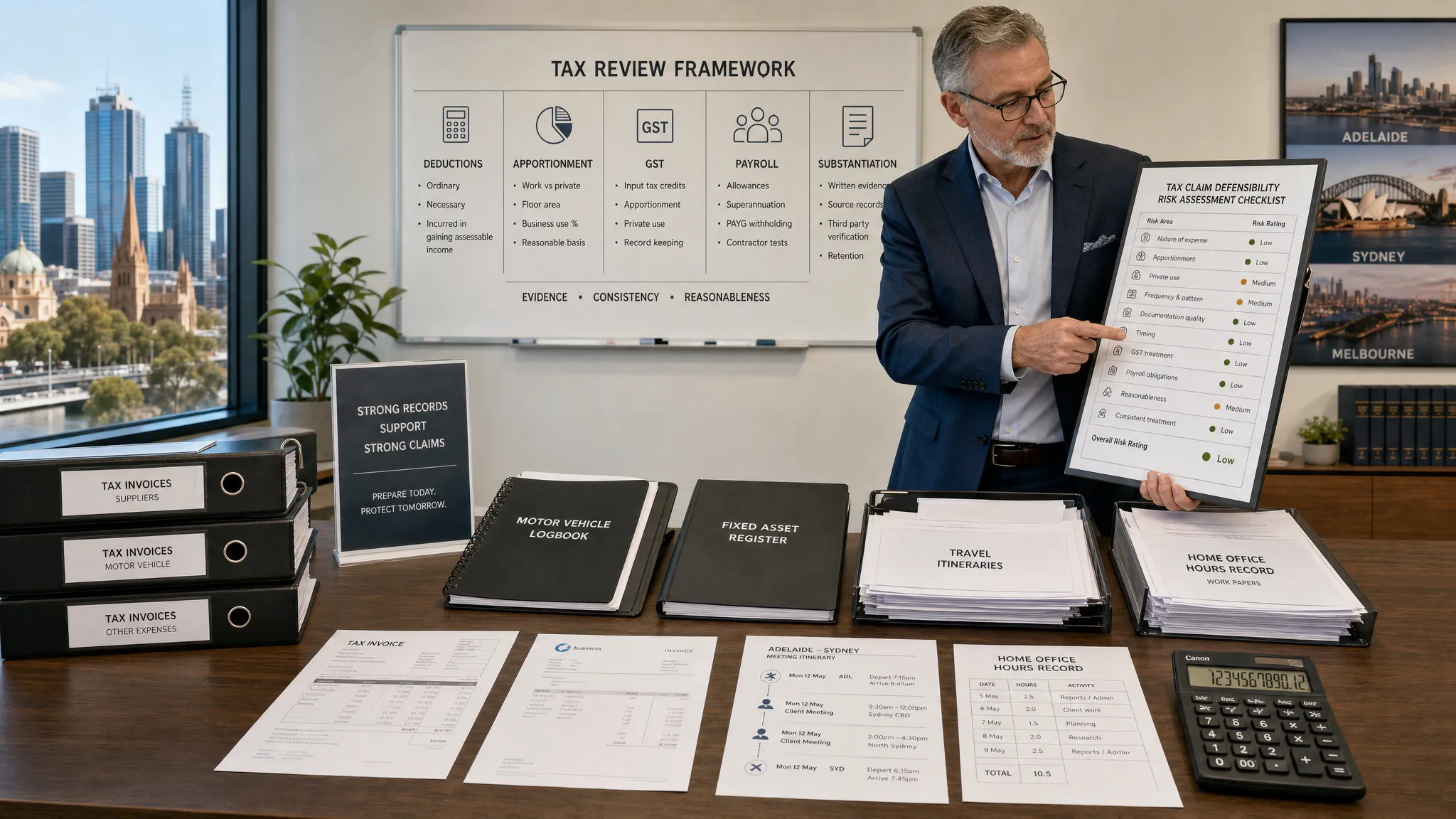
High-risk patterns include rounded estimates, missing invoices, duplicated expenses, 100 percent business-use claims for obviously mixed-use assets, large motor vehicle claims with no logbook, home office claims with no hours record, travel with a significant private component, and GST credits claimed without valid tax invoices.
We also see problems where business owners treat a company bank account as a personal account. Personal groceries, family travel, home renovations, school fees, jewellery, entertainment and lifestyle spending may need to be coded to loan accounts or drawings, not deductions. In some cases, they may create FBT or Division 7A consequences.
Another common weakness is inconsistency. If BAS reports, payroll records, tax returns and financial statements do not reconcile, the ATO has a clear pathway to ask further questions. Our team often finds that the fastest way to reduce audit exposure is to reconcile the entire compliance chain before lodgement.
The evidence hierarchy: what records carry the most weight?
Not all records are equal. A bank statement may prove that money left an account, but it may not prove what was purchased, who supplied it, whether GST applied or whether the expense was business-related.
The ATO's business record-keeping guidance makes clear that records must explain transactions and support tax obligations. For corporate groups, this should be viewed as a governance requirement, not an administrative burden.
| Claim area | Weak evidence | Strong evidence |
|---|---|---|
| Software subscription | Bank feed description only | Supplier invoice, user allocation, payment record, business purpose |
| Vehicle expenses | Fuel receipts only | Logbook, odometer readings, service records, trip purpose records |
| Travel | Credit card statement | Itinerary, meeting agenda, invoices, diary notes, private-use apportionment |
| Contractor costs | Payment transfer only | Signed agreement, invoices, ABN checks, TPAR records where relevant |
| Home office | Estimate of hours | Timesheets, calendar records, expense invoices, method calculation |
| Asset purchase | Receipt with no treatment | Tax invoice, asset register, depreciation schedule, disposal record |
This is where automation creates practical value. AI-driven accounting workflows can capture invoices earlier, classify transactions more consistently, flag unusual coding and give directors real-time visibility before the BAS or tax return is prepared. The objective is not only faster bookkeeping. It is a cleaner evidence base for strategic decisions and compliance defence.
How we risk-rate claims before lodgement
Before we recommend a claim, we consider both technical validity and audit defensibility. A technically available deduction can still be commercially unwise if records are weak and the tax benefit is small compared with the exposure.
| Risk level | Typical profile | Recommended action |
|---|---|---|
| Low | Clear business purpose, valid invoice, correct entity, no private component | Claim and retain records |
| Moderate | Mixed-use expense, partial evidence, reasonable apportionment needed | Document method and strengthen records before lodgement |
| High | Private component, missing source documents, unusual amount, complex entity issue | Review technical position and consider amendment, exclusion or disclosure |
This risk-rating approach is especially useful for directors, investors and businesses operating across multiple states. A Sydney corporate firm, a Melbourne creative agency and an Adelaide property group may have very different claim profiles, but the governance principles remain consistent.
What to do if the ATO questions a claim
An ATO query does not automatically mean a deduction is wrong. It means the ATO wants evidence or clarification. The response should be calm, complete and strategically controlled.
The first step is to verify the notice and identify exactly what is being requested. The second step is to reconstruct the claim from source documents, not from memory. The third step is to reconcile the claim to the lodged return, BAS, financial statements and accounting ledger. If an error is identified, the response strategy may involve amendment, voluntary disclosure or negotiation depending on the facts.
We have outlined practical response principles in our guide on how to deal with the ATO without costly mistakes. The main point is simple: do not provide incomplete, emotional or inconsistent responses. A well-prepared evidence pack is more persuasive than a long explanation unsupported by documents.
Strategic advisory: turning defensible claims into better decisions
Strong tax claims are not just about reducing taxable income. They reveal how a business is spending money, allocating capital and managing risk. When deductions are categorised correctly, directors gain a clearer view of margins, project profitability, contractor reliance, asset productivity and cash flow timing.
This is where compliance becomes a foundation for corporate growth. BAS reconciliation, payroll accuracy, GST coding and depreciation schedules should feed into forecasting, finance strategy and board-level decision-making. For sophisticated businesses and high-net-worth groups, we see this as the difference between reactive tax lodgement and proactive financial control.
Our integrated team supports clients across Australia, with service capability in Adelaide, Sydney and Melbourne. We combine technical tax analysis with automated workflows so that clients have faster access to accurate information and a stronger compliance position when the ATO asks questions.
Frequently Asked Questions
Is a bank statement enough to support a tax claim? Usually not by itself. A bank statement proves payment, but it may not prove the supplier, GST amount, business purpose or private-use apportionment. Tax invoices, contracts, logbooks and diary records are often needed.
How long should Australian taxpayers keep records? Many tax records must generally be kept for five years, but some records, such as those connected to assets, capital gains tax or long-term structures, may need to be retained longer. We recommend keeping digital records in a structured system.
Can the ATO deny a claim prepared by an accountant? Yes. The taxpayer remains responsible for the information lodged. A good adviser reduces risk by reviewing evidence, applying the law and identifying weak positions before lodgement.
Are large deductions always a red flag? Not necessarily. Large deductions can be valid if they match the business model, revenue activity and supporting records. The risk increases when claims are inconsistent with industry benchmarks, prior years or available evidence.
Can a company claim personal expenses paid for a director? Not automatically. Personal expenses may create Division 7A, FBT, loan account or wages issues. The correct tax treatment depends on the arrangement and documentation.
Next steps: how we can help
If you want tax claims that stand up to ATO scrutiny, the work should begin before lodgement. Our team can review your deductions, reconcile your BAS and income tax position, assess GST and FBT exposure, and identify documentation gaps before they become audit problems.
We also help businesses modernise their accounting workflows with AI-driven automation, improving accuracy, speed and real-time financial visibility. This gives directors and owners stronger evidence, cleaner reporting and better information for strategic advisory decisions.
For business owners, company directors, investors and high-net-worth individuals across Adelaide, Sydney, Melbourne and wider Australia, we can help turn tax compliance into a stronger financial control system.
Contact Perfect Accounting & Tax Services to arrange a consultation and learn how our automated accounting workflows can support more defensible tax claims, stronger compliance and smarter corporate growth.