

For high-income Australians, a tax return is not a clerical formality. It is a financial control point that can influence ATO risk, cash flow, investment decisions, lending capacity, succession planning and the credibility of business records.
When income comes from salary packages, companies, trusts, property, managed funds, employee share schemes, SMSFs or overseas interests, small tax errors can become expensive. They can also create inconsistent records across BAS, payroll, superannuation, bank data and ATO pre-fill information.
That is why working with a tax return expert is not simply about getting a return lodged. We see it as part of a broader advisory process: validating the numbers, protecting your position, and using tax compliance as a foundation for stronger financial strategy.
Higher income changes the tax equation
High income is not only about being in a higher marginal tax bracket. For Australian business owners, directors, senior executives and high-net-worth individuals, income is often layered across multiple entities and asset classes.
A high-income Australian may have employment income, director fees, dividends, trust distributions, rental income, capital gains, foreign income, reportable fringe benefits, superannuation issues and private company transactions in the same financial year. The tax return must bring those elements together accurately.
This matters because different parts of the tax system use different income concepts. Taxable income, adjusted taxable income, reportable fringe benefits, reportable superannuation contributions and net investment losses can affect outcomes such as Medicare levy surcharge exposure, Division 293 tax, HELP repayments, family trust distributions and superannuation strategy.
A tax return expert looks beyond the headline income figure. We examine how the income was earned, which entity received it, whether the timing is correct, whether deductions are supportable, and whether the result aligns with your commercial structure.
If you are deciding whether professional lodgement is worth it, we have also explained when tax return filing services become a strategic decision rather than a year-end administration task.
The margin for error is smaller at higher incomes
The ATO now works with extensive third-party data. Its data-matching programs can compare information from employers, banks, share registries, government agencies, property transactions, cryptocurrency service providers and other sources.
For high-income taxpayers, the practical issue is not whether data will be checked. It is whether your return tells a consistent, well-evidenced commercial story.
| High-income area | Common complexity | Expert focus |
|---|---|---|
| Salary and executive remuneration | Bonuses, allowances, FBT, reportable super and packaging arrangements | Reconcile employer data, payroll records and tax treatment before lodgement |
| Investment portfolios | Dividends, ETFs, managed funds, foreign holdings and capital gains | Review cost bases, tax components, timing and foreign tax offsets |
| Private companies and trusts | Director loans, dividends, distributions, unpaid present entitlements and Division 7A | Align entity accounts, trust minutes, loan agreements and tax positions |
| Property interests | Rental income, repairs, refinancing, private use and capital improvements | Separate deductible expenses from capital costs and support interest claims |
| Superannuation and SMSFs | Contribution caps, Division 293 tax, pension phase and trustee obligations | Coordinate tax outcomes with retirement and wealth strategy |
| Cross-border income | Residency, overseas assets, foreign tax paid and exchange rates | Identify disclosure obligations and reduce double-tax risk where possible |
A simple return can tolerate limited complexity. A high-income return cannot. One unsupported deduction, one missed managed fund statement, or one poorly documented director loan can create ATO questions that take time and cost to resolve.
Where a tax return expert adds the most value
1. Deductions must be defensible, not merely plausible
High-income Australians often have higher work-related, professional and investment-related expenses. That does not automatically make them deductible.
We assess whether the expense has the required connection to assessable income, whether private use has been excluded, whether apportionment is reasonable, and whether the substantiation can withstand review. This is especially important for motor vehicle claims, travel, home office arrangements, professional development, subscriptions, interest deductions and adviser fees.
The quality of evidence matters. A bank transaction alone may not prove deductibility. In complex situations, invoices, contracts, logbooks, diary records, loan documents, settlement statements and board or trustee resolutions may all be relevant.
For a deeper view of evidence standards, our guide to tax documents for complex returns explains why document quality can materially change the outcome.
2. Investment income requires accurate tax characterisation
High-income taxpayers frequently hold assets through multiple platforms. ATO pre-fill data is useful, but it is not a complete tax review.
Managed fund statements may include franked distributions, capital gains, foreign income, tax-deferred amounts and cost base adjustments. Shares and ETFs may have dividend reinvestment plans. Cryptocurrency transactions may require detailed capital gains tax analysis. Property sales may involve main residence issues, cost base reconstruction and timing questions.
A tax return expert does not simply enter totals. We consider the tax character of each amount and whether it interacts with carried-forward losses, CGT discount eligibility, trust distributions and broader cash flow planning.
3. Private companies and trusts need governance discipline
For directors and family groups, the individual tax return is often connected to company and trust records. This is where high-income tax issues commonly become governance issues.
Director loans, private expenses paid by a company, dividends, trust distributions, unpaid present entitlements and related-party transactions need consistent treatment across ledgers, resolutions, tax returns and financial statements. If the records do not align, the risk is not confined to one return.
We regularly see that the strongest tax outcomes start before 30 June. Trust distribution planning, remuneration strategy, dividend timing and Division 7A compliance should be managed proactively, not reconstructed after the event.
This is where technical judgement matters. We have covered the broader skillset required in our article on expert tax accountants in complex matters.
4. Superannuation decisions need tax and wealth alignment
High-income Australians may face Division 293 tax, contribution cap issues, carry-forward concessional contribution opportunities, SMSF compliance questions and retirement planning decisions.
Superannuation is not just a deduction tool. It is a regulated wealth structure. The right approach depends on cash flow, age, balance, contribution history, investment strategy, estate planning and whether the taxpayer controls an SMSF.
We encourage clients to coordinate superannuation planning with tax lodgement, rather than treating it as a separate conversation. That creates better visibility over caps, timing and long-term wealth outcomes.
5. Equity, foreign income and mobility can change the tax result
Senior employees, founders and technology executives increasingly receive employee share scheme interests, RSUs, options or offshore income. Australian tax treatment can depend on vesting dates, disposal restrictions, residency status, foreign tax paid and the terms of the plan.
For expatriates, returning residents and internationally mobile professionals, residency is often the first question. If residency is wrong, the income inclusion, foreign tax offset position and disclosure obligations may also be wrong.
A tax return expert should identify these issues early, request the right documents and ensure the return reflects both Australian law and the commercial facts.

Compliance data should become strategic financial intelligence
We do not view tax compliance as an isolated annual process. For high-income individuals and business owners, the best outcomes come from connected data.
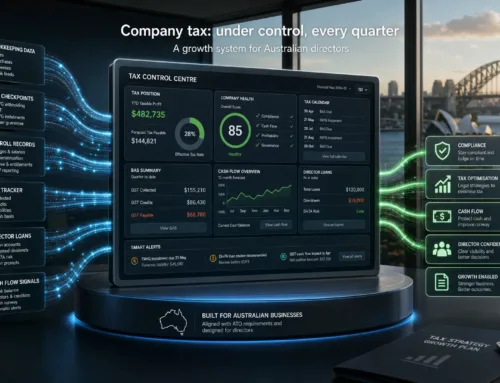
AI-driven accounting workflows can help identify anomalies before lodgement. Bank feeds, payroll reports, BAS data, GST coding, superannuation records, investment statements and entity ledgers can be cross-checked faster and with greater consistency. Human expertise remains essential, but automation improves the quality and timeliness of the review.
This is particularly valuable for company directors and owners of growing businesses. Clean compliance data supports management reporting, cash flow forecasting, tax provisioning, debt discussions and board-level decision-making.
In our view, the tax return is a final output. The real value is the financial visibility created along the way.
What we review before a high-income tax return is lodged
A robust high-income review should be structured. It should not rely only on pre-fill data or last year’s template.
Key review areas include:
- Completeness of income across salary, investments, entities, property, foreign sources and one-off transactions.
- Reconciliation between BAS, GST, payroll, PAYG withholding, superannuation and income tax records where a business is involved.
- Substantiation for deductions, including apportionment where expenses have both private and income-producing components.
- Capital gains tax calculations, cost base evidence, contract dates, settlement dates and discount eligibility.
- Trust resolutions, company loan accounts, dividend records and Division 7A documentation.
- Superannuation contributions, reportable amounts, Division 293 exposure and SMSF-related issues.
- ATO pre-fill comparison, data-matching risk and any inconsistencies that need explanation.
- Tax payable forecasting, PAYG instalment impact and cash flow planning for the next financial year.
This level of review is not about creating complexity. It is about preventing avoidable risk and converting compliance work into better decision-making.
When myTax is no longer enough
The ATO’s myTax system can work well for straightforward salary-and-wage taxpayers with simple deductions and limited investment income. We do not believe every Australian needs a complex advisory engagement.
However, high-income Australians should be cautious about self-lodgement when they have trusts, companies, rental properties, capital gains, employee share schemes, foreign income, SMSFs, large deductions, late returns or ATO correspondence.
The question is not whether you can lodge. The question is whether you can confidently defend the position, optimise the outcome and understand the downstream effects.
If your affairs are expanding, a tax return expert can also help you move from reactive lodgement to proactive tax planning.
How to choose the right tax return expert
For high-income taxpayers, the right adviser should bring technical depth, governance discipline and modern data capability.
We recommend confirming that your adviser is registered with the Tax Practitioners Board. The TPB public register allows you to check whether a tax agent is registered to provide tax agent services in Australia.
Beyond registration, look for experience with your specific profile. A property developer, SMSF trustee, medical specialist, technology founder and family business owner may all be high-income taxpayers, but their risks are different.
A strong adviser should be able to explain the tax position clearly, request the right documents early, use technology to improve accuracy, and connect compliance to strategic advisory. That includes decisions about business structure, profit extraction, financing, succession, investment timing and growth planning.
Our team supports clients across Australia through integrated service capabilities in Adelaide, Sydney and Melbourne. This is important for clients with cross-state operations, multiple entities or advisers in different locations.
Frequently Asked Questions
Do high-income Australians legally need a tax return expert? Not always. However, where income sources, deductions, structures or investments are complex, expert advice can reduce ATO risk and improve strategic outcomes.
Is ATO pre-fill data enough for a high-income tax return? Pre-fill data is useful, but it is not a complete review. It may not correctly address cost bases, private company issues, trust distributions, foreign tax offsets, apportionment or missing documents.
Can a tax return expert reduce my tax? A tax return expert should not promise artificial reductions. The value comes from claiming legitimate deductions, applying the correct tax treatment, planning timing, managing structures and avoiding costly mistakes.
When should high-income taxpayers start tax planning? Ideally, before 30 June. Many decisions, including trust distributions, superannuation contributions, asset sales and remuneration planning, are far more effective when reviewed before year-end.
How does automation improve high-income tax work? Automation helps reconcile data faster, detect inconsistencies, reduce manual processing errors and provide real-time visibility. Expert judgement is still required to interpret the law and advise strategically.
Next steps: turn tax lodgement into strategic control
If your income, assets or business interests have grown, your tax process should evolve with them. A high-income return deserves more than data entry. It needs technical review, document discipline, risk management and forward planning.
At Perfect Accounting & Tax Services, we combine 25 years of professional experience with AI-driven automation to support business owners, directors and high-net-worth individuals across Australia. Our work spans tax returns, BAS, payroll, corporate bookkeeping, SMSF compliance, complex tax planning, audit support, virtual CFO services and strategic advisory.
Our recommended next step is a structured review of your current tax position, entity structure, document quality and accounting workflows. From there, we can identify immediate lodgement priorities and longer-term opportunities for stronger financial control.
Contact our team to arrange a consultation and learn how our automated accounting workflows can improve accuracy, speed and visibility across your tax and financial reporting.