

When we assess how accounting tax firms use AI, we look beyond processing speed to who can access financial information, where it travels and who remains accountable for the output. For business owners, directors and high-net-worth families, an exposed TFN or unauthorised payment change can outweigh any saving in processing time.
We connect digital transformation with financial control. AI can support faster reconciliation, stronger exception detection and more timely reporting, but those benefits depend on disciplined data handling and professional review. We explain the controls a secure workflow needs, while recognising that each provider’s actual safeguards require verification.
Where automation changes the security equation
We distinguish between conventional automation and generative AI. A bank-feed rule that categorises transactions operates differently from an AI assistant that reads documents and produces written explanations. Both need controls, but their data flows and failure modes differ.
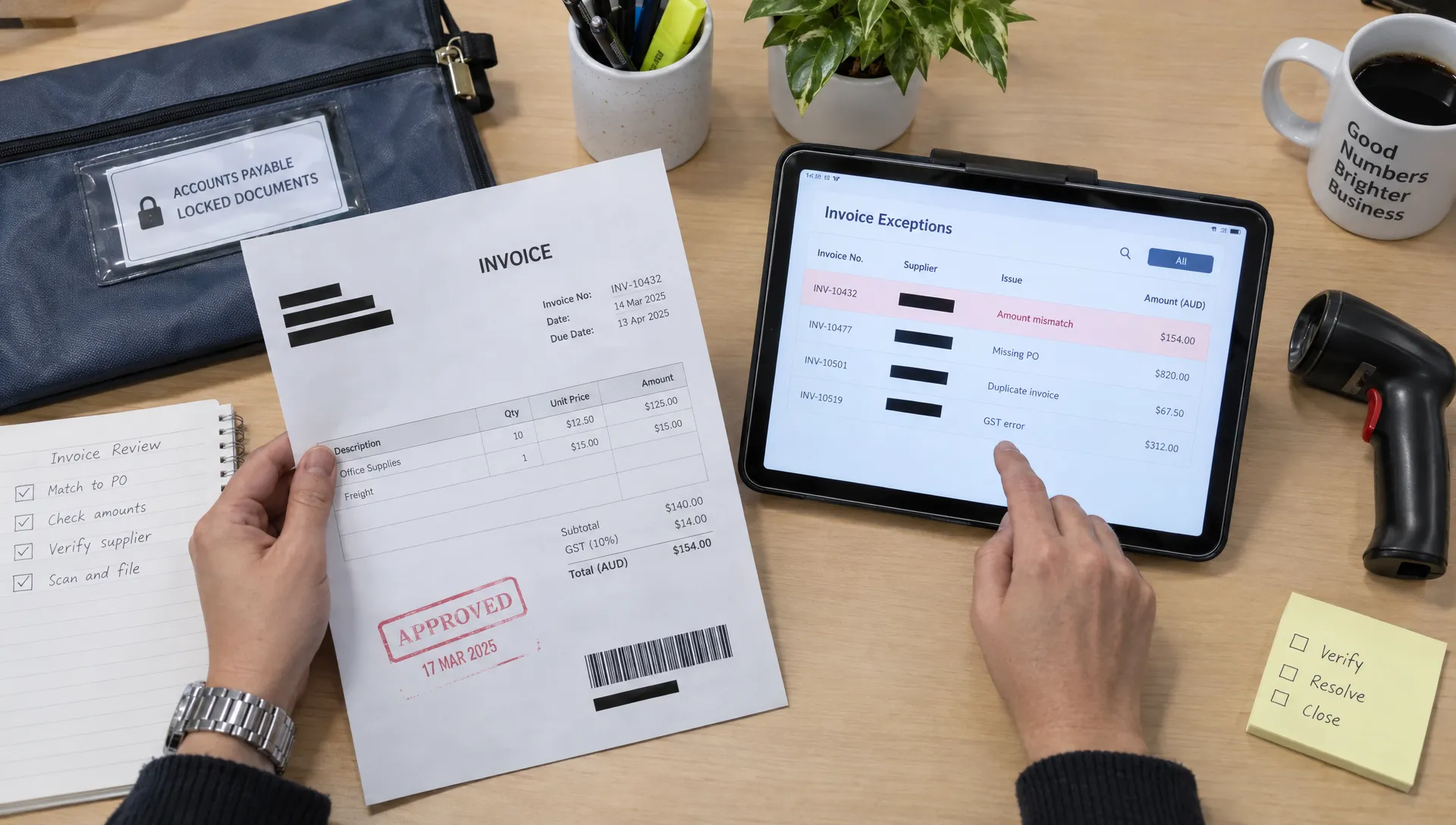
For example, we might assess an invoice-processing workflow that extracts supplier details, suggests a GST treatment and prepares a transaction for approval. The security assessment must cover the original invoice, the extracted data, the accounting integration and any retained AI inputs or outputs.
We also separate privacy risk from accuracy risk. A model may keep information confidential yet produce an incorrect tax explanation. Equally, an accurate summary may still be unacceptable if it discloses client information to an unauthorised recipient. We need safeguards for both outcomes, not simply a promise that the technology is secure.
Australian obligations accounting tax firms need to address
We begin with professional confidentiality. Under the Tax Practitioners Board’s Code of Professional Conduct, registered tax practitioners must not disclose client information to a third party without the client’s permission unless a legal duty requires disclosure. Introducing an AI supplier does not remove that obligation.
We then assess applicable privacy duties. For practices covered by the Privacy Act 1988, the Australian Privacy Principles address matters including collection, use, disclosure, security and overseas disclosure. We do not assume that every accounting practice has identical Privacy Act coverage or that a small-business exemption removes all information-handling obligations.
We also account for the specific requirements applying to TFN information under the Privacy (Tax File Number) Rule 2015. TFNs should not become routine inputs for tools that do not need them.
We use data classification to turn these obligations into workflow decisions:
| Information category | Examples | Recommended AI handling approach |
|---|---|---|
| Identity and tax identifiers | TFNs, identity documents | Exclude unless necessary, authorised and appropriately protected |
| Employment information | Payroll records, bank details, Superannuation information | Restrict access and minimise identifiable inputs |
| Commercial information | Forecasts, contracts, ownership structures | Check confidentiality, supplier access and permitted uses |
| Public or de-identified material | Published guidance, suitably anonymised examples | Check relevance and re-identification risk before use |
We treat these categories as a starting point, not a substitute for assessing the actual document and purpose.
Map the full journey of financial data
We recommend that accounting tax firms map information from collection through processing, storage, review and eventual deletion. A subscription agreement rarely reveals the entire journey on its own.
We would trace a payroll file, for example, from its upload location through any document-reading service, AI model, accounting platform and backup system. We would also identify whether prompts, attachments or outputs enter support logs that a separate service provider can access.
For each stage, we ask four practical questions: what information moves, why it is needed, who can access it and how long it remains available. We distinguish the production service from analytics, troubleshooting and product-improvement uses because their retention settings may differ.
We do not treat an Australian hosting location as proof that every operation stays in Australia. Overseas support access, subprocessors and disaster-recovery arrangements can create additional considerations. Where cross-border processing is involved, we assess whether it constitutes an overseas disclosure and what obligations follow, rather than assuming every offshore operation has the same legal treatment.
We also align retention with applicable tax, company, employment and professional obligations. Keeping every AI prompt indefinitely is not a records-management strategy, while deleting source records too early can undermine an audit trail. The objective is controlled retention, not maximum retention.
Control access, suppliers and system connections
We expect accounting tax firms to assess access to AI systems as carefully as access to the underlying ledger. Restricting the accounting platform achieves little if an integration can export the same information without equivalent oversight.
We recommend individual accounts, multifactor authentication and role-based access. Phishing-resistant authentication deserves particular consideration for administrators and other high-impact users. We also separate permissions to read records from permissions to change supplier details, approve payments or lodge information.
For integrations, we review service accounts and access tokens. We look for narrowly scoped permissions, secure credential storage and a process for withdrawing access when a tool or team member no longer needs it. Shared administrator credentials make accountability difficult.
Before approving an AI supplier, we examine these points:
- Permitted use: Whether client inputs or outputs may be used for model training, evaluation or other secondary purposes.
- Retention and deletion: What is stored, for how long and what deletion actually covers.
- Access and location: Which personnel and subprocessors can access information, including from overseas.
- Incident and exit arrangements: How breaches are reported, evidence is preserved and information is returned or deleted when the service ends.
We seek evidence rather than relying on labels such as “enterprise-grade”. Encryption matters, but we also need to understand key management, administrative access and the scope of any independent assurance. We would not place unredacted returns, payroll files or identity documents into an unapproved AI tool.
Keep AI outputs inside professional review
We consider human accountability essential when accounting tax firms automate compliance work. AI-generated classifications and explanations are working outputs, not independent authority for a tax position.
For GST, we recommend checking material exceptions against source documents, transaction context and applicable ATO guidance. For payroll, FBT or Superannuation calculations, the review must address the relevant rules and reporting period. A fluent explanation does not establish that the correct treatment has been applied.
We also distinguish document content from system instructions. An invoice or email can contain malicious text designed to influence an AI assistant, a risk commonly described as prompt injection. We would design the workflow so that a document cannot authorise a payment, change bank details or override approval requirements merely because the model reads an instruction within it.
We preserve the source evidence and the reviewer’s decision for significant exceptions. Where practical, we also retain enough information about the tool and workflow version to investigate why a result was produced. Logs themselves need protection because they can contain confidential information.
Our explanation of automated GST checks during business tax preparation explores the relationship between automation and professional review. We view reliable compliance records as the foundation for strategic advisory, rather than the endpoint of the accounting function.

Prepare for incidents before they occur
We recommend that accounting tax firms rehearse responses to realistic failures, including a compromised staff account, an incorrect document recipient or an AI integration exporting more information than intended. A generic incident policy is less useful than clear responsibilities and tested actions.
We would establish who can disable an integration, revoke credentials, preserve logs and contact the relevant supplier. We would also identify who assesses legal obligations, communicates with affected clients and coordinates recovery. Containment should not depend on a single staff member being available.
Where the Notifiable Data Breaches scheme applies, entities must take reasonable steps to complete an assessment of a suspected eligible breach within 30 days. An eligible breach generally requires notification to the OAIC and individuals at risk of serious harm as soon as practicable. We would not treat the assessment period as permission to delay containment or an otherwise required notification.
We also test recovery independently of AI performance. Backups need protection from compromised accounts, and restoration needs testing against business requirements. Recovering files without restoring access controls or resolving the original weakness can recreate the incident.
We include client communication in the exercise. Clear advice about affected information, immediate precautions and available support is more useful than a broad assurance that an investigation is underway.
Measure control quality alongside efficiency
We assess accounting tax firms on more than the volume of transactions processed automatically. Faster processing has limited strategic value if it increases unreconciled balances, weakens evidence or creates uncertainty about access to financial information.
We recommend a compact set of measures that combines operational performance with control quality:
| Measure | What we use it to assess |
|---|---|
| Exceptions resolved with supporting evidence | Whether automation is producing reviewable decisions |
| Access reviews completed and obsolete access removed | Whether permissions remain appropriate |
| Time taken to identify and contain an incident | Whether response arrangements work in practice |
| Successful restoration tests | Whether financial operations can recover |
| Reconciliation timeliness and unresolved balances | Whether reporting remains dependable |
We interpret these measures in context. A lower exception count is not automatically an improvement if detection thresholds have become less effective. Likewise, an automation rate should not encourage reviewers to approve uncertain results merely to keep work moving.
We connect stronger controls with better financial visibility. Timely, reconciled information supports cash-flow forecasting, funding decisions and corporate growth planning. Our discussion of how financial control supports business growth explains why sound records and proactive advice belong in the same service model.
Frequently asked questions
Can AI suppliers use financial information to train their models? We check the specific product, contract and configuration. Suppliers may apply different terms across consumer tools, business subscriptions and API services. We would not assume that a paid account automatically prevents training or other secondary use of client information.
Does Australian data hosting guarantee compliance? We treat hosting location as one factor. Support access, subprocessors, security controls and contractual permissions also matter. We assess the complete arrangement rather than using an Australian server location as a substitute for privacy and confidentiality checks.
Can an accountant’s AI tool approve payments or lodge a BAS? We distinguish technical capability from appropriate authority. For accounting tax firms, our recommended approach is to separate preparation, review and authorisation, with permissions matched to the task and the engagement. AI output should not bypass established approval requirements.
What should a business request before sharing records? We recommend a clear explanation of approved transfer methods, relevant third-party processing, access restrictions and incident contacts. For higher-risk engagements, we would also seek evidence of the applicable controls and clarify which responsibilities remain with the client.
Next steps: connect secure automation with strategic advice
We recommend starting with one high-value workflow, such as invoice processing or payroll reconciliation. We would map its data journey, identify unnecessary exposure, confirm approval responsibilities and establish measures for accuracy and control before expanding automation.
At Perfect Accounting & Tax Services, we bring 25 years of professional experience to accounting, tax and strategic advisory, supported by AI-driven workflow automation. We support clients across Australia through integrated service capabilities in Adelaide, Sydney and Melbourne.
We believe the value of accounting tax firms lies in turning dependable financial information into better decisions. Secure automation should strengthen that foundation, not obscure accountability.
We invite business owners, directors and high-net-worth individuals to contact our team for a consultation about automated accounting workflows, financial control and the next stage of their business growth.