
Financial reporting is not created at month-end. It is built transaction by transaction, through disciplined bookkeeping, accurate coding, timely reconciliations and a clear understanding of what directors need to see.
For many Australian businesses, the problem is not the accounting software. The problem is that the data inside the software is incomplete, inconsistent or not structured for decision-making. A professional bookkeeping service business improves reporting by turning everyday financial activity into reliable management information.
We see this across SMEs, property groups, professional practices, e-commerce businesses, construction firms and national operators. When bookkeeping is treated as a strategic system, not an administrative task, reporting becomes faster, clearer and far more useful.
Why reporting quality starts with bookkeeping
A profit and loss statement, balance sheet or cash-flow report can only be as accurate as the transactions feeding it. If sales are miscoded, supplier bills are missing, GST is treated inconsistently, payroll liabilities are not reconciled or loan accounts are ignored, reports become misleading.
The ATO expects businesses to keep records that explain their transactions and support their tax positions. Its business record-keeping guidance reinforces the importance of accurate, accessible and complete financial records. From our perspective, that compliance requirement is only the baseline.
Strong bookkeeping also supports:
- More accurate BAS and GST reporting
- Cleaner payroll, Superannuation and PAYG withholding records
- Better cash-flow visibility
- More reliable debtor and creditor management
- Stronger tax planning throughout the year
- Faster board, lender and investor reporting
- Better strategic advisory and growth decisions
This is why we approach bookkeeping as the operating layer beneath management reporting. The goal is not only to lodge on time. The goal is to give business owners and directors information they can act on.
What a bookkeeping service business changes in your reporting
A capable bookkeeping service business improves reporting by standardising the financial data before it reaches the accountant, director or adviser. That means fewer manual adjustments, fewer surprises and more confidence in the numbers.
| Reporting issue | Common bookkeeping cause | Reporting improvement |
|---|---|---|
| Profit appears volatile without explanation | Inconsistent income and expense coding | Comparable month-to-month reporting |
| BAS outcomes are difficult to predict | GST codes not reviewed regularly | More accurate GST and BAS forecasts |
| Cash flow feels disconnected from profit | Debtors, creditors and loan accounts not reconciled | Clearer working capital visibility |
| Payroll reports do not match liabilities | Superannuation, PAYG withholding or leave balances not checked | Better payroll governance and director oversight |
| Balance sheet contains old or unclear balances | Suspense accounts and unreconciled transactions accumulate | Cleaner reporting for lenders, tax planning and sale readiness |
| Directors receive reports too late | Month-end processes are manual and reactive | Faster close process and earlier decision-making |
These improvements are not cosmetic. They affect pricing, hiring, finance applications, tax strategy, dividend planning, business valuations and expansion decisions.
Building a reporting-ready chart of accounts
One of the first areas we review is the chart of accounts. Many businesses allow their accounting file to grow organically over time. New accounts are added quickly, similar expenses are spread across multiple categories and old accounts are never retired.
That creates reporting noise.
A reporting-ready chart of accounts should reflect how the business is actually managed. A construction firm may need job, project or division-level reporting. A hospitality group may need venue-level performance. A professional services firm may need reporting by partner, client segment or service line. An e-commerce business may need separate tracking for marketplace fees, freight, merchant charges, returns and inventory adjustments.
The right structure lets reports answer commercial questions such as:
- Which division produces the strongest margin?
- Which revenue stream is growing but consuming too much cash?
- Which overheads are rising faster than sales?
- Which products, jobs or locations are underperforming?
- Which costs should be reviewed before the next pricing cycle?
This is where bookkeeping becomes the foundation for strategic advisory. Clean categories allow directors to see the business clearly rather than relying on instinct.
Strengthening BAS, GST and payroll reporting
For Australian businesses, bookkeeping must align with ATO compliance obligations. BAS, GST, PAYG withholding, payroll and Superannuation reporting all depend on accurate transaction capture.
GST errors often arise from recurring issues. These include incorrect tax coding on supplier invoices, inconsistent treatment of overseas purchases, private-use adjustments, motor vehicle expenses, imported goods, financial supplies, property transactions and mixed-use expenses.
Payroll introduces its own reporting risks. Employee TFN declarations, PAYG withholding, Superannuation obligations, leave accruals, allowances and reimbursements need to be recorded properly. Where Single Touch Payroll reporting, super clearing houses or award interpretation are involved, poor bookkeeping can create compliance exposure very quickly.
A professional bookkeeping workflow reduces these risks by checking the underlying data before lodgement deadlines. It also gives the accountant better information for tax planning and year-end adjustments. We have explored the broader annual review process in our article on what a business tax accountant should be reviewing year-round.
Turning historical data into management reporting
Traditional bookkeeping often looks backward. It records what happened, reconciles accounts and supports tax lodgements. That work remains essential, but business owners need more than historical compliance.
Modern reporting should convert bookkeeping data into forward-looking insight. Depending on the business, that may include:
- Profit and loss reporting by location, project, product or department
- Balance sheet reporting with reconciled loans, GST, payroll and asset balances
- Cash-flow forecasts based on debtor collections, supplier terms and tax obligations
- Aged debtor and creditor analysis
- Gross margin, labour cost and overhead ratio tracking
- BAS, PAYG withholding and Superannuation provision reporting
- FBT, asset and tax planning schedules where relevant
The value comes from consistency. When reports are prepared the same way each month, directors can identify trends earlier. If gross margin falls, debtors stretch, payroll costs rise or stock levels increase, the issue can be investigated before it becomes a cash-flow problem.
This is the same strategic shift we expect from broader advisory relationships. We have discussed that standard in our guide to what small businesses should expect from modern accounting services.
How automation improves speed without removing professional judgement
AI-driven automation has changed what high-quality bookkeeping can deliver. Bank feeds, invoice capture, rule-based coding, document matching and exception reporting can reduce manual handling and improve processing speed.
However, automation is not a substitute for professional judgement. It is a tool that works best when supported by a well-designed accounting framework, strong controls and experienced review.
Our team uses digital workflows to help identify anomalies faster, reduce repetitive processing and improve real-time financial visibility. For example, automation can help flag unusual supplier payments, missing source documents, duplicate bills, unexpected GST coding or transactions posted to suspense accounts.
The strategic advantage is time. When routine processing becomes faster, advisers can spend more time interpreting the numbers. That means better conversations about cash flow, margins, tax planning, staffing, financing and growth.
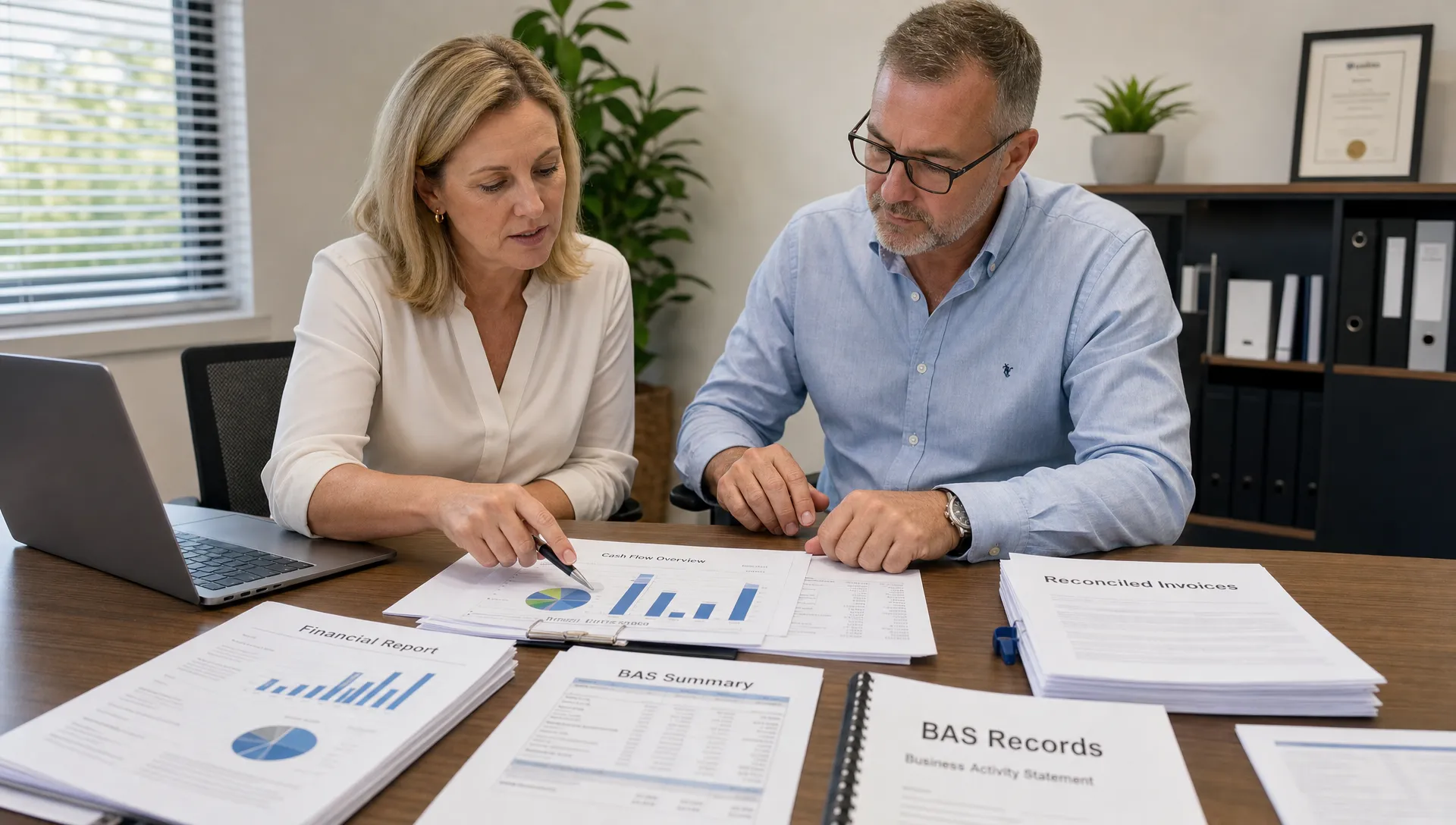
Improving reporting for directors, lenders and investors
As businesses grow, reporting expectations increase. Company directors need reliable information to discharge their governance responsibilities. Banks and lenders want current financials, clean balance sheets and evidence of cash-flow capacity. Investors want accurate revenue, margin and working capital information.
Poor bookkeeping slows these conversations. It can delay finance approvals, weaken valuation discussions and create unnecessary due diligence risk.
A structured bookkeeping service improves reporting by maintaining records that are ready for external review. That includes reconciled bank accounts, accurate debtor and creditor ledgers, clear GST liabilities, properly recorded loans, asset registers and payroll obligations that align with accounting reports.
For high-net-worth individuals, property investors and business owners with multiple entities, this becomes even more important. Inter-entity loans, trust distributions, SMSF-related records, investment income and property expenses must be tracked carefully. A small error in one entity can distort reporting across the wider group.
Creating a monthly close process
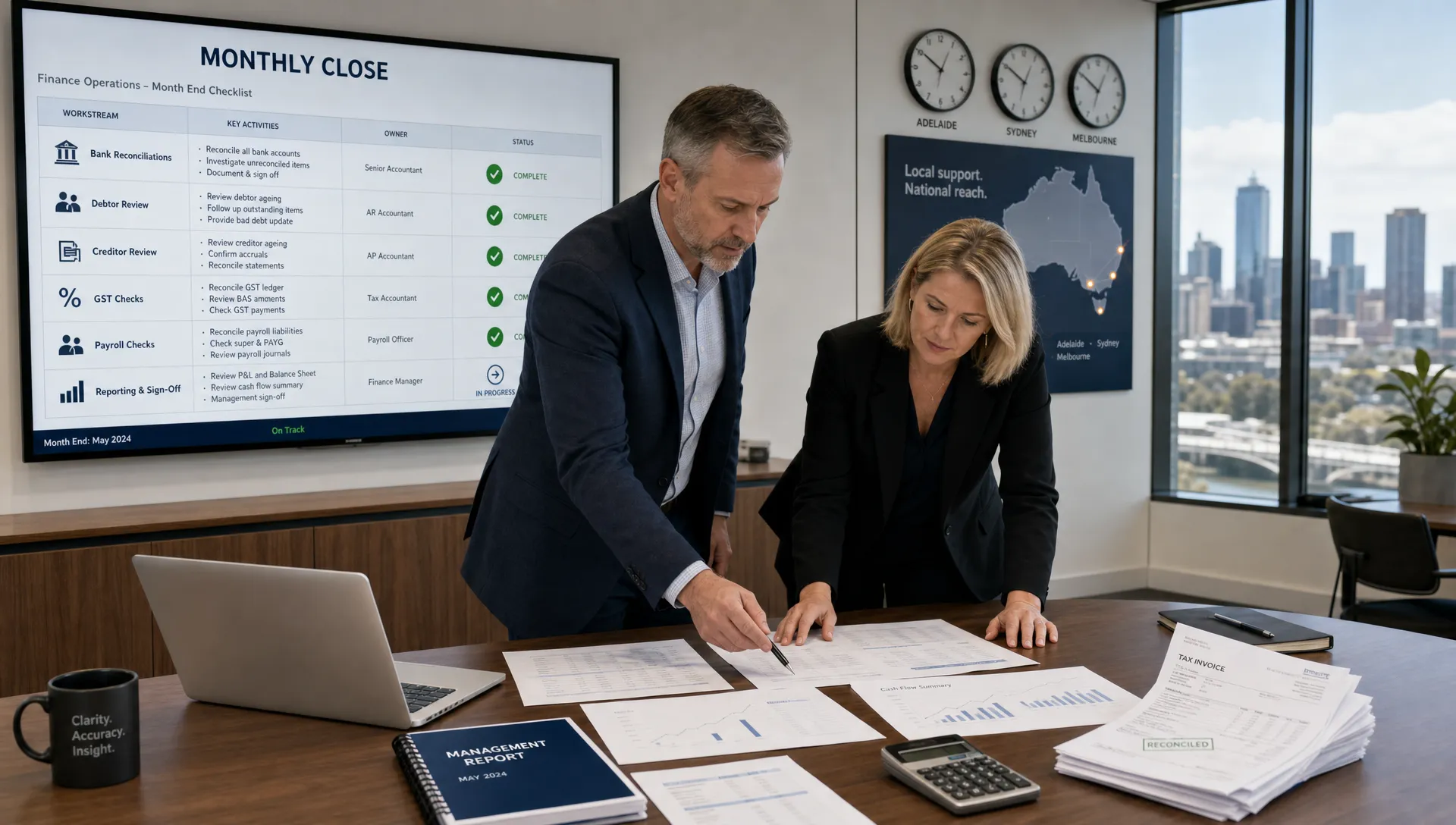
Better reporting requires a disciplined monthly close. Without a close process, reports are often produced late and corrected repeatedly. Directors lose confidence, and decision-making becomes reactive.
A practical monthly close process should include bank reconciliations, credit card reconciliations, debtor and creditor review, payroll liability checks, GST reasonableness checks, loan reconciliations, inventory or work-in-progress adjustments where relevant and a review of unusual transactions.
The key is accountability. Everyone involved should know what needs to be completed, who is responsible and when reports will be available.
| Monthly close area | Why it matters for reporting |
|---|---|
| Bank and credit card reconciliations | Confirms cash balances and reduces missing transaction risk |
| Debtor review | Improves cash-flow forecasting and collection planning |
| Creditor review | Clarifies upcoming payment obligations |
| GST and BAS checks | Reduces lodgement errors and improves tax provisioning |
| Payroll and Superannuation checks | Supports compliance and director oversight |
| Loan and asset reconciliations | Strengthens the balance sheet and finance reporting |
| Management review | Turns numbers into decisions and action points |
A monthly close does not need to be complex. It needs to be consistent, documented and aligned with the reporting needs of the business.
Supporting multi-city and cross-state businesses
Businesses operating across Adelaide, Sydney, Melbourne and regional Australia often face additional reporting complexity. Different locations may have separate cost structures, payroll profiles, leases, projects, revenue channels and management teams.
A centralised bookkeeping and reporting process helps create one source of truth. It allows directors to compare performance across locations without relying on inconsistent spreadsheets or delayed local updates.
For national businesses, we focus on standardised workflows, clean data capture and consistent reporting logic. This supports better oversight while still allowing location-level detail where it is commercially useful.
The result is reporting that works for both local managers and central leadership. Local teams can understand their performance, while directors can assess group-wide cash flow, profitability, compliance and capital allocation.
Using bookkeeping data for strategic advisory
The strongest reporting systems do more than explain the past. They support better decisions about the future.
Clean bookkeeping data helps advisers identify margin compression, rising debtor days, inefficient overheads, tax planning opportunities and funding pressure. It also helps determine whether the business is ready to hire, acquire equipment, open a new location, restructure debt or prepare for sale.
This is why we believe bookkeeping, tax and advisory should not operate in isolation. When those functions are connected, reporting becomes a strategic asset. Clean books feed better tax planning. Better tax planning supports cash-flow management. Stronger cash-flow visibility supports growth decisions.
That connection is central to how a business services accountant supports better decisions, particularly for owners managing complexity across entities, industries or states.
Signs your reporting is being limited by bookkeeping
Many businesses do not realise their reporting problem is actually a bookkeeping problem. The symptoms usually appear gradually.
You may need stronger bookkeeping support if reports are consistently late, BAS outcomes are unpredictable, directors question the accuracy of the numbers, debtor reports do not match expected cash collections, payroll liabilities are unclear or the balance sheet contains old unreconciled balances.
Other warning signs include frequent use of suspense accounts, repeated year-end clean-up work, unclear GST treatment, inconsistent expense categories, poor source document retention and management reports that do not match how the business is actually run.
When these issues appear, the solution is rarely just another report. The underlying bookkeeping workflow needs to be redesigned.
Next steps for improving your reporting
We recommend a structured review before changing systems or adding more dashboards. Better reporting starts with better data governance.
Practical next steps include:
- Review your chart of accounts against how the business is managed
- Confirm GST, BAS, payroll and Superannuation processes are being checked regularly
- Reconcile all bank, loan, debtor, creditor and payroll balances before relying on reports
- Identify which reports directors need monthly, quarterly and annually
- Automate document capture and transaction workflows where it improves accuracy and speed
- Establish a consistent monthly close timetable
- Use management reporting meetings to convert financial data into action
The most effective reporting system is one that combines automation, compliance discipline and commercial interpretation.
Frequently Asked Questions
How does a bookkeeping service business improve reporting? It improves reporting by ensuring transactions are captured, coded, reconciled and reviewed consistently. This gives directors more reliable profit, cash-flow, BAS, payroll and balance sheet information.
Can automation replace professional bookkeeping? No. Automation can improve speed and reduce manual processing, but professional judgement is still required for GST treatment, payroll checks, reconciliations, reporting structure and strategic interpretation.
How often should Australian businesses review financial reports? Most businesses should review management reports monthly. BAS, GST, payroll, Superannuation, cash flow and debtor positions should also be monitored regularly, not only at year-end.
What reports should directors receive each month? Directors usually need a profit and loss statement, balance sheet, cash-flow report, aged debtors, aged creditors, payroll and Superannuation summary, BAS position and key business KPIs relevant to their industry.
Does better bookkeeping help with tax planning? Yes. Accurate bookkeeping gives advisers current information for deductions, GST, PAYG withholding, FBT, asset planning, profit forecasting and cash-flow management before tax deadlines arrive.
How we can help
Our team supports Australian businesses with bookkeeping, BAS, payroll, tax planning and strategic advisory workflows designed for better reporting. We combine 25 years of professional experience with AI-driven automation to improve accuracy, processing speed and real-time financial visibility.
Whether you operate in Adelaide, Sydney, Melbourne or across multiple locations, we can help build a reporting framework that supports compliance, director oversight and corporate growth.
If your reports are late, unclear or not useful for decision-making, contact Perfect Accounting & Tax Services for a consultation. We can review your current bookkeeping process and show how automated accounting workflows can turn your financial data into stronger business intelligence.