
Most Australian business owners do not have a tax problem once a year. They have a timing problem. BAS payments, PAYG instalments, superannuation, FBT, payroll obligations, income tax and growth investments all compete for cash at different points in the year.
A tax accountant for business helps you plan ahead by turning those obligations into a forward-looking financial strategy. The work is not limited to preparing a return after the year has closed. It should help directors and owners understand what is coming, what can be controlled, and which decisions need advice before money changes hands.
At Perfect Accounting & Tax Services, we view tax compliance as the foundation for strategic advisory. Clean records, accurate lodgements and ATO-ready documentation are essential, but they are only the starting point. The larger opportunity is using that information to support stronger cash flow, smarter investment decisions and corporate growth.
Why planning ahead matters in Australian business tax
Reactive tax work usually starts when the numbers are already locked in. By then, the business may have missed opportunities to manage GST timing, document trust distributions, review Division 7A loans, assess FBT exposure, claim eligible deductions correctly or adjust PAYG instalments before cash is under pressure.
Australian tax law also rewards accurate timing and good evidence. The ATO expects businesses to keep records that explain transactions, substantiate deductions and support lodgements. The ATO’s record-keeping guidance for business reinforces a point we see daily: documentation should be created as part of the operating rhythm, not reconstructed in a rush at year end.
Planning ahead is especially important for businesses that are scaling. A company hiring staff, purchasing equipment, expanding interstate, taking on investors, restructuring debt or acquiring property will create tax consequences well before the annual return is lodged. If advice arrives after the transaction, the accountant is often explaining the result rather than shaping it.
This is where a tax professional becomes a strategic advantage. The right adviser helps management see the tax, cash flow and governance implications while decisions are still flexible.
What a proactive tax accountant should help you forecast
A strong business tax accountant should help you answer three questions throughout the year:
- What are we likely to owe, and when?
- Which tax risks are developing in our accounts, payroll or entity structure?
- Which commercial decisions should be made before 30 June, before a BAS period closes, or before a contract is signed?
The answer is rarely a single calculation. It is a rolling view of income tax, GST, PAYG withholding, PAYG instalments, superannuation, FBT, payroll tax where applicable, and any entity-specific issues such as trust distributions or director loans.
For directors and high-net-worth business owners, the planning horizon should also include retained profits, franked dividends, asset protection, succession, property holdings, SMSFs, related-party transactions and family group governance. These areas need coordination. Treating each one separately can create avoidable complexity.
Turning compliance into a tax cash flow calendar
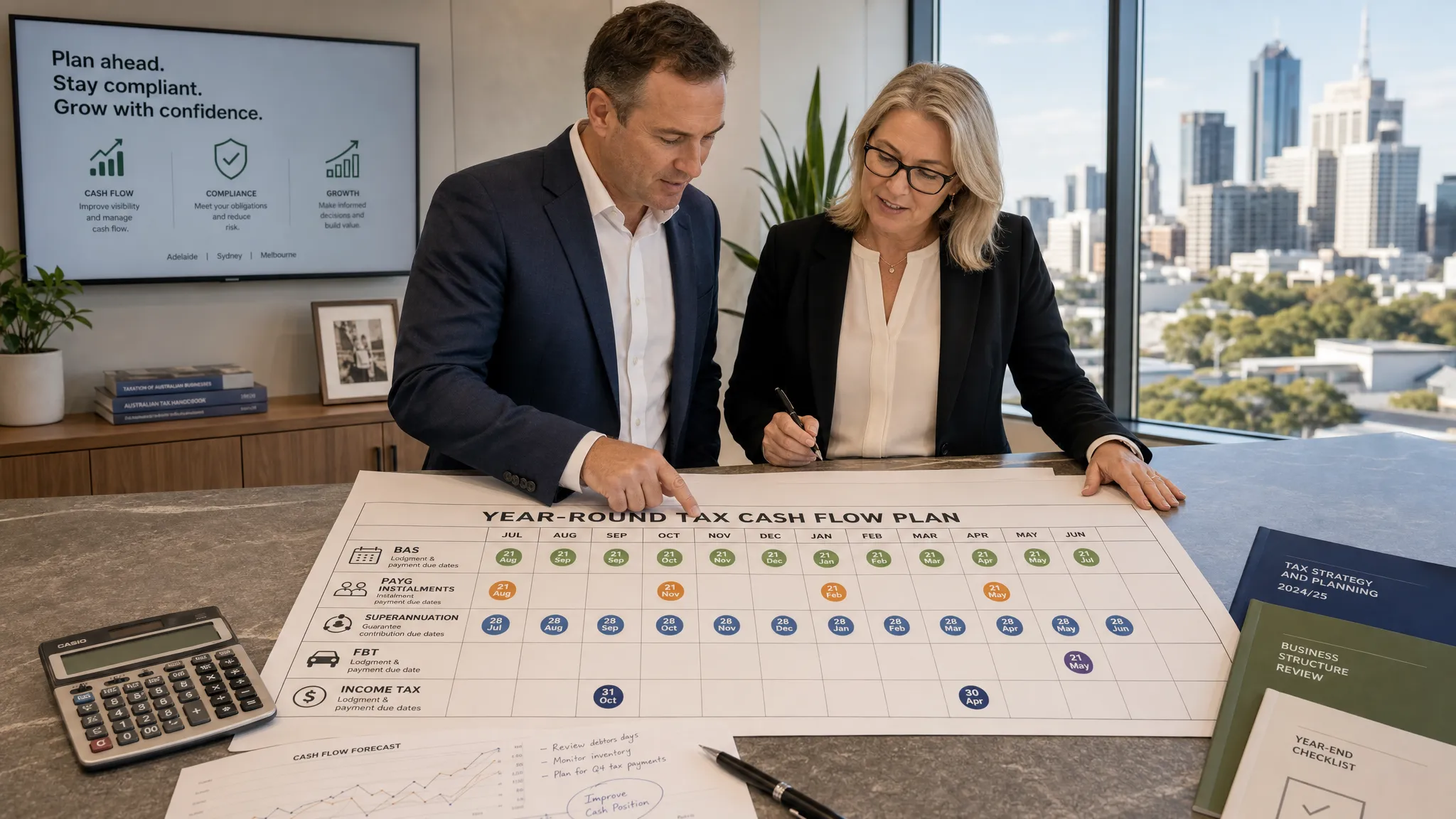
One of the simplest ways a tax accountant helps you plan ahead is by building a tax cash flow calendar. This brings your obligations into one view and aligns them with trading cycles.
For example, a construction business may have strong invoicing but slow debtor collection. A professional services firm may have high margins but large quarterly PAYG instalments. An e-commerce retailer may face GST, inventory financing and foreign supplier costs at the same time. Each business has a different pressure point.
A planning-led accountant maps these obligations before they create stress. The calendar should identify:
- BAS lodgement and payment dates, including GST and PAYG withholding
- PAYG instalments and expected income tax positions
- Superannuation guarantee due dates, with the current SG rate of 12% applying from 1 July 2025
- FBT review points, particularly before the 31 March FBT year end
- Payroll tax registration and grouping risks where state thresholds may apply
- Trust distribution resolutions and company dividend planning before 30 June
- Loan repayments, Division 7A minimum yearly repayments and related-party balances
This work is not just administrative. It changes how management allocates cash. It can prevent a profitable business from being caught short when tax, payroll and supplier commitments converge.
Using better data to make better decisions
Modern tax planning depends on the quality of the underlying accounts. If bookkeeping is months behind, the business is making decisions from stale information. If transactions are miscoded, GST is inconsistent, or payroll reports do not reconcile to Single Touch Payroll data, tax planning becomes guesswork.
Our team uses AI-driven automation to improve the speed and accuracy of data capture, reconciliation and exception review. Automation helps identify unusual transactions, missing supplier documentation, duplicate entries and category inconsistencies earlier. Human judgement remains essential, but it is applied to cleaner, more current information.
That shift matters. When accounts are updated regularly, directors can see gross margin trends, wage ratios, debtor days, GST liabilities and profit forecasts before the quarter ends. This supports more accurate BAS, better tax provisions and faster strategic decisions.
We have explored this broader decision-making role in our article on how a business services accountant supports better decisions. The core principle is the same: compliance data becomes valuable when it is structured for management action.
Planning before major business decisions
Tax planning is most valuable before key transactions occur. Once a contract is signed, funds are transferred or an asset is purchased, the options may narrow.
A tax accountant for business should be involved before decisions such as:
- Buying major equipment, vehicles, property or technology assets
- Hiring employees, contractors or offshore team members
- Paying bonuses, allowances, benefits or director remuneration
- Introducing new shareholders, investors or business partners
- Expanding into another state or setting up multiple trading locations
- Moving from sole trader to company, trust or group structure
- Selling a business, transferring assets or planning succession
- Taking profits out of a company or trust for personal investment
This is not about delaying commercial momentum. It is about ensuring the transaction is structured correctly from the start. For instance, the treatment of a vehicle may involve GST, depreciation, logbooks, FBT and private use calculations. A shareholder loan may involve Division 7A. A property acquisition may involve GST, stamp duty, land tax, financing, depreciation and ownership structure.
We do not reduce these issues to a generic deduction checklist. We assess how the decision affects cash flow, risk, tax, reporting and long-term strategy.
Key planning areas and what they influence
The following table shows how proactive advice turns technical tax areas into commercial planning tools.
| Planning area | What we assess | Strategic impact |
|---|---|---|
| GST and BAS | GST coding, timing, debtor collection and taxable supplies | Reduces reporting errors and improves cash flow forecasting |
| PAYG instalments | Current profit trends compared with prior-year tax settings | Helps avoid under-provisioning or overpaying tax during growth or downturns |
| Superannuation | SG obligations, payment timing and payroll data accuracy | Protects deductibility and reduces ATO compliance risk |
| FBT | Vehicles, entertainment, employee benefits and salary packaging | Clarifies the true cost of remuneration decisions |
| Entity structure | Company, trust, partnership, sole trader and group arrangements | Aligns tax planning with asset protection, investment and growth goals |
| Director loans and dividends | Division 7A, franking credits, drawings and retained earnings | Prevents unexpected tax outcomes and supports profit extraction planning |
| Expansion planning | Interstate payroll, GST, systems, staffing and reporting | Supports controlled growth across Adelaide, Sydney, Melbourne and beyond |
How forward tax planning supports corporate growth
Growth increases complexity. More revenue often means more staff, more systems, more tax obligations and more risk. Without forward planning, growth can create the illusion of financial strength while cash flow weakens behind the scenes.
We regularly see businesses grow into one or more of the following pressure points:
- GST liabilities rise faster than cash reserves because debtors are slow to pay
- Payroll expands without a clear superannuation and payroll tax review process
- Directors draw funds without understanding tax consequences
- Profit increases, but PAYG instalments are not adjusted strategically
- Stock, work in progress or project costs distort taxable profit expectations
- Multiple entities are created without consolidated reporting or governance
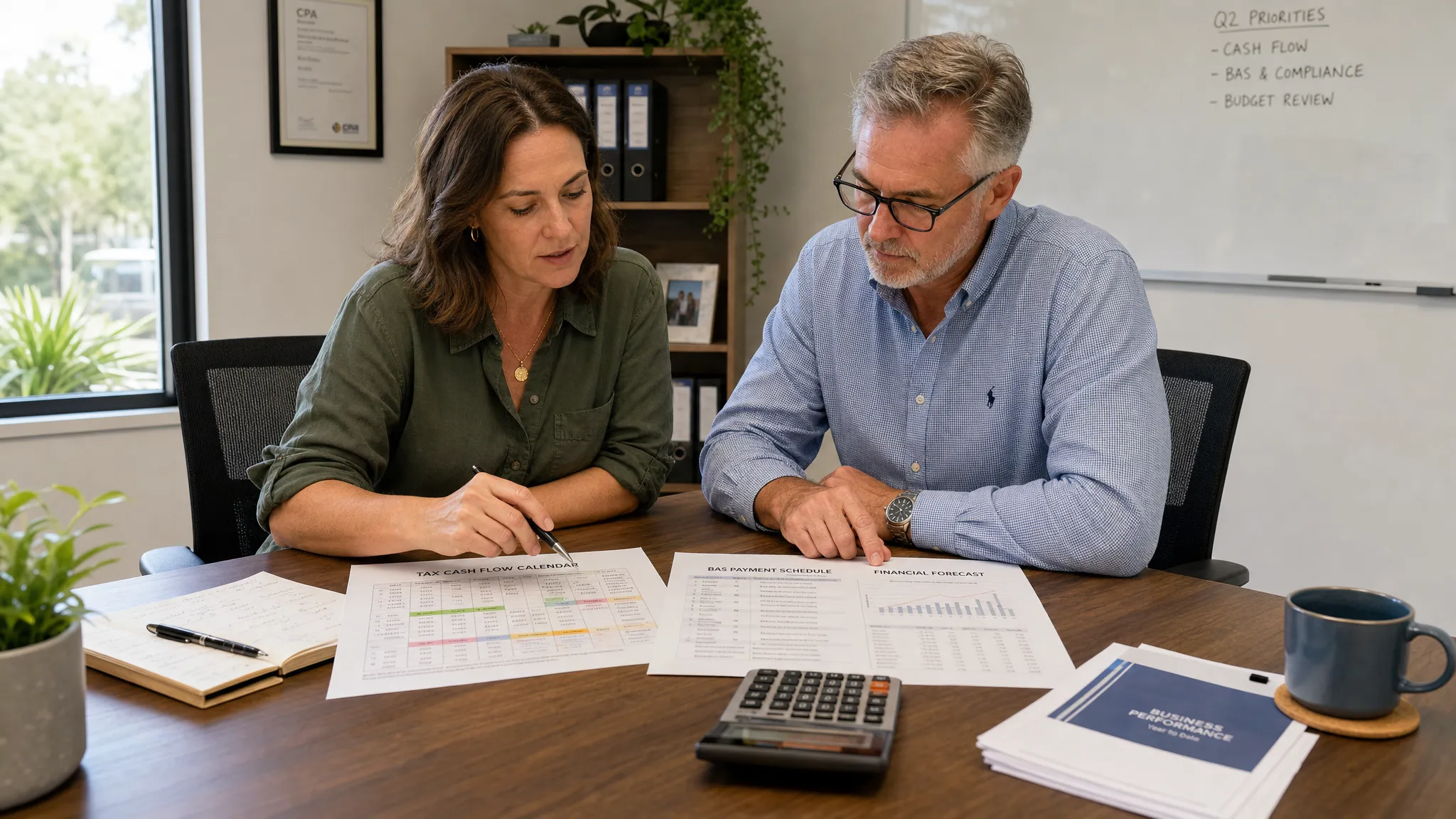
A planning-led tax accountant helps owners convert growth into controlled financial performance. This may involve monthly management reporting, tax provisions, working capital review, scenario modelling, funding preparation and board-level advisory support.
For larger SMEs and national operators, the role can extend into virtual CFO support. That means tax is considered alongside cash flow, debt, pricing, margins, hiring, technology investment and expansion planning. This is particularly important for cross-state businesses operating in South Australia, New South Wales and Victoria, where reporting, payroll and commercial conditions can vary.
Our integrated team supports clients across Australia, with service capabilities in Adelaide, Sydney and Melbourne. The objective is consistency: one coordinated advisory approach, regardless of where the business operates.
AI and automation make planning more timely
The most effective tax advice is current. ATO obligations, supplier payments, payroll costs and trading performance move quickly. Waiting until the end of the quarter, or worse, the end of the financial year, reduces the quality of decisions.
AI-driven accounting workflows help close that timing gap. They do not replace professional judgement, but they help us direct that judgement to the right issues sooner.
In practical terms, automation can support:
- Faster transaction coding and reconciliation
- Earlier detection of missing invoices or unusual entries
- More consistent GST treatment across recurring transactions
- Better matching between payroll, superannuation and STP records
- More current dashboards for cash flow and profit trends
- Scenario modelling for tax provisions, hiring, expansion and investment
The value is not simply speed. It is visibility. When a director can see a likely tax position before the year ends, there is time to review remuneration, debt, capital expenditure, distributions, working capital and compliance settings in a structured way.
We view automation as an enabler of strategic advisory. It reduces manual friction so our team can focus on analysis, risk management and commercial recommendations.
Signs your business has outgrown reactive tax support
Many businesses stay with a reactive tax process for too long. The system may appear to work while the business is small, but it becomes fragile as complexity increases.
It may be time to engage a planning-led tax accountant if:
- Your tax bills regularly surprise you
- BAS or GST reporting feels disconnected from cash flow
- Payroll, superannuation or contractor arrangements are becoming harder to manage
- Your business is expanding interstate or hiring in multiple locations
- You have director loans, trust distributions or related-party transactions
- You are considering a major asset purchase, property investment or business sale
- You need management reports for lenders, investors or directors
- You have received ATO correspondence, review activity or audit attention
- You want tax planning connected to growth, not just lodgement
These are not signs of failure. They are signs that the business has reached a level where tax, accounting and strategy need to be integrated.
What to prepare before a tax planning meeting
A productive planning meeting depends on good information. We recommend business owners prepare current financial reports, recent BAS lodgements, payroll summaries, superannuation records, bank and loan statements, asset registers, lease documents, shareholder or trust documents, and details of any planned transactions.
The discussion should also cover commercial context. Are you hiring? Expanding? Buying assets? Seeking finance? Considering a restructure? Planning to sell? Expecting a drop in revenue? These questions affect tax planning as much as the numbers do.
If you are close to lodgement, our guide on what to cover in a tax consultation before you lodge can help you prepare for a more valuable discussion. However, the ideal time to plan is earlier, while the business still has options.
Frequently asked questions
How early should a business start tax planning? We recommend reviewing your tax position throughout the year, not only before 30 June. Quarterly reviews are useful for BAS, GST, PAYG instalments, payroll and superannuation. Businesses with rapid growth, multiple entities or significant assets often need monthly advisory support.
Can a tax accountant legally reduce business tax? A tax accountant can help you claim eligible deductions, use available concessions, structure transactions correctly and manage timing within Australian tax law. The goal is not artificial tax avoidance. The goal is accurate, compliant and commercially sound tax planning.
What is the difference between a tax accountant and a tax agent? A registered tax agent can provide tax agent services and lodge returns with the ATO. A business tax accountant may also provide broader accounting, management reporting, structuring and advisory support. For complex matters, you should ensure the adviser has the right registration, qualifications and commercial experience.
Does automation replace the need for an accountant? No. Automation improves data quality, speed and visibility, but professional judgement is still needed to interpret the numbers, assess risk and advise on strategy. We use AI-driven workflows to strengthen advice, not to remove human expertise.
Is tax planning only for large companies? No. Sole traders, family businesses, medical specialists, consultants, tradies, property investors, e-commerce operators and tech founders can all benefit from forward planning. The complexity may differ, but the need for cash flow visibility and ATO compliance is consistent.
Next steps: plan tax before tax plans you
The best time to speak with a tax accountant is before a decision becomes irreversible. Whether you are preparing for growth, reviewing your entity structure, managing ATO obligations, planning dividends, hiring staff or expanding interstate, proactive advice gives you more control.
Our team at Perfect Accounting & Tax Services combines 25 years of professional experience with AI-driven accounting automation and strategic advisory. We help Australian business owners move beyond annual lodgement and build financial systems that support compliance, visibility and corporate growth.
We can assist with business tax planning, BAS and GST, payroll and superannuation, bookkeeping, complex tax matters, audit support, virtual CFO advisory, SMSF considerations and multi-city compliance across Adelaide, Sydney, Melbourne and wider Australia.
If you want your tax position to be planned, not discovered at the last minute, contact Perfect Accounting & Tax Services to book a consultation. We will help you understand your current risks, identify planning opportunities and explore automated accounting workflows that give you better visibility throughout the year.