
Profitability does not improve because a tax return is lodged on time. Control does not strengthen because a bank feed is connected. For Australian business owners and company directors, the real value of accounting solutions comes from designing a financial operating system that turns daily transactions into reliable decisions.
We see this most clearly in growing SMEs, multi-entity family groups, property businesses, professional practices and national operators. Revenue may be rising, but profit is often leaking through weak job costing, slow debtor collection, inconsistent BAS processes, payroll errors, poor stock visibility or tax planning that happens too late.
Modern accounting solutions fix that problem by combining accurate records, automation, governance and strategic advisory. The objective is not simply to “do the books”. The objective is to create a controlled financial environment where management can see what is happening, act earlier and allocate capital with confidence.
What accounting solutions actually include
A strong accounting solution is not just accounting software. Software is only one layer. The broader solution includes the way transactions are captured, coded, reviewed, reported and used for decision-making.
In our work with Australian businesses, an effective accounting solution usually includes cloud accounting infrastructure, bank reconciliation workflows, GST and BAS processes, payroll and Superannuation controls, management reporting, forecasting, tax planning and strategic advisory. For larger or more complex groups, it may also include Virtual CFO support, internal control reviews, multi-entity reporting and board-level performance analysis.
The key distinction is integration. When bookkeeping, BAS, payroll, tax and advisory sit in separate silos, owners receive fragmented information. When these functions are integrated, the business gains one financial truth. That is where profitability and control begin to improve.
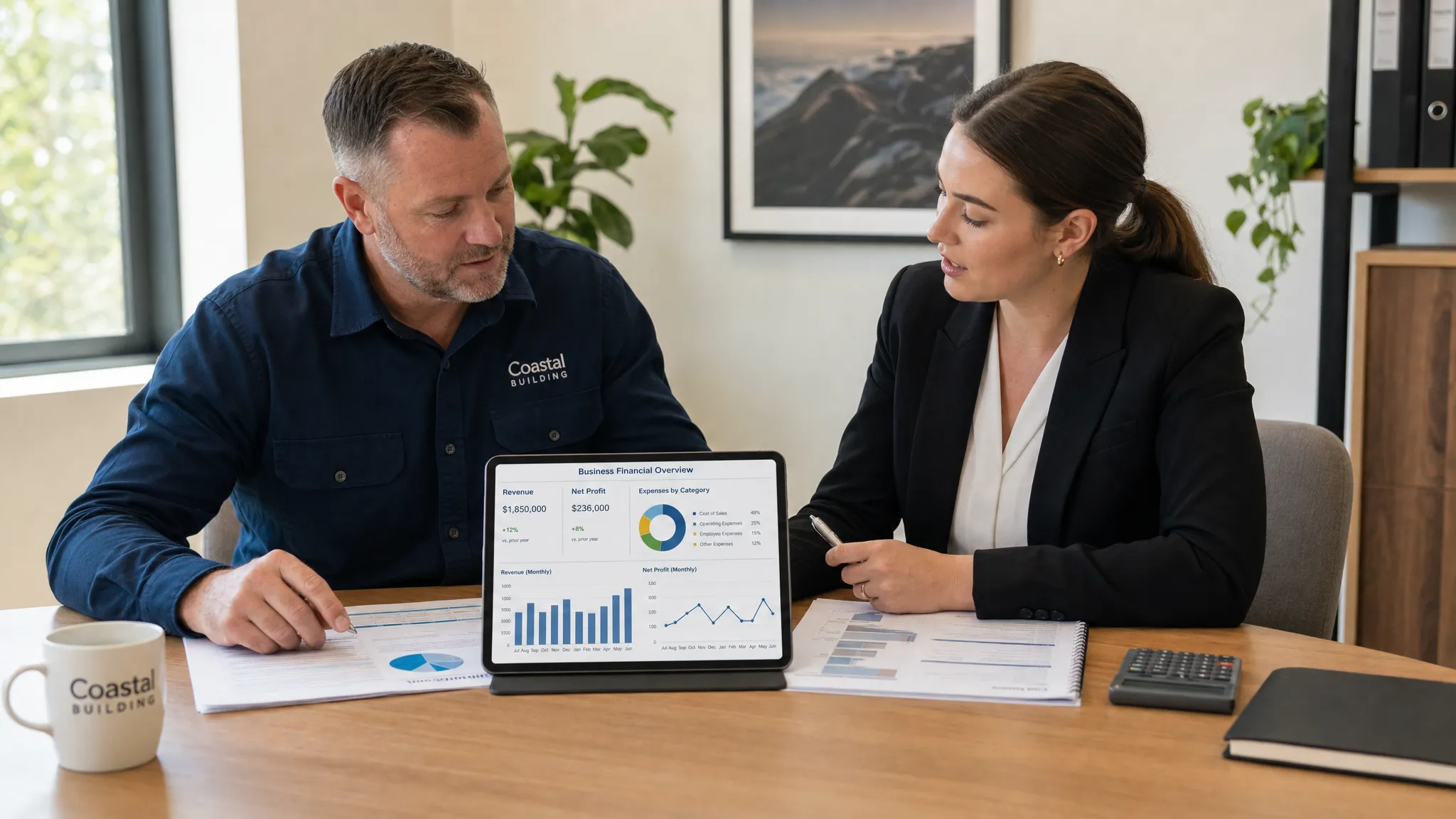
Why profitability and control must be managed together
Profitability without control is fragile. A business can show strong sales and still experience poor cash flow, unexpected ATO debt, excessive labour cost, weak margins or compliance exposure. Control without profitability is also incomplete. A business may be compliant, but still underperform because management reporting is too slow or too generic.
The most effective accounting solutions connect both sides. They help owners answer practical questions such as which services generate the best margin, which customers delay cash collection, whether pricing reflects rising costs, whether GST has been correctly allocated and whether payroll obligations are being met on time.
| Financial issue | Profitability impact | Control impact |
|---|---|---|
| Slow debtor collection | Reduces available cash and increases financing pressure | Requires credit terms, debtor follow-up and reporting discipline |
| Poor expense coding | Hides true margins and cost trends | Weakens BAS accuracy and management reporting |
| Inconsistent payroll processes | Distorts labour cost and project profitability | Increases Superannuation, PAYG withholding and award compliance risk |
| Weak stock or job costing | Leads to underpricing and margin leakage | Limits accountability across projects, sites or teams |
| Late tax planning | Reduces after-tax cash flow | Creates avoidable ATO exposure and payment shocks |
When these issues are visible early, directors can respond strategically rather than react under pressure.
Better data turns compliance into profit intelligence
Bookkeeping is often treated as a back-office task, but high-quality transaction data is the base layer of strategic advisory. If the chart of accounts is poorly structured, if private expenses are mixed with business costs, or if GST coding is inconsistent, the financial reports will not support confident decision-making.
We approach bookkeeping as data architecture. The chart of accounts should reflect how the business actually earns and spends money. A professional services firm may need reporting by partner, client segment or service line. A builder may need project-level costing. An e-commerce operator may need visibility across channels, freight, merchant fees and inventory. A property group may need clean reporting by entity, asset and financing arrangement.
AI-driven automation helps by reducing manual processing and identifying exceptions faster. Bank feeds, invoice capture, rules-based coding and automated reconciliations can accelerate routine work. However, automation must be supervised by accounting judgement. Incorrect rules can repeat errors at scale, which is why we combine automation with review, monthly close procedures and advisory interpretation.
The outcome is better than faster bookkeeping. It is earlier visibility of gross margin, overhead creep, cash pressure, GST exposure and tax planning opportunities.
Margin analysis shows where profit is actually made
Many growing businesses know their total revenue but do not know their true profit by customer, project, location, product or service. This is a control issue as much as a profitability issue.
For example, a consulting firm may discover that a large client generates high revenue but low contribution after senior staff time is allocated. A construction business may find that variation claims, subcontractor costs and rework are eroding project margin. A medical or allied health practice may find that practitioner utilisation, room costs and administrative time are materially affecting net profit.
Accounting solutions improve this by creating management reports that match operational reality. Rather than relying only on annual financial statements, owners can review monthly margin trends, labour ratios, cost of goods sold, average debtor days and overhead recovery.
This changes the quality of decision-making. Pricing can be reviewed before profit is lost. Unprofitable service lines can be redesigned. High-performing segments can receive more capital. Directors can stop making decisions based on turnover and start making decisions based on contribution, cash and risk.
Cash flow forecasting reduces stress and improves control
Profit and cash are not the same. A business can be profitable on paper while struggling to meet BAS, PAYG withholding, Superannuation, supplier payments or loan commitments. This is especially common in businesses with seasonal revenue, long project cycles, rapid growth or high debtor balances.
A proper accounting solution includes rolling cash flow forecasting. This should incorporate expected receipts, supplier payments, wages, GST, PAYG instalments, finance commitments, tax payments, capital expenditure and director drawings. For company directors, this is also a governance issue, because cash flow visibility supports better decisions around debt, dividends, remuneration and solvency.
Cash flow forecasting becomes more powerful when it is connected to live accounting data. Instead of preparing forecasts once a year, management can update assumptions monthly or weekly. If debtor days move from 35 to 52, the forecast should show the cash consequence. If a major asset purchase is planned, the forecast should show the GST, financing and tax timing impact.
This is where automation provides a practical advantage. By reducing delays in processing transactions, AI-enabled workflows help owners see cash pressure earlier. The value is not only speed. It is the ability to take action before cash becomes a crisis.
BAS, GST and payroll discipline protect profit
Compliance errors are not just administrative problems. They directly affect cash, profitability and reputation. Incorrect GST coding, unreconciled BAS figures, late Superannuation payments or payroll discrepancies can create penalties, interest, amended lodgements and management distraction.
The ATO expects businesses to keep accurate records that explain transactions and support tax positions. Its guidance on record keeping for business reinforces the importance of complete, accurate and accessible records. For directors, this should be viewed as part of the broader control environment, not a once-a-quarter scramble.
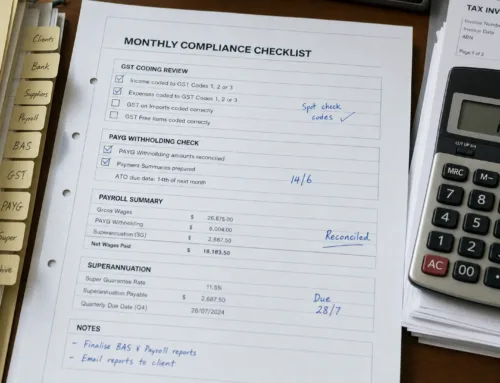
GST and BAS controls should include regular reconciliation of GST accounts, review of tax invoices, correct treatment of mixed-use expenses, accurate reporting of capital purchases and alignment between accounting records and ATO lodgements. Payroll controls should include PAYG withholding, leave entitlements, Superannuation Guarantee obligations and, where relevant, payroll tax considerations across states.
For employers, Superannuation is a particularly important control area. The ATO provides detailed guidance on Superannuation Guarantee obligations, and errors can be costly. A modern accounting solution should not simply process payroll. It should create a reviewable trail that helps management confirm obligations are being met.
Tax planning improves after-tax profitability
Tax planning should not be treated as an end-of-year exercise. By the time accounts are finalised after 30 June, many opportunities have already passed. The better approach is to integrate tax planning into quarterly management reporting and cash flow forecasting.
For Australian businesses, this may include reviewing company tax rates, trust distributions, Division 7A exposure, director remuneration, FBT, deductible prepayments, asset purchases, stock write-offs, bad debts, GST timing and PAYG instalments. For high-net-worth individuals and family groups, planning may also involve investment entities, property assets, SMSFs, capital gains and estate considerations.
The objective is not aggressive tax avoidance. The objective is lawful, well-documented, commercially sensible planning that improves after-tax cash flow. A good accounting solution gives the adviser accurate data early enough to make recommendations before decisions are locked in.
This is where strategic advisory becomes more valuable than compliance alone. When the accounting system is current, tax planning can be linked to expansion, funding, succession, asset protection and corporate growth.
Internal controls support scale and reduce key-person risk
As businesses grow, informal financial processes become dangerous. A founder-approved payment process may work at $500,000 revenue, but it may not work at $5 million. A single bookkeeper may manage the ledger, payroll, supplier payments and reconciliations, but that concentration can create risk.
Accounting solutions improve control by introducing structure. This may include digital approval workflows, role-based access, documented month-end procedures, separation of payment approval from payment processing, review of supplier master files, audit trails and exception reporting.
These controls are particularly important for businesses operating across Adelaide, Sydney, Melbourne and other Australian locations. Multi-site operations face additional complexity around payroll, state-based obligations, project reporting, internal accountability and consolidated management information.
Control should not slow the business down. Well-designed controls make the business more scalable because owners no longer need to personally inspect every transaction. They can rely on systems, reporting and review points.
The role of AI and automation in modern accounting solutions
AI and automation are changing the economics of accounting. Routine data entry, invoice capture, bank matching and report preparation can now be streamlined significantly. This reduces processing time and allows accountants to spend more time on analysis, governance and advisory.
However, automation is not a substitute for professional judgement. It is a force multiplier. We use AI-driven workflows to improve accuracy, speed and visibility, but the strategic value comes from interpreting the numbers in the context of Australian tax law, business risk and growth objectives.
A useful way to think about automation is that it should remove friction from compliance and create more time for advisory. If a business is still waiting weeks for basic reporting, it is unlikely to manage pricing, cash flow or tax effectively. If reporting is timely and reliable, directors can run the business with more confidence.
For further context on the shift from traditional compliance to modern advisory, we have also explored what small businesses should expect from modern accounting services and how accounting professionals improve financial control.
What a high-performing accounting solution should deliver
A practical accounting solution should be measured by the decisions it improves, not by the number of reports it produces. The reporting pack should be concise, accurate and commercially relevant.
| Accounting solution component | What it should deliver | Strategic value |
|---|---|---|
| Clean chart of accounts | Accurate categorisation of income, expenses, assets and liabilities | Clearer margin and cost analysis |
| Monthly close process | Timely reconciled accounts | Faster decisions and fewer year-end surprises |
| BAS and GST review | Correct GST treatment and ATO-ready records | Lower compliance risk and better cash planning |
| Payroll and Superannuation controls | Accurate wages, PAYG withholding and super processes | Reduced employee and regulatory risk |
| Management reporting | KPIs, trends and variance analysis | Better pricing, staffing and investment decisions |
| Cash flow forecasting | Forward view of receipts, payments and tax obligations | Stronger working capital control |
| Virtual CFO review | Interpretation of numbers and strategic recommendations | Better governance and corporate growth planning |
The point is not complexity. The point is relevance. A lean consulting firm does not need the same reporting framework as a manufacturing group. A property developer does not need the same controls as a veterinary clinic. The solution must fit the business model.
Signs your accounting setup is limiting profitability
We often meet business owners who are working hard but operating with limited financial visibility. The symptoms are usually clear once we review the workflow.
Common warning signs include:
- Management reports are delivered too late to influence decisions.
- BAS preparation requires significant manual rework each quarter.
- Gross margin is not reviewed by job, product, client or service line.
- Payroll, Superannuation or contractor records are not regularly reconciled.
- Directors are unsure how much cash must be reserved for GST, PAYG and income tax.
- Profit is rising, but operating cash flow remains weak.
- The business relies heavily on one person to understand the accounts.
- Tax planning only begins after the financial year has ended.
These are not just accounting inefficiencies. They are strategic constraints. If management cannot see reliable numbers, it cannot control profitability.
How we implement accounting solutions for stronger control
Our approach begins with diagnosis. We review the current accounting file, chart of accounts, reconciliations, BAS history, payroll processes, reporting cadence and tax planning framework. We also assess whether the current system reflects how the business actually operates.
From there, we usually focus on six practical steps.
- Stabilise the data: We clean up coding, reconciliations, GST treatment, payroll records and opening balances so the accounting file can be trusted.
- Redesign reporting: We align the chart of accounts and reporting structure with the business model, including divisions, projects, properties, locations or entities where relevant.
- Automate routine workflows: We introduce AI-driven and rules-based processes for data capture, bank reconciliation, document management and recurring transactions.
- Install control points: We define review procedures for BAS, payroll, Superannuation, supplier payments, debtor management and month-end reporting.
- Build advisory rhythm: We move from annual review to monthly or quarterly analysis of margin, cash flow, tax position and growth priorities.
- Review structure and tax strategy: We assess whether the entity structure, remuneration approach, tax planning and governance framework still support the owner’s goals.
This process is especially valuable when a business is scaling, expanding interstate, preparing for finance, considering acquisition, managing ATO issues or planning succession.
Accounting solutions for national and multi-city businesses
Australian businesses increasingly operate across locations, entities and digital channels. A company may have leadership in Adelaide, customers in Sydney, staff in Melbourne and contractors across regional areas. This creates complexity in payroll, reporting, compliance and management oversight.
Our national service model is designed for that environment. We support clients across Australia with integrated capabilities in Adelaide, Sydney and Melbourne. The aim is to provide consistent accounting governance while still understanding local commercial conditions.
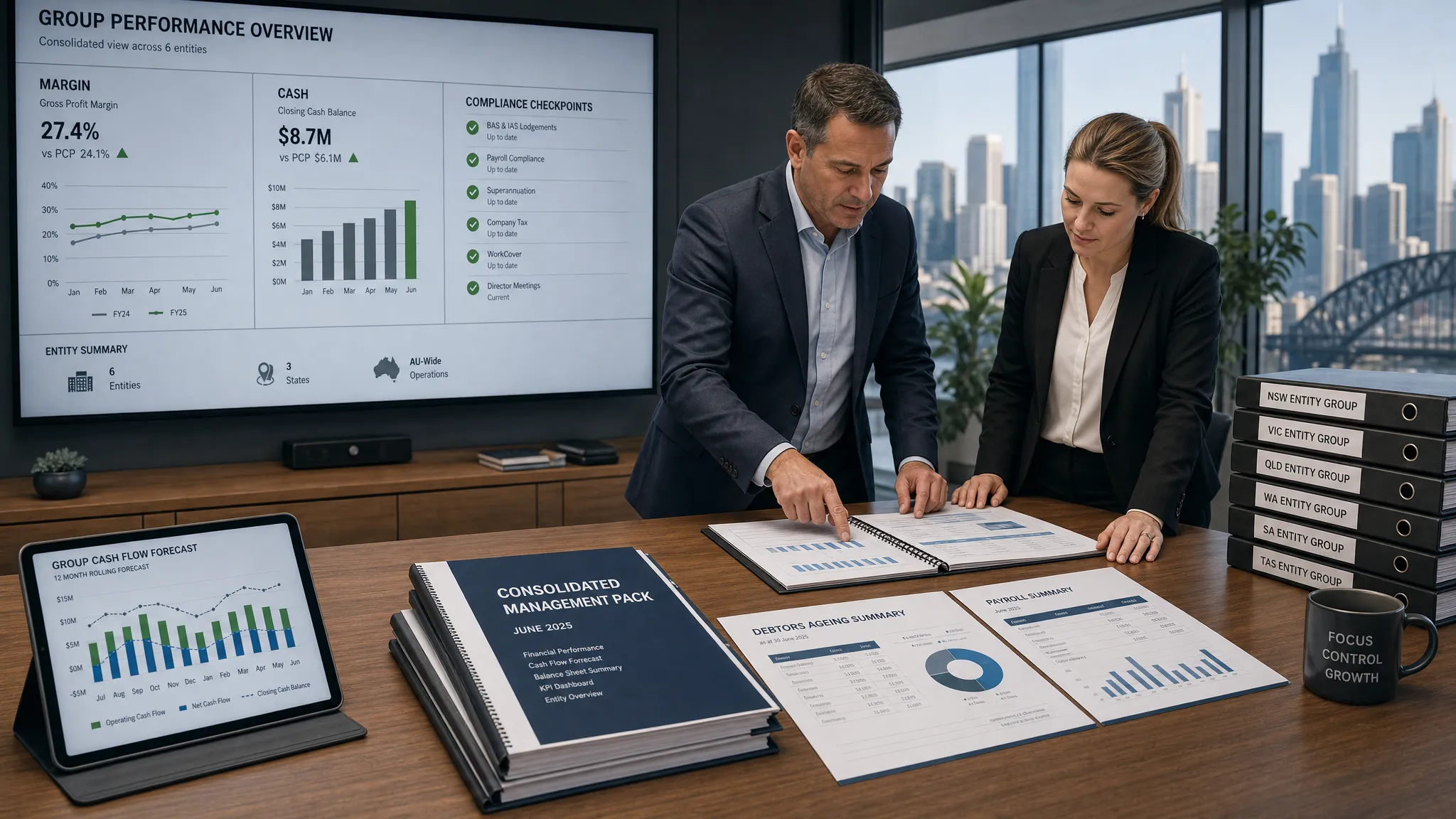
For cross-state businesses, this can include consolidated reporting, state-based payroll considerations, entity-by-entity performance review, centralised document workflows and tax planning that reflects the whole group rather than one isolated entity.
The benefit is not only convenience. It is control. Directors can compare performance across locations, identify cash requirements, manage compliance deadlines and make investment decisions with one coherent financial framework.
Frequently Asked Questions
What are accounting solutions in a business context? Accounting solutions are the combined systems, workflows and advisory processes used to manage financial records, tax compliance, reporting, payroll, cash flow and strategic decision-making. They include software, but they also require professional review, governance and tax expertise.
How do accounting solutions improve profitability? They improve profitability by making margins, costs, debtor performance, tax timing and cash flow visible earlier. With better data, owners can adjust pricing, reduce waste, control overheads and allocate capital to higher-return areas.
Can automation replace an accountant? No. Automation can streamline data entry, reconciliation and workflow management, but it cannot replace professional judgement. Australian tax law, GST, BAS, payroll, Superannuation, FBT and business structuring still require expert interpretation.
How often should management reports be reviewed? Most growing businesses should review management reports monthly. At a minimum, directors should review profit and loss, balance sheet, cash flow, debtors, creditors, BAS position and key operational metrics each month or quarter.
When should a business upgrade its accounting solution? A business should consider upgrading when reports are late, cash flow is unclear, BAS requires rework, payroll risk is increasing, margins are uncertain, or the business is expanding across entities, locations or product lines.
Next steps: turn accounting into a strategic control system
Accounting should give business owners more than historical records. It should provide a controlled framework for profitability, tax planning, cash flow and growth. When the right accounting solutions are in place, directors can move from reactive compliance to informed strategic management.
Our team at Perfect Accounting & Tax Services brings 25 years of professional experience across accounting, tax and advisory. We support businesses and high-net-worth clients across Australia, with integrated service capabilities in Adelaide, Sydney and Melbourne.
If your current accounting process is not giving you clear visibility over profit, cash flow, BAS, payroll and tax planning, we can help you redesign it. Contact us to discuss a consultation and learn how our AI-driven accounting workflows can improve accuracy, reduce manual work and support stronger financial control.