

Financial visibility is no longer a quarterly reporting exercise. For Australian business owners, company directors and high-net-worth individuals, it is a strategic control system. It tells you where cash is tied up, which activities are profitable, when tax liabilities will crystallise, and whether your structure still supports growth.
That is where modern tax and accounting services create material value. The objective is not simply to lodge income tax returns, BAS or payroll reports on time. The objective is to convert compliance data into a reliable financial operating picture, one that supports pricing, investment, debt management, staffing, acquisitions, succession and risk control.
In our view, visibility is the difference between reacting to financial events and managing them before they become constraints.
What better financial visibility actually means
Financial visibility is the ability to see, interpret and act on your financial position with confidence. It is more than having cloud software or receiving a profit and loss report. A report only becomes useful when the underlying data is current, reconciled, coded consistently and aligned with the decisions you need to make.
For a director, that may mean understanding whether the business can fund a new hire without compromising PAYG withholding, superannuation and GST obligations. For a property investor, it may mean seeing the impact of interest rate changes across multiple entities. For a growing company, it may mean knowing whether gross margin is improving before the annual accounts are finalised.
| Visibility factor | What it should show | Why it matters |
|---|---|---|
| Current data | Bank, debtor, creditor, payroll and tax positions updated regularly | Decisions are based on recent facts, not stale records |
| Accurate coding | Consistent GST, expense and revenue classification | BAS, tax planning and margin analysis become more reliable |
| Cash flow clarity | Timing of receipts, payments, loan commitments and ATO liabilities | Directors can plan funding before pressure builds |
| Compliance status | BAS, STP, superannuation, FBT and income tax obligations | Reduces ATO risk and avoids last-minute surprises |
| Strategic reporting | KPIs, trend analysis, forecasts and scenario modelling | Management can focus on growth, structure and profitability |
Better visibility is not produced by software alone. It is produced by professional judgement, disciplined workflows and a reporting rhythm that connects compliance with strategy.
Where visibility breaks down in Australian businesses
Many capable businesses lose visibility because their accounting process is designed around deadlines rather than management decisions. The books may be prepared when the BAS is due or when the accountant needs information for the annual tax return. By then, the opportunity to act has often passed.
Common visibility gaps include unreconciled bank feeds, inconsistent GST treatment, unclear director loan accounts, late payroll adjustments, insufficient superannuation tracking, and no clear view of future tax payments. These issues may appear administrative, but they affect cash flow, lending capacity, tax exposure and board confidence.
The ATO requires businesses to keep appropriate records, generally for five years, and those records must explain transactions and support tax positions. The ATO outlines these requirements in its guidance on business record keeping. Strong records are therefore not just a compliance requirement. They are the foundation of financial control.
| Visibility gap | Typical consequence | Strategic impact |
|---|---|---|
| BAS prepared from incomplete data | GST payable or refundable position is unclear | Cash flow forecasts become unreliable |
| Payroll not reconciled to STP and superannuation | Employee obligations may be understated | Compliance and director risk increases |
| Debtors reviewed irregularly | Slow-paying customers remain unnoticed | Working capital deteriorates |
| No rolling forecast | Tax, loan and supplier payments arrive unexpectedly | Growth plans become reactive |
| Multiple entities reported separately | Group position is difficult to interpret | Structure, funding and asset protection decisions suffer |
Our team sees this often in SMEs, professional practices, family businesses and multi-entity groups. The issue is rarely a lack of effort. It is usually a lack of integrated systems and advisory oversight.
How tax and accounting services create better visibility
Clean data before reports are produced
The first step is to improve the quality of source data. That includes the chart of accounts, GST codes, payroll categories, bank rules, document capture, approval workflows and month-end reconciliations. If these elements are inconsistent, management reports will look polished but remain unreliable.
We treat bookkeeping as a control function, not a clerical task. Clean data allows directors to identify margin movement, expense leakage, debtor risk and tax obligations early. This is closely connected to stronger financial control, because reporting quality depends on the discipline behind it.
Turn BAS, GST and payroll into early warning indicators
BAS preparation is often viewed as a compliance deadline. We see it as a recurring checkpoint on business performance. GST collected, GST credits, PAYG withholding and instalments all provide useful signals about turnover, margins, employment costs and future cash requirements.
For GST-registered businesses, the ATO’s GST guidance makes clear that correct reporting depends on accurate transaction records. Payroll visibility is equally important, particularly with Single Touch Payroll reporting. The ATO’s STP framework means payroll data is increasingly transparent to the regulator.
When BAS, GST, payroll and superannuation are monitored throughout the year, they become early warning indicators. They show whether cash is being reserved properly, whether wages are growing faster than revenue, and whether ATO liabilities are being managed before they affect working capital.
Link profit to cash flow
A profitable business can still experience cash pressure. This is especially common in construction, professional services, e-commerce, property development, logistics and fast-growing technology businesses. Profit may be recorded before cash is received, while GST, wages, superannuation and supplier payments continue to fall due.
Professional accounting support helps bridge this gap by connecting profit and loss reporting with debtor days, creditor timing, inventory, work in progress, loan repayments and tax instalments. That gives directors a more realistic view of available cash.
Make tax planning a year-round discipline
Tax visibility is strongest when planning occurs before the transaction or year-end event. This includes reviewing business structure, Division 7A exposure, trust distributions, capital gains tax, FBT, asset purchases, debt arrangements, superannuation contributions and timing of income or deductions.
A tax professional becomes valuable when they help you see the consequences of decisions before they are locked in. We have explored this broader role in our article on when a tax professional becomes a strategic advantage.
Why AI-driven automation improves visibility
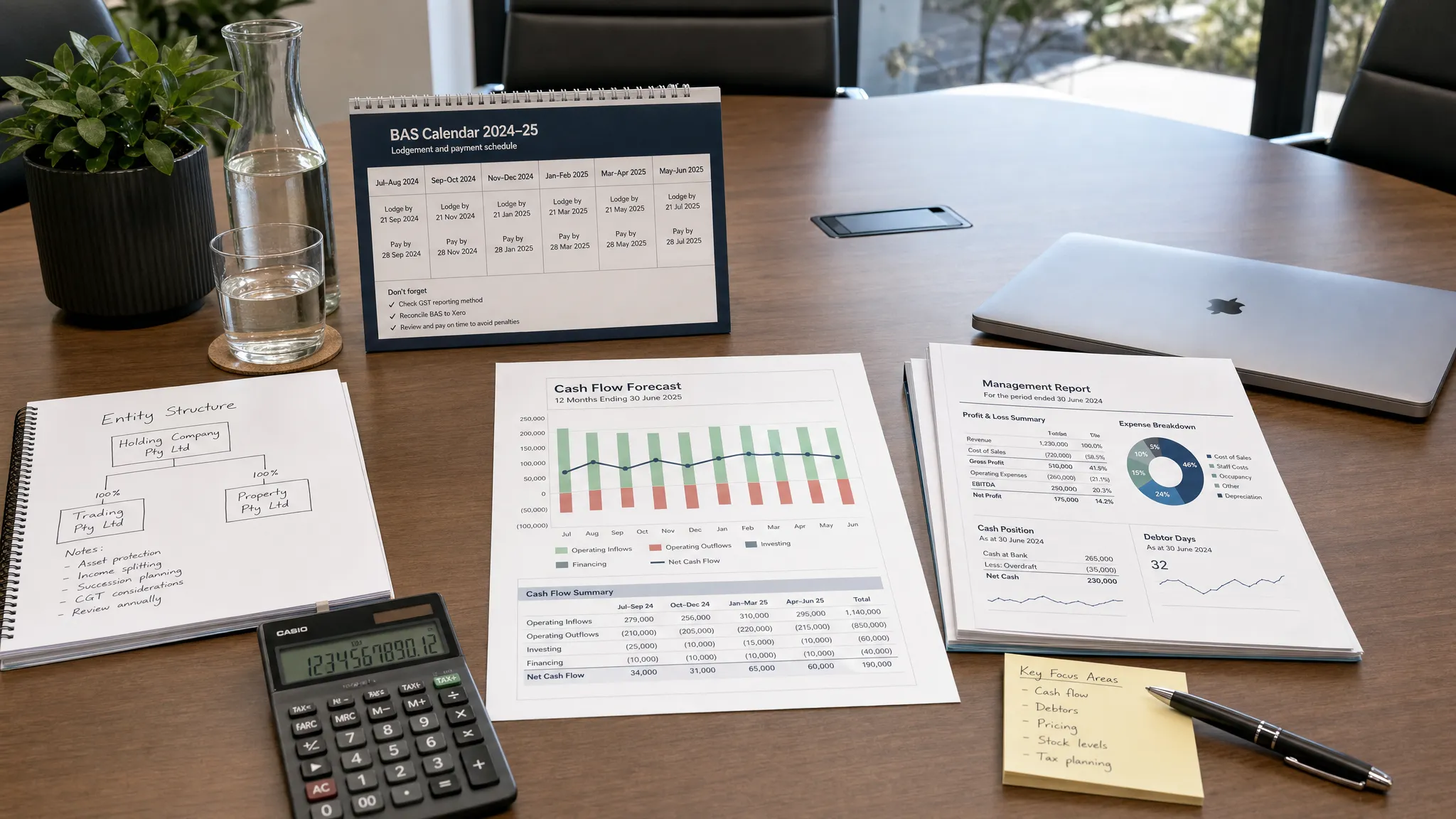
In 2026, the most effective tax and accounting services combine professional judgement with digital automation. AI-driven workflows can help classify transactions faster, identify unusual movements, streamline document capture and reduce manual handling. This improves the speed and consistency of the accounting process.
However, automation should not remove professional review. It should elevate it. Our role is to interpret the data, challenge assumptions and identify strategic implications. Technology improves the timeliness of information. Advisory expertise turns that information into better decisions.
| Traditional process | AI-enabled and advisory-led process |
|---|---|
| Data reviewed close to BAS or year-end | Data reviewed continuously with exception monitoring |
| Manual coding creates inconsistency | Automation supports consistency, with accountant oversight |
| Reports explain what already happened | Forecasts and dashboards support earlier action |
| Compliance is treated separately from strategy | BAS, payroll, tax and management reporting are connected |
| Advice is reactive | Advice is built into the operating rhythm |
This is particularly important for businesses operating across multiple locations, entities or revenue streams. A Sydney professional firm, a Melbourne manufacturer and an Adelaide property group may have different operational risks, but they all need timely, accurate and actionable financial data.
Visibility across entities, cities and asset classes
Many Australian business owners do not operate through one simple structure. They may have a trading company, family trust, investment company, SMSF, property holdings and related-party loans. Without consolidated visibility, each entity can appear manageable while the overall group position remains unclear.
This is where integrated accounting and tax advice matters. We support clients across Australia, with service capabilities across Adelaide, Sydney and Melbourne. That national reach is important for businesses expanding interstate, directors managing remote teams, investors with property in multiple states, and family groups requiring consistent reporting across entities.
For high-net-worth individuals and business families, visibility also supports asset protection, succession planning, estate considerations, philanthropic structures and investment governance. The accounting file becomes more than a compliance record. It becomes a financial map.
Practical signs you need better visibility
If your business is growing but your reporting process has not evolved, the signs usually appear in cash flow, tax surprises and delayed decisions.
- You only know your true profit after the financial year has ended.
- BAS payments regularly create cash pressure.
- Payroll, superannuation and PAYG withholding are reviewed only when payments are due.
- Your debtor position is larger than expected, but no one can explain the trend quickly.
- You cannot separate profit by division, project, location or service line.
- Director loan accounts, trust distributions or inter-entity balances are unclear.
- You are considering expansion, borrowing or acquisition without a reliable forecast.
- Your accountant mainly contacts you at lodgement time.
If several of these apply, the issue is not simply accounting administration. It is a visibility problem. Our guidance on what to expect from modern accounting services explains why year-round insight is now essential for serious business owners.
Next steps to build better visibility
Better visibility starts with a structured review. We generally recommend the following sequence for business owners and directors.
- Assess data quality: Review bank reconciliations, GST coding, payroll setup, debtor reporting, creditor reporting and chart of accounts design.
- Map compliance obligations: Identify BAS, PAYG withholding, superannuation, income tax, FBT and ASIC deadlines so future cash requirements are visible.
- Define management KPIs: Select the metrics that actually drive performance, such as gross margin, labour cost ratio, debtor days, utilisation or project profitability.
- Build a rolling forecast: Connect expected revenue, expenses, tax payments, debt servicing and capital expenditure into a forward-looking cash view.
- Create an advisory rhythm: Set monthly or quarterly reviews so accounting data informs decisions before deadlines arrive.
The key is consistency. A one-off clean-up may improve the file, but a disciplined reporting cycle improves the business.
Frequently Asked Questions
What does financial visibility mean in accounting? Financial visibility means having accurate, current and decision-ready information about profit, cash flow, tax obligations, debtors, creditors, payroll and business performance. It allows directors and owners to act before issues become urgent.
How do tax and accounting services improve cash flow visibility? They connect bookkeeping, BAS, GST, payroll, debtor management, creditor timing and tax planning into one view. This helps businesses forecast cash needs and prepare for ATO obligations instead of reacting to them.
Can AI automation replace an accountant? No. AI automation can improve speed, consistency and exception detection, but professional judgement is still required. An experienced accountant interprets the data, manages tax risk and provides strategic advice.
How often should a business review management reports? Most growing businesses should review core management reports monthly and complete deeper tax and strategy reviews quarterly. Higher-growth or cash-sensitive businesses may need more frequent monitoring.
Do interstate businesses need different accounting support? They often need more integrated support. Businesses operating across Adelaide, Sydney, Melbourne or regional Australia may have multiple payroll, tax, reporting and operational considerations that require consistent national oversight.
How we can help
At Perfect Accounting & Tax Services, we help Australian businesses move from reactive compliance to real financial visibility. Our team combines 25 years of professional experience with AI-driven automation, strategic tax planning, corporate bookkeeping, BAS management, payroll support, virtual CFO services and advisory insight.
We work with SMEs, directors, property investors, professional firms, family groups and growing corporations across Australia, including Adelaide, Sydney and Melbourne.
If you want clearer reporting, stronger cash flow control and a more strategic approach to tax, contact Perfect Accounting & Tax Services to arrange a consultation. We can review your current accounting workflows and show how automation-led financial visibility can support better decisions and sustainable growth.