
In Australia, lodging a non profit organization tax return starts with one critical question: are you required to lodge an income tax return at all, or does your organisation have a different annual reporting obligation?
For not-for-profit organisations, the answer depends on structure, charity status, tax endorsement, activities, revenue sources and whether the entity has an active ABN. A community association, registered charity, sporting club, foundation, school auxiliary, social club or company limited by guarantee can each have different ATO and ACNC obligations.
We approach NFP lodgement strategically. Compliance is the baseline. The higher-value outcome is clean financial visibility, stronger governance, grant-ready reporting and better board decision-making.
Start by identifying your NFP category
Before preparing any tax return, confirm what the entity is for Australian tax purposes. “Non-profit” does not automatically mean “income tax exempt”, and charity registration does not remove every ATO obligation.
| NFP category | Typical annual obligation | Main lodgement channel | Key risk to manage |
|---|---|---|---|
| Registered charity endorsed for income tax exemption | ACNC Annual Information Statement, plus ATO lodgements if applicable | ACNC Charity Portal and ATO systems | Assuming ACNC reporting replaces BAS, PAYG withholding or FBT obligations |
| Non-charitable NFP self-assessing income tax exemption with an active ABN | ATO NFP self-review return | ATO Online services, registered tax agent or enabled software | Failing to document why the organisation qualifies for exemption |
| Taxable NFP, such as a club, association or company with taxable activities | Income tax return, often a company tax return depending on structure | ATO lodgement channels | Treating all receipts as tax-exempt without analysing member, non-member and commercial income |
| NFP without income tax exemption and without company structure | Tax return depends on legal form, such as trust or partnership | ATO lodgement channels | Using the wrong return type or tax labels |
The ATO explains the annual self-review return requirement for many non-charitable NFPs with an active ABN. Registered charities should also review the ACNC’s Annual Information Statement obligations, because charity reporting follows a separate governance framework.
Step 1: Confirm the legal identity, ABN and TFN
The first practical step is to confirm exactly who is lodging. We look at the organisation’s ABN, TFN, legal name, entity type, officeholders and governing documents.
This matters because many NFPs operate under a trading name, public-facing program name or legacy association name that differs from the legal entity registered with the ATO or Australian Business Register. If the return is prepared under the wrong identity, lodgement can be rejected or reconciliations can become difficult later.
For companies limited by guarantee, we also review ASIC records. For incorporated associations, we confirm the relevant state or territory registration. For trusts and foundations, the trust deed is central. For charities, ACNC registration details must align with ATO records.
At this stage, we also confirm whether the organisation has registered for GST, PAYG withholding, FBT or other tax accounts. A tax return is often only one part of the compliance picture.
Step 2: Determine whether you are lodging an income tax return or an NFP self-review return
A common board-level misunderstanding is that every NFP lodges the same return as a company. That is not correct.
If the organisation is a registered charity
A charity registered with the ACNC may need to lodge an Annual Information Statement. Depending on size and structure, it may also need to lodge financial reports with the ACNC.
Charities may also have ATO obligations for GST, BAS, PAYG withholding, FBT, superannuation and deductible gift recipient reporting. Income tax exemption generally requires endorsement, so charity registration and ATO endorsement should be checked together.
If the organisation is a non-charitable tax-exempt NFP
From the 2023-24 income year, many non-charitable NFPs with an active ABN must lodge an annual NFP self-review return to confirm their eligibility to self-assess income tax exemption. This is not the same as a standard income tax return.
The self-review process asks the organisation to confirm details, assess eligibility and declare whether it qualifies as income tax exempt. It should not be treated as a quick tick-box exercise. The board or committee should be able to evidence the conclusion.
If the organisation is taxable
If the NFP is not income tax exempt, it may need to lodge an income tax return. The return type depends on the legal structure. A company limited by guarantee will generally use a company tax return, while a trust or partnership structure requires the relevant return.
For clubs and associations, the mutuality principle may be relevant. Broadly, certain receipts from members may be treated differently from income derived from non-members, investments, sponsorships, venue hire, trading activities or commercial services. This analysis requires careful accounting classification.
Step 3: Gather the right financial and governance records
Good lodgement depends on the quality of the records behind it. For NFPs, we focus on both financial records and governance evidence, because tax status often depends on purpose and activities.
Core records usually include bank statements, accounting software reports, grant agreements, donation records, membership income, invoices, payroll reports, BAS lodgements, superannuation records, asset registers, loan documents and investment statements. Governance records may include the constitution, rules, trust deed, board minutes, program reports and evidence that funds are applied to the organisation’s stated purpose.
For complex entities, document quality is often the difference between a clean lodgement and a costly review. We have outlined a broader record framework in our guide to which tax documents matter most for complex returns, which is particularly relevant for foundations, multi-entity groups, property-holding NFPs and organisations receiving significant grants.
Step 4: Reconcile income, grants, donations and expenses
NFP financial reporting can be more nuanced than ordinary business reporting. A retail business usually asks, “What did we earn and what did we spend?” An NFP must often ask, “Was this restricted funding, donation income, member income, trading income or non-member income, and was it applied consistently with our purpose?”
We typically review the following areas before lodgement:
- Grant income and whether it is tied to specific deliverables or reporting periods.
- Donations, fundraising receipts and whether DGR status applies to the recipient fund or entity.
- Membership subscriptions and whether mutuality principles may apply.
- Sponsorship, venue hire, merchandise, event and commercial income.
- Payroll, contractor payments, superannuation and PAYG withholding.
- GST coding and BAS reconciliation, particularly where restricted grants and fundraising activities are involved.
A key point for boards is that DGR status does not automatically mean income tax exemption. DGR status affects whether donors can claim tax deductions for gifts to eligible entities or funds. It does not, by itself, resolve GST, FBT, PAYG withholding or income tax treatment.
Step 5: Review GST, BAS, payroll and FBT obligations
An NFP may be income tax exempt but still have other ATO obligations. This is where many organisations create avoidable risk.
The GST registration threshold for not-for-profit bodies is generally $150,000 in annual turnover, which differs from the standard business threshold. If the organisation is registered for GST, BAS records must reconcile to the annual accounts. GST errors can flow directly into income reporting and board financial statements.
Payroll is another high-risk area. If the NFP employs staff, it must manage PAYG withholding, superannuation guarantee and payroll reporting. Depending on benefits provided, FBT may also be relevant. Some charities and public benevolent institutions may access FBT concessions, but eligibility must be confirmed rather than assumed.
Where an organisation operates across states, payroll tax, fundraising registrations and state-based reporting can also become material. Our national service model is designed for that environment, with integrated support across Adelaide, Sydney and Melbourne and advisory capability for organisations operating across Australia.

Step 6: Prepare the return or self-review using the correct lodgement channel
Once the classification and records are clear, lodgement becomes more straightforward.
For an ATO NFP self-review return, lodgement can generally be completed through ATO online services, a registered tax agent or compatible lodgement software. The return usually covers organisation details, income tax exemption eligibility and a declaration.
For a taxable NFP income tax return, the entity’s accounting profit must be adjusted for tax purposes. This may include analysing non-deductible expenses, depreciation, investment income, mutual receipts, carried-forward losses and franking credits where relevant.
For a registered charity, the ACNC Annual Information Statement is lodged through the ACNC portal. If the charity also has BAS, FBT or PAYG withholding obligations, those remain separate ATO lodgements.
Before lodgement, we recommend a structured review meeting. This should confirm tax status, material transactions, governance changes, BAS alignment, payroll accuracy, funding restrictions and any ATO correspondence. Our article on what to cover in a tax consultation before you lodge sets out the type of agenda we use for higher-risk returns.
Common mistakes when lodging a non-profit tax return
Most NFP tax issues are not caused by dishonesty. They are caused by weak classification, outdated records or assumptions carried forward from prior years.
| Mistake | Why it matters | Better approach |
|---|---|---|
| Assuming all NFP income is tax exempt | Not all non-profit entities qualify for exemption | Review legal structure, governing rules and actual activities each year |
| Ignoring the ATO NFP self-review return | Non-charitable NFPs with active ABNs may have annual review obligations | Build the self-review into the annual compliance calendar |
| Treating ACNC reporting as the only obligation | GST, PAYG withholding, FBT and superannuation may still apply | Maintain a separate ATO obligations register |
| Mixing restricted grants with general income | Grant funds may need specific reporting and acquittal | Track grants by project, funder and reporting period |
| Poor BAS and accounting reconciliation | GST mismatches increase ATO review risk | Reconcile BAS, bank feeds and annual accounts before lodgement |
| Weak evidence of non-profit purpose | Exemption depends on governing rules and activities | Keep constitutions, minutes and program evidence current |
If the ATO has already contacted the organisation, it is important to respond carefully and consistently. We have provided practical guidance on how to deal with the ATO without costly mistakes, including when to pause, verify the issue and prepare evidence before replying.
How automation improves NFP lodgement quality
We do not view automation as a replacement for professional judgement. We use it to strengthen the evidence base behind that judgement.
AI-driven accounting workflows can classify transactions faster, identify GST coding anomalies, flag unusual supplier payments, reconcile grant income to project spending and surface missing documents before lodgement. For NFP boards, this creates a more reliable audit trail and improves reporting discipline throughout the year.
The strategic value is real-time visibility. Instead of discovering compliance issues at year-end, management and directors can monitor grant utilisation, cash reserves, payroll exposure and BAS alignment during the year. That makes tax lodgement a controlled process, not a last-minute scramble.
For larger NFPs, we also see automation as a foundation for virtual CFO advisory. Clean data supports scenario modelling, funding strategy, program sustainability reviews and stronger board packs. Compliance becomes the platform for better governance and corporate growth, even in mission-led organisations.
Practical lodgement checklist for Australian NFPs
Before lodging, we recommend confirming these items at board or finance committee level.
| Area | Question to confirm |
|---|---|
| Entity status | Are the ABN, TFN, legal name and officeholders current? |
| Charity status | Is the organisation ACNC-registered, and is ATO endorsement current where required? |
| Income tax position | Is the NFP exempt, self-reviewable or taxable? |
| Governing rules | Do the constitution, rules or deed contain appropriate non-profit and winding-up clauses? |
| Activities | Did actual activities align with the stated non-profit purpose during the year? |
| BAS and GST | Do BAS lodgements reconcile to the annual accounts? |
| Payroll | Are PAYG withholding, superannuation and employee records complete? |
| Grants | Are restricted funds tracked and acquitted correctly? |
| ATO and ACNC correspondence | Are all notices, due dates and outstanding obligations resolved? |
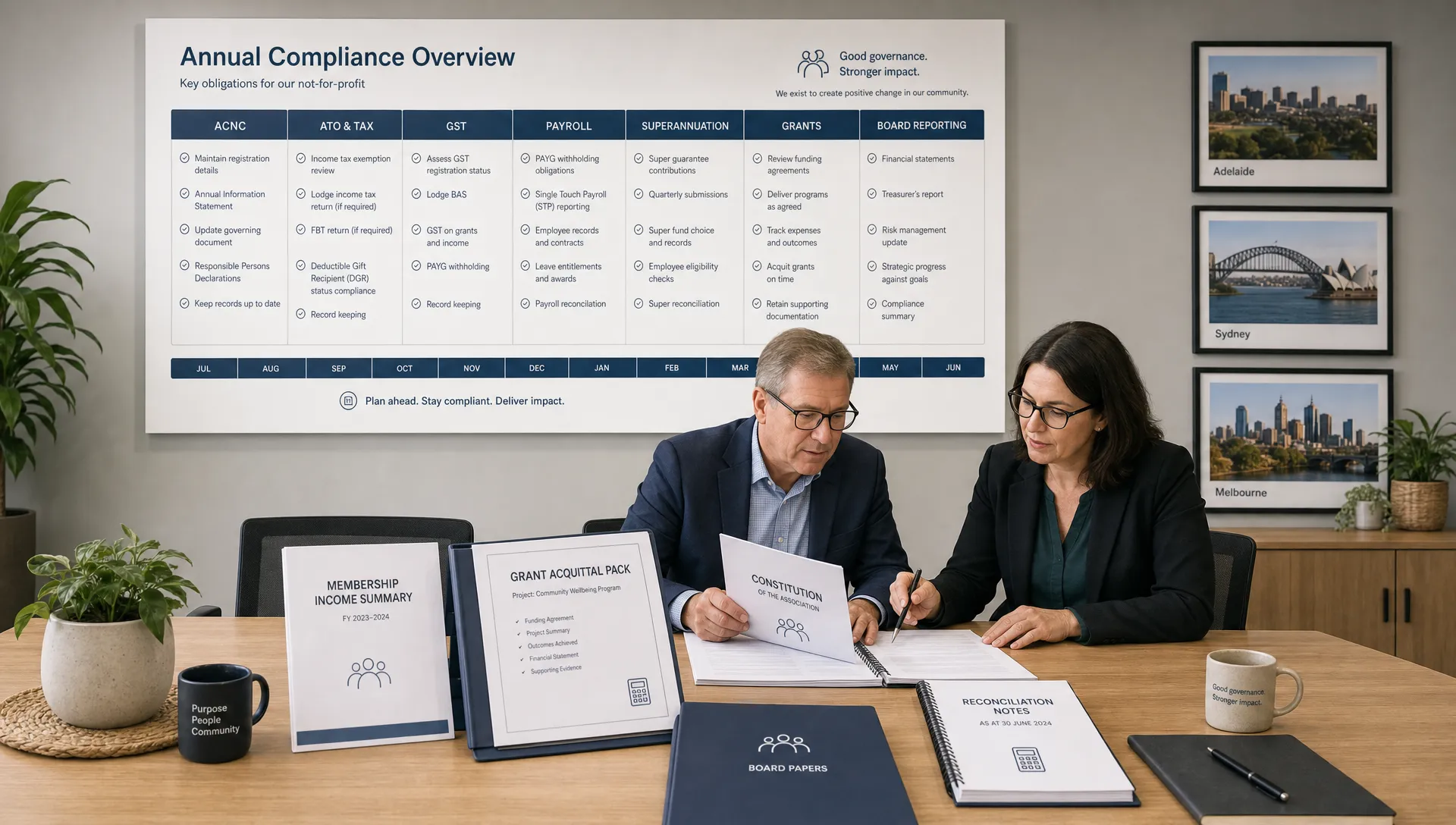
This checklist should be embedded into the finance calendar, not left until lodgement week. For NFPs receiving public funds, philanthropic funding or government grants, disciplined records also strengthen stakeholder confidence.
Frequently Asked Questions
Does every non-profit organisation in Australia lodge an income tax return? No. Some registered charities report to the ACNC and manage separate ATO obligations, while many non-charitable tax-exempt NFPs lodge an ATO self-review return. Taxable NFPs may need to lodge an income tax return depending on their structure.
What is the ATO NFP self-review return? It is an annual return used by many non-charitable NFPs with an active ABN to confirm whether they are eligible to self-assess as income tax exempt. It is different from a standard income tax return.
Can a charity ignore ATO lodgements if it reports to the ACNC? No. ACNC reporting does not automatically replace BAS, PAYG withholding, FBT, superannuation or other ATO obligations. Charities should maintain both ACNC and ATO compliance calendars.
Is GST different for not-for-profit organisations? Yes. The GST registration threshold for not-for-profit bodies is generally $150,000 in annual turnover. Once registered, the organisation must manage BAS reporting and GST coding carefully.
What happens if a non-profit tax return or self-review return is late? Late lodgement can lead to ATO follow-up, penalties or loss of confidence in the organisation’s governance. If the entity has overdue obligations, it is best to prepare records, confirm the correct return type and engage with the ATO strategically.
Next Steps: How We Can Help
A non-profit tax lodgement should do more than satisfy a deadline. It should confirm tax status, strengthen governance and give directors confidence that financial data is accurate.
Our team supports charities, foundations, associations, clubs and community organisations across Australia with tax lodgement, BAS, payroll, grant accounting, governance-focused reporting and strategic advisory. We combine 25 years of professional experience with AI-driven automation to improve accuracy, speed and real-time financial visibility.
If your organisation operates in Adelaide, Sydney, Melbourne or across multiple states, we can help you determine the right lodgement pathway and build an automated accounting workflow around it.
Contact Perfect Accounting & Tax Services to arrange a consultation and review your non-profit tax obligations before the next lodgement deadline.