
Complex tax rarely announces itself as a single problem. It usually appears as a combination of entities, transactions, timing issues, ATO exposure, cash flow pressure and incomplete records. For Australian business owners, company directors and high-net-worth individuals, that is the point where routine tax preparation stops being enough.
We see this regularly across Adelaide, Sydney and Melbourne. A company grows interstate, a trust distributes income unevenly, a shareholder loan remains unresolved, an SMSF acquires property, or a business sells a major asset. Each event may be manageable on its own. Together, they create tax consequences that require judgement, documentation and forward planning.
A Chartered Accountant becomes essential for complex tax when the decision affects more than one return, more than one year or more than one stakeholder. At that stage, the work is not simply to calculate tax. It is to protect the client’s position, manage risk and turn financial data into a reliable basis for strategic advisory and corporate growth.
Why Complex Tax Needs More Than Basic Lodgement
Basic tax lodgement is retrospective. It records what happened and reports it to the ATO. Complex tax requires a different discipline. We need to understand the commercial context, identify the tax rules that apply, test alternative positions and document why a particular treatment is reasonable.
This distinction matters because the ATO does not assess complexity based on how busy a client is. It looks at facts, records, consistency and compliance with Australian tax law. If a transaction has GST, CGT, FBT, payroll tax, Superannuation Guarantee or Division 7A consequences, the tax outcome depends on much more than entering figures into software.
For example, a company director may see a transfer from the business bank account as a temporary drawdown. The ATO may see a Division 7A loan, a deemed dividend or evidence that director drawings are not being governed properly. A property investor may see renovations as general improvements. Tax treatment may depend on whether the expenditure is a repair, capital improvement, depreciating asset or part of the cost base for CGT.
This is also why we distinguish routine tax work from deeper advisory work in our guide to what sets expert tax accountants apart in complex matters. Complex matters need diagnosis before calculation.
When a Chartered Accountant Becomes Essential
A Chartered Accountant is especially valuable where technical tax knowledge must be combined with commercial analysis. In Australia, tax agent services must be provided by an appropriately registered tax agent. In practice, complex matters should be handled by an adviser who brings CA-level expertise, current Australian tax knowledge, governance discipline and the ability to work with reliable financial systems.
Clients sometimes ask whether they need a Chartered Accountant, a registered tax agent or a CPA tax expert. The designation matters less than the capability, but for complex tax, we look for a professional who can interpret the law, model outcomes, challenge assumptions and communicate the position clearly to directors, lenders, investors and the ATO where required.
The following situations are strong indicators that Chartered Accountant support is not optional.
| Complexity trigger | Why it needs specialist attention | Common tax areas involved |
|---|---|---|
| Multiple entities | Transactions between companies, trusts and individuals must be mapped correctly | Trust distributions, Division 7A, GST, CGT |
| Business expansion | Growth can change reporting obligations and cash flow timing | BAS, payroll, Superannuation, FBT, PAYG instalments |
| Property transactions | Tax treatment depends on purpose, structure and timing | CGT, GST, margin scheme, depreciation |
| Shareholder or director loans | Poorly managed drawings can create deemed dividends or audit risk | Division 7A, income tax, governance |
| SMSF activity | Trustees must meet strict compliance and investment rules | SMSF tax, contribution caps, pension phase rules |
| International dealings | Cross-border income and payments require careful classification | Residency, withholding tax, GST, transfer pricing principles |
| ATO review or audit | Evidence, timelines and technical positions must be managed professionally | Income tax, GST, BAS, payroll, record keeping |
| Sale, merger or restructure | The wrong structure can create avoidable tax leakage | CGT concessions, rollovers, duty considerations, income tax |
These are not minor compliance issues. They influence profitability, capital allocation and future transaction readiness.
Entity Structures Create Opportunity and Risk
Companies, discretionary trusts, unit trusts, partnerships and SMSFs can all be legitimate and effective structures. The risk emerges when the structure no longer matches the commercial reality of the business or investment group.
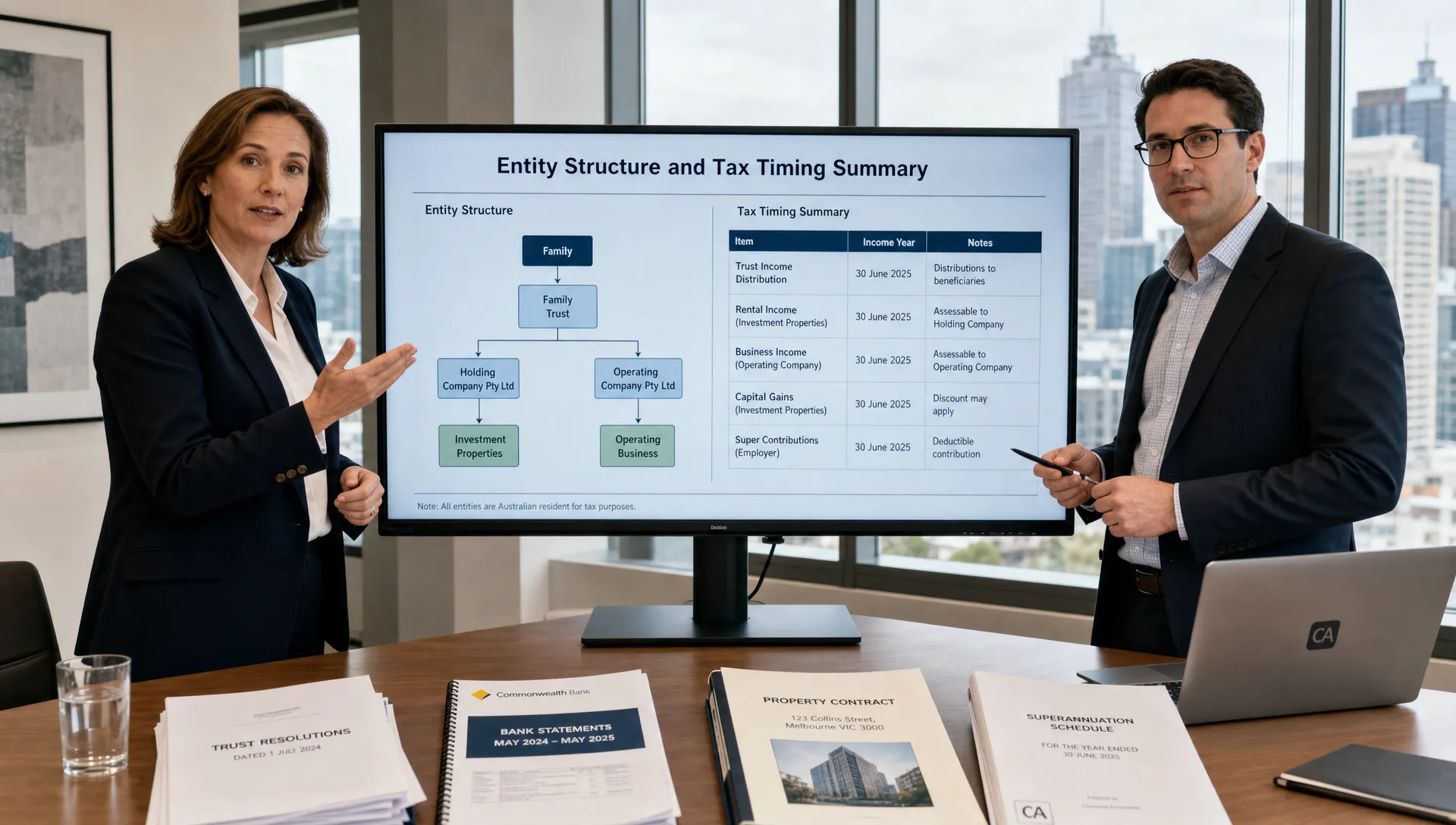
A family-owned business may have started with a simple company and later added a trust, a property entity and a related service entity. Without proper documentation, inter-entity loans and management fees can become difficult to support. Distributions may be tax ineffective or inconsistent with trust deed requirements. GST registrations may not align with actual trading activity.
We often begin by mapping the structure visually, then testing each connection against the financial records. Who owns the assets? Who earns the income? Who bears the expenses? Who owes whom money? This structure-first approach helps prevent tax returns from being prepared in isolation.
For company groups and high-net-worth families, structure review should not wait until year-end. It should be part of board-level financial governance, especially before asset purchases, succession planning, refinancing, business sales or investor entry.
Property, CGT and GST Often Require Early Advice
Property remains one of the most common sources of complex Australian tax issues. Residential property investors, commercial landlords, developers and high-end renovators can face very different tax outcomes from transactions that appear similar on the surface.
A property sale may trigger CGT, GST, income tax treatment as trading stock or a combination of issues depending on intention and history. A developer acquiring land through one entity and funding construction through another may also create related-party loan and GST attribution questions. Commercial property can introduce GST registration, tax invoices and lease incentive issues.
For first-time property investors, the most expensive mistakes often occur at purchase, not at lodgement. Ownership structure, borrowing arrangements and record keeping set the foundation for future deductions and CGT calculations. Once contracts are signed, some planning options narrow significantly.
This is why we encourage clients to seek advice before they commit to major transactions. Tax planning after settlement is often damage control. Tax planning before settlement is strategy.
ATO Risk Is Really an Evidence Problem
When the ATO reviews a complex return, the issue is rarely just the final number. The ATO wants to see the evidence behind the number. That includes contracts, loan agreements, trust resolutions, invoices, payroll records, logbooks, BAS reconciliations, bank statements and working papers.
Complex tax positions require a clear audit trail. We need to be able to explain the facts, the treatment adopted and the reason that treatment is supportable. If the records are fragmented across spreadsheets, email inboxes and multiple software systems, the client’s risk increases even when the underlying tax treatment is correct.
Before we calculate a complex return, we prioritise document quality and source data. We have outlined this evidence-first approach in our article on which tax documents matter most for complex returns.
How AI-Driven Accounting Improves Complex Tax Outcomes
Complex tax depends on clean data. Traditional accounting workflows often identify issues late because transactions are reconciled after the event and reviewed only around BAS or tax time. That delay reduces planning options.
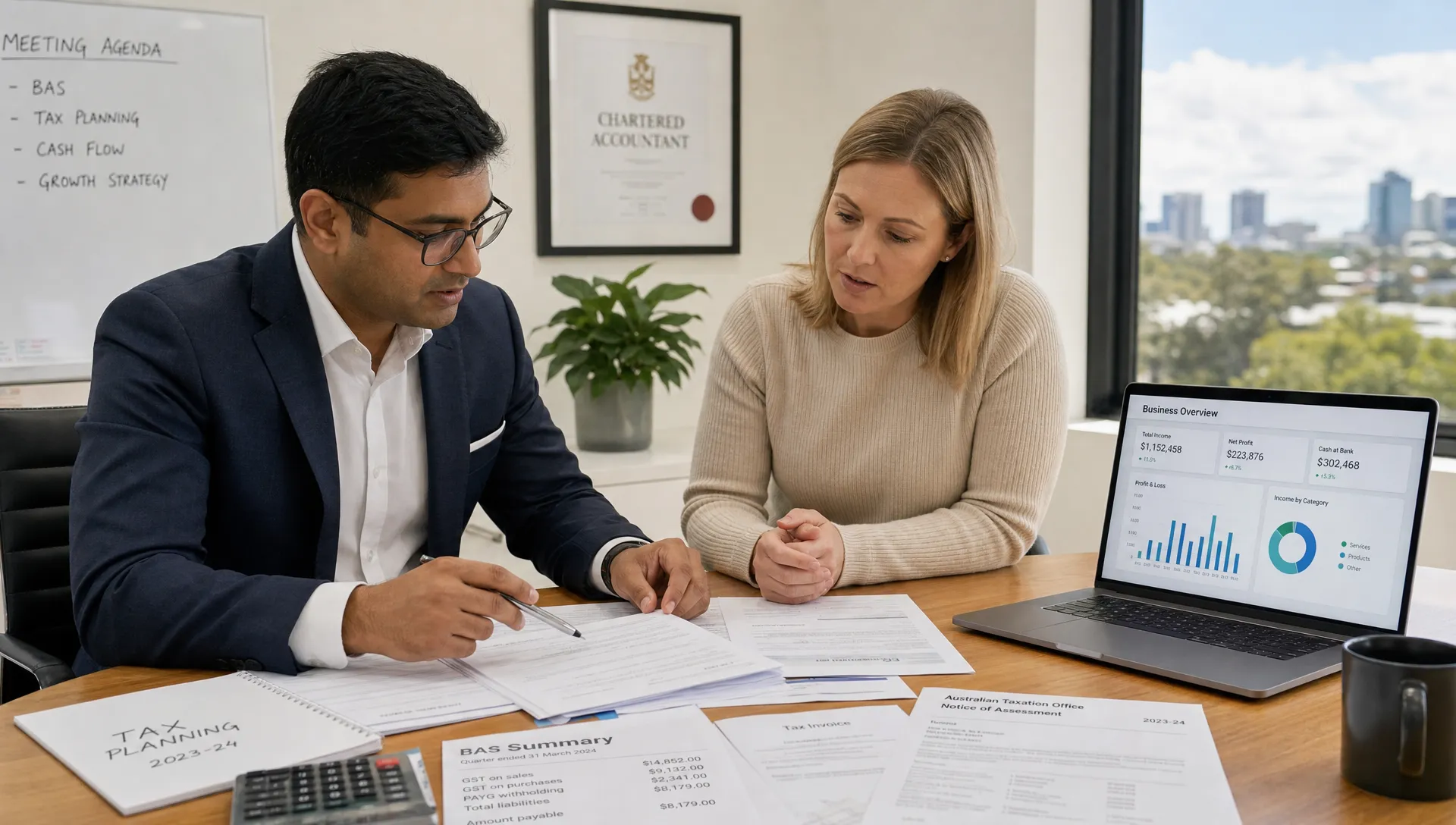
Our team uses AI-driven automation to improve the speed and reliability of the compliance process. Automated data extraction, transaction classification, exception reporting and real-time reconciliations allow us to identify anomalies earlier. That can include unusual director drawings, uncoded GST transactions, missing supplier invoices, payroll discrepancies or unexplained movements between related entities.
For digital businesses, the complexity is even more pronounced. E-commerce operators, SaaS companies, marketing agencies and app developers often deal with payment gateways, subscriptions, overseas suppliers and multi-currency revenue. If an Australian business engages offshore providers, such as a custom web design and SEO agency for international growth campaigns, the tax review should consider deductibility, exchange rates, GST treatment and whether any withholding obligations apply.
Automation does not replace judgement. It gives us better visibility so that our professional judgement is based on timely, complete and structured information. That is where compliance becomes a foundation for strategic advisory rather than an administrative burden.
The Commercial Cost of Getting Complex Tax Wrong
The direct cost of tax errors can include penalties, interest, amended assessments and professional fees. The indirect cost can be larger. Poor tax governance can delay finance approvals, reduce business valuation, complicate due diligence or create disputes between shareholders and beneficiaries.
For directors, the risk is personal as well as corporate. Payroll, Superannuation Guarantee and PAYG withholding obligations must be taken seriously. If a business is under cash flow stress, falling behind with ATO obligations may appear to be a temporary survival tactic. In reality, it can narrow restructuring options and increase director exposure.
High-net-worth individuals face a different challenge. Their tax position may involve investment entities, family trusts, property portfolios, overseas income, capital gains and estate planning considerations. The annual tax return is only one part of the picture. The real objective is to ensure the total structure remains compliant, efficient and aligned with family or investment goals.
What a Chartered Accountant Should Deliver in Complex Tax Matters
A strong Chartered Accountant should not simply ask for documents and produce a return. We believe complex tax work should deliver clarity, defensible positions and decision-ready reporting.
At minimum, the process should include:
- A diagnostic review of the entity structure, transaction history and compliance status
- Identification of key Australian tax issues, including GST, BAS, FBT, Superannuation and CGT where relevant
- Reconciliation between accounting records, bank data, BAS lodgements and tax returns
- Practical modelling of tax outcomes before major transactions are finalised
- Clear documentation of tax positions and assumptions
- A forward-looking plan for governance, automation and cash flow management
For larger SMEs and growing corporate groups, this is where Virtual CFO support becomes valuable. Tax planning should connect with forecasting, pricing, funding, working capital and growth strategy. A technically correct tax outcome is useful. A tax outcome that supports commercial decision-making is far more powerful.
At a governance level, a tax professional becomes a strategic advantage when they help directors anticipate consequences before decisions are locked in.
When to Engage a Chartered Accountant
The best time to engage a Chartered Accountant is before the complexity becomes urgent. We recommend seeking advice before any of the following events:
- Buying or selling a business, property or major asset
- Restructuring companies, trusts or family investment entities
- Introducing new shareholders, investors or business partners
- Expanding interstate or overseas
- Falling behind with BAS, tax returns or Superannuation obligations
- Receiving ATO correspondence, a review notice or an audit notification
- Taking significant funds out of a company or trust
- Planning retirement, succession, estate transfer or SMSF strategy
Timing matters because tax choices are often transaction-dependent. Once a contract is signed, a distribution minute is missed or a payment is made without documentation, the available remedies may be limited.
How to Prepare for a Complex Tax Consultation
A productive consultation starts with facts. We do not expect every client to have perfect records, but we do need enough information to identify the risks and opportunities accurately.
Before meeting with our team, gather your most recent tax returns, financial statements, BAS lodgements, trust deeds, company registers, loan agreements, property contracts, payroll summaries and ATO correspondence. If you use cloud accounting software, ensure bank feeds are connected and reconciliations are current.
For businesses with digital revenue streams, we also review payment platforms, marketplace reports, subscription systems and foreign currency records. For property clients, we review settlement statements, depreciation reports, loan documents and renovation records.
The objective is not to overwhelm the process with paperwork. The objective is to create a reliable evidence base so that advice can be specific, practical and defensible.
Frequently Asked Questions
Is a Chartered Accountant always required for complex tax? Not always, but complex tax should be handled by a professional with the right technical capability and, where tax agent services are provided, appropriate TPB registration. A Chartered Accountant is often essential when tax advice must be integrated with business strategy, governance and financial reporting.
What is the difference between a tax preparer and a Chartered Accountant? A tax preparer may be suitable for straightforward lodgements. A Chartered Accountant is better suited to complex matters involving structures, CGT, GST, trusts, SMSFs, related-party transactions, ATO reviews and strategic planning.
Can automation replace a Chartered Accountant? No. Automation improves accuracy, speed and visibility, but complex tax still requires professional judgement. We use AI-driven workflows to identify issues earlier, then apply Australian tax expertise to interpret and resolve them.
When should a business seek complex tax advice? Seek advice before major transactions, restructures, investor changes, property sales, interstate expansion or any ATO review. Early advice usually gives directors more options and better control over tax outcomes.
Do you support clients outside Adelaide? Yes. Our team supports businesses and high-net-worth clients across Australia, with integrated service capability in Adelaide, Sydney and Melbourne. We use secure digital workflows to provide timely support regardless of location.
Next Steps: Turn Complex Tax Into Strategic Control
Complex tax should not be treated as a once-a-year compliance exercise. It should be managed as part of your financial governance, risk management and growth strategy.
Our team at Perfect Accounting & Tax Services brings 25 years of professional experience across accounting, tax, Virtual CFO advisory and AI-driven workflow automation. We support Australian businesses, directors and high-net-worth individuals with accurate compliance, clear tax positions and real-time financial visibility.
If your structure, transactions or ATO obligations have outgrown basic tax support, contact our firm for a consultation. We can review your current position, identify tax risks, improve your records and show you how automated accounting workflows can support smarter decisions across Adelaide, Sydney, Melbourne and beyond.